Campaign objective
Help a knowledgeable contributor share practical expertise with an appropriate business audience. Build a repeatable editorial process around useful articles and accurate attribution. Publication decisions remain with editors; the plan does not promise rankings, links or a fixed number of placements.
Who this plan is for
- Consultants with hands-on experience they can explain clearly.
- B2B teams with an available subject expert and editorial support.
- Business owners who can share practical lessons without revealing confidential information.
Story angles that get coverage
Editors publish stories that help their readers. Pick one angle as the core of your campaign and keep the others as follow-ups.
A decision framework
Help readers choose between realistic approaches to a problem. Explain when each option fits and what evidence informs the decision.
A practical teardown
Walk through a process, explain common mistakes and provide a checklist readers can apply. Label invented examples as hypothetical.
A lesson from experience
Describe a lesson the contributor can substantiate. Obtain permission before sharing client names, results or confidential details.
Choosing the right publishers
A short, relevant list beats a long, generic one. Look for publications that meet these criteria:
- An identifiable business audience that benefits from the contributor's expertise.
- Recent in-depth articles demonstrating the publication's preferred format and level.
- Open contributor guidelines and a confirmed submission route.
- A topic gap that your article can address without repeating existing coverage.
- Clear policies on originality, author attribution, disclosure and promotional links.
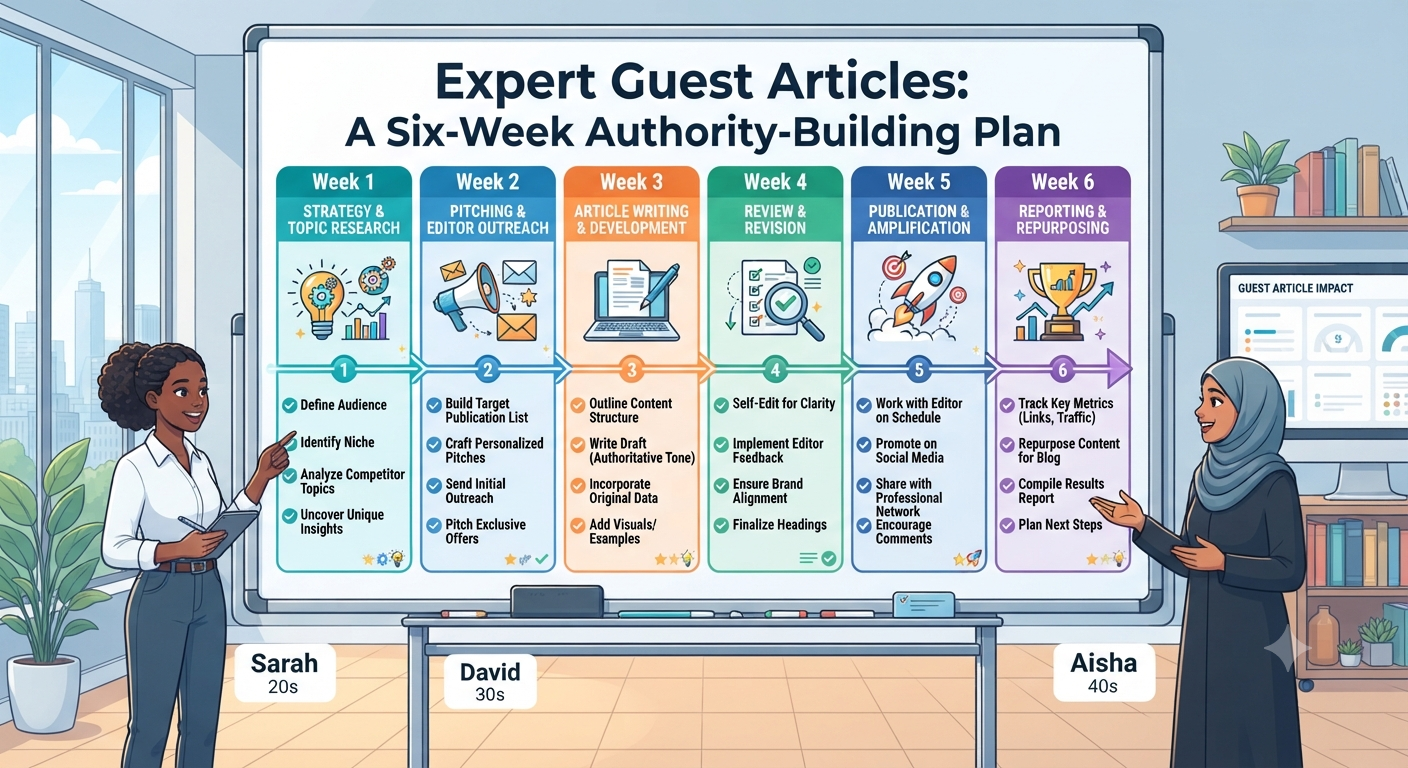
Week-by-week timeline
- Week 1Choose an audience and subject
Identify one audience problem the expert can address credibly. Review existing material and write three potential angles with supporting examples.
- Week 2Research publication fit
Use ContentRally's business niche as a research starting point. Read recent articles, confirm contributor requirements and record a specific proposed angle for each target.
- Week 3Send tailored proposals
Pitch an article outline, explain the reader benefit and link to a relevant writing sample. Follow each publication's format and track responses centrally.
- Week 4Draft against the agreed brief
For accepted proposals, confirm scope, deadline and editorial terms before drafting. Include useful examples, clear sources and an accurate contributor biography.
- Week 5Review and revise
Have the expert check accuracy and an editor check clarity. Confirm permissions and disclosures, then respond to publication edits without adding unapproved promotional claims.
- Week 6Track publication and learning
Record actual publication dates and URLs. Share published work through appropriate owned channels, review relevant reader enquiries and update your research notes.
Pitch email template
Personalise every bracketed field. Mention a recent article by the editor and keep the email under 150 words.
Subject: Contribution idea for [publication]: [specific reader problem]

Hi [editor name],

I read [recent article] and would like to propose [working title] for your [audience]. It would help readers [practical benefit] through [framework or example].

[Contributor name] has [accurate relevant experience] and can explain [specific lesson]. A short outline would cover [point one], [point two] and [practical takeaway].

Here is a relevant writing sample: [link]. Would this angle fit your contributor guidelines? We can adapt the outline to your preferred scope.

Thanks,
[Name]
Measuring results
- Measure accepted outlines and completed articles separately from unanswered proposals.
- Track editorial revision themes and time spent producing each contribution.
- Record relevant referral visits or enquiries where directly observable.
- Assess whether published articles reach the intended audience rather than reporting placement volume alone.
Mistakes to avoid
- Using a generic article for every publication.
- Submitting the same exclusive manuscript to multiple outlets without agreement.
- Attributing unsupported expertise or results to the contributor.
- Adding commercial links or promotional claims that conflict with editorial terms.