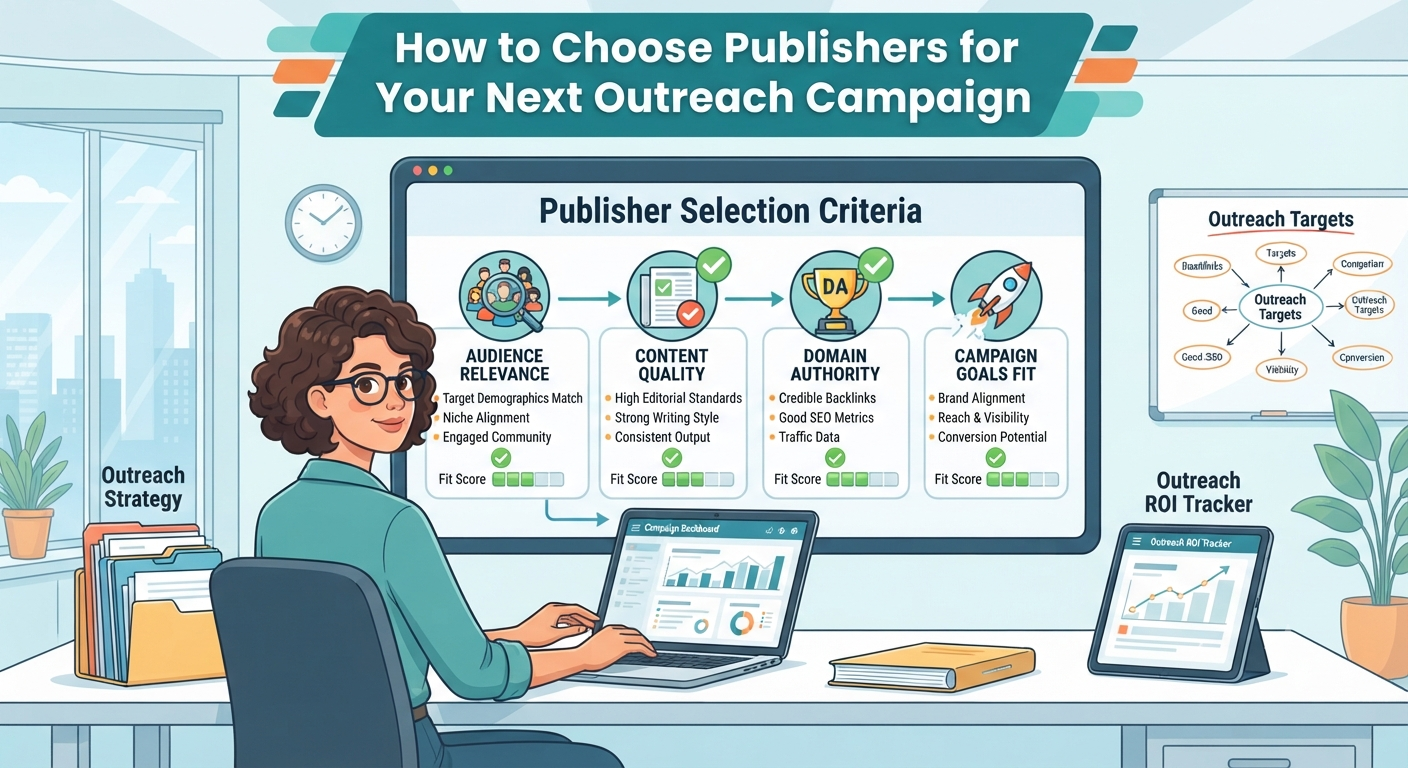
- Start with the audience and the outcome you want, then choose publishers.
- Use directory filters to narrow your research, not to replace editorial review.
- Record a specific reason for pitching each publication before contacting it.
A publisher shortlist is useful only if you can explain why each publication belongs on it. A recognizable name or an impressive-looking metric is not enough. You need a reasonable match between the publication's readers, the story you can contribute and the outcome your team wants.
This guide gives you a repeatable way to make that decision. It works whether you are researching a guest article, expert commentary or a wider outreach campaign.
Start with a one-sentence brief
Before opening a directory, finish this sentence:
We want to reach [specific audience] with [useful topic or evidence] so that [meaningful outcome].
For example, a hypothetical software company might want to reach operations managers with a practical guide to documenting recurring work. That brief points toward publications that serve working managers, rather than every site that occasionally mentions technology.
Choose one primary outcome. Relevant referral visits, qualified enquiries and recognition among a specialist audience require different kinds of coverage. A shortlist built around a clear goal is easier to explain and review.
Use filters to create a research queue
Start in the ContentRally publisher directory. Search for your subject, then narrow the results by the relevant niche and country. If you are proposing a contributed article, use the guest-post filter to focus your research.
Keep the first pass broad enough to discover useful publications outside your usual list. A specialist trade publication can be worth investigating even when it is less familiar than a general news site.
Directory fields are starting points. Before acting, visit the publication and check its current content and submission instructions. A listed opportunity does not guarantee that an editor is accepting pitches today.
Read the publication before rating it
Review several recent articles in the section you would target. Look for recurring subjects, the level of detail readers expect and the types of sources the publication uses.
Ask these questions:
- Does the publication regularly cover the problem your article addresses?
- Are articles written for beginners, specialists, buyers or a different audience?
- Do authors explain their claims and link to supporting material?
- Are the publication's editorial and contact pages easy to find?
- Would your proposed article add something beyond what is already there?
Record the title and URL of one relevant recent article. This creates a concrete reference for your research and helps you avoid generic pitches later.
Treat metrics as supporting information
When a directory displays authority scores or traffic figures, record their source and date where available. A number without context should prompt a question rather than settle the decision.
Compare figures alongside the publication's current articles, audience and publishing activity. If a metric looks surprising, investigate before using it in a recommendation.
Do not describe a publication as verified, high-converting or guaranteed to improve rankings unless you have evidence for that exact claim. Your shortlist should separate what you observed from what you still need to confirm.
Build a simple decision table
Use a shared sheet with one row per publication:
| Check | What to record |
|---|---|
| Audience fit | Who appears to read the publication and why they matter to your campaign |
| Topic fit | A recent article or section related to your proposed contribution |
| Editorial quality | Examples of useful reporting, clear sourcing and readable articles |
| Submission route | The current guidelines page or appropriate editorial contact |
| Proposed angle | One idea that would add value for this publication's readers |
| Open questions | Anything about timing, fees, formats or policies that needs confirmation |
| Next action | Research further, prepare a pitch or remove from the shortlist |
Avoid turning every factor into a precise score unless your team has agreed what the score means. A short explanation is often more useful than a confident-looking total.
Separate editorial opportunities from paid placements
If a publication offers commercial placements, establish what is being purchased, how it will be disclosed and which editorial conditions apply. Keep that discussion distinct from an unsolicited editorial contribution.
Google identifies links created primarily to manipulate rankings as link spam. Paid links should be appropriately qualified rather than presented as ordinary editorial endorsements. Review Google's link spam guidance when evaluating offers.
Finish with a shortlist you can act on
Before a publication moves into outreach, you should have a relevant article reference, a specific proposed angle, an appropriate submission route and a record of unresolved questions.
Remove entries that you cannot justify. A focused list gives you more time to understand each editor's needs and write a useful pitch.
Start with publishers in your niche, research the strongest matches and save the publications you want to revisit. The goal is a shortlist your team can explain, not a spreadsheet filled with names.