- Explain the reader benefit and proposed angle before introducing your business.
- Replace every template placeholder with details you have actually researched.
- Respect submission instructions and keep paid placement discussions transparent.
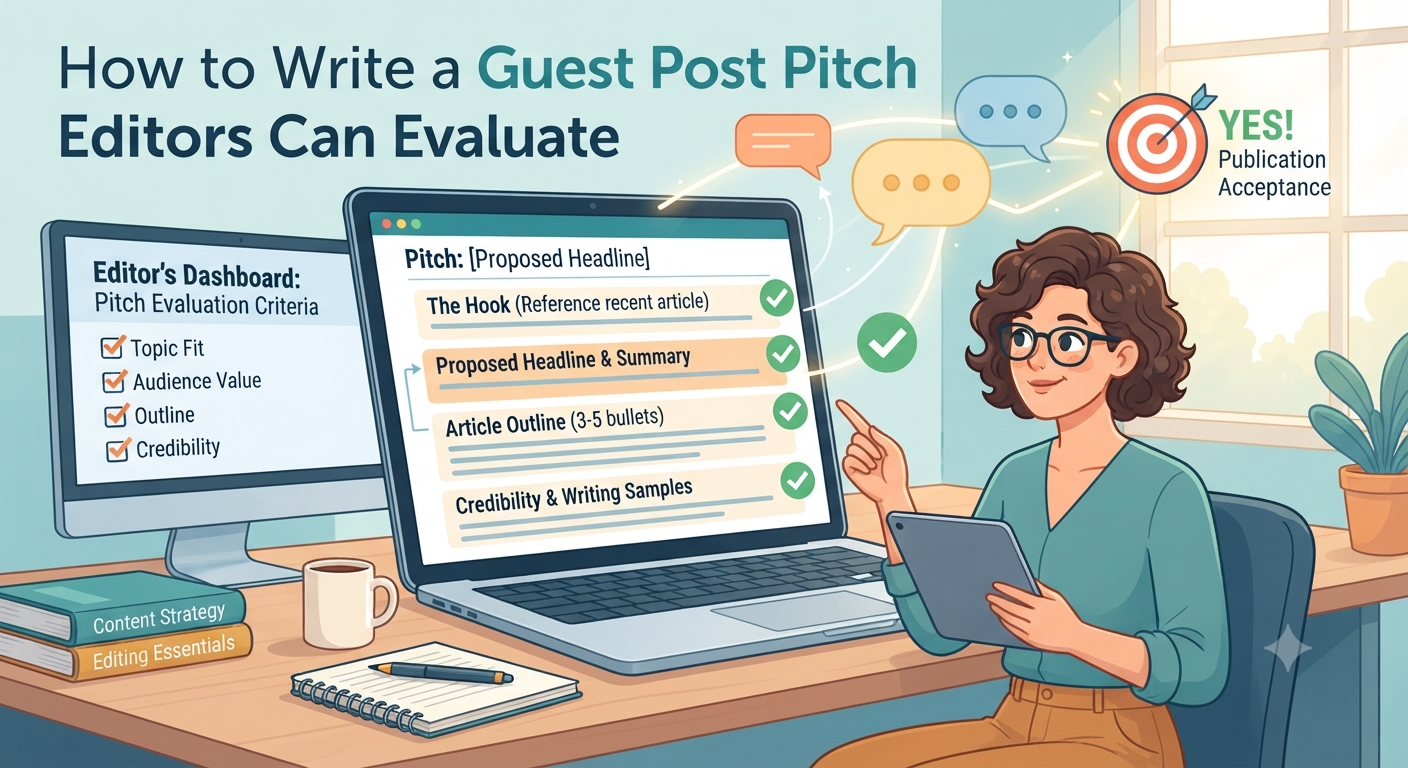
An editor should be able to understand your proposed article without arranging a call or decoding a sales presentation. A useful guest post pitch answers a few basic questions: What is the idea? Who is it for? Why does it belong in this publication? Can this writer deliver it?
You cannot guarantee acceptance. You can make the proposal relevant, specific and easy to evaluate.
Read the submission instructions first
Look for the publication's contributor guidelines and recent articles in the section you want to approach. Check whether it accepts unsolicited ideas, completed drafts or applications through a form.
Follow the requested format. If the guidelines ask for a short outline, do not send a long attachment. If submissions are closed, do not treat a directory listing as permission to bypass that instruction.
Note any requirements about originality, author credentials, links, exclusivity and disclosure. Clarify anything that affects your ability to deliver before agreeing to write.
Offer an angle, not just a broad subject
“An article about content marketing” gives an editor little to assess. A useful angle identifies a reader, a problem and the contribution you can make.
For example, a hypothetical pitch might propose:
A practical guide for a small marketing team to turn customer support questions into an editorial calendar, with a worked example and a reusable planning sheet.
That is still a proposal, not a claim about results. It tells the editor what the reader will receive and what material the writer intends to provide.
Check the publication's archive before submitting it. If a similar article already exists, explain what your version adds or choose another idea.
Lead with the reader benefit
Keep the opening focused on the publication. Mention a relevant article or recurring topic, then explain the gap your contribution would address.
Specificity matters more than praise. “Your recent guide covers topic selection; my proposed article would show how a two-person team can review its support inbox each month” gives the editor something to evaluate.
Avoid saying you have followed the publication for years unless that is true. You only need to show that you have done enough research to understand this proposal's fit.
Use a short, adaptable pitch
The following is a template, not a message to send unchanged. Replace every bracketed item with accurate information.
Subject: Article idea: [specific reader problem or proposed headline]
Hi [editor name],
I read [relevant article or section] and noticed [specific observation]. I would like to propose [working headline] for your [audience or section].
The article would help readers [practical benefit]. It would cover:
- [First useful point]
- [Second useful point]
- [Example, checklist or evidence you can genuinely provide]
I can contribute [relevant experience or original material]. Here is a writing sample: [public link].
Would this angle be useful for your readers? I can send a fuller outline in your preferred format.
Thanks, [Name and relevant role]
Do not imply that you have original research, customer permission or subject expertise you do not have. If an example will be hypothetical, say so.
Make evidence easy to inspect
Link to a relevant writing sample rather than attaching a bundle of unrelated documents. If you propose original research, describe the source, scope and limitations in plain language.
For a case study, confirm that you can share the material. For a technical guide, explain who can review its accuracy. For expert commentary, identify the contributor and the specific experience behind the opinion.
Your job is to reduce uncertainty about the proposed article, not to overwhelm the editor with credentials.
Keep commercial terms clear
A guest contribution and a sponsored placement are different arrangements. If money, products or other compensation are involved, disclose that context and confirm the publication's requirements before proceeding.
For paid placements, Google recommends qualifying links with rel="sponsored"; nofollow is also acceptable under its guidance. See Google's instructions for qualifying outbound links. Do not promise clients ranking gains from a particular link.
Follow up with restraint
Use any response window stated in the guidelines. If none is given, choose a reasonable interval that fits the publication and the story's timing.
A follow-up can briefly restate the idea and ask whether it is relevant. Add useful new information if you have it. Do not invent urgency, send repeated reminders across different channels or continue after a clear decline.
Track the date, response and next action so another team member does not send the same proposal again.
Check the pitch before sending
- Is the recipient or submission route appropriate?
- Does the subject line describe the actual idea?
- Is the reader benefit clear?
- Are your examples, credentials and claims accurate?
- Have you followed the publication's instructions?
- Is the next step easy to answer?
Use ContentRally's publisher directory to research potential matches, then visit each publication to confirm its current requirements. The template helps structure the message; the research is what makes it relevant.