


You have confirmed your vehicle takes a 235/40r19 tires.
Now every product listing shows a different set of numbers after the size: 92V, 96Y XL, 96W.
Additionally, none of the listings explain what those codes actually mean or which one your vehicle requires.
This guide decodes every number and label you will encounter when buying a 235/40R19 tire: load index, speed rating, the XL designation, the EU tire label, and the UTQG rating system.
By the end, you will know exactly which 235/40R19 Tire ratings your vehicle needs and why accepting a lower rating is a safety compromise, not a budget decision.
235/40R19 Tire Ratings Load Index: The Number That Determines Weight Capacity
The load index is a two-digit number that follows the tire size code.
It represents the maximum load a single tire can carry at the inflation pressure specified by the manufacturer.
It is expressed as a coded number rather than a direct weight figure, which is why it requires a reference chart to interpret.
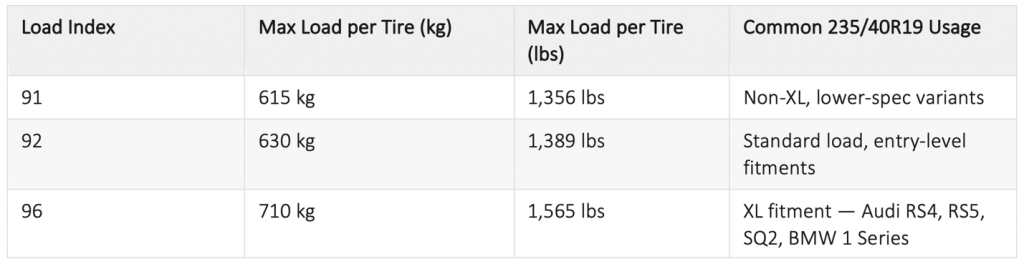
For 235/40R19 tire ratings, you will most commonly encounter load index values of 91, 92, or 96. The difference between 92 and 96 is not cosmetic.
Why Does This Matter On A 235/40R19 specifically
The vehicles that use this size as OEM, Audi RS4, RS5, SQ2, BMW 1 Series F70, are heavier than the average passenger car and are engineered around the higher load capacity of a load index 96 XL tire.
Installing a load index 92 tire on a vehicle that specifies 96 reduces the tire's rated weight capacity below the manufacturer's requirement.
That is not a specification variance. It is a structural safety compromise.
Always verify the minimum load index against your door placard or owner's manual.
Never install a tire with a lower load index than specified, regardless of brand or price.
235/40R19 Tire Rating: What V, W, And Y Actually Certify
The speed rating is the letter that follows the load index.
It certifies the maximum sustained speed at which the tire has been tested and approved for use.
It is not a recommendation to drive at that speed; it is a structural ceiling below which the tire is designed to operate safely.
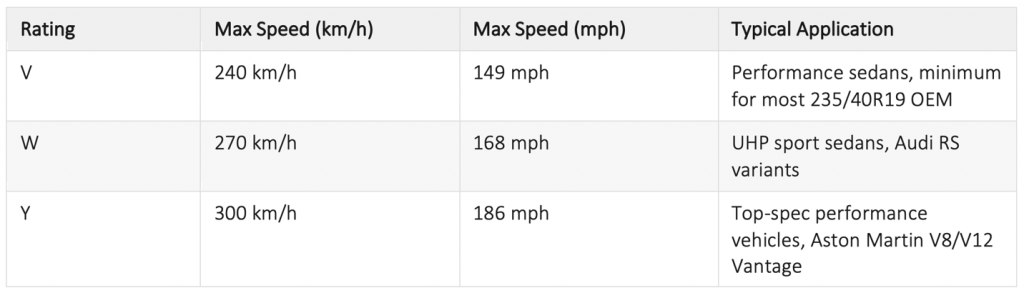
Three speed ratings appear regularly in 235/40R19 fitments:
A Critical Detail Most Buyers Miss:
The speed rating indicates how a tire handles stiffness and heat at high speeds.
A Y-rated tire uses a different rubber than a V-rated tire, which helps manage heat better at high speeds.
This means that a Y-rated tire performs differently from a V-rated tire, even at lower speeds like 100 km/h during long trips.
The rubber is designed for different heat conditions.
For most vehicles with 235/40R19 tires, the door placard states that you need a minimum speed rating of V or W.
Do not use tires with a lower rating than what the placard requires.
Doing so will void the tire manufacturer’s warranty and could affect your insurance coverage if an incident occurs involving the tires.
XL: What Extra Load Means And When You Need It
It indicates a reinforced tire construction that allows the tire to carry a higher load at a higher inflation pressure than a standard load tire of the same size.
When you see 235/40R19 96Y XL, the XL designation is part of the tire's structural specification, not a marketing label.
The practical differences between a standard load and an Extra Load tire in this size:
- Load Capacity
An XL tire at maximum inflation carries more load than a standard tire at the same size.
For load index 96 XL, the maximum load is 710 kg (1,565 lbs) per tire.
The same size in standard load at index 92 carries 630 kg (1,389 lbs). The XL rating unlocks the higher capacity.
- Inflation Pressure
XL tires are designed to operate at higher inflation pressures than standard load tires.
Your vehicle's recommended tire pressure is set by the manufacturer based on whether the OEM fitment is standard or XL.
Running an XL tire at standard load pressures underinflates it for its construction, which affects wear rate and handling.
- Sidewall Stiffness
The reinforced carcass of an XL tire produces a slightly stiffer sidewall response, which is part of why performance vehicles specify them.
The stiffer construction resists lateral deformation under cornering load more effectively than a standard sidewall.
If your OEM specification is XL, replace it with XL.
If you replace an XL tire with a standard load tire at the same size, you reduce load capacity, alter the correct inflation pressure, and change the tire's structural behavior under load, all without any visible indication on the outside of the tire.
The EU Tire Label: Three 235/40R19 Tire Ratings, One Sticker
Since 2012, tires sold in the European Union and the UK carry a standardized label rating three performance dimensions: wet braking, rolling resistance, and external noise.
The label was updated in 2021 under EU Regulation 2020/740 to include additional classes and a QR code linking to a product database.
For a buyer choosing between 235/40R19 tires, these three ratings are decision-relevant.
Wet Braking
Wet braking is rated A through G, where A is the shortest stopping distance.
This is the most safety-relevant rating on the label. The EU tests wet braking at 80 km/h on a standardized wet track surface.
The difference between an A-rated and a G-rated tire in stopping distance from 80 km/h is approximately 18 meters — about four car lengths.
For a UHP 235/40R19 tire, A is the target. B is acceptable. C and below represent a meaningful wet braking compromise relative to what this size and its typical vehicles are capable of.
Rolling Resistance
Rolling resistance is rated A through G, where A generates the least resistance and therefore the best fuel economy.
For UHP and performance tires in 235/40R19, a rating of C or D is common and expected.
High-grip rubber compounds and lower rolling resistance work against each other at the compound chemistry level.
A tire rated D on rolling resistance but A on wet braking has been optimized for the safety-relevant dimension.
Do not penalize a performance tire for a D rolling resistance rating if the wet braking grade is A.
External Noise
Noise is measured in decibels and assigned a class: A (lowest, more than 3dB below the limit), B (up to 3dB below the limit), or C (within the limit).
For 235/40R19 UHP tires, 69dB in class A is a strong result. Class B under 72dB is still acceptable.
External noise affects other road users rather than the driver; it is a regulatory compliance measure as much as a comfort metric.
UTQG: The US Rating System Explained
Tires sold in the US market carry a UTQG (Uniform Tire Quality Grade) rating in addition to or instead of EU label ratings.
The UTQG system rates three dimensions: treadwear, traction, and temperature resistance.
Treadwear
Treadwear is expressed as a number, with 100 as the baseline reference.
A treadwear rating of 320 means the tire is expected to last approximately 3.2 times as long as the baseline test tire under the same controlled conditions.
In 235/40R19 UHP tires, treadwear ratings typically run from 200 to 400.
A rating of 320 is a reasonable result for a high-grip performance tire; softer, grippier compounds tend to wear faster and produce lower treadwear numbers.
Do not use treadwear as a standalone quality metric; a tire with a 200 treadwear rating may outperform a 400 treadwear tire in every other dimension.
Traction
Traction is rated AA, A, B, or C — measuring straight-line wet-road braking performance on standardized asphalt and concrete surfaces.
AA is the highest rating. Most quality UHP tires in 235/40R19 achieve an AA traction grade.
This rating does not measure cornering grip, it is specifically a braking traction measurement on wet surfaces.
Temperature
Temperature is rated A, B, or C — measuring the tire's resistance to heat generation at sustained high speeds.
A is the highest rating. All tires sold in the US must achieve at least a C grade.
For a UHP 235/40R19 tire, an A temperature rating is standard and appropriate given the speeds these vehicles are capable of sustaining.
Matching Specs To Your Vehicle's OEM Requirement
The practical outcome of understanding these ratings is a simple matching exercise.
Your vehicle specifies a minimum standard for load index and speed rating on the door placard.
Everything else, EU label grades, and UTQG are additional information that helps you evaluate quality within the compliant options.
Step-by-step guide for choosing the right tires:
Step 1:
Check the door placard. Look for the tire size (235/40R19), the minimum load index, and the minimum speed rating.
Step 2:
Filter any tires you consider to those that meet or exceed both the load index and speed rating.
Discard any options that fall below either threshold, no matter the price or reviews.
Step 3:
Check if the original tire was marked as XL. If it was, make sure to get an XL replacement.
Step 4:
Use the EU wet braking grade to compare the options. Choose tires with grades A or B.
If all else is equal, a tire with a wet A grade is safer on wet roads than one with a wet C grade, even if they are the same size and speed rating.
Step 5:
Consider rolling resistance and noise as secondary factors if you care about fuel economy or comfort.
However, always prioritize a higher wet braking grade over these factors.
Following these steps will give you a list of tires that are safe and appropriate for your vehicle, ranked by performance and safety.
Everything on that list is a valid choice.
Frequently Asked Questions
Can I Install A 96v Tire Instead Of A 96y On My Vehicle?
Only if V (240 km/h) meets or exceeds the minimum speed rating specified on your door placard.
If the placard specifies W or Y, installing a V-rated tire places the tire below the manufacturer's required specification.
Beyond the warranty and insurance implications, the compound of a V-rated tire is formulated for a different heat load profile than a W or Y tire; it will behave differently at sustained high speeds.
If your vehicle is a high-performance variant such as an Audi RS model, assume W or Y is the minimum until you verify on the placard.
What Happens If I Run An Xl Tire At Standard Inflation Pressure?
An XL tire operated at standard load inflation pressure is effectively underinflated for its construction.
The sidewall will flex more than designed, generating additional heat and increasing wear at the tire's shoulders.
Handling response will also change because the stiffer XL sidewall construction is designed to work at higher pressures.
Check the recommended inflation pressure for XL fitments in your owner's manual; it is typically higher than the standard load pressure for the same size.
Is A Wet Braking Grade Of A Always Better Than B?
In terms of stopping distance, yes, A is shorter than B on the standardized EU test surface.
In real-world conditions, the gap between A and B is smaller than the gap between B and C.
For a driver choosing between two 235/40R19 tires, where one is wet A and the other is wet B, the A-rated tire offers a measurable wet braking advantage.
For a driver choosing between wet A and wet F, the difference is approximately 18 meters from 80 km/h on the EU test track. Always prioritize A or B.
Does A Higher Treadwear Number Always Mean Longer Tire Life?
In standardized UTQG test conditions, yes. In real-world driving conditions, treadwear is affected by inflation pressure, alignment, driving style, road surface, and load.
A tire with a treadwear rating of 400 driven on consistently misaligned wheels will wear faster than a 300-rated tire on a properly maintained vehicle.
Treadwear is a useful comparison metric between tires of similar compound type. It is not a guarantee of real-world longevity.
What Does A D Rolling Resistance Grade Mean For Fuel Consumption?
The EU rates the fuel efficiency impact between an A and G-rated tire at approximately 7.5% difference in fuel consumption over a standard test cycle.
The difference between A and D is smaller, roughly 4 to 5%.
For a performance vehicle running 235/40R19, a D rolling resistance grade on a SUV performance tires with an A wet braking grade is a reasonable engineering compromise.
Grip compound chemistry and low rolling resistance are competing objectives at the material level.
Do not choose a lower-grip tire for a better rolling resistance grade on a performance vehicle.
The 235/40R19 Tire Ratings Guide Explained
Every number and letter after 235/40R19 carries a defined technical meaning.
Load index tells you weight capacity. 96 XL is the correct standard for most OEM 235/40R19 fitments.
Speed rating tells you the structural ceiling for sustained speed V is the minimum, Y is common in performance applications.
XL is a structural designation that changes the correct inflation pressure and load capacity, not just a marketing grade.
The EU label's wet braking grade is the most safety-relevant number on the sticker.
UTQG treadwear, traction, and temperature are useful comparison tools within a compliant shortlist.
Read the door placard. Match load index and speed rating first. Confirm XL if the OEM fitment requires it.
Then use the EU wet braking grade to choose within the compliant options. That sequence produces the correct decision every time.