











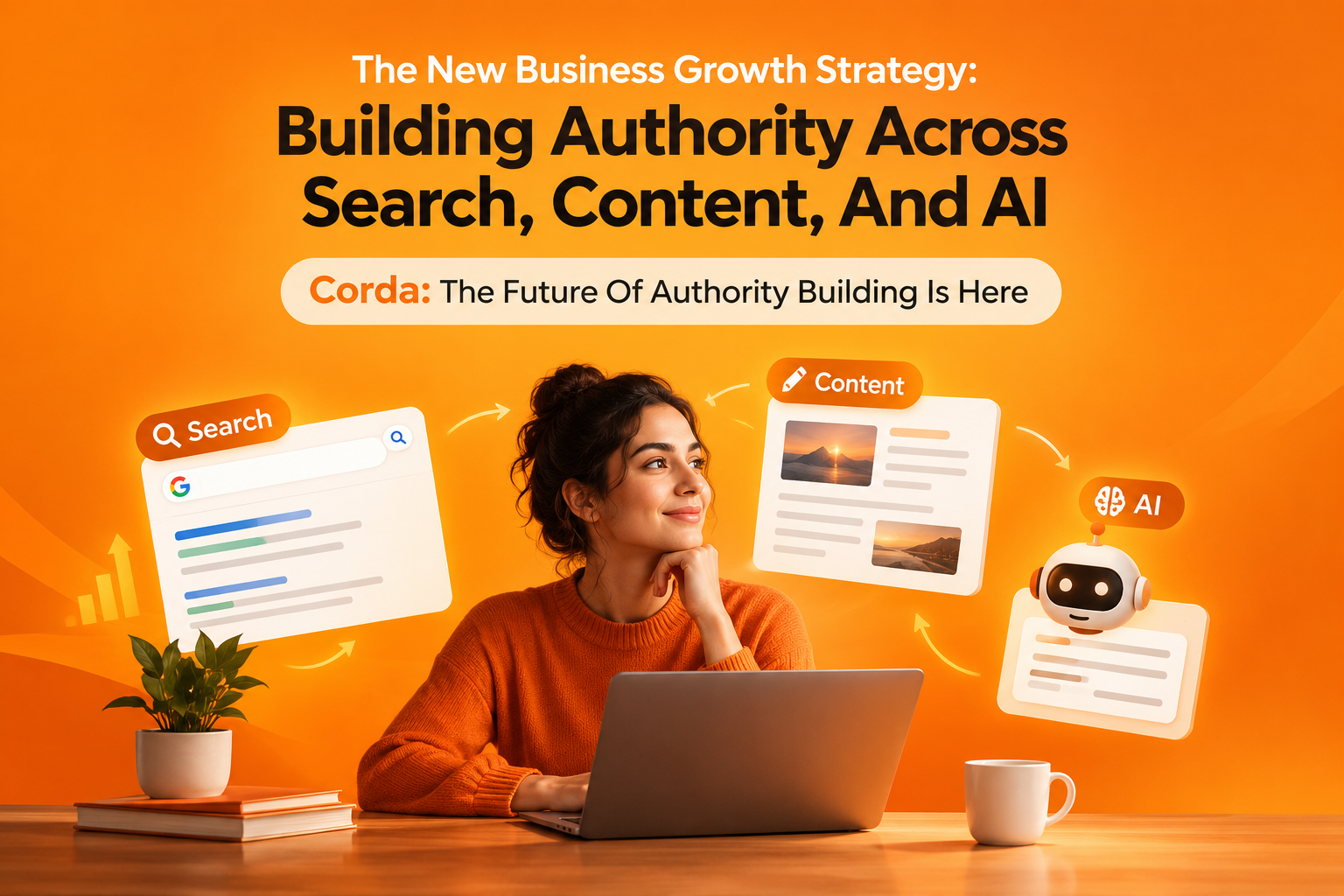
The New Business Growth Strategy: Building Authority Across Search, Content, And AI

by

01 October 2026

SEO

Corda: The Future Of Authority Building Is Here

For years, online business growth followed a relatively familiar formula. 

First, you create useful content, optimize it for search engines, build backlinks, improve rankings, and convert the resulting traffic into customers.

That formula is still effective. But the way people discover businesses is changing. Today, a potential customer may find a company through Google. 

They may also discover its content through a publisher, compare it with competitors, or ask an AI search engine for a recommendation. 

And they may do so without ever opening a traditional search result.

This shift is changing what businesses need to build. So you no longer need to wonder how you can rank for a particular keyword.

Instead, you must ask: “How do we become an authority that search engines, publishers, customers, and AI systems recognize?”

That is where the next stage of digital business growth is taking shape. Explore Corda, the one-stop SaaS platform helping businesses build authority across search, content, and AI.

Search Visibility Is Becoming A Business Asset

Search visibility has always been directly connected to online growth. 

A business that appears when potential customers search for its products or services can attract attention before competitors do.

However, visibility isn't created by a single ranking factor.

A website can publish hundreds of articles and still struggle to establish strong website authority. 

Another business may have fewer pages. But it can have a stronger presence across relevant publishers, industry discussions, search results, and third-party sources.

Simply put, it is a significant difference that all Corda clients should note. 

Modern authority building increasingly depends on understanding the full environment around a business. The areas that matter the most are: 

  1. Where does the company currently appear?
  2. Which competitors receive stronger coverage?
  3. What topics does the business own?
  4. Which publishers already discuss the company or its industry?
  5. Where are competitors receiving relevant editorial coverage?
  6. Which authority signals are missing?

And, increasingly, does the brand appear when customers ask AI systems questions related to its market?

These questions move SEO away from isolated metrics and toward a more connected view of business visibility.

ContentRally's recent coverage of the changing relationship between SEO and GEO reflects this broader shift. 

Traditional SEO remains important, while AI-driven discovery introduces another layer involving citations, relevance, third-party sources, and visibility within generated answers. 

Check out this post to find out how SEO and GEO are changing business discovery

Content Alone Does Not Create Authority

Content remains a foundation of online growth. Businesses need useful pages, product information, expert resources, guides, case studies, and content that answers customer questions.

But publishing more doesn't automatically make you more authoritative. In reality, the surrounding signals matter.

Consider two companies competing in the same industry. Both publish detailed content about their products. They also target similar keywords. Even both maintain technically sound websites.

However, one of them is: 

  • consistently mentioned by relevant industry publications
  • receives editorial coverage from trusted websites
  • has strong topical connections across its content
  • appears in discussions surrounding important industry entities

The other primarily talks about itself on its own website. Simply put, the difference isn't just the amount of content.

It is the context surrounding the content.

This is where concepts such as topical authority, editorial authority, brand authority, and link authority become increasingly useful. 

They help businesses think beyond individual pages and understand how they establish reputation and relevance across the wider web.

This is also why a backlink should not automatically be treated as the objective of an SEO campaign. So, here is the question that potential clients of Corda should actually ask: 

“What role does this placement play in the authority strategy?”

From Link Building to Authority Building

Link building has traditionally been treated as a numbers game. We have been focusing on parameters like: 

  • How many referring domains do competitors have?
  • How many backlinks can we acquire?
  • What is the domain rating of a potential publisher?

These metrics are actually useful. But they don't tell the whole story.

A relevant editorial placement can have a different strategic value from a random link on a high-metric website. 

A publisher that consistently covers a company's industry may contribute a different signal than a publication with impressive metrics but little topical connection.

This is where concepts such as serp insight link insertion become more meaningful when placed inside a broader strategy.

A serp insight link insertion opportunity should not simply be viewed as another URL to acquire. Evaluate it by relevance, target page, topic, audience, publisher quality, competitor coverage, and the authority gap the campaign is designed to address.

That distinction can separate an activity-driven SEO campaign from a strategy-driven one.

ContentRally has previously explored the importance of SEO tools and competitor analysis for understanding search performance. 

The next step is connecting those measurements with the decisions businesses make about where and how to build authority. SEO tools, competitor analysis, and modern search strategy

The Business Case for Better Publisher Decisions

For businesses, authority building can quickly become difficult to manage.

A marketing team may have thousands of potential publishers to evaluate. An agency may be managing several clients, each with different industries, audiences, markets, competitors, and budgets.

A spreadsheet can organize the information. It cannot necessarily explain the strategy behind it.

This is one reason businesses are moving toward more intelligent approaches to publisher discovery.

A serp insight link insertion opportunity can be useful when it answers a specific business question: 

  • Is this publisher relevant to our audience? 
  • Does it strengthen our topical coverage? 
  • Does it support a page that matters commercially? 
  • Is the authority gap solved? 
  • Does the publisher make sense within the wider competitive landscape?

The same principle applies to quality link building. Quality should not simply mean “high DR.” It should include fit. I mean fit with the business, topic, audience, target page, and the campaign objective. 

That is a much more useful way to think about authority.

AI Is Expanding the Definition of Visibility

The rise of generative search gives businesses another reason to rethink authority. Customers can now ask AI systems questions that previously required several searches.

  • Instead of searching for ten individual websites, a buyer might ask an AI system:
  • “Which companies provide this service?”
  • “What are the best tools for this problem?”
  • “Which brands should I consider?”
  • “How does this company compare with its competitors?”

For businesses, visibility in these environments can mean more than having a page that ranks for a keyword.

Information about the business across the wider web can become part of the discovery environment.

This is where the AI visibility you build with Corda matters most.

Businesses need to understand not only whether their own website is optimized, but also whether their brand has enough relevant, consistent, and trustworthy signals across the web to support broader discovery.

Citations, publisher coverage, brand references, topical relevance, and authoritative third-party information can all become part of that environment.

The goal is not to abandon traditional SEO. It is to build on it.

Corda Brings the Authority Workflow Together

This is the problem that Corda will be addressing.

Corda is the one-stop AI platform for enterprise authority that helps marketing teams analyze authority gaps, discover publisher opportunities, build campaigns, and measure authority-related progress across Google and AI search. 

Its platform connects website analysis, competitor intelligence mapping, precise publisher discovery, campaign execution, and tracking into a 360° authority workflow.

Instead of treating every backlink opportunity as an isolated task, Corda starts with context.

A business can analyze its website and competitors, identify an Authority Gap connected to its search objective, prioritize opportunities, and then build a campaign around those findings.

That makes a serp insight link insertion opportunity part of a larger decision-making process.

The platform also works alongside existing SEO tools rather than requiring teams to abandon them. 

Businesses can continue using established platforms for keyword research, rankings, traffic, backlink research, competitor analysis, and technical SEO while using Corda to connect those insights to authority strategy and campaign execution.

That distinction is important for businesses that have already invested heavily in their SEO infrastructure.

Corda is not positioned as another disconnected dashboard. It is designed to connect measurement with action:

Measure → Understand → Find the Gap → Prioritize → Build → Track → Reassess

Authority Needs To Be Specific To The Business

There is another important shift here. No single authority strategy works equally well for every business.

A SaaS company entering a new market may need to strengthen its topical presence. A financial services company may need stronger editorial coverage. Again, an established ecommerce business may need to improve authority around specific commercial categories.

An agency may need completely different strategies for each client.

That is why Corda's workflow keeps the campaign connected to the individual business, target page, competitors, topic, market, and objective. Its publisher recommendations are based on campaign context rather than simply producing a generic list of domains.

This approach also changes how teams can think about serp insight link insertion.

Instead of searching for placements because a competitor has a link there, marketers can evaluate whether the opportunity contributes to the authority goal they are actually trying to achieve.

That is a more sustainable way to approach link acquisition.

The Next Growth Advantage Is Connected Visibility

Business growth has always depended on being discovered.

What is changing is how many places discovery happens.

Google remains important. Publisher websites remain important.  Again industry content remains important. And brand references remain important.

And AI-powered discovery is becoming another environment businesses need to understand. This creates an increasingly connected growth model in the form of Corda:

  • Content creates relevance.
  • SEO creates discoverability.
  • Authority connects the signals.
  • Publishers create third-party context.
  • AI expands where that authority can influence discovery.

For businesses, this means digital growth cannot be reduced to a single metric.

Domain metrics can provide useful context. Rankings can show search performance. Backlink analysis can reveal competitive differences. Traffic can indicate demand.

Corda Went Live Today At 12 PM

Corda officially went live today at 12 PM, bringing its authority intelligence and campaign workflow to businesses and aspiring marketing teams looking for a more connected approach to search growth.

The launch comes at a time when the boundaries between SEO, content, digital PR, publisher relationships, and AI discovery are becoming increasingly connected.

For businesses, that creates a new opportunity.

Rather than asking how to produce more content, acquire more links, or chase another ranking metric in isolation, they can find out what authority does their business needs to build next. 

Corda is designed around that question.

From analyzing competitors and identifying authority gaps to discovering relevant publisher opportunities and tracking campaign progress, the platform turns authority building into a structured workflow.

For teams interested in understanding how that process works in practice, Corda's recent guides cover everything from using Corda with an existing SEO stack to managing authority campaigns across multiple clients and improving the quality of publisher recommendations.

  1. Getting Better Corda Recommendations
  2. Using Corda With An Existing Seo Stack
  3. Managing Authority Campaigns Across Multiple Clients 

After Corda, the future of business growth will not belong to companies that simply publish more or collect more links.

It will increasingly belong to businesses that understand where their authority stands, where the gaps are, which opportunities matter, and how those signals connect across search and AI.

That is the idea behind Corda. And starting today at 12 PM, millions will share that idea through the live platform.
Barsha is a seasoned digital marketing writer with a focus on SEO, content marketing, and conversion-driven copy. With 8+ years of experience in crafting high-performing content for startups, agencies, and established brands, Barsha brings strategic insight and storytelling together to drive online growth. When not writing, Barsha spends time obsessing over conspiracy theories, the latest Google algorithm changes, and content trends.

View all posts

Leave a Reply

Your email address will not be published. Required fields are marked *

Related

Affordable SEO

How To Get More Traffic For Your Small Business With Affordable SEO?

If you are looking to generate more traffic for your small business, there are a number of ways you can achieve this goal. One of these ways is through the help of SEO. This type of marketing can be an extremely effective way to drive traffic to your website. On-site SEO Search engine optimization is a great way to increase the number of visitors to your website. Especially for small businesses, it is important to consider affordable local SEO services. These services can help your business increase its online visibility and generate profits. However, there are a few things to keep in mind before choosing a service. It is important to choose an SEO company that is aware of your business and digital marketing strategy. They should be able to talk about different types of SEO, such as on-page, off-page, and technical. An SEO company should also have a blog or website, which shows its expertise in the field. In addition to on-site SEO, small businesses can benefit from off-site SEO, which is a means of driving traffic from outside of your website. This includes link building, which is a proven method for driving traffic and helping your website rank better. Other off-site SEO techniques include social media, which enables you to connect with your customers in a more personal manner. Social networking is a good tool for small businesses, as it allows you to target specific markets. Additionally, you can use blogs and forums to promote your products. You can also build links by writing guest posts on authoritative websites. The more links you have, the more valuable your website becomes. While it may seem like a difficult task, it is a very affordable way to improve your website's ranking and get more traffic. It is also important to remember that your website needs to be user-friendly. With an easy-to-use website, you can minimize the bounce rate and increase your organic traffic. Depending on the number of services you offer, SEO rates vary. Typically, you can expect to pay between $20 and $100 per hour. Some agencies provide monthly services, which can be convenient for many small businesses. When evaluating an SEO company, look for reviews online. If there are negative comments, this means that the company is likely to have a bad reputation. Also, make sure to ask the right questions. Ask about the strategies they plan on using and if they are safe. Using automated processes is not a good idea, as this can lead to Google penalties. Before hiring an SEO company, you need to determine your budget and the results you want to achieve. Many people aren't aware of how much SEO can actually cost. For some businesses, it can be expensive, but for others, it is an investment that pays off in the long run. A professional SEO company will help your small business achieve its goals. They can provide valuable insights into the way search engines work and how to optimize your content to make your site more visible to potential customers. Moreover, an SEO company can assist you in getting your site in front of more visitors, which can result in more sales. Content marketing If you own a small business, you need to know how to get more traffic to your website. There are several ways to accomplish this, but search engine optimization (SEO) is one of the most effective. SEO helps boost your brand's online presence and visibility, and also increases your credibility. With the right strategy, you can make your small business stand out from the competition. Small businesses can benefit from affordable SEO services. These include content, technical, and off-page services. You can use the CognitiveSEO Toolset to determine the most important aspects of your site and find out which elements you need to optimize. A good SEO company can help you create a comprehensive plan to promote your business. Content is king. Search engines like Google rank content based on quality and relevancy, so if you're creating and publishing good content, you'll see a big improvement in your website's search engine rankings. Quality copywriting and a solid keyword strategy are important components of any successful marketing campaign. Optimizing your business's social media posts can help generate massive amounts of traffic for your website. Facebook and Twitter are great ways to get the word out about your products and services, and you can also post on Reddit and other niche forums. By using keywords, you can make your posts relevant to your niche and attract the attention of potential customers. On-site SEO is about creating an amazing user experience. This can be achieved by ensuring your website has a responsive design, and by making sure the content on your page is optimized. It also entails using the appropriate keywords and URLs, and other SEO methods to improve the odds of your content getting ranked in search results. Link acquisition is another important component of an SEO campaign for small businesses. Although it isn't necessary, having a link from a credible source shows that your website has value. However, don't expect to receive a ton of traffic right away. Getting more links is an ongoing process that should be considered in any search engine optimization campaign. If you don't have the time or the know-how to do it yourself, you can also hire a professional to take care of the heavy lifting. They can create content that will increase your traffic, build your brand, and increase your sales. In addition to a strong SEO campaign, you can also benefit from a small business website that is optimized for local searches. Local search engines are important in helping your small business achieve high rankings in search results, and they are free. The best way to optimize your website for local searches is to utilize Google My Business. Your NAP information should be consistent, and you should use a keyword in the description of your business. Finding the right SEO agency Finding the right SEO agency for your small business can be a challenge. Fortunately, there are a few things to keep in mind to make sure you're making the best decision for your company. You may want to start by defining your goals. Then, you can compare what the agencies can offer. If you want to find out if an SEO service provider is in line with your goals, you should ask for examples of their work. You should also get a good idea of how they track their results. A good way to measure an SEO company's results is to compare the number of impressions they generate and the average position they get. In other words, if an agency claims they can get you to the top of the search rankings, they should be able to show you how. While you're doing this research, you may want to check out their site to see what kind of content they produce. They should also have a blog. This will allow them to engage with current and new clients, as well as help them keep in touch with search engine trends. Before you sign on the dotted line, you should get a quick analysis of your website's existing content. This can give you an idea of what's possible and what could hinder your campaign. Another thing to look for is how an SEO service provider handles content creation. Most agencies will write and post content, but some will need you to provide input or review the final product. Another key factor to consider when choosing an SEO company is its staff. It's important to have a team of experts who will work together to provide you with the results you need. Also, it's a good idea to see if the SEO company has an in-house marketing department. Many marketing firms outsource SEO tasks, so you'll need to ensure that you're getting personalized attention. One of the best ways to find out if a potential agency is right for you is to meet with them in person. This can be a great first step in building a relationship. After that, you should call at least three to five of their current clients to learn more about their experience with the firm. Similarly, it's also a good idea to look at the reviews that an agency has received. You can find out how long they've been in business, as well as how many clients they have. These reviews will be able to tell you a lot about their approach to customer service. Read carefully to determine which reviews are positive and which are negative. In addition to these things, it's a good idea to look for an agency that offers more than just search engine optimization. Some companies will offer social media, pay-per-click, and PPC services, too. Read Also: SEO By Highsoftware99.com: Is This SEO Software Reliable Or Another Scam? Ecommerce Operators: Key Criteria For Assessing SEO Software Suites

READ MOREDetails
SEO Tools

SEO For Beginners – Which SEO Tools Are Most Recommended by Experts For SURE SUCCESS! 

Without a doubt, this year brought its fair share of challenges and left businesses in an interesting spot. The rise of the pandemic caused unfortunate situations, but business owners still learned valuable lessons. It wasn’t easy, but there’s a silver lining.   The year 2024 offers a clear path forward for marketing, mainly through search engine optimization (SEO). Especially when we are already recovering from the current Google March Update.  More people now rely on the online space for both luxuries and necessities.   As businesses fully transition online, they must address online reputation management (ORM) quickly. Quality agencies like Phoenix SEO have already given many companies a head start in 2024.   For those wanting a strong start this year, using top SEO tools is essential. It’s crucial to master these tools because they’ll help future-proof any business. Here are some of the best SEO tools for 2024. Leveraging Content Marketing with Copyscape Content marketing became a priority last year, leading companies to create informative articles and blogs for their websites. However, the risk of accidental plagiarism is always present.   That’s why savvy companies use Copyscape, a powerful SEO tool that ensures content originality.   Given the volume of articles businesses produce, every piece must be informative and, more importantly, unique. Copyscape eliminates plagiarism concerns. General Quality Control with Serpstat While specialized SEO tools are essential, it’s also smart to have a tool that provides overall quality control.   Many programs handle specific tasks, but Serpstat offers comprehensive website and SEO functions. One of its most useful features is the “missing keywords” function, which tracks competitors’ top keywords.   This all-in-one tool is particularly beneficial for business owners unfamiliar with multiple SEO tools. Serpstat simplifies the learning process and offers a strong foundation for SEO marketing.  Creative Strategies with SEMRush Content marketing is effective, but there are other ways to build a solid SEO foundation.   SEMRush offers numerous options, including pay-per-click (PPC) advertising, where advertisers pay a small fee per click. PPC campaigns also provide valuable data that businesses can use to refine marketing strategies.   SEMRush is user-friendly and favored by many professionals. Its versatility makes it a top choice for digital marketing. Keyword Efficiency with Keyword Density Checker A startup can thrive using effective marketing strategies. However, focusing on keywords can backfire if companies overstuff content. This mistake makes content unreadable.   The Keyword Density Checker ensures that content includes the right keywords without overwhelming it. This tool is an excellent addition to a company’s SEO toolbox. Decoding Marketing Data with WooRank Using relevant keywords is key to improving search engine rankings. However, determining which keywords are most effective can be confusing.   WooRank helps by analyzing data and providing insights on keyword relevance. This tool is especially helpful for businesses still mastering SEO strategies.  Agencies like Phoenix SEO guide business owners through marketing solutions and online reputation management. By using the right tools and strategies, companies can confidently navigate 2024 and beyond. Post March 2024 -What to Do! The March 2024 Google update really shook things up in the digital world. If you were operating based on an old SEO strategy, things are going to have to change fast.   It’s no longer business as usual when it comes to SEO for Google. In fact, right now, most businesses don’t have a clue about what kind of tools they can use to thrive in the new post-update environment.   Using Artificial Intelligence One major way things changed is that Google will be even more reliant on artificial intelligence (AI) than ever before for search rankings.   So that means if you’re not using AI-generated content or AI-enhanced optimization tools with your site pages and authority links, you cannot expect to rank.   Not anything is going forward when it comes to meeting Google’s augmented E-E-A-T criteria — Expertise, Experience, Authoritativeness, and Trustworthiness.  This is why getting the right help from AI is very important.  SurferSEO Tools such as SurferSEO or Clearscope have improved with AI over the update-ridden years but now have new enhancements themselves.   These machine-powered editors aim not only to give less focus on the page keywords but also to focus on semantic relevance.  Yes, these are actual words within websites that rank above assumed “KW density.”   This tool also has on-user-intent modifiers, which drive traffic higher through index-based publication schemes.  Think about User Experience  But content alone won’t get you to the top. With user experience as a bigger ranking factor, you must take care of your website's performance, too.   UX testing and improvement tools like PageSpeed Insights, GTmetrix, or Hotjar can become game changers.   They will help loading speed to mobile usability. This is because Google now analyses how users are using your website, so definitely don’t forget about this “little” thing.  Semantic SEO Tools And while we’re on the topic of user intent and context, semantic SEO tools were never more important than they are today.   Thanks to Google’s AI ability - it is now better at understanding relations between entities, topics, and user queries.   Tools such as MarketMuse or InLinks revolve around optimizing your article for entity-based search & natural language processing (NLP).   They both help you craft articles that go beyond keywords but rather focus on depth and context. Therefore, there are two things that Google values even more right now.  Competitor Analysis  Let’s not forget about competitor analysis. The update changed how rankings work across competitive industries.   That’s where competitor analysis tools like SEMRush and Ahrefs are getting smarter post-update.  They’ve been tweaked to reveal what is working for your competitors.   So, you can keep track of them, make changes faster than light, and get back into the rankings.  SEO Is Everchanging! SEO is an ever-changing dynamic field. This means you need to explore, change, and upgrade SEO strategies sometimes.  From 2020 to 2024, the change has indeed been quite the roller coaster.  So, how do you stay ahead after the March 2024 update?   Start by evolving with these new SEO changes. While the world of SEO may be complicated, there are tools that can help simplify things, and other marketers may not tell you about it for fear of competition.  Read Also: Ecommerce Operators: Key Criteria For Assessing SEO Software Suites SEO For Beginners – Which SEO Tools Are Most Recommended by Experts For SURE SUCCESS!

READ MOREDetails
Demystifying SEO

Demystifying SEO: A Comprehensive Guide To Navigating The Digital Landscape 

In the vast world of the internet, you might have stumbled upon the term "SEO" a lot. Having a staunch online presence is crucial for any business to thrive. But how do you incorporate SEO practices to build a strong web presence? For long, search engine optimization has captivated everybody’s interest. But what does it mean, and why does everyone seem to care about it? Let's break it down without diving into the jargon. What's SEO, Anyway? SEO stands for Search Engine Optimization. It's the magic behind getting your website to show up when people search for things on Google, Bing, or any other search engine. Imagine you have a shop on a bustling street. SEO is like putting up a big, clear sign so people can easily find you. For more information, you can visit this link: https://firstpage.nz/seo/. SEO is further subdivided into two main categories: on-page and off-page. Firstly, on-page SEO is all about optimizing web pages to enhance search engine ranks. On the other hand, off-page SEO determines external factors that impact your website’s relevance. Keywords: The Building Blocks When you search for something online, you type words into the search bar. Those words are keywords. In the SEO world, understanding what words people use to find stuff is crucial. If you sell sneakers, you'd want your website to pop up when someone types "best running shoes" or "cool sneakers." Quality Content Matters Search engines love content that's relevant and helpful. So, if you're writing about sneakers, make sure your content is all about sneakers – not about cats or the weather. Quality matters more than quantity here. Write content that people find useful, and search engines will notice. Titles And Headings: Make Them Count When someone searches, they see a list of results. The title and headings on your page are like the headlines in a newspaper. Make them catchy and reflective of what's inside. If your title is "Sneaker Paradise," but your page is about sandals, that's a no-go. Links: The Web's Street Signs Imagine links as street signs that guide people around the internet. When reputable websites link to yours, it's like a vote of confidence. Search engines see these links as a sign that your site is trustworthy and relevant. So, aim for quality links, not just quantity. Mobile-Friendly Websites More and more people are using their phones to browse the internet. If your website isn't mobile-friendly, you're essentially shutting the door on a big chunk of your audience. Search engines also favor mobile-friendly sites, so it's a win-win. Speed Matters Too Have you ever left a website because it took forever to load? You're not alone. Search engines know this, and they prefer websites that load quickly. Optimize your images, use a reliable hosting provider, and keep things snappy. Site speed optimization is a necessary criterion for any website or webpage that must be fulfilled, which is where SEO comes into play. Social Media: It's Not Just For Fun Social media isn't just a place for cat memes and vacation photos. It's also a tool for SEO. When people share your content on platforms like Facebook or Twitter, it sends signals to search engines that your content is worth checking out. So, don't shy away from social media – it's more than just a popularity contest. Schema Markup: Enhancing Visibility Schema markup refers to the form of structured data that provides additional context to search engines about your website’s content. By leveraging schema markup, one might enhance how your website appears in SERPs, potentially securing rich snippets that offer users more information directly on the search page. This not only improves visibility but also increases the possibility of attracting clicks. SEO Audits: A Diagnostic Checkup Periodic SEO audits are akin to health checkups for your website. These audits involve a comprehensive review of your site's performance, identifying areas of strength and weakness. Conducting an SEO audit allows you to rectify issues such as broken links, outdated content, and technical glitches that might be hindering your site's search engine ranking. Ethical Link Building While the quantity and quality of links are essential, the ethical aspect of link building should not be overlooked. Engaging in manipulative tactics to acquire links can lead to penalties from search engines. Instead, focus on building organic, high-quality links through genuine relationships, guest posting, and creating shareable content that naturally attracts backlinks. Future Trends: Video and Visual Search The future of SEO is undoubtedly intertwined with the rise of video content and visual search. Search engines increasingly prioritize multimedia content, including videos, images, and infographics. Incorporating visually engaging elements into your content not only caters to evolving user preferences but also positions your website favorably in the eyes of search algorithms. Read Also: Local SEO is a vital aspect of any SEO tactic; let’s find out why? Inclusivity And Accessibility SEO extends beyond keywords and algorithms; it encompasses creating an inclusive and accessible online space. Ensuring your website is accessible to users with disabilities not only aligns with ethical principles but also positively influences your search engine ranking. Search engines value websites that prioritize a seamless user experience for all visitors. Stay Updated The internet is like a constantly changing city. What worked yesterday might not work tomorrow. Keep an eye on the latest trends and updates in the SEO world. Search engines evolve, and you need to adapt to stay in the game. Staying on the same SEO page helps your industry discover what’s going around and strategies used by your competitors. Conclusion SEO might sound like a mysterious code only known to a select few, but in reality, it's about making your online presence visible and accessible. Use the right keywords, create quality content, and make your website a welcoming place for both users and search engines. It's not rocket science – it's just good old common sense for the digital age. So, that’s all about search engine optimization practices! Thank you for reading the article till the end. Do share your thoughts in the comment box below. Read More : SEO For Dummies Best SEO Tools For Ranking The Website Get A Return On Investment With Your SEO

READ MOREDetails