











For years, online business growth followed a relatively familiar formula.
First, you create useful content, optimize it for search engines, build backlinks, improve rankings, and convert the resulting traffic into customers.
That formula is still effective. But the way people discover businesses is changing. Today, a potential customer may find a company through Google.
They may also discover its content through a publisher, compare it with competitors, or ask an AI search engine for a recommendation.
And they may do so without ever opening a traditional search result.
This shift is changing what businesses need to build. So you no longer need to wonder how you can rank for a particular keyword.
Instead, you must ask: “How do we become an authority that search engines, publishers, customers, and AI systems recognize?”
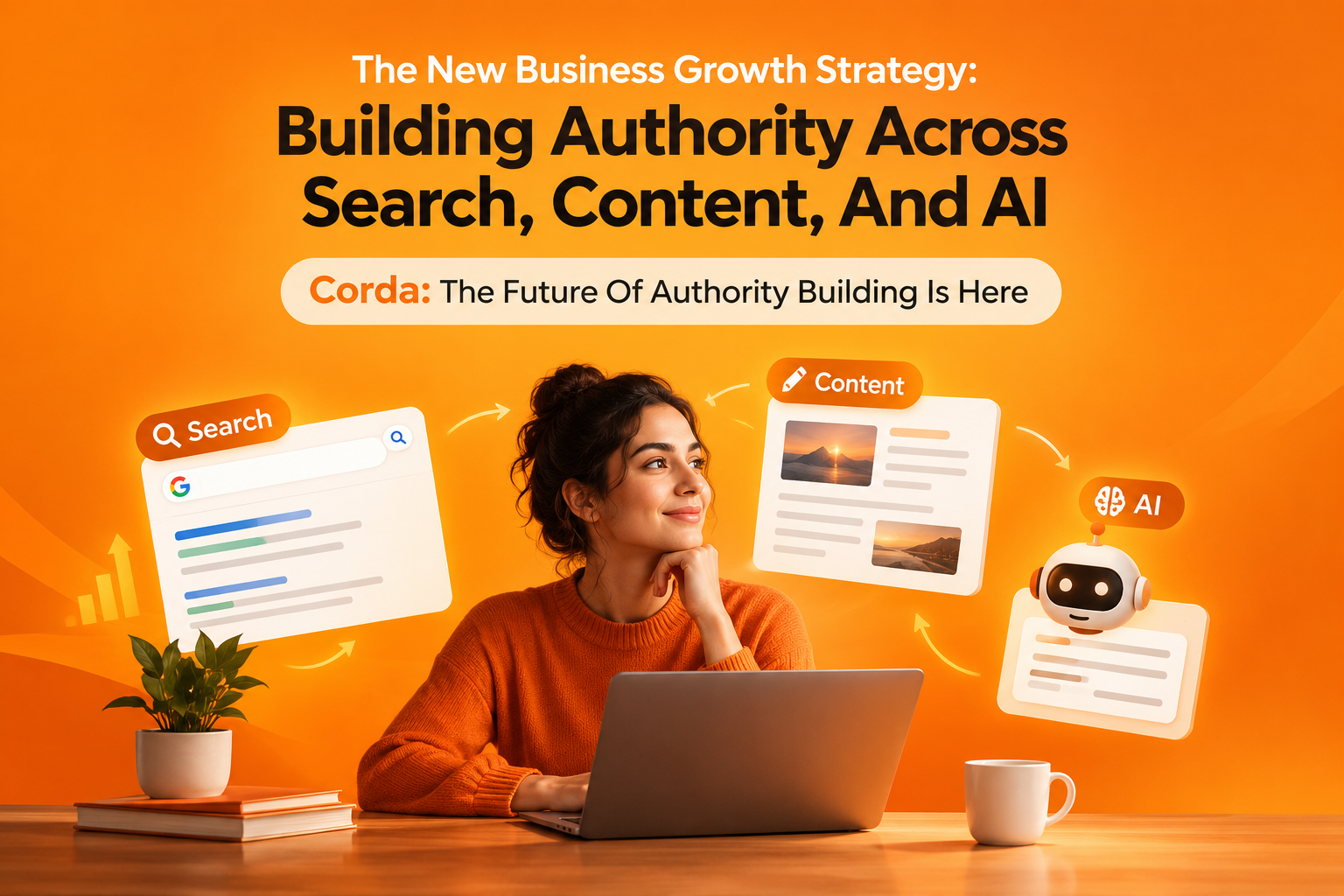
That is where the next stage of digital business growth is taking shape. Explore Corda, the one-stop SaaS platform helping businesses build authority across search, content, and AI.
Search Visibility Is Becoming A Business Asset
Search visibility has always been directly connected to online growth.
A business that appears when potential customers search for its products or services can attract attention before competitors do.
However, visibility isn't created by a single ranking factor.
A website can publish hundreds of articles and still struggle to establish strong website authority.
Another business may have fewer pages. But it can have a stronger presence across relevant publishers, industry discussions, search results, and third-party sources.
Simply put, it is a significant difference that all Corda clients should note.
Modern authority building increasingly depends on understanding the full environment around a business. The areas that matter the most are:
- Where does the company currently appear?
- Which competitors receive stronger coverage?
- What topics does the business own?
- Which publishers already discuss the company or its industry?
- Where are competitors receiving relevant editorial coverage?
- Which authority signals are missing?
And, increasingly, does the brand appear when customers ask AI systems questions related to its market?
These questions move SEO away from isolated metrics and toward a more connected view of business visibility.
ContentRally's recent coverage of the changing relationship between SEO and GEO reflects this broader shift.
Traditional SEO remains important, while AI-driven discovery introduces another layer involving citations, relevance, third-party sources, and visibility within generated answers.
Check out this post to find out how SEO and GEO are changing business discovery
Content Alone Does Not Create Authority
Content remains a foundation of online growth. Businesses need useful pages, product information, expert resources, guides, case studies, and content that answers customer questions.
But publishing more doesn't automatically make you more authoritative. In reality, the surrounding signals matter.
Consider two companies competing in the same industry. Both publish detailed content about their products. They also target similar keywords. Even both maintain technically sound websites.
However, one of them is:
- consistently mentioned by relevant industry publications
- receives editorial coverage from trusted websites
- has strong topical connections across its content
- appears in discussions surrounding important industry entities
The other primarily talks about itself on its own website. Simply put, the difference isn't just the amount of content.
It is the context surrounding the content.
This is where concepts such as topical authority, editorial authority, brand authority, and link authority become increasingly useful.
They help businesses think beyond individual pages and understand how they establish reputation and relevance across the wider web.
This is also why a backlink should not automatically be treated as the objective of an SEO campaign. So, here is the question that potential clients of Corda should actually ask:
“What role does this placement play in the authority strategy?”
From Link Building to Authority Building
Link building has traditionally been treated as a numbers game. We have been focusing on parameters like:
- How many referring domains do competitors have?
- How many backlinks can we acquire?
- What is the domain rating of a potential publisher?
These metrics are actually useful. But they don't tell the whole story.
A relevant editorial placement can have a different strategic value from a random link on a high-metric website.
A publisher that consistently covers a company's industry may contribute a different signal than a publication with impressive metrics but little topical connection.
This is where concepts such as serp insight link insertion become more meaningful when placed inside a broader strategy.
A serp insight link insertion opportunity should not simply be viewed as another URL to acquire. Evaluate it by relevance, target page, topic, audience, publisher quality, competitor coverage, and the authority gap the campaign is designed to address.
That distinction can separate an activity-driven SEO campaign from a strategy-driven one.
ContentRally has previously explored the importance of SEO tools and competitor analysis for understanding search performance.
The next step is connecting those measurements with the decisions businesses make about where and how to build authority. SEO tools, competitor analysis, and modern search strategy
The Business Case for Better Publisher Decisions
For businesses, authority building can quickly become difficult to manage.
A marketing team may have thousands of potential publishers to evaluate. An agency may be managing several clients, each with different industries, audiences, markets, competitors, and budgets.
A spreadsheet can organize the information. It cannot necessarily explain the strategy behind it.
This is one reason businesses are moving toward more intelligent approaches to publisher discovery.
A serp insight link insertion opportunity can be useful when it answers a specific business question:
- Is this publisher relevant to our audience?
- Does it strengthen our topical coverage?
- Does it support a page that matters commercially?
- Is the authority gap solved?
- Does the publisher make sense within the wider competitive landscape?
The same principle applies to quality link building. Quality should not simply mean “high DR.” It should include fit. I mean fit with the business, topic, audience, target page, and the campaign objective.
That is a much more useful way to think about authority.
AI Is Expanding the Definition of Visibility
The rise of generative search gives businesses another reason to rethink authority. Customers can now ask AI systems questions that previously required several searches.
- Instead of searching for ten individual websites, a buyer might ask an AI system:
- “Which companies provide this service?”
- “What are the best tools for this problem?”
- “Which brands should I consider?”
- “How does this company compare with its competitors?”
For businesses, visibility in these environments can mean more than having a page that ranks for a keyword.
Information about the business across the wider web can become part of the discovery environment.
This is where the AI visibility you build with Corda matters most.
Businesses need to understand not only whether their own website is optimized, but also whether their brand has enough relevant, consistent, and trustworthy signals across the web to support broader discovery.
Citations, publisher coverage, brand references, topical relevance, and authoritative third-party information can all become part of that environment.
The goal is not to abandon traditional SEO. It is to build on it.
Corda Brings the Authority Workflow Together
This is the problem that Corda will be addressing.
Corda is the one-stop AI platform for enterprise authority that helps marketing teams analyze authority gaps, discover publisher opportunities, build campaigns, and measure authority-related progress across Google and AI search.
Its platform connects website analysis, competitor intelligence mapping, precise publisher discovery, campaign execution, and tracking into a 360° authority workflow.
Instead of treating every backlink opportunity as an isolated task, Corda starts with context.
A business can analyze its website and competitors, identify an Authority Gap connected to its search objective, prioritize opportunities, and then build a campaign around those findings.
That makes a serp insight link insertion opportunity part of a larger decision-making process.
The platform also works alongside existing SEO tools rather than requiring teams to abandon them.
Businesses can continue using established platforms for keyword research, rankings, traffic, backlink research, competitor analysis, and technical SEO while using Corda to connect those insights to authority strategy and campaign execution.
That distinction is important for businesses that have already invested heavily in their SEO infrastructure.
Corda is not positioned as another disconnected dashboard. It is designed to connect measurement with action:
Measure → Understand → Find the Gap → Prioritize → Build → Track → Reassess
Authority Needs To Be Specific To The Business
There is another important shift here. No single authority strategy works equally well for every business.
A SaaS company entering a new market may need to strengthen its topical presence. A financial services company may need stronger editorial coverage. Again, an established ecommerce business may need to improve authority around specific commercial categories.
An agency may need completely different strategies for each client.
That is why Corda's workflow keeps the campaign connected to the individual business, target page, competitors, topic, market, and objective. Its publisher recommendations are based on campaign context rather than simply producing a generic list of domains.
This approach also changes how teams can think about serp insight link insertion.
Instead of searching for placements because a competitor has a link there, marketers can evaluate whether the opportunity contributes to the authority goal they are actually trying to achieve.
That is a more sustainable way to approach link acquisition.
The Next Growth Advantage Is Connected Visibility
Business growth has always depended on being discovered.
What is changing is how many places discovery happens.
Google remains important. Publisher websites remain important. Again industry content remains important. And brand references remain important.
And AI-powered discovery is becoming another environment businesses need to understand. This creates an increasingly connected growth model in the form of Corda:
- Content creates relevance.
- SEO creates discoverability.
- Authority connects the signals.
- Publishers create third-party context.
- AI expands where that authority can influence discovery.
For businesses, this means digital growth cannot be reduced to a single metric.
Domain metrics can provide useful context. Rankings can show search performance. Backlink analysis can reveal competitive differences. Traffic can indicate demand.
Corda Went Live Today At 12 PM
Corda officially went live today at 12 PM, bringing its authority intelligence and campaign workflow to businesses and aspiring marketing teams looking for a more connected approach to search growth.
The launch comes at a time when the boundaries between SEO, content, digital PR, publisher relationships, and AI discovery are becoming increasingly connected.
For businesses, that creates a new opportunity.
Rather than asking how to produce more content, acquire more links, or chase another ranking metric in isolation, they can find out what authority does their business needs to build next.
Corda is designed around that question.
From analyzing competitors and identifying authority gaps to discovering relevant publisher opportunities and tracking campaign progress, the platform turns authority building into a structured workflow.
For teams interested in understanding how that process works in practice, Corda's recent guides cover everything from using Corda with an existing SEO stack to managing authority campaigns across multiple clients and improving the quality of publisher recommendations.
- Getting Better Corda Recommendations
- Using Corda With An Existing Seo Stack
- Managing Authority Campaigns Across Multiple Clients
After Corda, the future of business growth will not belong to companies that simply publish more or collect more links.
It will increasingly belong to businesses that understand where their authority stands, where the gaps are, which opportunities matter, and how those signals connect across search and AI.
That is the idea behind Corda. And starting today at 12 PM, millions will share that idea through the live platform.