











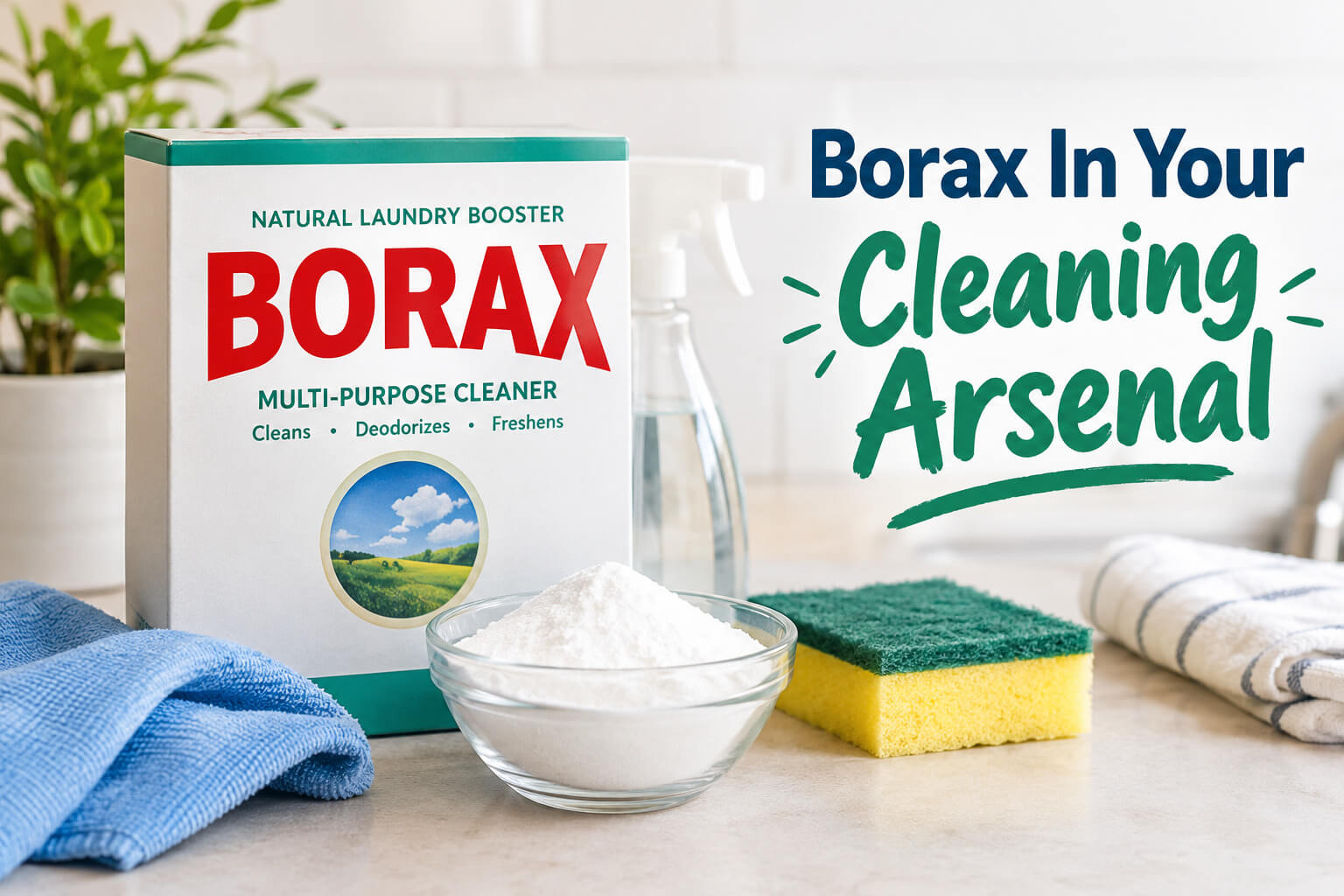
Honestly, borax has been sitting under people’s kitchen sinks for ages. Moreover, there is a pretty simple reason for that.
It is cheap, can be bought anywhere, and actually works when you’re dealing with the right kind of mess.
However, just like any other cleaning product in your cabinet, borax cleaning has some major limitations.
Most people don’t realize this until they have already spent an hour scrubbing their fingers to the bone for zero results.
If you figure out exactly when to use it and when to leave it in the box, you are going to save yourself a ton of cash, time, and pure frustration.
This overview of borax cleaning best practices reveals not just how to use borax correctly, but more importantly, when something else is the smarter choice.
What It Actually Cleans
First, you need to think of borax as a specialist, not a cure-all.
Chemically, it’s a mild alkaline salt.
Because of that, it’s absolute magic at breaking down mineral deposits and wiping out gross bathroom soap scum. Additionally, it helps in softening up hard water, actually letting your laundry detergent do its job.
Plus, it has a tiny bit of grit to it. So, it acts like a gentle scrubber that won’t scratch up your plastic tubs or tile.
But What It Totally Bombs At
However, here is where things go sideways.
People assume that because it fixed one stain years ago, it can clean anything. But here is the bottom line: it cannot.
If you try to use borax on greasy kitchen backsplashes, oily bacon splatters, protein stains, or active mold, you are going to get annoyed.
Moreover, it just was not built for that.
No matter how much extra powder you dump on the counter or how long you let it sit there, you cannot force an alkaline salt to dissolve grease.
Basically, it's just simple chemistry. The main issue is that it works so brilliantly on bathroom grime that everyone assumes it should work on kitchen grease too.
That’s a fast track to wasting your entire weekend.
Four Huge Mistakes That Are Wasting Your Time
Take these mistakes into consideration when it comes to borax cleaning.
First: Using It Dry
First of all, you need to stop using it dry.
Borax completely relies on water to activate and get to work. If you just sprinkle the dry powder onto a dirty countertop, you are basically doing nothing.
You have to dissolve it in warm water or mix it into a thick and wet paste to activate the compound.
Second: Mixing It With Vinegar
Next, please stop mixing borax with vinegar.
This is probably the biggest fake cleaning hack on social media right now.
Here is the thing: Borax is alkaline. On the other hand, vinegar is acidic. Think of seventh-grade chemistry.
When you dump them into the same bucket, they literally cancel each other out. Moreover, you just end up making a bowl of slightly salty water that is way weaker than either ingredient would be if you used them alone.
The next time you are scrubbing a tub, try using borax and water instead.
Conversely, for dissolving hard water scale, use vinegar and don't mix them.
Third: Guessing Measurements
You cannot just guess the measurements. The strength of your mix matters a lot. A single tablespoon mixed in a gallon of water is perfect for wiping down walls or tossing into the wash.
But if you're trying to clean a heavily crusted shower door, you will be scrubbing forever.
Flip that around, and using a super strong mix on an everyday counter is just total overkill and might irritate your skin.
Fourth: Letting It Sit On Your Counters All Day
Finally, don't let it sit on your counters all day.
With some chemical cleaners, letting it sit for hours means less scrubbing for you. Borax doesn't work that way.
It does its job fast, which is usually in about ten to fifteen minutes tops.
Leaving it on a surface for an hour won't make it cleaner. Accordingly, it just dries out into a nasty, chalky crust that is incredibly brutal to rinse off.
When To Grab It And When To Leave It Behind
If you are dealing with a bathroom covered in hard water film and soap scum, borax is your best friend. The alkaline cuts right through those crusty mineral buildups and is also a super cheap way to boost your laundry.
This is especially true when your house has hard water.
However, remember to keep it far away from your stove. Cooking grease needs a real degreaser instead of just alkaline salt.
Moreover, it would not do anything for fresh food spills such as coffee, juice, or dropped eggs.
Those need immediate attention from standard dish soap or enzyme cleaners. And even though it has some minor germ-killing properties, it is nowhere near strong enough to wipe out active mold or deep mildew.
You need bleach or an actual mold killer for that. Also, if you're trying to get sticky tape or sticker residue off a mirror?
Pass on the borax. It won't dissolve adhesive; you need an oil or a solvent for that.
The Guest Bathroom Scenario
Let’s say you’re deep cleaning a guest bathroom. The shower glass has that cloudy, hard-water haze, there’s a ring around the tub, and the grout looks pretty dingy.
This is the perfect moment for borax. Mix a cup into a gallon of warm water, spray it everywhere, wait fifteen minutes, and wipe it down.
The mineral buildup will lift right off.
But if that same bathroom has a sticky, greasy film on the exhaust fan from kitchen steam drifting down the hall, borax isn't going to fix it.
You have to switch over to a degreaser for the fan and maybe an acid-based cleaner if there's rust in the sink.
That is why pros use a bunch of different products in one house. One single box cannot fix every problem.
Work Smarter, Not Harder
Don't even bother buying borax unless you actually have hard water or major soap scum issues.
If your water is soft, it’s just going to sit in your cabinet taking up space. When you do use it, always dissolve it in warm water first, so it actually activates and doesn't leave a gritty mess.
Match your recipe to the grime, never mix it with vinegar, and always rinse the surface with clean water when you’re done so you don't leave a dull film behind.
At the end of the day, borax is an awesome tool, but it's just one piece of the puzzle. The idea that it's a universal cleaner only exists because it's so good at fixing common bathroom issues.
But treating it like a miracle worker is only going to stress you out.
Just look at the mess first: if it's minerals or soap scum, grab the borax. If it's grease, glue, or mold, save your energy and use something else.