




The Cross Market AI Scam Exposed: Here’s All You Need To Know To Stay Safe

Published on: 21 January 2026 Last Updated on: 18 June 2026
Cross Market AI

I am sure you all have realised this by now: AI is restructuring the entire world as we speak. Forget the world, I am sure it's on its way to reshape the goddamn Cosmos! 

I am still not sure whether placing AI on the pedestal and putting it out as a solution to EVERY single issue is a wise decision or not.  

When it comes to the financial industry, it’s important to be careful about what sounds too good to be true.  

This is where Cross Market AI comes in. The platform claims it can offer returns of about 1% every day. 

How? Well, as Aseem Juneja wrote in his blog, it uses automated strategies and AI for market trading.  

This promises a steady income. So, this can be appealing in an uncertain market.  

However, this raises important questions about safety and honesty. Investors need to think carefully.  

Can we trust these claims, or is it just hype? In this article, I will examine Cross Market AI and what it promises. 

I will also give you guys a fair idea of how it works and the risks involved. I have curated this blog in a certain way to help you make an informed decision. 

Let us delve into the broader context of this platform and discuss possible solutions for users who may face challenging situations.

Cross Market AI Is A Pyramid Scheme In Disguise 

All of us have seen the platform claim its profits come from high-speed exchange arbitrage. 

However, its official compensation structure reveals a complex 30-level referral network designed to trap capital: 

Revenue Type  Mechanics & Distribution Details 
The Bot Fee Split The $125 upfront license fee is immediately broken up to pay commissions to promoters. 
Referral Income Direct affiliates receive a flat $10 bonus for every new member they recruit into the pool. 
30-Level Payouts Commissions scale down across 30 tiers, taking up to 20% of all platform "profits" to feed the upper pyramid. 
The Fuel Fee A heavy 25% "service charge" is deducted from user dashboards under the guise of API and automation costs. 

When user dashboards show a balance, it is often a notional, fake number.  

The actual money paid out to older investors comes entirely from the deposits made by newly recruited members. 

Is Cross Market AI Legal In India? 

Cross Market AI operates without any regulatory approvals.  

So, this immediately makes it unlicensed to conduct business or collect funds within India.  

The Securities and Exchange Board of India (SEBI) and the Reserve Bank of India (RBI) have issued multiple warnings against such platforms. 

In fact, we receive regular message alerts, warning us against any unregulated AI-driven trading applications. 

Cross Market AI is one such scammy unauthorized offshore forex broker.  

In addition, Cross Market AI is an unlisted and unregulated platform. 

Also, it is not available on official ecosystems such as the Google Play Store or Apple App Store. 

Therefore, you have no legal protection if the platform unexpectedly ceases to process withdrawals.

How Can You Report Cross Market AI?
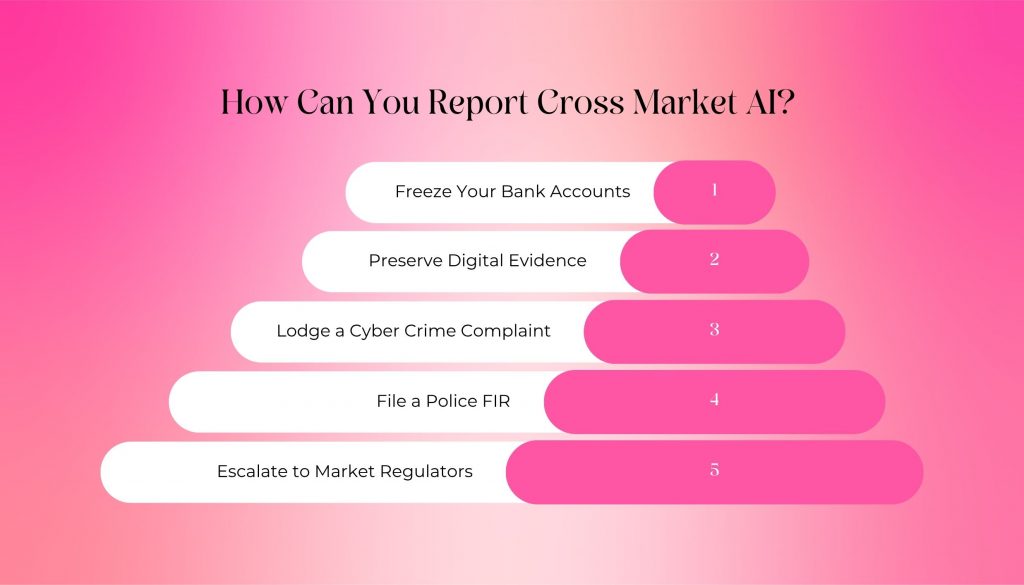
This section will be useful to you if you find yourself in a situation where your funds are inaccessible. 

In fact, it will also come in handy when your Cross Market AI dashboard is malfunctioning. 

It’s essential to take immediate action to enhance the likelihood of recovering your assets.  

Here are the steps you should follow: 

1. Freeze Your Bank Accounts 

Contact your bank’s fraud hotline right away to freeze your accounts.  

Additionally, you must halt any automated payments associated with the platform. 

2. Preserve Digital Evidence 

Ensure you take clear screenshots and video recordings of your dashboard balances. 

Also, you must have records for your deposit transaction hashes and cryptocurrency wallet addresses, particularly for USDT transfers.  

Also, save all communications, such as WhatsApp or Telegram chats with any promoters. 

3. Lodge a Cyber Crime Complaint 

Visit the Government of India's National Cyber Crime Reporting Portal. Here, you have to file a formal digital fraud complaint. 

4. File a Police FIR 

Go to your local police station to file a First Information Report (FIR) under Section 420 (Cheating) of the Indian Penal Code (IPC).  

Bring along your cybercrime complaint receipt and relevant financial statements. 

5. Escalate to Market Regulators 

Compile your documentation and submit it to the SEBI SCORES Portal.  

Additionally, report the illegal deposit-taking activity to the Reserve Bank of India (RBI) through their Sachet Portal.

Final Verdict: Should You Invest In Cross Market AI? 

When evaluating various platforms, it is common to encounter both advantages and disadvantages.  

Cross Market AI, in particular, has garnered attention from users due to a recurring issue: unexpected malfunctions where the platform ceases to operate.  

This situation raises concerns that some users may be facing challenges indicative of a potential scam. 

Understanding the platform's core features is essential for informed decision-making.  

While many blogs emphasize the benefits and functionalities of Cross Market AI, it is crucial to approach this information with a critical mindset.  

My goal is to provide a balanced perspective, highlighting both the positives and the concerns that users have reported, allowing you to make a well-informed decision. 

I would strictly dissuade you from investing in this platform. There are many more credible platforms that will make your investment worth it. 

All the information I have on this platform points towards the undeniable fact that this one is a huge risk, one not worth taking.


Barsha is a seasoned digital marketing writer with a focus on SEO, content marketing, and conversion-driven copy. With 8+ years of experience in crafting high-performing content for startups, agencies, and established brands, Barsha brings strategic insight and storytelling together to drive online growth. When not writing, Barsha spends time obsessing over conspiracy theories, the latest Google algorithm changes, and content trends.

View all posts

Leave a Reply

Your email address will not be published. Required fields are marked *

Related

Content Marketing Tips For Better Results

Content Marketing: Tips For Better Results

Content marketing has been around for quite a long time, and it is the go-to marketing strategy for many businesses nowadays. But everybody uses it, and the results they get are more or less along the same lines…in terms of the time they take to materialize. What if you’re looking to get better results from your content marketing endeavors? What if you want to do some smart work rather than hard work? In this post, let’s take a look at some answers to this question. What Is Content Marketing? Content marketing is basically defined as the type of marketing that involves creating and publishing/distributing content to a certain audience. The purpose of distributing this type of content is to increase awareness of the product/services so that they can be sold more. While “content,” in this context, refers to the content of all types, mostly written stuff is utilized for marketing purposes. This type of marketing takes different shapes and forms. Some people can engage in content marketing by writing and publishing blogs regularly. Others can utilize their product pages as a medium to engage in marketing, i.e., by making the descriptions and the visuals, etc., appealing and attractive. Actually, instead of mentioning them here somewhat haphazardly, let’s look at some of the content marketing methods in detail before moving on to the tips. What Are Some Common Methods Of Content Marketing? Here are a few of the common ways in which content marketing is employed. Blogs: Blogs, especially when created by a professional writing service, have a key role that goes beyond just advertising products or services. Their main goal is to educate and engage readers. This approach helps grow a brand's readership and audience. By providing valuable and informative content, the brand naturally attracts more people. This isn't just a marketing strategy; it's about genuinely helping readers. As more people find the blogs helpful, they start to trust and follow the brand, leading to increased business opportunities. With the help of a blog writing agency such as Compose.ly, brands can consistently deliver high-quality content that connects with their audience. Emails: Email marketing is technically a marketing strategy on its own, but since it almost always utilizes content of some sort, it can also be mentioned in content marketing. In an email marketing campaign, individuals are reached out separately by the brand. These emails can either inform the recipient about some sort of new product release, a sale or a special discount, etc. Newsletters: Newsletters are technically emails, but they are not like other messages that are typically used and sent in an email marketing campaign. While the latter, for the most part, directly promote the offerings of a brand, newsletters are geared toward educating the readers. You can think about them to be a type of hybrid between a blog and a typical email marketing message. E-books: While this one is a more elaborate step than what brands usually do, it is a good way to engage in content marketing. Now, with all that out of the way, let’s take a look at some tips that you can follow to get better results from your content marketing endeavors. Tips For Getting Better Results From Content Marketing As we mentioned earlier, while content of all types can be employed in content marketing, written content is the most common…and perhaps the toughest to create. That is why our tips will be geared towards it in particular. Don’t Write Like A Robot, And Don’t Write For Robots In that rather wordsmith-is line, we’ve summed up one of the most important principles of writing online content. Firstly, when you write content for marketing purposes, be it of whatever type and kind, you should make sure that your tone is friendly, communicative, and human-like. Mind you, there are exceptional cases where a totally opposite tone would be more suitable, but we are talking about the common cases here. This is what we mean by not writing like a robot. Here is what you can do to make your writing tone fall into this criterion. Of course, depending on the situation at hand, some of these tips may not be very applicable. Try and refer to the reader as “you” and yourself as “I” or “we.” This is one of the basic and simplest ways to make your tone look more natural and human-like. Since you have to make your written content look more like a conversation than a piece of written text, you should reduce your overall use of passive voice. People hardly use passive voice when they speak. I mean, I could have just said, “The passive voice is hardly used by people when they speak,” but I did just make my point. Keep sentences short. Keeping your sentences short can also give a natural touch to your writing and make it more reader-friendly. The second part of our tip was Don’t write for robots. We should actually clear this up a little before moving on. Nowadays, a lot of content marketing is done via search engines. When people write blogs, they channel them to their readers via search engines. The same goes for a lot of other types of content, like product descriptions and e-books, etc. Now, in a bid to make their content look nice to the search engines, a lot of people can end up making it look too mechanical, erratic, and awkward for human taste. Consider the following example: We offer the best ramen in Tokyo. Our quality ramen store in Tokyo is very good. Buy quality ramen near me in Tokyo. (Note the atrocious keyword usage) Good content? For the search engine, maybe. For the reader? It’s just gibberish. You have to avoid doing this sort of stuff when writing content for your audience. You should strike a balance between making the content appealing for SEs as well as your human readers. Do Proper Research…And Use It When it comes to content marketing materials such as blogs and newsletters, your aim should be to provide reliable and educative content to your audience. This can only be done if you do proper research and then utilize it when writing the content itself. In this part, let’s look at how you can do research properly and what benefits you can get from it. Here are some things that you can do for effective research: Look for popular and reliable sources on the internet. Before you start gleaning information from anywhere, you should establish its reliability first. Once done, be sure to find out relevant facts and figures to add to your content. This tip is, of course, subjective. In some types of content, adding facts and figures may not be very suitable. However, it can be a good idea in things like blog posts, emails, and the like. If you find yourself in a situation where you have to use some material from a source verbatim in its actual form. (More important than implementing theoretical and conceptual information is the utilization of the data you get from audience research. In other words, you should conduct audience research and then use the details that you find to adjust your content as per the needs of the audience. When we say “audience research,” we basically refer to using analytical tools to find out necessary information and details about your audience, such as the details about their age, gender, location, and so on.) Now let’s look at what benefits you can get by doing and incorporating research into your work. Authority: When your content is backed with research, it comes off as authoritative. For example, when you present a stat for a certain situation or occurrence, it looks more grounded as compared to an opinionated guess. Up-to-date information: Conducting research can also get you in touch with up-to-date information. By not researching your material before writing it, you can get stuck with old, outdated information that can neither help you nor your readers. Value: When your content is based on research, it provides value to your readers. For problems, it can provide solutions. For choices, it can provide expert opinions. This sort of content is a lot more potent in building a better readership and for growing your brand. Aim For Content Perfection Perfection is not attainable, but if we chase perfection, we can catch excellence. Vince Lombardi It’s a bit of a dramatic way to start off this heading, but it does make the point that we want. No content is perfect because perfection (least of all in written content) is not achievable. But if you aim for the bullseye, you can land somewhere close to it. That is why you should make all the effort possible to remove all types of imperfections from your content. Grammar errors: Grammar errors are by far the most common and most harmful errors that you can make in your content. You should be proactive about avoiding such errors during the writing phase. And once you do write the content, you should take steps like proofreading the content and using an online grammar checker to weed out the remaining ones. Clunky readability issues: Readability issues, such as confusing words, long-winded sentences, and weird phrase choices, can also adversely affect the quality of content. you can remove these types of imperfections from your content by using an online AI-driven paraphrasing tool. A good AI paraphraser can improve the readability of the provided content during the rephrasing process. Plagiarism: Plagiarism is like the diamondback of content imperfections. You can’t spot it quickly enough, and it can kill the quality of your write-up without you realizing it. Removing this imperfection is necessary and tricky at the same time. The best way to go about it is to use an online plagiarism checker and then analyze the results to take the steps you need. Conclusion A lot of brands do content marketing nowadays. But, to bring yourself a cut above the others, you have to follow some best practices. We’ve outlined a few of those in the post above. Read Also : How To Monitor The SEO Health Of Your Website Best SEO Tools For Ranking The Website Get A Return On Investment With Your SEO

READ MOREDetails
SMS Marketing

Mistakes Entrepreneurs Should Avoid When Using SMS Marketing

SMS marketing has become increasingly popular for entrepreneurs to reach out to their target audience and boost sales. However, like with any form of marketing, there are mistakes that entrepreneurs should avoid when using SMS marketing if they want it to be successful. This blog post goes over the most common mistakes entrepreneurs make when using SMS marketing software and how they can fix them. So read on to learn more about SMS marketing! Not Having a Clear Objective One of the most common mistakes entrepreneurs make when using SMS marketing is needing a clear objective. Before sending out any message, you should have a goal that you would like your message to achieve. Are you trying to increase brand awareness? Are you looking for increased sales? By setting clear objectives before sending messages, you can craft messages tailored toward achieving those objectives. Not Having Clear Messaging Guidelines Another mistake entrepreneurs often make does not have clear messaging guidelines before launching an SMS campaign. Without these guidelines, it’s difficult for entrepreneurs to measure the success of their campaigns and ensure that all messages sent out are consistent with each other and the company’s overall branding and messaging strategy. It’s essential to establish a set of guidelines that outlines how often messages should be sent out, what type of content should be included in each letter, who should receive each piece of news, etc. so that all messages remain consistent and on-brand throughout the campaign. Not Getting Permission from Recipients The law requires companies to get permission from recipients before sending them promotional or transactional text messages. Please do so to avoid legal issues and a poor reputation among your customers. To ensure compliance with this law, companies need to provide customers with options on how they can opt in or opt out of receiving text messages from the company at any time during their relationship with the company. This ensures that customers always have control over whether or not they want to receive text messages from your company and helps protect both parties from potential legal issues or reputational damage in the future. Not Testing Messages Before Sending Them Out It’s also essential for companies to test their text messages before sending them out en masse so as not to send out incorrect or incomplete information, which could lead customers astray. Before sending out any message, companies should test it thoroughly by testing different versions of the same message until they find one that works best for their audience and goals. This will help ensure accuracy and consistency throughout all aspects of your SMS campaign while also helping you avoid potential pitfalls such as typos or incorrect information being sent out in your messages which can lead customers astray or give them a negative impression of your brand. Conclusion: SMS marketing effectively enables entrepreneurs to reach their target audience and boost sales. Still, there are several mistakes entrepreneurs need to avoid when implementing an SMS campaign if they want it to succeed. Companies must have a clear objective before launching a campaign and setting up clear messaging guidelines. Hence, as not keep track of its effectiveness over time while ensuring consistency across all aspects of its communication strategy with customers. Additionally, companies need to get permission from recipients before sending them promotional or transactional text messages to stay compliant with laws regarding texting campaigns and protect their reputation among customers. Finally, companies must test their text messages before sending them out en masse to avoid sending wrong information, which could lead customers astray. By avoiding these common pitfalls, businesses can maximize the success potential of their SMS campaigns. Additional: What Is SMS Gateway And How It Works Exploring The Different Types Of Digital Marketing Strategies Get More Installs: Which Extensions Can Help Drive Installs Of Your Mobile App? A How-To Guide For Every Entrepreneur – How To Use Unified Communications

READ MOREDetails
digital marketing consultant

Why Should You Hire a B2B Digital Marketing Consultant?

With the growing trend in the domain of digital marketing, if you want to stay ahead in the competition, it is suggested to hire a b2b digital marketing consultant. Hiring a consultant is often the best thing for the business if you are looking to have the best outcomes. With the growth of digital marketing, it has become important to not miss out on the train and catch the growing market. It has become a necessity since your competitors are already utilizing the best features of digital marketing to win the market share. As we have known how important digital marketing is to your firm, it is important to know the added benefits of having a consultant. Knowing what they bring to the table is very important for heading in the right direction. Perks of having a B2B digital marketing consultant on-board Every B2B business needs to understand that there is immense scope for growing online. A good and credible b2b marketing agency can make a world of difference when it comes to reaching new customers and increasing sales figures. They can help you optimize your verticals and plan campaigns in a manner that delivers the best results. The value that a consultant adds to the firm is unmatchable. Often regarded as the jack of all the trades, the consultants from the best universities bring forward huge experience. The added network effect along with the rich know-how about the latest technologies is why you must hire them. Instead of focussing only on immediate growth, the consultant's primary focus is to create a niche and a brand image for your firm. More than just providing the solution, they provide a long-lasting result to your firm, that enhances the image of your firm. To explore more into the benefits of a digital marketing consultant, let us understand them in detail. Growth Hacking: If you are looking forward to having a growth hacker in your team, there is no better alternative than a consultant. With the rich experience across all the domains, it is very necessary to have them on your team. They also bring into the varied culture and the unique factor of learnings from across the globe that enhances your team’s outlook. Short term goal achievement: You can easily achieve the short-term goals if you are well equipped with the best consultant. If you are not having the best consultant; you might miss out on the short-term vision and fail to capture a larger market share. Staying with the trend: Having a consultant is often the best way to implement the latest trends in the domain of digital marketing. If you are looking forward to capturing the market share, it is often recommended to be the first mover. Having the first-mover advantage will let you attract more consumers. It shall reduce the monopoly of your competitor thus keeping you ahead in the curve. Knowledge of every market: Do you know why consultants are one of the highest-paid professionals? It is because of their extensive knowledge about the outside world. Having outside knowledge about real-world happenings makes them unique in a lot of ways. They have been employed in different companies which have a wide range of cultural variation. It gives them the eye for scrutiny and a critical view of the organization. Having a consultant in your team can lead to hijacking the market and eventually increasing the customer share. If you are looking to improve your firm’s standing, you must not hesitate to hire a digital marketing consultant. Omnichannel B2B Marketing (...Yes, You Might Have to Do It All)  In today’s fast-moving digital landscape, one marketing channel alone simply won’t be enough.    You’ve got to be everywhere!   I mean everywhere!   This includes mail, social media, search engines, content platforms, and beyond.   This is what we call omnichannel marketing. It’s not just a trend anymore; it is a means of survival in the digital world.   It's a must to keep up with your competition. But here’s the thing: it’s a lot harder than it seems. Especially if you do not have a consultant by your side!  Align Your Channels   Omnichannel marketing is all about achieving a consistent and seamless experience for your customers. No matter what platform or channel they’re connecting with you on.    Whether they come across your business on LinkedIn, read one of your blog posts, or receive an email from you, the communication should be similar.   It needs to feel like a single conversation with your brand. Simple right? Not so much, and here is why!  Keeping Everything Connected  The trickier part is making sure everything connects. If your social media messaging doesn’t mesh with what’s in an email, or if the branding on your website doesn’t align with the display ads you create, it can throw potential leads off.   In fact, it can also make it much more difficult to attract new business. Since your own brand looks half-hearted, how can you take care of another brand?  That’s where having a strategy that spans all these platforms comes into play. It’s not just about being active in a lot of online channels – it’s about keeping them talking in the same voice.   The Experience NEEDS to be Seamless  When people click on your LinkedIn ad and then land on your website, if it’s not the same feeling that they got from the ad, you might lose them. They might just bounce to another competitor of yours! Yes, the competition is tough.  Omnichannel makes each platform transition feel native. Meeting your customers where they are and walking alongside them through their journey is crucial.   Only then will you be able to show that you are not just selling something, but rather creating an experience!  Focusing on Key Platforms   Now, you might be thinking!  “Do I really need to be on every platform?”   The answer is yes — and no. Depending on who your target audience is and what you are planning to achieve through your channels.   For example, you don’t have to stretch yourself too thin. If you are a B2B service that deals with a logistic niche, you do not need an account on Pinterest. No client of yours is reaching out to you over Pinterest!  Finding the target audience, and the right platform is what a B2B consultant is an expert at! So, hire one as soon as possible!  Focus on the platforms that matter most to your target audience. For B2B businesses, this might mean prioritizing LinkedIn, email campaigns, and targeted content marketing.   But don’t ignore emerging channels. Depending on your niche, there could be opportunities in areas you haven’t explored yet.   Finally - Do Not Overwhelm Yourself!  It can seem very overwhelming when you first start with omnichannel marketing. But you don’t have to do it all at once.   First, figure out where your audience is and start there… and slowly expand as you become more comfortable. The key here is to stay consistent and not try to be everywhere. This is why hiring a B2B digital marketing consultant is crucial.  They are the ones who make you understand that -  “Omnichannel success is a marathon, not a sprint.”  Read Also: Why Email Marketing is the BEST Digital Marketing Outreach in Singapore When Will Social Media Addiction Be Considered a Mental Health Condition?

READ MOREDetails