




How Content Creators Are Using Video To Video AI to Repurpose Best Content? 

by

29 June 2026

Blog

How Video To Video AI Works

Every content creator has a backlog problem. 

Somewhere in their archive are videos that performed well, covered genuinely useful topics, and attracted real audience engagement. 

But they are now underperforming because they look dated, were recorded before the creator developed their production quality, or are simply buried under two years of newer uploads. 

The instinct is to remake them from scratch, which rarely happens because it is equally time-consuming as making something new.

Video-to-video AI has introduced a different approach: transforming existing footage rather than replacing it. 

Moreover, the ability to restyle, reformat, and repurpose video content using AI has changed the economics of content libraries in a way that's worth understanding.

And this is true for everyone, whether you're managing a YouTube channel, a brand's social media presence, or a portfolio of educational content.

On that note, let’s break down how video to video AI works and, more importantly, highlight how content creators are using this innovation to repurpose their content.

Stay tuned. 

How Video To Video AI Works?

The core capability of video-to-video AI is style and format transformation.

The point is to take an existing video and adjust its visual treatment, pacing, aspect ratio, background, or overall aesthetic without requiring a complete reshoot. 

This is different from basic editing, which trims and rearranges existing footage. In contrast, video-to-video AI alters the character of the footage itself.
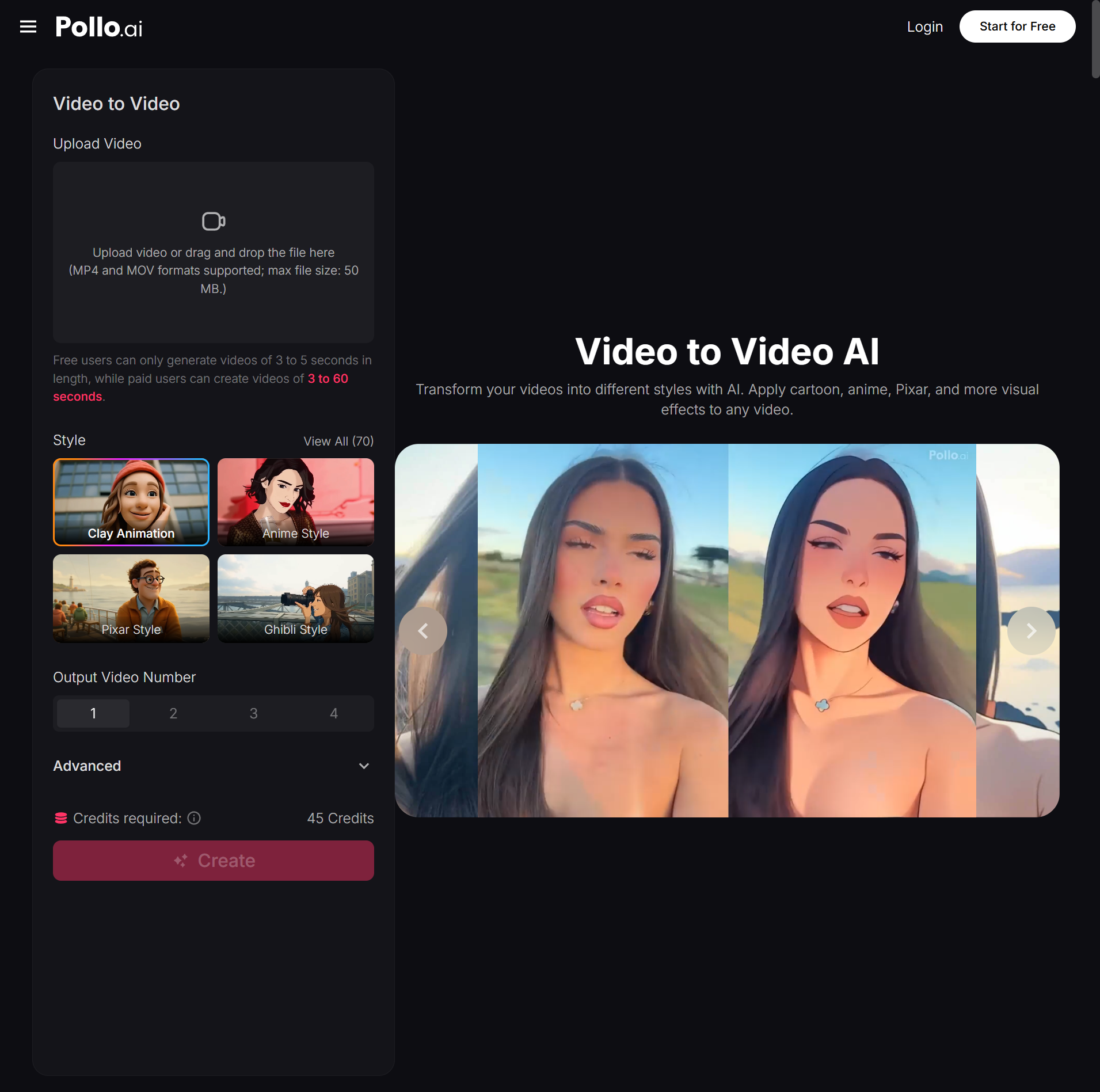
The video to video AI tool on Pollo AI is built around this transformation capability.

An older talking-head video shot against a plain background can be given a more polished visual treatment. 

Moreover, you can intelligently reformat horizontal footage for vertical platforms without losing the subject in the crop. 

You can restyle a corporate training video, recorded in a different style, to match a brand's new guidelines without a full reshoot. 

Pollo AI handles these transformations through AI-powered processing that preserves the content and performance while updating the presentation.

This is exactly the distinction that makes it useful for repurposing rather than just remaking.

For creators with substantial back catalogs, this opens a repurposing strategy that compounds in value.

The research, scripting, and performance work that went into producing strong evergreen content doesn't have to be redone just because the visual treatment needs updating. 

Also, Pollo AI's approach makes the content reusable across a longer timeframe and across more platform contexts than the original recording allowed for.

The Platform Fragmentation Problem That AI Helps Solve:

The modern content creator will try to maintain a presence across platforms, each with distinct format requirements.  

YouTube favors horizontal video with specific thumbnail conventions. Instagram Reels and TikTok require a vertical format. 

LinkedIn performs best with square or slightly vertical video. Twitter/X rewards short, punchy clips. 

Moreover, each of these platforms is a distinct audience with distinct viewing behavior. Plus, content that isn't formatted for the platform it's on underperforms regardless of its quality.

Historically, serving all these platforms from a single piece of source footage meant either accepting format compromises or investing in separate edits for each distribution channel. 

Neither was satisfying: cropped horizontal footage in a vertical frame loses compositional intent, and producing six separate cuts of every video multiplies production time in a way that most creators can't sustain.

Video-to-video AI changes this by making intelligent format transformation fast enough to include in a regular production workflow. 

The same source footage can generate platform-specific versions that are properly composed for each context rather than just mechanically cropped. 

Also, for creators managing content across multiple platforms, this is one of the most practical workflow improvements available.

Using AI Avatars To Scale Talking Head Content:

Beyond the transformation of existing footage, there's a growing category of video creation that sidesteps the filming process entirely: AI avatar video. 

For certain content types, an AI-generated presenter can deliver the content effectively without requiring the creator to record themselves.

For instance, AI avatars are becoming popular for explainers, announcements, educational breakdowns, and internal communications.
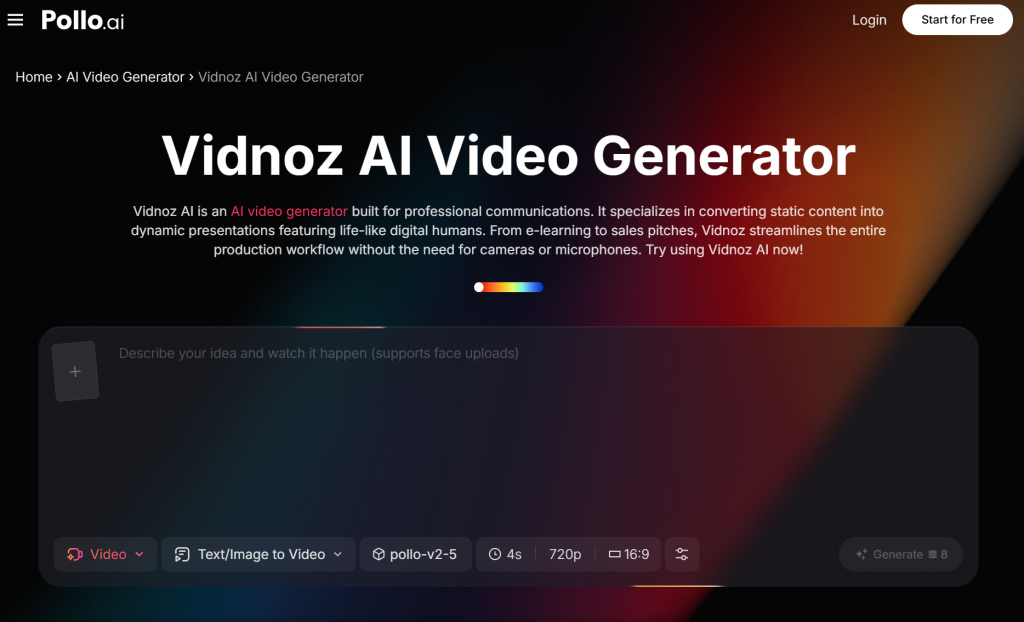
Vidnoz AI, accessible through Pollo AI, specializes in this avatar video category. It creates realistic AI presenters that you can customize to match a brand's visual identity. 

Also, it can deliver scripted content in multiple languages and styles. 

Moreover, for content creators seeking to maintain a consistent publishing schedule, Vidnoz AI offers a practical production workflow. And this is also true for creators who don't want to appear on camera for every piece of content.

Also, this is applicable for brands that need video content across multiple regional markets without separate recordings for each, 

Pollo AI's offering of both video transformation tools and Vidnoz AI's avatar capabilities within the same ecosystem means creators can handle diverse video content needs. 

This can refresh existing footage and generate new presenter-led content — within a connected workflow.

The use cases for AI avatar video have expanded considerably as the output quality has improved. 

Internal training content, product feature announcements, multilingual market content, and high-volume explainer series are all contexts in which avatar video delivers professional results efficiently. 

The ceiling on quality is high enough that avatar-led content is now indistinguishable from filmed content for many practical purposes.

Building A Sustainable Content Repurposing System

The creators who get the most value from video transformation and repurposing tools aren't treating them as one-off solutions for individual problems. 

They're building systems: structured workflows that regularly mine their content archive for repurposing opportunities.

Also, they systematically update and redistribute strong-performing content to extend its value.

A basic version of this system looks like this: once per quarter, review top-performing content from the previous six months. 

Then, identify which pieces are evergreen and which need factual updates versus just visual refreshes. 

Queue the visual refresh candidates for video transformation processing. Update any factual content through re-narration or on-screen text overlays. 

Redistribute the updated versions with new titles and thumbnails that reflect current search patterns and platform conventions.

This approach treats a content library as an appreciating asset rather than a depreciating one. 

The research and creative thinking embedded in strong content don't expire. But the presentation layer that delivers it to audiences does. 

Separating those two layers and maintaining the presentation layer through AI transformation rather than full reproduction is what makes a content library genuinely valuable over a multi-year timeframe.

The Practical Value Of Quality Consistency Across A Library:

One consequence of rapid platform evolution and improving production tools is that a creator's older content often looks noticeably worse than their newer content, even when the older content is substantively stronger. 

A viewer who discovers a creator through a recent, well-produced video and then navigates to their back catalog may encounter footage that undermines the impression of quality they just formed.

This quality inconsistency problem affects audience retention and subscriber conversion in ways that are easy to underestimate. 

Viewers make decisions about whether to subscribe based on the overall impression of a channel, not just the individual video they're currently watching.

Moreover, a channel that looks uniformly professional throughout its archive converts better than one where quality varies dramatically by year.

Video-to-video AI makes it feasible to bring older content up to a consistent quality standard.

And that too without the full production investment of recreating it. 

The result is a channel that presents a coherent identity across its entire history. This is ultimately what the platforms reward and what audiences trust.

The tools for building and maintaining that consistency are accessible. Moreover, the workflow is learnable. Also, the compounding value of a well-maintained content library is significant. 

Plus, for creators who have been producing content seriously for more than a year, the repurposing opportunity sitting in their existing archive is almost certainly larger than they've recognized.

Read Also:

Sohini is a MarTech and business writer with over two years of experience creating and editing content in the digital marketing space. She has a strong interest in emerging digital trends, marketing strategies, and the evolving relationship between technology and business growth. Alongside writing, she also works on guest posting strategies, carefully aligning sponsored content with niche relevance to help maintain strong organic visibility and audience engagement. Outside of work, Sohini enjoys reading, exploring internet subcultures, and endlessly scrolling through Reddit, Pinterest, and Substack looking for new ideas and trends.

View all posts

Leave a Reply

Your email address will not be published. Required fields are marked *

Related

How to become a Caregiver

Your Guide To Becoming A Caregiver Online: Steps To Start Your Journey

The healthcare industry is massively changing with digital evolution. And, slowly, the professionals are opting for the online support system. So, amidst this, the question that most healthcare professionals want to know is “How to become a caregiver online?” That is, they are looking for ways to provide healthcare support without disrupting the flexibility of the digital world. So, patients can get the care without compromising on the flexibility. But is it that easy? Well, honestly speaking, it is a hard nut to crack. That is, mixing technology with human intuition is quite difficult. So, making a successful career in this field in a jiffy is not possible. But with the right guide, individuals can become proficient caregivers in the healthcare industry. So, in this blog, I have brought you a complete guide. Keep reading to know more! What Is An Online Caregiver? Understanding The Basics First things first, an online caregiver and a regular caregiver are not the same.  That is, an online caregiver uses the digital platform to understand the pain points of the client and provide them with a solution virtually. Moreover, an online caregiver is responsible for providing remote support to patients. So, they can manage their day-to-day activities without needing an appointed individual. Why Should You Become A Remote Caregiver? Key Benefits Of An Online Caregiver Becoming a remote caregiver can offer countless benefits to these healthcare professionals. So, here are some of the reasons to opt for the remote caregiver— Provides a proper work-life balance, Improves the flexibility of the work, and Enables individuals to remotely keep an eye on the patient’s conditions. Apart from these, becoming an online caregiver can help patients get a fulfilling treatment option. So, they can get proper care from someone responsible and takes accountability for their work. How To Become A Caregiver? A Step-By-Step Guide Now, becoming a caregiver online is not an easy task. That is, it requires patience and learning the right courses. But a step-by-step guide can help navigate through the process with ease. So, here are the steps you need to follow to become a caregiver online— 1. Building A Foundation Of Trust Developing a strong foundation often starts with obtaining the right certifications to build trust with potential clients. Since these clients are often making deeply personal decisions about their loved ones, they need trustworthy caregivers. So, building a trustworthy foundation with your clients should be a top priority. While you are working through your training, it is helpful to research the specific needs of families. Especially for families who are looking for home-based senior care. Since this is a fast-growing industry, knowing the immediate needs of seniors can essentially help providing them the support that they are typically looking for. By understanding the daily challenges these families face, you can tailor your online services. That is, it becomes easier to plan the impactful solutions, such as— remote scheduling,  medication reminders, or  even video-based wellness. That is, elements that bridge the gap between modern technology and human intervention. Making it easier to combine them for a more efficient and streamlined workflow. 2. Establishing Your Digital Presence Once you have your credentials in place, you should focus on building a professional digital presence. Moreover, this digital presence should not be superfluous. Rather, it should be able to highlight your unique expertise and your genuine compassion. So, even with your best work or simple and organized tasks, you can build your presence on various digital platforms. Creating a profile on dedicated caregiving platforms or even launching your own website allows you to showcase how you can streamline the logistics. Especially for senior home care, where you can show your clients through— organized digital portals, curated reviews, and testimonials from your clients and customers. Making it easier for them to make the decisions about the services. This professional visibility is crucial because it helps you stand out in a competitive market. So, when families search for reliable individuals who can manage complex care plans effectively from a distance, your profile pops up. 3. Mastering The Tools Of The Trade As you begin to take on your first few clients, remember that communication is the most vital tool in your toolkit for long-term success. Since you will usually be communicating with the clients over digital platforms, it is vital to establish an empathetic connection with them. That is, you need to clearly state the quality of support and services you will provide. This way, you can avoid miscommunication and provide the best care. So, even beyond the physical proximity, you can deliver the right kind of caregiving services. This way, your clients can get what they are looking for. So, you can list out the services you provide, like— Daily caretaking, Scheduling and planning appointments, Reminding of health checkups, and Virtually conducting sessions for their mental health. Staying updated on the latest telehealth tools and caregiving software will also give you a significant advantage. So, as you continue to grow your journey and transition into a full-time online caregiving career that makes a tangible difference in the lives of others. Becoming An Online Caregiver With The Right Tools And Leaning Courses Ultimately, embarking on a career as a virtual caregiver requires a unique blend of technical proficiency and genuine heart. Since individuals need to serve patients and older people beyond the digital screens, compassion is the key.  Allowing them to support people in need without making them feel isolated or lonely. So, it is vital to have compassion and warmth while dealing with the elderly. By committing yourself to continuous learning and focusing your efforts on the growing demand for home-based elderly care, you can establish a sustainable practice that offers both professional stability and deep personal fulfillment.  As the world becomes increasingly interconnected through digital tools, your role in providing remote guidance will only become more essential. So, taking these initial steps today sets you on a path toward a truly impactful and modern caregiving journey. Take this chance to learn how to become a caregiver online and help older people by providing heart-warming services to help them.

READ MOREDetails
Rich text editor

Build Vs. Buy: The True Cost Of Rolling Your Own Rich Text Editor For An Edtech Platform

At some point in every EdTech company's growth, an engineer says, "We could build our own editor."  The reasoning sounds solid. Open-source editors are free. You get full control. You can customize exactly what you need. Six months later, that engineer is maintaining a cross-browser text rendering engine. So, they don’t waste time anymore building the features that make your LMS valuable.  This article breaks down the true cost comparison between building on an open-source rich text editor and adopting a commercial solution. Additionally, it also draws specific attention to the long-term total cost of ownership (TCO). In fact, you will also get to learn a lot about security and feature velocity. Key Takeaways Building an open-source fork drains roughly $126,000 over three years in direct engineering time compared to a fraction of that for commercial licenses. Maintaining a custom cross-browser text rendering engine requires 10 to 20 hours per month of unplanned reactive work that directly delays core roadmap features. Managing security patches for XSS vulnerabilities in an open-source fork introduces significant FERPA compliance risks and deployment bottlenecks. Commercial editors reduce integration time from several months to a few days while handling browser compatibility and performance optimization automatically. Rolling your own solution only makes sense if the editor itself is your primary product rather than a supporting infrastructure layer. What Are The Two Divisions Of A Rich Text Editor? The pathways of a rich text editor are divided into two major sections. Let’s see what they are: The "Build" Path: What It Actually Involves Most teams that "build" a rich text editor don't write one from scratch. This feels like a shortcut, but it creates a distinct set of costs that compound over time. 1. Initial Integration: 2-6 Months Open-source editors provide a foundation, not a finished product. So, your team needs to build the toolbar UI. In addition, you must also implement paste handling for Microsoft Word and Google Docs.  Also, you need to add image upload and management.  After you are done with these, your next steps will be to: Create table editing functionality Configure HTML sanitization for security Design the mobile editing experience The engineering salary data from Levels gives us striking information. FYI, a mid-senior frontend engineer in the U.S. costs approximately $150,000-$200,000 annually, including benefits.  If that engineer spends four months on editor integration, the initial cost is $50,000-$67,000 in engineering time alone. Also, they must keepin mind that they're not building anything else during that period. 2. Ongoing Maintenance: 10-20 Hours Per Month Browser vendors ship updates continuously. Chrome's release schedule delivers a new version roughly every four weeks.  Your editor fork needs to be tested against every browser update. When something breaks (and it will), someone on your team needs to diagnose and fix it.  We call it reactive, unplanned work. It interrupts sprint cycles and delays roadmap items. For EdTech platforms specifically, you also need to maintain compatibility with institutional browsers.  Many universities standardize on specific browser versions. In addition, some K-12 districts use managed Chromebooks with delayed update cycles.  So, I am sure that your editor needs to work across this range. 3. Security Patching: High Stakes, Unpredictable Timing Rich text editors handle user-generated HTML. That makes them a target for cross-site scripting (XSS) attacks.  Additionally, the OWASP Top 10 lists injection attacks as a persistent web application risk. Also, the rich text editors are a common vector. When an XSS vulnerability is discovered in your editor's upstream open-source project, you need to evaluate the patch. Additionally, you must also merge it into your fork (resolving any conflicts with your customizations). In turn, test it across your supported browsers and deploy it.  If you've diverged significantly from the upstream project, merging patches can take days. For EdTech platforms handling student data protected by FERPA, a delayed security patch carries compliance risk beyond the technical vulnerability itself. The "Buy" Path: What It Actually Costs Commercial rich text editors charge a license fee in exchange for a production-ready product with ongoing maintenance, security updates, and support. 1. License Cost Commercial editors typically charge annual license fees. It starts at a few hundred dollars for basic plans. Additionally, it scales to a few thousand for enterprise features.  Also, you must compare this to the $50,000+ in engineering time for initial integration of an open-source fork. Then, you will see that the license fee is a rounding error. The relevant comparison is not "free vs. paid." It's "your team's time vs. the vendor's team's time."  When you buy, the vendor's engineering team handles browser compatibility, security patches, performance optimization, and feature development. Your team focuses on your product. 2. Integration Time: Hours To Days A commercial editor with dedicated framework wrappers and production-ready features integrates in hours, not months.  Paste handling, table editing, image management, mobile support, and HTML sanitization come built in. Your team configures rather than builds. There are certain EdTech-specific requirements like:  Math equation support Track changes Collaborative editing For these, the commercial editors offer tested integrations with tools like MathType and real-time collaboration plugins, and as for students with dysgraphia or motor challenges, pairing in a math writing software removes the handwriting barrier entirely. Building these integrations from scratch on an open-source foundation adds months to your timeline. 3. Ongoing Maintenance: Near-Zero With a commercial editor, browser compatibility testing, bug fixes, and performance improvements are the vendor's responsibility.  Your team's maintenance burden drops to applying version updates. Now this should be low-friction. But it will only happen if the vendor provides clear migration guides. Also, he has to maintain backward compatibility. What Are The Components Of A Three-Year TCO Comparison? Here's a simplified comparison for an EdTech platform with a five-person frontend team. 1. Open-Source Fork Path Initial integration costs four months of one engineer's time, roughly $60,000.  Ongoing maintenance runs 15 hours per month at $85 per hour (loaded cost), totaling $15,300 per year.  Security patch response averages 20 hours per quarter at the same rate, adding $6,800 per year.  Opportunity cost from delayed features is harder to quantify, but real. Over three years, direct costs alone total approximately $126,300. Additionally, the engineer hours lost to editor maintenance could have shipped two to three significant product features. 2. Commercial Editor Path License costs run $1,000-$2,000 per year, depending on plan and deployment model.  Initial integration takes two to five days of one engineer's time, roughly $3,400-$8,500.  Ongoing maintenance is limited to applying updates. So, it is estimated at two hours per quarter. Additionally, it totals $680 per year. Over three years, direct costs total approximately $10,000-$16,000. The difference is roughly $110,000 in direct engineering costs over three years. In addition, you will see that the real value is in the features your team ships. It is not in the editor's work that they avoid. Making The Decision For The Rich Text Editor Ask your team three questions. First, how many engineering hours did we spend on editor-related work in the last six months?  Second, what features would we have shipped with those hours? Third, what is our editor's current XSS vulnerability exposure? In addition, you must also ask, how quickly can we patch it? If the answers to these questions make you uncomfortable, the build vs. buy decision has already been made.  But the only remaining question is how quickly you can make the switch.

READ MOREDetails
how Ventilation Experts work

Heating, Cooling & Ventilation Experts Serving Chilliwack And Surrounding Areas

Do you want your household to function properly and the atmosphere to be comfortable all year round? You will need to have the perfect heating, cooling, and ventilation systems in place.  And, of course, you will also want to maintain them regularly. Without regular maintenance, you can certainly expect some problems to arise along the way.  Naturally, even when you properly maintain all the systems, you can still encounter some issues from time to time.  When you do, it is important for you to involve experts in the mix. If you’re looking for some AC maintenance tips, for example, though, this could help: https://home.howstuffworks.com/how-to-maintain-an-air-conditioner.htm.  Nevertheless, in today’s blog, I will discuss how ventilation experts work and how you can find the best one.  How Ventilation Experts Work? Why Do You Need The Professionals?  For all things HVAC-related, you will absolutely need to hire professionals.  But not just any professionals. That is, not just any company that comes your way.  Instead, you want to ensure that you are hiring the right heating, cooling, and ventilation experts in your area. After all, you do want what’s best for your systems, and that certainly requires you to make the best choice. How To Find The Best Ventilation Experts In Chilliwack? Now, there are plenty of amazing experts serving Chilliwack and the surrounding areas that you can hire.  However, you might have never had to hire these professionals in the past. Or, if you haven’t been happy with the ones you have previously hired, you may find yourself a bit confused about how to actually find and choose the right professionals in Chilliwack and the surrounding areas. Hence, we will talk a bit more about how you can actually find the right experts.  In other words, we will talk about the steps you should take in this process. Moreover, you need to understand the factors you should keep in mind to make the best hiring decision.  So, without any more ado, let us get started. In case you need more AC maintenance tips, go here. 1. Ask Around Okay, the absolutely very first thing you should do when trying to find the right HVAC experts in your area is, naturally, talk to the people you know and check if they may have any recommendations to share.  Perhaps some of your neighbors have recently had to hire these professionals because they have been having issues with their systems.  Or, some of your friends may have experience cooperating with these experts, or they know someone who knows someone… You get the drill.  The bottom line is that you should absolutely talk to the people around you and check what they have to say, because they could absolutely be able to provide you with the perfect suggestions. 2. Search Online Moving on, you will also have to do some searching of your own.  This means that you shouldn’t jump right towards hiring an expert that someone recommends, because you still have some research to do.  Yet, the above step should serve as a good starting point for you to begin creating a list of potential experts in Chilliwack or in the surrounding areas. The next step that can help you make that list is, of course, your own browsing. Chances are that you will remember to do this, because that’s what most people do nowadays when they are in need of pretty much anything.  So, search for these professionals online, and add the ones you think could be great to your list of potential ones.  The good thing is that most HVAC companies will be online these days, so you won’t have trouble finding them this way. 3. Check The Offered Services Once you have made that list using the steps we have mentioned above, you will be ready to start researching these different professionals in more detail.  And, naturally, the first thing to do is check the actual services they are offering. Some focus solely on maintenance or repair, while others may be able to provide you with a full scope of service.  What you have to do when checking out the different heating and cooling experts in Chilliwack is check if their services align with what you need in the moment.  But, it would also be a good idea to go for those pros that can provide you with the full scope, so that you know who to call in the future as well, because a long-term partnership with HVAC professionals in Chilliwack is always the right move. 4. Check Experience And Reputation Of How Ventilation Experts Work Naturally, the next thing you should do is inspect the experience and the reputation of the professionals you are considering.  The goal here is for you to hire experts who are highly experienced. You need those who are known to be reliable and trustworthy. So, read some reviews written by previous clients. 5. Talk Availability And Prices Finally, talk about their availability and their prices. Waiting for a while is completely normal, as I am sure you understand.  But you shouldn’t wait for far too long. And, when it comes to the prices, the goal is not for you to go for the lowest bidder. Instead, it’s about choosing an expert who offers great quality services at fair prices. 6. Choose The Service That Encourages Transparent Communication  The requirements you will have for the HVAC system of your home will be different from those of others. So, you need to find a service that listens to your complaints and diagnoses each problem scientifically.  Transparent communication also helps to be on the same page regarding pricing. There will not be hidden charges or a sudden hike in the budget.

READ MOREDetails