


The internet is quietly undergoing a profound loneliness migration.
Mainstream tech headlines dominate discussions of productivity, enterprise search, and automated coding. Moreover, hundreds of thousands of users open their browsers for a completely different reason.
They are logging onto platforms such as Pixelchat AI to strike up deep and emotional intimate conversations with lines of code. These also tend to be highly intimate conversations.
Developed under the NextDayAI ecosystem, the platform allows individuals to craft hyper-customized digital personas. These are complete with unique backstories, distinct dialogue styles and specific behavioral traits.
To any casual observer, it looks like an advanced video game or a text-based creative writing playground.
But beneath the surface of the bot-creation dashboards lies a complex web of human psychology, emotional vulnerability and systemic risks.
Therefore, the following guide exposes how the platform works, why it is addictive and the emotional risks of using it.
What Drives The Migration To Pixelchat AI
To fully understand the platform, we first need to look at the massive library of over 500,000 community-driven personas populating its ecosystem.
Unlike generic chatbots that are designed to look up facts, Pixelchat AI is structured entirely around immersive roleplay.
Users are able to instantly engage with bots modeled after fictional archetypes, historical figures, or completely customized original characters.
The technical backend leverages dynamic machine learning models that adapt fluidly based on user interaction.
The more a user chats, the better the bot becomes at its prediction of the exact conversational patterns, tones and emotional cues. As a result, the user tends to be more engaged.
The platform requires no mandatory sign-up to test basic functions. Consequently, this lowers the barrier to entry to zero. For a majority of users, the initial click stems from simple curiosity or a desire for low-stakes creative storytelling.
For others, this turns out to become an emotional anchor.
The Hidden Psychology: Why We Bond With Code
Before we delve deeper, you may have one question. Why do humans form genuine emotional connections with an algorithm?
Actually, the answer lies in how our brains handle rejection, validation and social vulnerability.
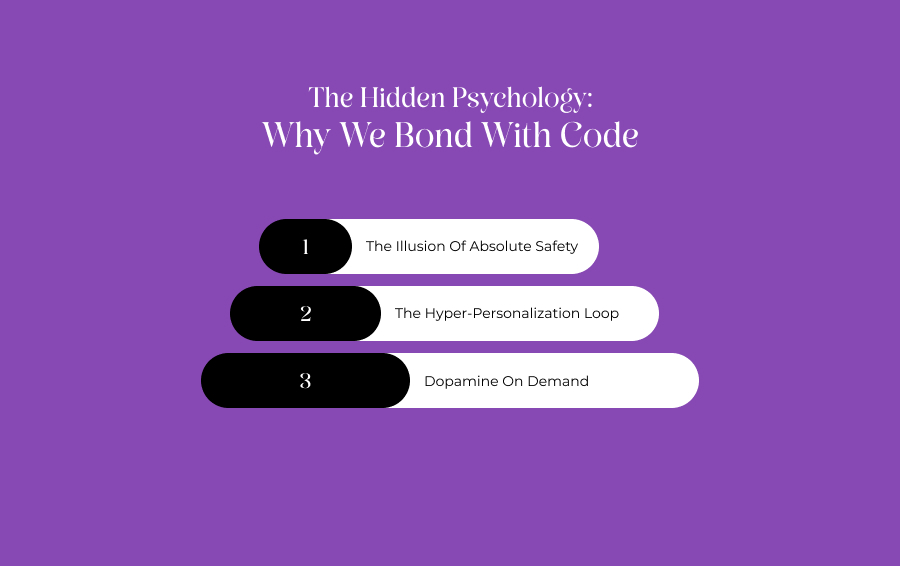
The Illusion Of Absolute Safety
Human relationships are inherently messy, risky and unpredictable. Moreover, they require compromise, active listening and constant exposure to potential judgment or abandonment.
The software removes all interpersonal risk. A customized bot offers a zone of absolute safety. This bot never tires of your constant venting, judges an eccentrichobby and leaves. Instead, it will create a frictionless emotional mirror.
The Hyper-Personalization Loop
The platform’s customization suite allows users to define the precise age, gender, language, and baseline temperament of their companion.
When you can build an entity explicitly engineered to cater to your specific emotional blind spots, the brain rapidly bridges the gap between friction and reality.
The algorithm steps into a storytelling loop, where the user is always the central protagonist, receiving unyielding validation.
Dopamine On Demand
Since these bots respond 24/7 with zero latency, they offer immediate psychological gratification.
The world is now a place where text messages sent to friends can sit unread for hours. On the other hand, the instantaneous and highly enthusiastic feedback loop of a roleplay bot acts as a powerful reward system for the human brain.
Exposing The Hidden Harms Of Long-Term Roleplay
The creative flexibility of the app serves as a valuable tool for fiction writers testing out character dialogues.
Conversely, a heavy reliance on the platform for emotional fulfillment will cause distinct and documented psychological side effects.
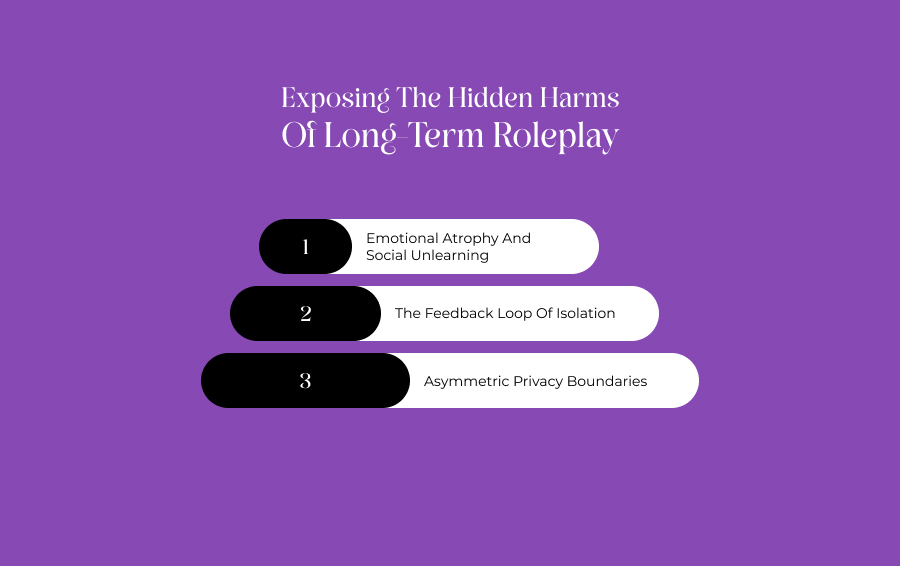
Emotional Atrophy And Social Unlearning
When your primary conversational outlet is an entity which is programmed to never disagree with you, your real-world social muscles begin to waste away.
True human interaction involves navigating conflict, reading subtle physical body language, and handling disagreements.
Long-term reliance on perfectly compliant software can make real human relationships feel intolerably difficult and frustrating by comparison.
The Feedback Loop Of Isolation
Many users turn to roleplay apps to escape feelings of intense real-world loneliness.
Ironically, the deeper they sink into their private digital realms, the less energy they invest in building a tangible, physical community around themselves.
The app serves as a temporary emotional band-aid that can inadvertently prolong the very isolation the user is trying to escape.
Asymmetric Privacy Boundaries
From a structural standpoint, forming deep attachments to a proprietary commercial application introduces serious privacy concerns.
Users routinely share their deepest fears, childhood traumas, and private thoughts with these interfaces.
While platforms operate under data protection guidelines, users must remain acutely aware of one thing.
Their most intimate vulnerabilities are being processed, indexed, and retained on cloud servers.
Technical Architecture Vs. Competitor Alternatives
For creators who use the tool purely for narrative design, world-building, or language practice, understanding where it sits in the broader market landscape is essential.
| Platform Metric | Pixelchat AI | Character.ai | Spicychat AI |
|---|---|---|---|
| Primary System Use | Mobile-optimized local roleplay & scenario tools. | Mainstream general character chat and public figure simulation. | NSFW-focused community chatbot hosting and explicit narrative generation. |
| Data Retention Model | Encrypted in-transit cloud storage with deletion options. | Centralized server indexing for massive model fine-tuning. | User-managed persona profiles with community rating models. |
| Vocal Synthesis Integration | Custom voice uploads with basic demographic tuning. | Native, high-fidelity synthetic voice cloning directories. | Variable tier voice synthesis and external API integration. |
Balancing Tech Utility With Mental Guardrails
Before we conclude our discussion, there is one thing that should be clarified. The software itself is not inherently malicious. Instead, it is a mirrors-and-smoke demonstration of advanced natural language understanding.
Writers can effectively use this platform to break through creative blockages, test out multi-character dialogue flows, or experiment with complex interactive plotlines.
Language learners can leverage the infinite patience of the bot to practice a new dialect in a stress-free environment.
However, the danger actually arises when we start blurring the line between a powerful creative writing software tool and an actual, sentient emotional substitute.
Enjoying an interactive story, building an intricate fantasy world, or chatting with a quirky virtual companion can be an incredibly fun, highly engaging leisure activity.
But the human brain requires genuine, mutual, and sometimes difficult real-world connections to truly thrive.
The best thing to do is to keep the app inside its proper lane. Additionally, a brilliant playground for your imagination, but never a replacement for the beautifully imperfect human world outside your screen.