











I tried adopting to the zero waste lifestyle in 2018, and I failed after a few weeks. And that is when I realized that it is harder than one can imagine.
However, last year, I went back and tried to analyze the real reason why I failed. This is what I understood:
- I was focusing more on an overnight change.
- I constantly doubted whether my efforts could change the world.
- My sole attempts at measuring my progress were based on what I could see in front of me.
- The idea of convenience took the better of me!
So, with these things in mind, I restarted my journey of having a sustainable zero waste lifestyle. And trust me, I have been doing so much better.
A zero waste lifestyle is basically a sustainable way ofliving. It focuses on minimizing waste production by refusing unnecessary items, reducing consumption, reusing products, recycling responsibly, and composting organic materials.
The primary goal is simple: to send as little waste as possible to the landfills or the environment!
If you are typing to understand how you can successfully embrace the zero waste lifestyle, keep reading…
Why A Zero Waste Lifestyle Matters Today
These days, a lot of people are talking about zero waste lifestyle. And to be honest, it makes sense – we’re all starting to realize just how much trash we create and how much that hurts the planet.
The numbers are kind of wild.
The United Nations says that every year, households, small businesses, and public services churn out somewhere between 2.1 and 2.3 billion tons of solid waste. And this includes about everything from food scraps and plastic wrappers to old electronics.
Now, the problem is, most waste management systems just can’t keep up. Around 2.7 billion people don’t even have basic waste collection.
Only about 61% to 62% of all that trash gets processed at proper facilities. So, most of it just ends up sitting somewhere, polluting the environment.
Still, more people are jumping on the zero-waste bandwagon. About 69% of people worldwide say they support the movement. That’s a big deal.
But here’s the catch: while lots of people like the idea, only about 51.6 % actually stick to zero-waste routines every day, like sorting their trash or reusing containers.
So, there’s plenty of enthusiasm, but putting it all into practice? That’s where things get tricky.
What Is A Zero Waste Lifestyle?
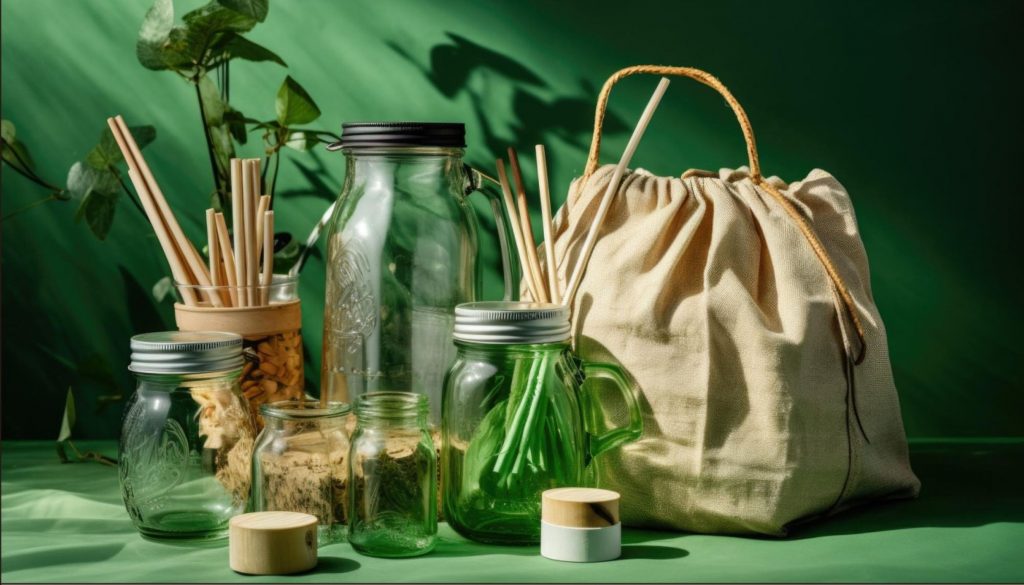
Living a zero waste lifestyle isn’t about being perfect – it’s about trying to send as little as possible to landfills, incinerators, or the ocean.
Instead of just taking, making, and tossing stuff, people who practice a zero waste lifestyle aim to keep things in use for as long as they can, looping resources back into the system rather than letting them go to waste.
Most people in the movement stick to what’s called the “5 R’s,” which Bea Johnson talks about in her book, Zero Waste Home. Here’s how it breaks down:
- Refuse.
- Reduce.
- Reuse.
- Recycle.
- Rot.
Sure, calling it “zero” waste sounds kind of daunting, but trust me: nobody here is expecting perfection. Rather, the real goal is just to do better, bit by bit.
About The Zero Waste Movement
Zero waste started out as a grassroots idea—people in local communities pushing back against all the waste produced by modern industry.
What began as a small movement has grown into something global. Now, people, organizations, and even governments are getting behind it.
It is basically about living with as little waste as possible, all inside the bigger picture of a circular economy. Instead of throwing things away, you keep materials in use for as long as you can.
So, what does that look like?
Businesses are re-evaluating their product manufacturing processes and creating items that can be repaired, reused, or recycled. Additionally, municipalities are creating their own initiatives to reduce waste.
Individuals in their everyday lives are also trying to make more conscientious choices, such as using reusable grocery bags or fixing something instead of throwing it away.
Basically, the main objective is to find a way to keep products and materials in circulation rather than discarding them and continuing to purchase new items.
Purpose Of Zero Waste Lifestyle Living
According to Banyan Nation, zero waste lifestyle is all about cutting down on trash that ends up in landfills or gets burned. But what does “zero waste” really mean?
At its core, it’s a way of thinking – and acting – that pushes us to rethink how we use resources, design products, and handle waste.
It connects directly to bigger goals like:
- Protecting nature.
- Saving resources.
- Fighting climate change.
When you dig into zero waste, you see it’s not just about tossing less stuff. It’s about making choices that shrink our environmental footprint, use resources wisely, and build products that last.
On top of that, these practices often bring people together and help communities thrive. In the end, zero waste means creating systems that respect the planet and support everyone who lives here.
| Zero Waste Lifestyle: Quick Start For Beginners • Carry a reusable bag and water bottle. • Switch to reusable kitchen and bathroom items. • Start composting food scraps. • Buy in bulk when possible. • Say no to single-use plastics. |
Zero Waste Lifestyle Myth-Buster: Rethink Your Choices!
As a beginner, you will be surprised to know that most of the things that you think are a zero-waste approach are actually not.
Yes, that’s right. While people try to adopt habits that they believe are sustainable, more often the case is actually the opposite.
Here are some of the myth-busters when it comes to adopting to zero waste, sustainable lifestyle:
1. Clothing Donations:
First on the list is donating your old clothes. Yes, shocking, right? Donating old clothes often leads to them being exported to overseas landfills or incinerated.
I know, this is something that never really occurred to you. Which is why it is best to actually sell them locally.
2. Recycling as a Primary Solution:
Secondly, most people think that zero waste is actually all about recycling. But that’s not true!
Zero waste is a hierarchy that prioritizes refusing and reducing first. Recycling is actually the final, least preferred stage because it requires significant energy.
3. Constant Reusable Swaps:
Thirdly, one of the most common mistakes is buying new “sustainable” products to replace items that you already own.
For example, you might end up buying new bamboo cutlery just because you want to go green.
And tell me something – do you really need to buy that 10th reusable water bottle when you already have metal utensils and glasses at home?
These seemingly small things are actually not that small. They create more waste through manufacturing and shipping.
How To Practice A Zero Waste Lifestyle? Step-by-Step Guide
Living a zero-waste life really comes down to paying attention to what you buy and what you throw away. Yes, it is as simple as that.
Zero-waste living isn’t about being perfect. It’s about paying attention, making better choices, and doing what you can – one step at a time.
So, if you’re just getting started and want to make a real difference, here’s how you can jump in:
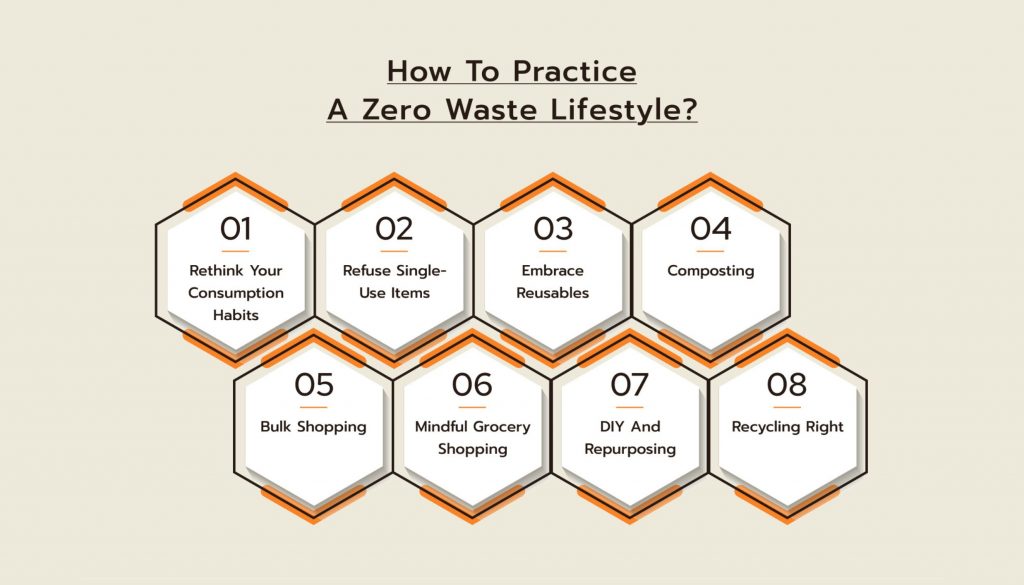
1. Rethink Your Consumption Habits:
First, it is important that you take a hard look at how you shop. Consider your shopping habits.
Do you actually need that item? If so, could you find a more sustainable product that is made with sustainable materials that will outlast the cheap disposable item?
These small things make a lot of difference!
2. Refuse Single-Use Items:
Secondly, you should definitely try to eliminate single-use products as much as possible. This includes plastic grocery bags, plastic straws, disposable eating utensils, etc.
So, the next time you leave your home, make sure you are carrying a reusable bag and a water bottle to prevent unnecessary waste.
3. Embrace Reusables:
Instead of using disposable products on a regular basis, consider using reusable products instead. For example, use cloth napkins rather than paper towels.
Refill your shampoo, soap, laundry detergent, and other items in refillable containers, rather than continuing to buy disposable containers.
Another great example of a reusable item is rechargeable batteries. These small changes will have a big impact on the amount of waste you create.
4. Composting:
Another way to reduce waste is to compost.
When you compost your fruit and vegetable scraps, or any dead plants, you are putting the nutrients back into the soil so that you can grow food that does not require the use of artificial fertilizers or pesticides.
If you do not have access to outdoor composting options, you can always compost indoors by using a worm bin or countertop composter.
5. Bulk Shopping:
When you can buy in bulk, it is not only a smart way to save money but also your time.
By carrying your jars, containers, or bags with you to the grocery store, you can help reduce the production of tiny packaging that you usually see.
Such shopping habits contribute to less garbage being thrown away as landfill, especially the food that regularly appears on our table, such as grains, nuts, and coffee.
6. Mindful Grocery Shopping:
Before going to the grocery store, make a comprehensive grocery list. Thus, when you get to the store, you just have to refer to your shopping list and want to buy according to the plan.
As a result, you will be less likely to buy items that are not on the list or even more than your needs.
Select fresh produce that is not wrapped in plastic. The less packaging or the simplest packaging to recycle an item’s packaging, the better!
There are various kinds of recyclable materials, so pick recyclable packing materials that are suitable for your local recycling facilities.
7. DIY And Repurposing:
Don’t be afraid to get creative. Repurpose glass jars as storage, cut up old t-shirts for rags, or make your own cleaning sprays with vinegar and lemon. You’d be surprised how much you can reuse with a little imagination.
8. Recycling Right:
Finally, you need to recycle! While cutting down waste is the main goal, recycling still matters.
Learn the rules where you live so you can sort things the right way. Focus on using less, but when you have to recycle, do it right.
Common Mistakes Beginners Make When Going Zero Waste
While it is important to know what to do when going zero waste, knowing what NOT to do is equally important (if not more). As I have already mentioned in the beginning, I thought this was something easy – something I could do easily.
But, only after I started doing this, did I realize how difficult it can be at times. Or maybe it was because I put an unnecessary amount of pressure on myself. Whatever the case may be, here are some common mistakes that beginners make:
1. Trying To Change Everything Overnight
Firstly, stop trying to shift to a completely new lifestyle overnight. It doesn’t work like that. Trust me when I say this – the idea of throwing everything away and starting perfectly feels appealing.
However, if you want to truly transform and start living a sustainable life, it really takes time. So, don’t rush
2. Buying “Eco” Products Unnecessarily
We live in a world where all of us are bombarded by ads. And these primarily aim to cater to our inner consumerism. And let’s be honest, for most of us, retail therapy is a thing. Besides, because we try to buy less, we get the urge to do the opposite even more.
That is why most of the beginners try to buy everything that has the label of “eco-friendly” or “sustainable” on it. But that is not what you need to do. And that is something that I would like to tie to the first point: do not try to change everything overnight!
If you have things at home, finish that up! You do not have to buy things that are “green.” Because when you do that, you automatically end up buying more!
3. Forgetting Zero Waste Is An Approach
Thirdly, and probably one of the most important things that one forgets is the fact that this way of living is an approach. Something that you need to embrace holistically. And that it does not only focus on objects.
As a beginner, you should understand that sustainable zero-waste living is about having a sustainable approach towards consumption, mentality, and behavior.
Try choosing local products and ensure that you are able to really bring down the packaging as much as possible.
4. Letting Perfectionism Kill Motivation
Finally, please try to understand that you do not need to be perfect. You do not have to feel pressured about it. Zero waste does not have to mean “no waste whatsoever!”
You do not have to feel guilty just because you forgot to carry your reusable bag or because you had to use a plastic straw at a restaurant. All you need to do is try to focus on progress over perfection.
Frequently Asked Questions (FAQs)
Here are some of the questions that people often ask about zero waste lifestyle. Take a loo at them before you leave:
A zero waste lifestyle is basically a sustainable way of living. It primarily aims to keep trash out of landfills, incinerators, and the ocean.
It’s all about changing how you buy and use things, moving away from the old pattern of just using stuff and tossing it out.
Instead, you find ways to reuse and repurpose what you have, creating less waste and making resources last.
If you want to start a zero waste lifestyle, here are a few things that you need to do:
• Conduct a trash audit: observe and understand what exactly you want to throw.
• Make easy swaps: Switch from plastic bottles to glass bottles or stainless steel bottles.
• Rethink your shopping habits: Always buy things in bulk. In that way, you will be able to reduce the consumption of plastics. Additionally, you can visit thrift stores.
• Manage organic waste: It is best to practice composting. You can throw your food scraps or house waste into compost bins.
• Focus on consistency and gradual transition: You don not have to hurry and change your lifestyle. Take small steps.
The 5 steps of zero waste lifestyle are:
1. Refuse
2. Reduce
3. Reuse
4. Recycle
5. Rot
The 5 principles of zero waste lifestyle include:
• Refuse: saying no to the things that you do not need to buy.
• Reduce: minimizing whatever you are buying.
• Reuse: choosing to stick to reusable items like cloth bags and glass jars.
• Recycle: recycling and processing the things that you cannot refuse to buy.
• Rot: choosing to compost organic waste instead of throwing it into landfills.
Bea Johnson popularized these 5 principles.