
15 High-Paying Careers: Six Figure Jobs to Consider in 2024

by

21 August 2024

Job & Career

inner-img

Six figure jobs are the ones that pay anywhere from $100,000 to $999,999. Here, the salary number is six digits. For most people, having a six-figure job is a dream. This is because it gives them enough options to be financially secure and have a better lifestyle than most.

In this article, you will learn about jobs that offer six-figure salaries. Here, you will learn about fifteen different jobs from various sectors. Apart from that, you will also get a general overview of six-figure salaries and why they matter. Hence, to learn more, read on to the end of the article.

What Are Six Figure Jobs? - A General Overview

What Are Six Figure Jobs_ - A General Overview

When considering what career you want, you look for the ones that pay a good salary. Here, you might search for a job that has a good salary potential, especially the ones that are called six figure salary jobs.

Basically, a six-figure job is one that has a salary of six figures. That is, the salary ranges from $100,000 to $999,999. Currently, the healthcare sector has some of the highest-paid jobs and a bright future.

Now, you might think that the difference between the two numbers is huge. Also, a big change within this salary range will greatly impact on your financial stability and lifestyle. Moreover, $100K might seem very small compared to $999,999. But even $100,000 per year is a dream for many in the United States.

Hence, starting with jobs that pay 100K a year can be a really good step forward. That is why many people aim to earn a six-figure salary early in their careers. It would help if you did the same, and as you grow and take on more responsibilities in your career, you must negotiate your salary accordingly and increase your income.

The US Bureau of Labor and Statistics (BLS) says there will be significant growth in the healthcare sector in the next few years. Hence, some of the highest-paying occupations in this article will belong to the healthcare sector. Moreover, outside the healthcare field, the best-paying job is for a corporate chief executive.

Top 15 Six Figure Jobs in 2024 in the United States
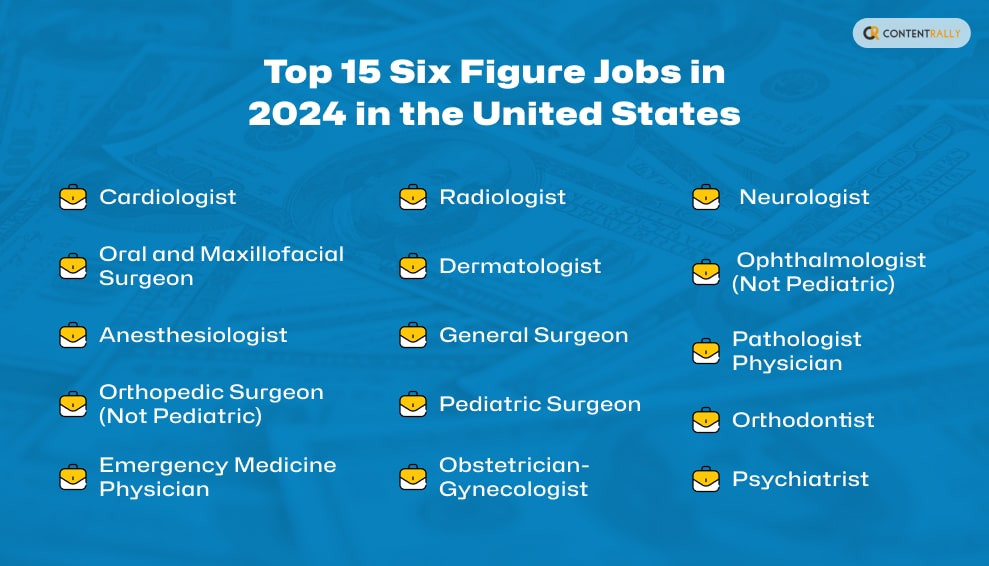
Top 15 Six Figure Jobs in 2024 in the United States

The following are the top six figure jobs in the United States (as of 2024):

1. Cardiologist

The job of the cardiologist is to treat diseases of the cardiovascular system. These are the surgeons who treat heart conditions. However, being a cardiologist is difficult.

This is because the individual must go through four years of medical school and six to eight more years of specialized cardiology training and general internal medicine training. Apart from that, you also need to clear the American Board of Internal Medicine certification exam.

2. Oral and Maxillofacial Surgeon

These surgeons treat different types of diseases, defects, and injuries around the mouth and the jaw.

Here, it would help if have a four-year dental degree and further specializations.

3. Anesthesiologist

Anesthesiologists are physicians who apply anesthetics and analgesics to manage pain due to surgery. However, since these individuals follow the procedure of operating rooms, they have long work hours. Also, their work is quite unpredictable.

To become an anesthesiologist, you must complete four years of medical school and a four-year residency in anesthesiology. Furthermore, this system might change depending on your specialization.

4. Orthopedic Surgeon (Not Pediatric)

The job of orthopedic surgeons is to perform surgery for rheumatic and other similar diseases. Generally, these individuals work in hospitals or private clinics. Hence, the schedule can be hectic and lengthy.

To become an orthopedic surgeon, you must go to medical school after graduation. Moreover, you also need to spend time in a surgery center and then get a state certification.

5. Emergency Medicine Physician

Generally, the job of emergency medicine physicians is to make on-spot medical decisions to treat serious injuries or prevent deaths. Since these individuals must act immediately, the job can sometimes be extremely hectic.

To become an emergency medicine physician, you need to complete a four-year medical school after graduation. Afterward, you must complete a four-year residency as an ER physician. Also, it would help if you cleared a licensing exam post-residency.

6. Radiologist

The job of a radiologist is to diagnose and treat injuries and diseases using technologies like Magnetic Resonance Imaging (MRI), X-rays, Nuclear medicine, and Ultrasound. Here, the individual mainly needs to work in an official setting. Here, they interpret reports and images, as well as recommend diagnoses.

However, you must spend thirteen years in education to become a radiologist. Here, it would help if you had a bachelor’s degree, followed by medical school, residency, and fellowship. Also, you need a license and board certification.

7. Dermatologist

People go to dermatologists when they face problems with skin, hair, and nails. The job of a dermatologist is to perform dermatological and medical surgery functions. Basically, a dermatologist might practice privately or might be a part of a hospital.

Dermatologists get a bachelor’s degree followed by a medical one like other physicians. After getting a specialization, these individuals must go through three to nine years of internship. Moreover, there is also a need for a state-level certification.

8. General Surgeon

The job of an experienced general surgeon is also among the various six figure jobs. Here, you need to review X-rays and other reports and communicate with the patient about diagnostic procedures. If necessary, you must prepare for surgery and complete it with the help of other surgeons.

Like other healthcare professionals, you need to complete four years of medical school after graduation. Additionally, you need a three-year residency and a multi-year internship in the surgery department.

9. Pediatric Surgeon

There is a need for a pediatric surgeon when there are fetal abnormalities, birth defects, injuries, and diseases. Apart from that, pediatric surgeons also treat newborns and infants. They generally work at children’s hospitals. If not, they work privately. However, there is mostly a team of professionals working together.

To become a pediatric surgeon, you must complete five years of adult general surgery after completing your medical school. After that, you have to complete additional training in pediatric surgery for two more years, followed by certification.

10. Obstetrician-Gynecologist

According to WebMD, “Obstetricians focus on pregnancy and related health issues, while gynecologists focus on general reproductive health. These two types of medical professionals work together closely.” These healthcare professionals also diagnose and treat problems that happen in the female reproductive system.

To become an Obstetrician or Gynecologist, you must complete an obstetrics and gynecology residence program after completing your bachelor’s degree and graduation.

11. Neurologist

A neurologist specializes in disorders of the brain and the nervous system. For example, they treat Alzheimer’s disease, amyotrophic lateral sclerosis (ALS), and epilepsy. However, due to subtle surgeries and pressure situations, the job can be hectic at some times.

If you want to be a neurologist, you must complete your four-year medical degree and pass the MCAT exam. After that, you need neurological surgery residency along with board certification and licensure.

12. Ophthalmologist (Not Pediatric)

An opthalmologist helps treat diseases and eye problems. Apart from that, they also offer vision solutions to treat eye problems. These also include glasses and contacts. Generally, ophthalmologists work privately. They not only see patients in their offices but also perform surgery.

It would help if you also had a bachelor’s degree and a four-year medical degree. After that, you must complete your internship between three and eight years. Moreover, after passing the state medical board exam, you can apply for a medical license.

13. Pathologist Physician

Pathologists are those doctors who diagnose diseases and conduct laboratory testing using tissues, body fluids, and organs. Most of them work in clinical labs, hospitals, and clinics. However, depending on the type of work, pathologists might have pressure work situations.

14. Orthodontist

They work to provide corrective measures for the teeth. Hence, they often receive referrals from patients as well. To deal with teeth problems, these doctors look at reports, apply braces and mouth guards, and offer other treatments for the teeth.

To become an orthodontist, you need to complete your dental school program. Furthermore, you must also get clinical experience for a few years to get your license.

15. Psychiatrist

The job of a psychologist is to treat issues related to mental health. However, there are certain specialties for psychologists, depending on what they want to treat. While some of them work on children, others work on consultation, forensics, addiction, psychoanalysis, and many more.

Bottom Line

As you can see, the top 15 six figure jobs are all in the healthcare sector. Hence, if you want to get a six-figure salary at a job early on, you must get one of these specializations. You can do that after you get a medical degree and residency as a healthcare specialist. Furthermore, you also need to get a license to practice.

Do you have more suggestions on the best six-figure jobs? Consider sharing your information in the comments section below.

Read Also:

Content Rally wrapped around an online publication where you can publish your own intellectuals. It is a publishing platform designed to make great stories by content creators. This is your era, your place to be online. So come forward share your views, thoughts and ideas via Content Rally.

View all posts

Leave a Reply

Your email address will not be published. Required fields are marked *

Related

how long does it take to become a physician assistant

How To Become A Physician Assistant In 7 Years Or Less

The title "physician assistant" may evoke images of someone whose job it is to run professional errands for doctors to someone with little knowledge of the health sector. Physician assistants (PAs), however, are highly skilled individuals who are authorized to diagnose, track, and provide medication to patients. Though the responsibilities of PAs and doctors frequently overlap, the degree of autonomy that each enjoys at work varies. Although PAs normally require a doctor's supervision to treat patients, doctors are legally permitted to practice independently. There are other options for pursuing an advanced career in healthcare besides attending medical school or nursing school, as evidenced by the growing demand for PAs. This article covers the steps involved in becoming a physician assistant, as well as typical specializations, salary ranges, and employment prospects for this field. How Long Does It Take To Become A Physician Assistant? Are you interested in becoming a physician assistant? Do you know how to become a pa? Are you wondering how long does it take to become a pa? Did you just google "What bachelor degree do I need for physician assistant?" This article will explain everything to you in detail. Who Is A Physician Assistant? Physician assistants, or PAs for short, are certified medical professionals who assist doctors in delivering care. They provide care as well as keep an eye on the health of patients alongside doctors. While some states permit physician assistants to operate autonomously, the majority mandate that they remain under the direct supervision of physicians. PAs perform physical examinations, write prescriptions for medication, and administer tests. Additional duties for PAs are as follows: Obtaining the medical histories of patients Placing as well as evaluating diagnostic test orders Assisting with medical operations Directing patients to appropriate experts Creating therapy programs Offering patients preventive care advice Track the advancement of your patients. Carrying out clinical research Physician assistants are employed in a variety of locations, including surgery rooms, outpatient clinics, hospitals, and doctor's offices. In addition to working in medical settings, PAs are employed by military institutions, sports teams, and educational institutions. The majority of PAs have full-time jobs with flexible schedules that sometimes include weekends and holidays. Similar to physicians, they might have to work long shifts on short notice and be on call. PAs should be physically fit and have strong interpersonal skills because spending hours interacting with patients and coworkers can get tiresome. How To Become A Physician Assistant? Here are the steps to take before you can become a physician assistant.  Get Your Bachelor's Degree  Getting a bachelor's degree from a recognized university is the prerequisite for working as a physician assistant. Applications from a variety of backgrounds are usually accepted into PA programs, but a science-focused major is advised as it will enable you to apply undergraduate credits toward your PA requirements. Acquire Patient Care Or Healthcare Experience (PCE) (HCE) Prior to applying to graduate school, prospective physician associates (PAs) are advised by the American Academy of Physician Associates to obtain experience in healthcare or patient care. HCE describes employment, whether paid or unpaid, in which you may still interact with patients but are not directly in charge of their care. PCE, on the other hand, necessitates direct patient treatment. At least 1,000 HCE or PCE hours are needed for most PA programs, and these hours are normally obtained after working in the health industry for about a year. A medical technician, paramedic, surgical assistant, dental assistant, hospice worker, physical therapy assistant, and phlebotomist are among the positions that satisfy the need for clinical experience. Enroll In A PA Program With Accreditation You can acquire the advanced knowledge required to pass the national certification exam and start working as a physician assistant by enrolling in a PA graduate program. Clinical anatomy, clinical therapeutics, histology, as well as medical principles are among the subjects covered in a PA program. Additionally, you might participate in clinical rotations or clerkships, which entail observing certified PAs. For those who cannot attend in person, several colleges offer online PA programs. Concentrations are a common feature of these PA programs, enabling students to customize their degrees to meet their professional objectives. Moreover, geriatrics, family medicine, women's health, pediatrics, psychiatry, and general internal medicine are among the common specialties of PAs. Through the Centralized Application Service for Physician Assistants (CASPA), students can submit their admissions applications. PA applicants must submit HCE and PCE records, college transcripts, recommendation letters, resumes, and personal statements to CASPA. Before applying, make sure the Accreditation Review Commission on Education for the Physician Assistant (ARC-PA) has approved the program of your choice. Obtain Certification Graduates from ARC-PA-accredited programs are eligible to take the Physician Assistant National Certifying Examination (PANCE). The National Commission on Certification of Physician Assistants (NCCPA) is responsible for administering the exam. The PANCE is a five-hour multiple-choice test designed to evaluate candidates' knowledge of medicine and surgery. To obtain a PA license in any state in the United States, one must pass the PANCE. States may have different requirements for other particular licenses. How Long Does It Take To Become A Physician Assistant? Usually, it takes at least seven years to finish all of the steps above. You will need four years to complete your undergraduate studies, followed by a year to obtain experience in healthcare and two years to finish a PA program. If you need more time to study for and pass the PANCE, or if you want to gain experience when moving from undergrad and grad school, then the path to becoming a PA may take longer. Salary Of A Physician Assistant As of May 2022, the U.S. Bureau of Labor Statistics (BLS) reported that the median annual salary for physician assistants was $126,010. The industry, degree of experience, and place of residence all affect an individual's compensation. Certain regions of the United States, such as Connecticut, New York, North Carolina, Nebraska, and Montana, have the highest concentrations of physician assistant jobs, putting them in great demand. According to BLS projections, employment for these professionals will grow by 28% between 2021 and 2031, which is nearly six times the projected growth rate for all U.S. jobs and three times the projected job growth rate for other health practitioners nationwide. Specializations Similar to nurses and clinicians, physician assistants can choose to specialize in different areas of healthcare based on their areas of interest as well as strengths. Moreover, the types of patients PAs work with, as well as the range of salaries they can earn, depend largely on their specializations. The majority of PA programs provide elective courses and some mandate that students finish supervised clinical practice across several specializations. Before starting graduate school, we advise you to select your PA specialization so that you can enroll in a program that offers comprehensive instruction in your field of interest. Here are some typical specializations for PA professionals and students. Emergency Practice In this specialization, PA aspirants learn how to assess, stabilize, and treat patients with life-threatening conditions. Students specializing in emergency medicine also gain skills for collaborating with urgent care teams and for presenting cases to physicians. Pregnancy And Gynecology PA students who choose this concentration will graduate with a thorough understanding of childbirth, midwifery, and the female reproductive system as a whole. They get training in giving women prenatal and postpartum care as well as family planning counseling. Pediatrics By providing ambulatory care for infants and children, pediatric PAs assist pediatricians. Students specializing in the pediatrician field gain the ability to assess typical pediatric issues, provide prophylactic care, and explain treatment regimens to patients' guardians. Surgery PA students can assess and oversee surgical patients through the surgery specialization. They gain knowledge on how to care for surgical patients both before and after surgery. Mental Wellness The treatment and support of patients dealing with mental health issues is the main focus of this specialization. Students in this specialty gain knowledge on how to perform mental assessments, track patients' progress, as well as recommend individuals to behavioral health professionals. Certifications Furthering your experience, profile, as well as career certifications helps you gain credibility. Here are a few you can check out. PA-C The primary certification for PAs is the Certified Physician Assistant (PA-C) credential, for which you must pass the Physician Assistant National Certifying Examination. Three hundred multiple-choice questions, given in five blocks of sixty questions each, make up the five-hour PANCE exam. Between sessions, candidates can take 45-minute breaks. Those who wish to take the PANCE must complete a program approved by the ARC-PA before taking it. Potential PAs have 180 days from the date of graduation to apply for the exam; however, they can only take the test beginning seven days later. After submitting an application and paying a $550 fee, NCCPA will email you an acknowledgment along with more details.   Additional Qualifications NCCPA provides optional credentials for ten PA specialties in addition to the PA-C: Cardiovascular and thoracic surgery Dermatology Emergency medicine Hospital medicine Nephrology Orthopedic surgery Pediatrics Palliative medicine and hospice care Psychiatry Obstetrics and Gynecology These qualifications are known as certificates of additional qualifications, or CAQs. They give PAs credit for their specialized knowledge. Professional Organizations While it's not necessary, becoming a member of a professional organization can help PAs become more credible and open up more career development opportunities. The two professional associations that were established to aid physician assistants are highlighted below. The American Academy of Physician Assistants (AAPA) is the preeminent national organization for PA professionals. It was established in 1968. It encompasses more than 168,000 PAs in each of the 50 US states. The AAPA gives its members the tools they need to grow professionally and enhance patient care. Physician Assistant Education Association (PAEA) is the national organization for PA education. It helps academic programs attract and hold onto talented faculty members and PA students. Additionally, it offers a range of study resources for PA certifications. Wrapping Up Additional motivations to become a physician assistant include demand, high pay, work-life balance, autonomy, and job security. If you have the desire and passion to become a PA, then the amount of time it takes is unimportant. Your clinical experience and self-assurance will enable you to lead health care forward and improve patient health and well-being with the Physician Assistant Studies Program. If you have thoughts to share or questions to ask how long does it take to become a physician assistant, then please leave a comment below. We would love to hear from you! Learn More About: The Future Of Healthcare: Adapting To An Aging Society Healthcare Jobs That Will Be Most In Demand 2020–2025 Is Medical Specialities A Good Career Path? – 12 Best Jobs

READ MOREDetails
best paying jobs in electric utilities central

Best Paying Jobs In Electric Utilities Central

Are you looking for the best paying jobs in electric utilities central? I might be able to help you in that case. The electric utility industry is a vast field for many of us looking for employment. There are more than 3300 electric utility centers in the US alone. Two hundred centers offer electricity to many users in the states. Job opportunities in this sector are in high demand with promised professional growth. In addition, many job titles in this sector include travel opportunities across the country, offer compensation based on educational qualification, and excellent job security. If you are looking for employment in this sector, you will find plenty of opportunities in the electric utility center. In this article, I have discussed some best job opportunities in this sector. Read More: “No Career Interests Me” – What To Do? What Are Electric Utilities Central? Electric utility Centrals are electric corporations responsible for generating, transmitting, and distributing electricity to individual users or to a whole country. Also, the electric utilities are public utilities. Although a very labor-intensive industry, the electric utility industry offers rewards to people seeking jobs in this industry. How Does Electric Utility Sector Work? The chain of electric utility central is a complicated one. The whole process revolves around electricity generation at power plants and transmitting them via electricity grids. The grid involves electricity substations, power lines, and transformers. The whole chain links the producers and the consumers in a systematic manner and keeps the service optimized and maintained. How Much Can A Person Earn At Electric Utility Central? According to several benefits available in the electric utility central, job seekers can expect a good pay scale. On average, a working professional would earn around $77k in this industry. However, there are better positions according to qualifications and experience, and those positions will help you earn as much as $145k in the electric utility central. Best Paying Jobs In Electric Utilities Central: 10 Jobs To Consider Here are the ten jobs available in the electric utility central that pay well. 1. Gas Controller Job Description: Indeed there are other jobs in the sector. But this is one of the high-paying ones. As a gas controller, you will have to work with oil and gas companies and make sure that the customers’ needs are met. Some other responsibilities of gas controllers include maintaining pipelines, fixing identified problems, do conduct checks, doing emergency readings, etc. Qualification You need a minimum experience of 2 to 4 years of oil industry techniques. Passionate and energetic enthusiasm.Efficient communication skills. Be better at solving problems.Salary (per annum)$78k to 130K. 2. Power Plant Engineer Job Description: Power plant engineer is one of the best paying jobs in electric utilities central. As a power plant engineer, you have to monitor and manage the day-by-day preparation of the energy plant. They have to conduct tests to check if any maintenance is necessary. Qualification You need a bachelor’s degree in engineering. Mechanical skills.Thinking critically. Communication skills.Salary (Per annum)$100500 to $143500. 3. Nuclear Criticality Safety Engineer Job Description: While looking for the highest paying jobs in the electric utility center, you cannot overlook the post of Nuclear criticality safety engineer. Their occupational task includes dealing with radioactive materials. They monitor to prevent any problematic events from happening in the plants. Qualification Spotting possible dangers. Coming up with new storage and transportation techniques. Working with review boards to send reports and ideas.Salary (Per annum)$89000 to $124000. 4. Nuclear Licensing Engineer Job Description: Nuclear licensing engineers offer technical assistance to nuclear power plants. They ensure the technical efficiency and smooth operations of nuclear power plants. You will also need to work with the nuclear regulatory commission and plan new systems.  Qualification Efficient knowledge of technology. Knowledge of mathematics and physics. Critical thinking, Analytical skills.Salary (Per annum)$77k to $150k. 5. Pipeline Controller Job Description: Another best paying job in the utility central is pipeline controller. Pipeline controllers need to check for leaks in the pipeline and ensure the constant flow of liquid in the pipes. They are also good at optimizing power usage. QualificationTechnical problem-solving. Efficient communication skills. Technical certification is necessary. Salary (Per annum)$70K to $116K. 6. Substation Engineer Job Description: Substation engineers are working professionals who maintain efficient operation of energy. They also need to design substations of high or medium voltages to generate, distribute and transmit energy. Qualification Degree in electrical engineering. Technical problem-solving. Organizational skills. Good communication skills.Salary (Per annum)$89k to $129k. 7. Power System Dispatcher Job Description: Another good job role in the electric utility central is power system dispatcher. Their responsibility is to transmit electricity to the customers via transmitting lines. They also have to communicate with engineers and provide customers with information about clearances. Qualification You need a bachelor’s degree. Good communication skills. Good organizational skill and technical skills.Salary (Per annum)$50k to 120k. 8. Utility Manager Job Description: One of the best paying and hassle-free jobs in the electric utility center is utility manager. Your job role is to look after facilities like - treatment facilities and electrical plants. Qualification You need a bachelor’s degree.Skills of thinking critically. Good communication skills.Salary (Per annum)$64k to 90k. 9. Radiation Engineer Job Description: Another well-paying job in the electric utility sector is the job of radiation engineer. The main work here is to examine and understand the impact of radiation based on the diversity of what surrounds them. They also make powerful devices to utilize radioactivity without any harm. Qualification Masters degree Knowledge of physics. You should be technologically advanced.Salary (Per annum)$89k to $119K. 10. Power System Dispatcher Job Description: Among many jobs in the electric utilities, central Power system dispatcher is a good option that pays well. You have to be efficient at managing the distribution of electricity among suppliers and customers. Qualification You need to monitor generators and ensure efficiency. Determining the daily requirement of electricity. You need good communication skills. Critical thinking and decision-making are other necessary skills.Salary (Per annum)$47,500 to $11,500. Frequently Asked Questions (FAQs): Although I have answered all of your queries, you may still have some questions. In that case, you can take help from the following questions and answers. 1. What Is The Best Utility Company To Work For? Some good utility companies you can work for our.1. ConocoPhillips.2. Baker Hughes. 3. ExxonMobil.4. Duke Energy. 5. PPL. 2. What Are Some Careers In The Field Of Energy? There are many career opportunities in the field of energy. Here are some options worth checking out.1. Welder.2. Transmission system operator.3. Electrician.4. Wind turbine technician.5. Solar panel installer. 3. Does The Energy Industry Pay Well? The energy industry requires many hard-working professionals who are skilled in their work. Indeed the work is hard, but the salary in this industry is also good. You can have 34% more median income in this sector compared to the other industries in this sector. Final Words! This article contains a list of the best paying jobs in electric utilities central. If that is your query, the list provided in this article should help you. I have listed all the qualifications needed for different jobs and their salary. I hope you got your answer from reading this article. In case there are any more queries, you can reach out to us in the comment. Read Also: Are Second Career Programs Worth It?Are Commercial Banks A Good Career Path?How To Move Your Career In Social Media Marketing Up A Gear?

READ MOREDetails
top 10 best paying jobs in real estate investment trusts

Top 10 Best Paying Jobs in Real Estate Investment Trusts in 2024!

If you are looking for a career move in real estate, becoming a part of the REIT can be smart! Considering the trend of shifting to this field is growing quickly, people are often googling the top 10 best-paying jobs in real estate investment trusts. Therfore, in case you are someone who is also looking for this, I have you covered! So, keep reading this blog until the end to learn more, and thank me later… What are Real Estate Investment Trusts? Real estate investment trusts, or REITs, own portfolios of properties supported by institutional and personal investors. A common mechanism for this is real estate investment trusts (REITs), which can own lengthy physical assets (like office buildings and shopping centers) and derive revenue through the collection of rent or lease payments. These businesses create an option for investors to own an actual piece of equity, enabling them to buy stock without having to put up large amounts of capital or assume the responsibilities of ownership. To put it simply, REITs are a form of public real estate entity that allows for a wide variety of jobs in real estate investment and management for either the residential, industrial, or commercial sectors. Types of REITs and Career Opportunities Real Estate Investment Trusts (REITs) are like massive sling pouches of different categories of properties. Like many kinds of fruits, REITs can be invested in different sectors. These commercial properties would include office buildings where people work or shopping malls where we go shopping. Some additional examples are healthcare facilities, such as hospitals or nursing homes, where people go to receive medical care. As we know, not all REITs are created equal. They are like ice cream flavors; they still have different tastes. For instance, Equity REITs are companies that own/manage properties and get paid rent from tenants. Mortgage REITs either loan money for mortgages or invest in existing mortgages. Hybrid REITs do a little bit of both. There is a wide range of occupations that you can accomplish, which makes this variety amazing. Deal-making is a great fit for an Acquisitions Specialist who searches for new properties to purchase. Moreover, if you have strong numerical skills, you may work as a financial analyst, determining whether those properties are worth the money. Or, if you have an environmental conscience, you might work as a sustainability manager who promotes green building practices. REITs present a plethora of chances for lucrative employment. Therefore, in the broad and fascinating world of real estate investment trusts, there's a place for you whether your forte is building management, spreadsheet crunching, or environmental compliance. Benefits of Working for REITs So, now you know about what REITs are and how they operate. But will you have benefits working in this sector? ABSOLUTELY! There are several pros and cons to a career in Real Estate. However, things are a little different when it comes to REITs. Here are some of the reasons why working for Real Estate Investment Trusts can be a great career move: 1. Good Pay: REITs frequently provide competitive pay. You should anticipate receiving a respectable salary, incentives, and other benefits. 2. Variety of Roles: REITs offer jobs in marketing, law, finance, and other fields. They require a wide range of skills to manage investments and assets. 3. Growth Opportunities: REITs offer the ability to advance your career through various divisions and locations. You can begin in a little capacity and progress to a larger one. 4. Security and Stability: REITs' primary emphasis is on generating stable cash flow, as they are obligated to distribute the majority of their revenue to shareholders. 5. Diversification: You work with various property types in REITs, such as shopping centers and hospitals. It is about managing assets that people use daily, not only about selling properties. 6. Professional Management: You will collaborate with knowledgeable managers who handle the day-to-day difficulties associated with property management. Additionally, you will have less tension as a result. 7. Passive Income: You can receive dividend payments if you invest in the REIT where you are employed. It's similar to receiving a bonus for joining the group. 8. Learning Curve: REIT employees must constantly learn new things since the real estate industry is continuously shifting. This keeps their abilities current and their work exciting. What is the Job Outlook for REIT Professionals? How many jobs are available in REITs? This is a valid question that you might be thinking of! Due to the expansion of the real estate market, the need for managers of additional buildings and projects is growing. This increase generates many new jobs for those interested in REITs. Additionally, REITs own various properties, including retail centers, housing, and offices. This is a reason why real estate factors into business decisions. Because of the variety, you can find a job in finance, management, or another field that best suits your skills. Moreover, it's not only about landing a job when working with REITs; it's about developing a career. Over time, there are opportunities to handle larger projects, assume more responsibility, and advance into higher positions. Furthermore, because of the industry's continuous growth, there is a significant demand for REIT specialists. Increased investor interest in REITs also creates additional job opportunities. Top 10 Best Paying Jobs in Real Estate Investment Trusts in 2024! Real Estate Investment Trusts (REITs) are a fundamental part of the real estate sector, allowing investors (individuals) to earn a share of the income produced through commercial real estate ownership. A REIT offers similar diversity and can pay life-changing income in some roles. Wondering what the top jobs in this field pay the most? I have you covered! The top 10 high-paying jobs in real estate investment trusts in 2024 are as follows: 1. REIT Chief Executive Officer (CEO) Firstly, the CEO sets the strategic direction for a REIT and is in charge of overseeing the company's resources, general operations, and important business decisions. Besides, because of the extensive skill set and heavy obligations, the CEO position in a REIT is the highest-paying one. 2. Portfolio Manager Secondly, portfolio managers decide which properties to buy and sell, and they develop the REIT's investment strategy. The REIT's financial stability depends on its proficiency in market analysis and investment strategy, which makes it one of the highest-paying positions in the sector. 3. Real Estate Attorney Thirdly, we have real estate attorneys. You must have heard of law firms helping companies with their real estate issues. These lawyers, who focus on real estate law, deal with complicated transactions, zoning conflicts, and disputes. Their high salaries result from their legal competence, guaranteeing that all transactions are legal and compliant. 4. Property Appraiser An appraiser's evaluation of a property's value is crucial in a REIT. Their assessments impact investment choices and are necessary for truthful financial reporting. Additionally, they are extremely useful due to their specialist understanding of real estate valuation. 5. Investor Relations Manager These experts cultivate and preserve connections with analysts and shareholders. They also provide financial data and business plans, which are crucial for a REIT's reputation and investor trust. 6. Asset Manager The performance of the investment portfolio is monitored by asset managers. Furthermore, they seek to optimize property values and investment returns by making calculated choices on upkeep and improvements. 7. Financial Analyst Financial analysts closely examine corporate fundamentals, economic situations, and market movements. Their observations guide REITs' investment decisions, making their role indispensable for financial planning and analysis. 8. Acquisitions Director Finding and negotiating the purchase of properties are part of this profession. Furthermore. acquisition directors must be skilled negotiators who can find great investment opportunities and get them at the cheapest price. 9. Leasing Manager The leasing managers guarantee that the buildings in the REIT's portfolio are leased to dependable tenants at the best possible rates. Besides, their role directly impacts the REIT's revenue sources. 10. Sustainability Manager Lastly, sustainability managers are becoming increasingly important as the sector shifts to environmentally friendly methods. Moreover, they implement plans to make properties more eco-friendly, which can save money and ensure that rules governing the environment are followed. Wrapping It Up! In conclusion, the real estate investment trust sector offers a variety of lucrative career paths. The roles mentioned above are not only the best paying but also integral to the success and growth of any REIT. Furthermore, as the industry evolves, these positions may adapt, but the essence of their contribution to a REIT's success remains significant. If you are searching for the top 10 best-paying jobs in real estate investment trusts, I hope that this blog has helped you. If you have any other queries, please let me know. All you need to do is scroll down until you reach the bottom of the page. Then, leave your comments and queries in the box below. I will be there to answer them all for you! Learn More About: 5 Mistakes To Avoid In Estate Planning How To Invest In Real Estate Business Dubai? Is Real Estate Investment Trusts A Good Career Path In 2024?

READ MOREDetails