













What Is a Remote Job? Everything You Need to Know

Published on: 03 September 2024 Last Updated on: 15 September 2025
inner-img

There was a time when companies feared that remote work might affect healthy company culture and productivity. However, the pandemic made us realize that remote work can be a great work experience. 

When it comes to remote work, companies allow employees and employers to control where, how, and when they want to work. Multiple studies have confirmed that it helps to establish a positive work environment.

Since 2020, remote work has become popular among all industries. We can observe that remote opportunities are all over the job boards. Some companies even describe themselves as fully remote.

But the real question is, what exactly is remote work, and how successful is it to work from a remote location?

Don’t worry, we have covered everything you must learn about remote work in this blog post. We will pay attention to the benefits and challenges of remote working. I will also discuss the recent remote job posts in high demand.

What Is a Remote Job?

What Is a Remote Job_

In simple terms, remote jobs specifically talk about such work which does not require you to be physically present in the office space.

Previously, remote working was considered just the same as working from home. However, in recent years, the term has evolved. Now, remote working means working from anywhere other than the traditional work setting.

Whether working from a co-working space, your couch, or even a hotel room in another country, it is considered a remote job.

Ultimately, the main aim is to get the job done regardless of the location from which you are working. If you have your laptop or proper internet, you can work from wherever you want.

Remote working includes two specific types:

  • Full remote. In this case, all the interactions take place on a virtual platform.
  • Partial mode. This is also known as hybrid working. In case of partial more, the team splits up, and some of their employees work from multiple locations.

Most of the companies follow their definition of remote working. You can find the specifications on their job descriptions and websites. For example, a company may offer you remote work, but you may have to work while residing in a particular city.

Why Have Remote Jobs Become So Popular Lately_

The traditional 9 to 5 and 40 hours of week still exists in various companies. However, more companies are moving towards the remote working policy. As per the remote working policy, employees are free to choose whether they want to work from the office or from a remote location.

They get the opportunity to choose whatever suits them the best. Remote working has made a massive transformation in our way of working. It offers both flexibility and productivity in an organization. On top of that, it provides excellent access to the global talent pool.

The remote working process has helped redefine the overall company culture. It also helps to adopt new and advanced technologies. Alongside the benefits, remote working has become a central part of the professional landscape.

Thus, both employees and employers must adapt or instead embrace the opportunities and challenges it offers.

In such ways, the companies can combine remote working with their daily operation. This will further empower individuals as well as organizations to connect through the digital world. 

The Major Benefits Of Remote Jobs
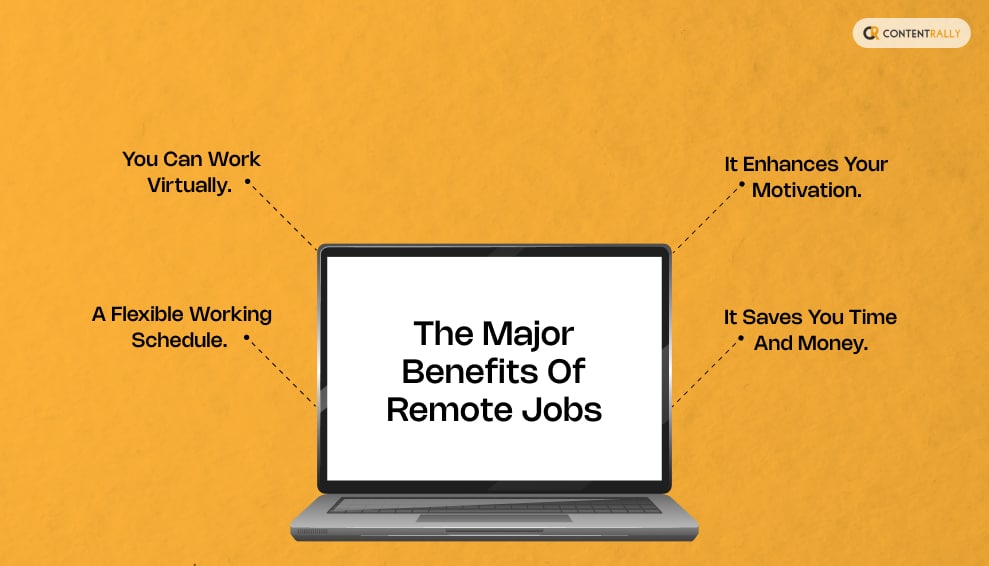
The Major Benefits Of Remote Jobs

There are a lot of benefits to working as a remote worker. In this section, we will discuss the benefits of remote jobs and why they appeal to employers and employees.

You can work virtually

To learn about what a remote job is, it is necessary to understand the significant benefits that it offers. One of the most prominent benefits of remote jobs offer is that you can work from anywhere . You just need to have better internet access.

While working as a remote worker, you can choose your location. It can be a cafe or your own house. You can also work when you are traveling. You have a good internet connection, a well-functioning computer setup, and the time to complete the allocated tasks.

However, some companies have specific rules and regulations regarding location. It would be helpful to understand the company policies regarding remote working.

A flexible working schedule

Remote working offers you a flexible working schedule. Suppose you are mostly productive during the early morning hours. In such cases, you choose the morning shift and tailor your working schedule accordingly.

Remote working allows you to seize the opportunity and choose flexible working hours, leading to great productivity.

It enhances your motivation

Remote working helps you decrease additional distractions from your co-workers, further increasing your motivation. Additionally, it allows you to develop good habits. You also start following best practices that can help you to optimize your day-to-day activities.

It saves you time and money

When working as a remote worker, you can quickly minimize the time you spend commuting. It also helps you to save money on gas or maintaining your car.

Moreover, you can invest less in working clothes or the meals you have outside. As a result, you can keep a proper balance between work and personal life while saving money. 

Are There Any Challenges?

Are There Any Challenges_ 

While remote working has a lot of benefits to offer, there are a lot of challenges that you might face while working as a remote worker. But that doesn’t mean that you cannot avoid the obstacles.

You need to have proper planning to overcome the challenges. In this section, we will discuss the significant challenges of remote working. 

Long working hours

There can be instances where you may have to work longer than your usual shift timing. As we have learned, remote working promotes flexible working hours. Thus, you must ensure you are logging off right on time.

Consider setting an alarm to help you stay updated about your working hours.

Complexity in establishing communication

When working as a remote worker, you communicate with your co-workers virtually. This can lead to a massive communication gap.

If you feel like such things are happening, consider talking to your manager and scheduling a meeting. This can help you to speak to everyone directly and further resolve the communication issue.

Massive workload

As a remote worker, you are more productive than in an office setting. This can lead to an increased workload. In such cases, do not hesitate to speak to your manager about it. Let the management know about the excessive responsibilities.

The manager can help you to rearrange all your priorities. This can help you to maintain a manageable workload. 

What Are The Different Types Of Remote Jobs Available In The Job Market?

What Are The Different Types Of Remote Jobs Available In The Job Market_

Remote working frees you from a 9 to 5 desk job just to complete some meaningful work. In 2024, a lot of industries and companies prefer to provide remote jobs.

In this section, I have provided you with a list of remote work available in the job market.

The industries that are preferring remotes working in 2024:

  • Computer and IT industry
  • HR and recruitment
  • Customer service
  • Medical and health industry
  • Accounting and finance industry
  • Marketing
  • Project management

The top and most common remote jobs of 2024:

  • Accountant
  • Front and back-end developer
  • Content writer
  • Marketing executives
  • Financial analysts
  • Product marketing managers ‘
  • Brand managers
  • Customer service representative
  • Graphic designer
  • HR recruiter
  • Technical writer
  • Project manager

Can I Do Work From Home?

Can I Do Work From Home_

Is the remote job the one for you? Remote jobs may be an ideal deal for all employees. Imagine taking frequent breaks, balancing your work and personal life, and working in a flexible shift- who doesn’t want it?

Even if remote work is ideal for all, practically, only some are perfect fit for remote work. There are many cases where the employees felt left out, isolated, and lonely. As a result, it had a significant impact on their productivity.

But you can still try to determine whether it is ideal. Firstly, you can start working as a remote worker and try it. See if it works out for you or not.

Secondly, you can ask yourself whether you will be motivated to work even when your supervisor is not around! Are you going to feel isolated, or if remote working can actually increase your productivity?

Asking such questions yourself can help you get a proper idea about it.

This article has been helpful for you in understanding what a remote job is and everything you must know about remote working. , don’t forget to stay connected with us for more blogs and articles.

Read Also:

Content Rally wrapped around an online publication where you can publish your own intellectuals. It is a publishing platform designed to make great stories by content creators. This is your era, your place to be online. So come forward share your views, thoughts and ideas via Content Rally.

View all posts

Leave a Reply

Your email address will not be published. Required fields are marked *

Related

Treated Unfairly

Most Important Steps To Take When You Think You Have Been Treated Unfairly

Finding a great job can be difficult. The better the job the more competition there is, meaning that you have to stand out from the crowd. However, what do you do when you have started your dream job and find that you are being treated unfairly. You may think that you simply have to put up with it, after all, what other options are there? But, the simple truth is that every person has the right to be treated fairly. You need to identify if you are being treated unfairly and do something about it. Identifying Unfair Treatment The first step is to look at how you are being treated in comparison to others in your workplace. There is a difference between unfair treatment when you are treated differently from others, and bad treatment when everyone is treated badly. It can help to speak to a reputable unfair dismissal lawyer, even if you haven’t been dismissed. They will help you to identify whether and how you are being unfairly treated. They can also be of assistance in resolving the matter. Step 1 – Bring It Up The first step in dealing with unfair treatment is to bring it up with the company and the specific individual. In many cases, this is your direct boss. Talk to them about the issue you are facing and see how they respond. This can be enough to end the issue. You must remain calm when talking and it is advisable to take a witness into any meeting. You should make notes regarding the entire process. Step 2 – Contact Superiors If this has no effect and the business has an HR department you can bring the issue up with them. They will have set procedures that need to be followed to assess your claim and deal with it properly. If your business doesn’t have a separate HR person that you can talk to then you will need to go to the boss or owner of the company. Of course, if this is the person unfairly treating you that won’t help! Step 3 – Involve The Professionals Should both the above steps have been unsuccessful then it is time to speak to your dismissal lawyer again, even if you haven't yet been dismissed. On the other hand, if you have already been dismissed, contacting a lawyer is the most important step in your 'what to do after an unfair dismissal' plan. The lawyer will be able to contact your employer for you and remind them of the law regarding the treatment of employees. The fact that they are already in the loop means it will be easier for them to assist you if the employer reacts badly and dismisses you (if they have not already done so). Read Also: 5 Ways You Could Have Been Sexually Harassed in the Workplace The Benefits of Drug Testing in the Workplace using Drug Test Cups

READ MOREDetails
How To Become a Midwife

How To Become A Midwife In 2024: A Step-By-Step Guide For Beginners

Are you considering a career as a midwife or nurse? Learn about the various facets of the field, such as typical responsibilities and certification needs, by using this guide. This article also includes information on typical program durations, skills acquired as a nurse midwife, and educational requirements for midwifery schooling.   Pregnancy, childbirth, and the first six weeks after giving birth are the main areas of focus for midwives. Due to the more personal experience that midwives can offer. Expectant people frequently choose to work with them. For example, some midwives in private practice can provide specialized services, such as home births.    Studies indicate that individuals who receive care under a midwife-led model also experience improved health outcomes, reduced need for interventions, and greater satisfaction. In addition, a lot of midwives work in hospitals, obstetrician and gynecologist offices, and birthing centers.    Primary care for expectant patients, physical examinations, creating patient care plans, and educating the public about birth options are among the duties. Here is everything you need to know about how to become a midwife   How To Become a Midwife? To pursue a career as a nurse midwife, students must first obtain a registered nurse (RN) license, which calls for either a Bachelor of Science in Nursing (BSN) or an associate degree in nursing (ADN).    A BSN is necessary to pursue advanced degrees, even though an ADN is a minimal requirement to become an RN. A master's degree in nursing (MSN) or a doctorate is required for students interested in advanced nurse midwife positions to become certified nurse midwives (CNM). Advanced practice registered nurses (APRNs) are what CNMs are.   If you want to know about the duration of each degree, exam, and licensing requirements, we have all the information here. Keep reading to know all about how to become a midwife.    Obtain a Bachelor of Science in Nursing More opportunities are available, and leadership skills can be developed with a four-year BSN program than with an associate degree. Nonetheless, students who wish to start their careers quickly might want to think about getting an ADN.   Students who complete an ADN program in just two years are eligible for a state license. An accelerated BSN can provide a quicker route to a nurse-midwifery degree for students who already hold a bachelor's degree or have college experience in another field. If you want to enter directly into midwifery without a degree as a nurse, then you can skip this step and go for the same certification exam that nurse-midwifery graduates take. Here is how to become a midwife without a nursing degree.    Pass the NCLEX If you are wondering how to become a midwife, you must pass the National Council Licensure Examination for RNs (NCLEX-RN) after completing a BSN program to start working in entry-level nursing positions. There are eight subcategories and four main categories in this exam. Up to 145 questions in a variable question format are possible on the NCLEX.   Gain experience Prior to admission, most graduate-level nursing programs require at least one to two years of clinical experience. Practical experience is beneficial when applying to selective graduate programs. Before earning degrees as certified nurse midwives and additional licensure, nurses often work as RNs. They can possess the authority and knowledge required for advanced practice roles because of their experience.   To get ready for their future positions as CNMs, nurses can obtain additional certifications during this time. For example, the National Certification Corporation certifies registered nurses in neonatal intensive care. This credential requires passing an exam as well as one year of professional experience. This will further strengthen nurses' abilities with newborn infants.   Experience is a crucial factor if you are curious about how to become a midwife.    Enroll for the nursing midwifery program While part-time students may complete their degree in as little as five years, those interested in a career in midwifery should anticipate earning their MSN in two years with full-time attendance.   A Doctor of Nursing Practice (DNP) can be obtained by students in three to four years, although an MSN is a minimum requirement for CNMs. Part-time options, which can take up to seven years, are also offered by universities. Students can choose the population as well as topics they wish to concentrate on with a DNP.   APRN licensure and specialty certification Students enrolled in advanced nurse-midwifery programs are eligible to sit for the national certification exam for the specialty. A practitioner's national certification by the American Midwifery Certification Board (AMCB) attests to their expert knowledge and ability to care for patients.   Students must hold an unrestricted RN license and graduate from an institution recognized by the Accreditation Commission for Midwifery Education to be eligible. Every five years, CNMs are required to reapply for certification. Nurse midwives can apply for an APRN license in their state after passing their certification exam. Each state has different licensing requirements.   Start looking for a position RNs should think about the population they want to work with to identify the facilities that will best advance their careers. According to BLS projections, there will be a 45% rise in the demand for midwives between 2020 and 2030. Students should, however, consider elements like credentials and experiences that can help them stand out from the competition.    Midwife Schooling An MSN is the minimal degree required for certified nurse midwives. Students should be aware that the length of time required to become a nurse midwife varies depending on the level of training and experience required. The coursework, average program lengths, and admission requirements are described in the sections that follow.   BSN The first step towards becoming a midwife should be obtaining a BSN, as this degree prepares graduates for an MSN. Graduates of ADN programs can also obtain an RN license. Moreover, to obtain an MSN, practitioners must consider alternate bridge programs.   Admission Criteria: 2.5 GPA, CV, essay, and two to three recommendation letters   Program Curriculum: Basics of caregiving and beginning science and math classes may be covered in the courses. In addition, clinical field experiences are required of students.   Time Required: Four years of consistent attendance   Acquired Skills: Students gain leadership, management, as well as evidence-based practice skills and learn how to treat patients from various communities.   MSN The minimal qualification needed to work as a nurse midwife, or CNM, is an MSN. Since this degree takes less time than a DNP, practitioners obtain it to begin their careers as midwives.   Admission Criteria: 3.0 GPA, resume, three recommendation letters, RN license, and some schools' requests for GRE results are the requirements.   Program Curriculum: Patient advocacy and clinical leadership are prioritized in MSN programs. Gynecologic health, advanced pathophysiology and pharmacology, and healthcare ethics are among the possible course topics. For students to be eligible for licensure, clinical experience is required.   Time Required: Two years of full-time attendance. Accelerated bridge programs may be available to ADN holders.   Acquired Skills: Students enhance their clinical leadership, decision-making, and interpersonal communication abilities.   Doctor of Nursing Practice Candidates for DNP programs must have an MSN from an approved university to be eligible. In certain nurse-midwifery programs, students can earn both a master's and a doctorate in three years by completing a bridge program that combines their MSN and DNP requirements. DNP holders give themselves a distinct advantage as subject-matter experts in the marketplace.   Admission Criteria: Minimum 3.0 GPA, unencumbered RN license, GRE results, and clinical experience with the target population are required.   Program Curriculum: Women's health maintenance and restoration on their own are among the objectives. Clinical experiences and the science of healthcare delivery may be covered in courses.   Time Required: Three years of consistent full-time attendance   Acquired Skills: Students here gain an advanced clinical introduction to research methods to improve patient outcomes.    Nurse Midwife Credentials After completing nursing school, CNMs can obtain a state license as well as national certification, proving they meet the legal requirements to practice. Additionally, graduates must obtain American Midwifery Certification from the AMCB. This certification verifies to patients and employers that the candidate has the necessary knowledge and abilities in midwifery. Moreover, certification enables CNMs to apply for state licensure.   Certifications To legally practice midwifery, a certified nurse midwife must obtain certification. The AMCB establishes the minimal requirements for midwifery practitioners and grants the CNM credential.   Moreover, prospective CNMs need to have clinical experience. They must be proficient in handling STDs, assisting with childbirth, offering reproductive care, and caring for women's health.   In addition, qualified candidates must possess an unrestricted RN license and an advanced nursing degree from an accredited program. Candidates must finish a four-hour computer-based exam at a testing location that has been authorized. There are 175 multiple-choice questions on the test.    Licensure RN and APRN licenses are the two state-level licenses required for CNMs. State-specific requirements for APRN licensure and RN licensure differ. Each applicant for an RN license must have either an associate or bachelor's degree. To be eligible for graduate school, nurses who aspire to become advanced licensed practitioners should select a bachelor's degree.   Occasionally, states release a list of accredited programs with a thorough curriculum and the required number of clinical hours for RN candidates to obtain licensure. Candidates must also pass the NCLEX-RN. State boards that oversee nursing licenses typically charge an application fee and demand a background check. After receiving a graduate degree, a prospective CNM can apply for an APRN license.   They should be licensed registered nurses (RNs) and can earn a master's or doctorate in nursing. For these nurses to be eligible for APRN licensure, they typically need to obtain a certification in a specialized field.    APRNs need a state license to practice nurse-midwifery. When choosing a school, students should check the requirements set forth by their state since every state board of nursing has minimum requirements. Before applying for a certificate of authority, candidates should first obtain their AMCB certification. Moreover, the renewal process varies depending on the state. For example, in odd-numbered years, some states might mandate renewal every two years.   Becoming a Nurse Midwife in Practice In order to help them network and find employment after completing their nursing and midwifery degrees, students might want to think about developing relationships during clinical and fieldwork. Reaching out to practices before graduation or volunteering could be another tactic. According to BLS data, the average salary for nurse midwives is $114,210. Students ought to research the typical income in their county or state, though.   Hospitals (State, Local, and Private) CNMs work with physicians to provide nonsurgical family planning methods and provide primary care for expectant patients.   Birthing Facilities CNMs support laboring individuals emotionally, help parents with labor, and keep an eye out for any complications.   Clinics for Public Health CNMs lower the incidence of unfavorable outcomes like preterm birth and stillbirth. They can investigate healthcare disparities, including how nurses can address differences in infant mortality. They oversee programs that advance women's health.   How Much Does a Midwife Earn? When asking "how to become a midwife,” you may also ask "how much does a midwife make?"    Now that you know what kind of education and training a midwife requires, here is a little detail on midwives' salary scope.   The US Bureau of Labor Statistics reports that midwives in typical work environments, such as doctor's offices, hospitals, schools, and local government establishments, earn an average of $77,510 to $171,239 per year. The highest-paid midwives are said to work in outpatient care facilities, where their annual salary is $153,310.    The geographic location of a midwife can also affect their pay. The following states have the highest rates of midwife employment and mean yearly salaries:   California: $169,530   New York: $126,610   Florida: $97,690 Texas: $93,280   Minnesota: $116,780  These rates reflect the general need for midwives in these areas, the cost of living, as well as the standard of living.  Wrapping Up Even though job security might be desirable, you should think about a lot more factors before accepting a position in the healthcare industry—or any field, really. It's important to consider if becoming a midwife is in line with your values as well as aspirations. Determine your areas of interest and consider whether becoming a midwife would be a rewarding career choice for you. If your response to the previous question is yes, then you should consider whether you would be prepared to devote the necessary years of study and training to become a licensed midwife. It will take about seven years to finish your training with a bachelor's degree as well as a foundational master's degree. What kind of midwife you want to become is something else to think about. The route that leads to becoming a CNM will yield greater advantages, particularly regarding your desired practice location. As was previously mentioned, CNMs have a lot more options. But the training you get will be far more thorough. If you have thoughts to share or questions to ask about how to become a midwife, then please leave a comment below. We would love to hear from you! Learn More About: Therapist Or Psychiatrist: Which One Is Right For You? How To Become A Physician Assistant In 7 Years Or Less Is Medical Specialities A Good Career Path? – 12 Best Jobs

READ MOREDetails
slider-img

55+ Unique Interview Questions to Ask Your Future Employer

Unique interview questions to ask employer? But are you supposed to ask questions as a candidate? Who said an interview is a one-way process? As a potential candidate, are you only there to answer their question and prove your worth? Please remember you are also assessing the workplace to understand whether the workplace is fit for you. It would help if you asked questions to ensure you are joining the right place. Now, we all know basic questions like job roles and salary negotiation. However, asking the right questions can improve your interview experience. The to-and-fro communication can create a memorable experience for your employer, compelling them to give you a callback. Therefore, swallow your anxiety and start making the most of your interview. Especially if this is your ultimate dream job and you are well prepared to get it. However, you shouldn’t have to think and prepare these questions when you can get a compiled list from your predecessor all over the internet. So, without further ado, let’s get into the unique interview questions to ask the employer. Unique Interview Questions to Ask Employer – 10 Questions About the Work Here are the ten unique questions you can ask about the work. Because asking questions should also be a part of your interview prep. 1. Do you offer opportunities for cross-departmental collaboration, and how can I get involved in such projects? 2. How does the company measure success in this role, both in the short term and long term? Plus, are they just quantitative, or their qualitative measures as well? 3. Can you please share an example of a recent project where the team exceeded expectations? What made it successful? 4. How does the company prioritize work-life balance, and are any specific practices or policies in place to support it? 5. What are the most significant challenges the team is facing? Additionally, how can we overcome it with my skills? 6. How does the organization encourage continuous learning and development within the team? 7. What role does innovation play in our department, and how do you typically receive new ideas from employees? 8. Can you give me an insight into the company’s long-term vision and how my role fits into achieving those goals? 9. What key skills have led to success for individuals in this role or in this company? 10. How does the company approach feedback and performance reviews? Additionally, what can I expect in terms of ongoing communication and support? Unique Interview Questions to Ask Employer – 10 Questions About Your Team If you are going for a role that requires you to hold a leadership position, or you are a fresher joining a new team, understanding your team is important. Therefore, queries about your team should be one of the crucial questions to ask in an interview. 1. What is the current team strength, and how can I help leverage the strength for optimal growth? 2. How about conflict? Is the team more prone to conflict? If yes, how can I help deal with any form of disagreement? 3. What is the current team dynamic? What kind of personalities am I going to encounter? 4. Can you tell me your team's immediate priorities? 5. Is the team currently dealing with any problem delaying its productivity? Can I help the team in any way? 6. What about success? How do we acknowledge & celebrate the big and small successes as a team? 7. Does the team conduct meetings to understand the different challenges each member faces or what the team is facing in general often? 8. How does the team show their support to each other in terms of professional and personal problems? 9. Do we have access to professional tools? Is the senior management willing to take suggestions regarding paid tools that can ease the team’s work? 10. Finally, what unique role does each member play in the team besides their everyday job role? Unique Interview Questions to Ask Employer – 10 Questions About Your Own Future & the Company’s We all join an office with a certain personal plan. Therefore, questions confirming that your plan aligns with a company’s are important. Think about asking at least one or two of the following questions. 1. I have a two-year plan. If I plan to stay in this company for the next two to three years, what opportunities can help align my personal plan? 2. What is the minimum time for a promotion? Plus, is there any exceptional case for this? 3. Are there any upcoming projects in which I can take an active part and improve through real-time experience? 4. How do you see me grow in your company? What are you expecting from me in terms of career growth? 5. In my potential job role what are some of the analytical or conceptual skills you expect me to improve? 6. How often will the senior management or my team manager give me feedback on my work? 7. Is there any soft skill I need to build to do better in my current team? 8. How does the company encourage employees towards creative challenges & innovations? 9. Is there any current roadmap for the company’s growth? 10. How frequently do you reassess roles & responsibilities within a team or even cross-team? Unique Interview Questions to Ask Employer – 10 Questions to Ask About the Office Environment No matter how good the role, team, or salary is, getting your job done every day could be detrimental if you are not getting a positive environment. Therefore, try to sneak in some of these questions regarding the office environment. 1. What is the company doing to improve cross-team & employee bonding? 2. Is there any strict policy against office politics & discrimination that can create an unhealthy working environment? 3. Has the company implemented a POSH (Policy of Sexual Harassment)? 4. What are some of the unspoken rules & disciplinary measures on the office floor that I should be aware of? 5. Can you please tell me some of the new changes made in the office policy to improve the overall environment? 6. What about hybrid work? Will I be asked to come to the office for a few days without prior notice? 7. When working from home am I permitted to leave town, or do I need to place an official notice? 8. What is the policy regarding informal networking post office hours with my team for relationship-building? 9. How about office desk personalization? Is there any formal or informal policy regarding it? 10. What is the balance between formal & informal communication in the team? 10 Challenging Questions – Questions about Challenges These unique interview questions cannot end without asking some of the questions regarding the corporate challenges of the company. After all, no job is all bed of roses and sunshine. Yes, there will be challenges, the trick is always to be aware of the common problems. These questions are also important to ask if you want to detect some interview red flags early on. What are the most significant challenges this team currently faces, and how are they being addressed? Can you share an example of a recent challenge the company overcame and the lessons learned from it? What are the biggest challenges you foresee for someone stepping into this role? How does the company approach problem-solving when faced with unexpected challenges? What are some common challenges new employees face during their first six months here? How does the company support employees in overcoming challenges related to work-life balance? What are the main obstacles the company anticipates in achieving its long-term goals? How does the leadership team communicate and manage challenges affecting the company? What strategies are in place to handle rapid growth or expansion challenges? Can you describe a time when the company faced a major challenge that tested its core values? How was it handled? What’s Next – 5 Next Steps About the Interview Process Finally, let’s get into the top questions to help you understand what comes next in the interview process. 1. What is the next step of this interview process? 2. When can I expect to hear from you again? 3. Will you let me know the results even if I am not accepted for the role? Plus, how long will that take? 4. What is a good time before I could follow up? 5. Can I share any further documents with you? Finally, do more than lead the interview with your own queries. Yes, also show gratitude towards the interviewers and thank them for their time. You can also send them a thank you mail 24 hours after the interview. Remember this mail is not a follow-up to the interview. Yes, you can subtly ask about the results, but the subject matter of the mail would be a simple thank you. The Final Note! Remember, an interview is as much about you evaluating the company as it is about them assessing you. By asking thoughtful and unique questions, you demonstrate your genuine interest and gather crucial information to make an informed decision. Whether it’s about the role, team dynamics, or company culture, your inquiries can uncover the deeper realities of the workplace. Use this opportunity to ensure the company aligns with your career goals and values. And don't forget to express your gratitude for the interview opportunity—your positive demeanor can leave a lasting impression. Good luck! Read Also: Red flags of a job interview: 8 reasons to turn down an offer 6 Things You Must Do to Prepare for a Video Interview

READ MOREDetails