









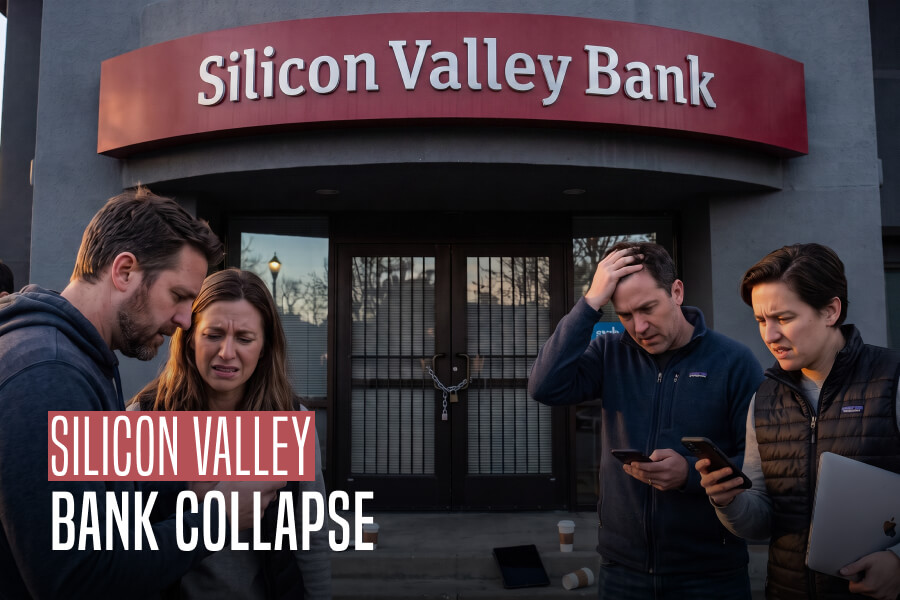
Silicon Valley Bank (SVB) is the 16th largest commercial banking institution in the United States.
On 10 March 2023, it was officially closed by regulators following an unprecedented liquidity crisis.
For over four decades, SVB functioned as the primary financial anchor for the global technology, venture capital, and life sciences startup ecosystems.
However, its specialized business model left its balance sheet highly vulnerable to sudden market shifts.
This case study analyzes how a severe asset-liability mismatch, combined with aggressive macroeconomic interest rate hikes, created a massive hole in the bank's finances.
When management attempted a forced, uncoordinated sale of assets to raise cash, it sparked immediate panic across highly connected venture capital networks.
The resulting panic triggered the first light-speed, mobile-app-driven bank run in human history, with depositors attempting to withdraw $42 billion in a single 10-hour window.
This institutional breakdown forced emergency regulatory interventions from the Federal Reserve to safeguard global market stability.
The Silicon Valley Bank Collapse Speaks Of An Asset-Liability Trap
The collapse of Silicon Valley Bank was not caused by high volumes of bad loans or toxic credit defaults.
Instead, it was a structural failure.
Additionally, it was driven by a classic Asset-Liability Mismatch (ALM) that left the bank completely exposed to rapid shifts in interest rates.
During the tech boom of 2020 and 2021, venture-backed startups flooded SVB with massive amounts of liquid cash.
Therefore, this caused total deposits to balloon from $61 billion to over $189 billion in less than 24 months.
In addition, short-term corporate lending demand could not keep pace with this sudden wall of capital.
Therefore, SVB’s treasury department made a fateful investment choice.
Then, it parked $91 billion of this excess cash in long-term, fixed-rate Held-to-Maturity (HTM) mortgage-backed securities and US Treasuries.
This allocation strategy assumed that macroeconomic interest rates would remain low indefinitely.
However, throughout 2022, the Federal Reserve launched an aggressive monetary tightening cycle to combat rising inflation.
This rapidly raised benchmark interest rates.
As interest rates soared, the open-market value of SVB’s older, low-yield fixed-rate bonds depreciated significantly.
Because these assets were locked in the HTM accounting box, these massive multi-billion-dollar losses remained hidden on paper.
It stayed this way until the tech funding market began to dry up.
Therefore, this forced startups to draw down their accounts and forced SVB to find immediate cash.
How Does The Timeline Look?
The operational lifecycle of the crisis shows how a stable financial institution can spiral into complete insolvency in less than 48 hours:
| Milestone Date | Financial Event | Underlying Systemic Impact |
|---|---|---|
| Mid-2021 | SVB invests over $90B in fixed-rate bonds at an average yield of 1.56%. | Locks up vital cash reserves into long-term assets right before a major inflation cycle. |
| Full-Year 2022 | Federal Reserve raises interest rates from 0% to over 4.25%. | Triggers massive, unhedged paper losses across SVB's long-term bond portfolio. |
| 8 March 2023 | SVB liquidates $21B in available bonds at a crushing $1.8 billion net loss. | Management announces an uncoordinated $2.25B emergency stock sale to plug the hole, triggering widespread market alarm. |
| 9 March 2023 | Prominent VC firms order their portfolio companies to withdraw their funds immediately. | Sparks a massive digital run, with customers initiating $42 billion in electronic withdrawal orders in 10 hours. |
| 10 March 2023 | Regulatory agencies step in to freeze operations and protect assets. | The DFPI revokes the bank's operating license and places SVB into official FDIC receivership. |
What Are The Root Causes Behind The Silicon Valley Bank Collapse?
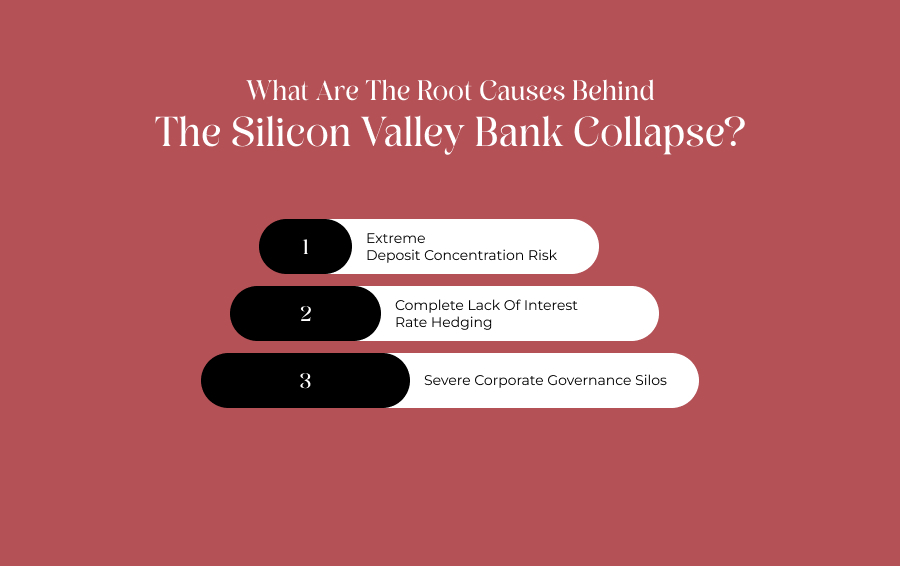
These three are the primary causes of this major shutdown. Let’s look at each of these closely.
1. Extreme Deposit Concentration Risk
This case is completely different from traditional commercial banks that diversify their ledgers across:
- Retail Consumers
- Varied Manufacturing Lines
- Multiple Distinct Industries
SVB's client base was almost entirely concentrated within the venture capital and tech startup ecosystem.
Furthermore, an overwhelming 90% of SVB’s total deposits exceeded the standard $250,000 FDIC insurance limit.
This lack of baseline security meant that when tech funding slowed down, clients began drawing down their accounts simultaneously.
Also, this left the bank highly vulnerable to a sudden herd mentality.
2. Complete Lack Of Interest Rate Hedging
As the Federal Reserve launched its historic interest rate hikes, SVB's asset managers failed to adjust their strategy.
In fact, throughout 2022, the bank systematically reduced or completely canceled its interest rate swap derivatives.
Therefore, the standard financial instruments institutions use to hedge against bond value drops.
This left its multi-billion-dollar bond portfolio completely exposed, turning a macroeconomic rate adjustment into a fatal capital drop.
3. Severe Corporate Governance Silos
The bank's internal safety checks failed due to leadership gaps.
SVB operated without an official Chief Risk Officer (CRO) for nearly eight months during the exact window when the Federal Reserve was aggressively raising interest rates.
This internal vacuum allowed the asset-liability mismatch to expand completely unchecked by internal risk auditors.
The Digital Mechanism: The First Smartphone Bank Run

A defining characteristic of the SVB collapse was the speed of the panic, accelerated by modern communications and digital banking channels.
Traditional bank runs were physically constrained by real-world logistics—customers had to stand in lines outside brick-and-mortar branches, which naturally slowed the withdrawal rate. SVB, conversely, was the first entirely digital bank run.
The second the bank announced its balance sheet losses, prominent venture capital funds flagged the risk on private WhatsApp groups, Slack channels, and public social networks.
Fearing immediate capital freezes, fund managers advised their founders to withdraw capital immediately.
Because tech founders are highly connected and online, they initiated multi-million dollar wire transfers simultaneously via mobile apps and online portals.
This light-speed panic pulled $42 billion out in a single day—accounting for a quarter of the bank's total deposit base—and completely broke the bank's liquidity routing systems.
Comprehensive Lessons For Modern Corporate Treasuries
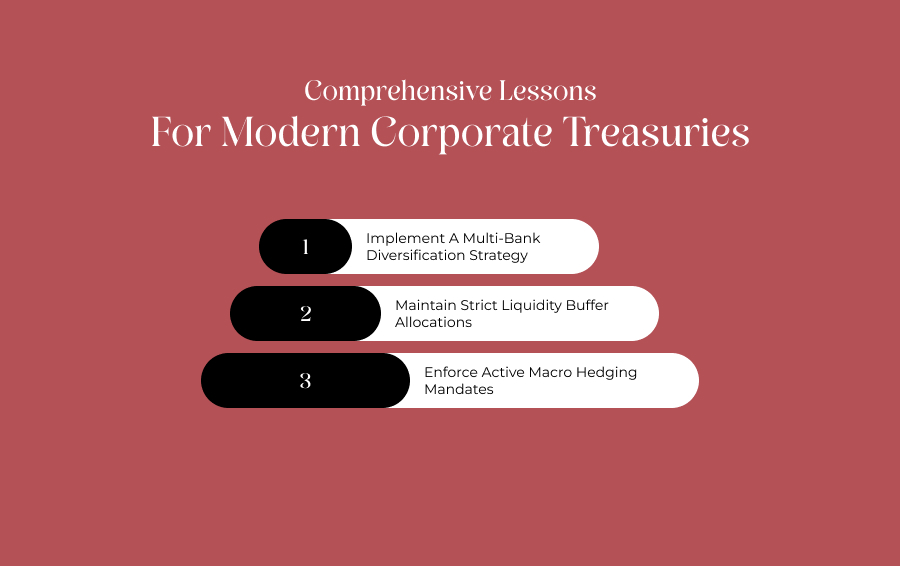
Analyzing the SVB collapse highlights several essential risk-management rules for modern financial officers and corporate team leaders:
· Implement A Multi-Bank Diversification Strategy
Never park your entire operating capital within a single financial institution, no matter how specialized they are in your sector.
Secure your funds by spreading your cash reserves across multiple systemic banks using automated sweep accounts to maximize your FDIC insurance coverage.
· Maintain Strict Liquidity Buffer Allocations
Ensure your internal treasury guidelines require that at least 20–30% of your total corporate reserves be held in highly liquid, short-term cash equivalents.
These can be overnight deposits or short-term Treasury bills.
Both of which can be accessed instantly without triggering market-sale penalties.
· Enforce Active Macro Hedging Mandates
Board-level risk committees must enforce strict, ongoing evaluation cycles to track shifts in macroeconomic interest rates. Ensure your internal treasury policies are actively aligned with changing central bank rates, using interest rate swaps to insulate long-term asset values against sudden market shifts.