










The clean energy sector requires immense capital expenditure.
Also, we must agree that another important factor is highly disciplined project management.
Additionally, you must pay attention to predictable, long-term cash flow matching.
Therefore, this is something to consider when firms are expanding global infrastructure footprints.
In fact, they must prioritize concrete balance sheet liquidity over ambitious growth projections.
A primary historical baseline for structural corporate failure in this space is SunEdison, Inc.
Originally a silicon wafer manufacturer spun out of Monsanto (MEMC Electronic Materials), SunEdison transformed itself through aggressive acquisitions into the world’s largest renewable energy development company.
However, its rapid ascent culminated in one of the most spectacular failures in corporate history.
On April 21, 2016, SunEdison filed for Chapter 11 bankruptcy protection.
There, it listed a staggering $20.7 billion in assets alongside $16.1 billion in liabilities.
This exhaustive case study dissects strategic miscalculations and flawed financial engineering architectures.
Also, this blog will point out the governance of blind spots and structural lessons of the collapse.
SunEdison Corporate Operational Profile
| Evaluation Category | Peak Growth Architecture (2013–2015) | Bankruptcy Reality And Failure Triggers (2016) |
|---|---|---|
| Market Identity | Evaluated as a premier global clean-energy champion and Wall Street darling. | Consolidated as a permanent cautionary tale of extreme financial engineering and insolvency. |
| Growth Strategy | Inorganic expansion funded entirely via aggressive corporate debt and acquisitions. | Severe liquidity crisis driven by an inability to service rapid debt margins. |
| Capital Vehicle | Deployed two twin YieldCo vehicles: Terraform Power and Terraform Global to pool assets. | YieldCo structures faced intense public market scrutiny and deep investor panic. |
| Regulatory Standing | Fueled by extensive federal subsidies, state grants, and low-interest capital injection. | Subject to sweeping investigations by the U.S. Department of Justice (DOJ) and the SEC. |
| Valuation Peak | Enterprise value soared past $10 billion; stock appreciated over 2,200% at its zenith. | Erased 99% of total equity valuation within a tight nine-month market window. |
What Are The Core Failure Factors Behind SunEdison Collapse?
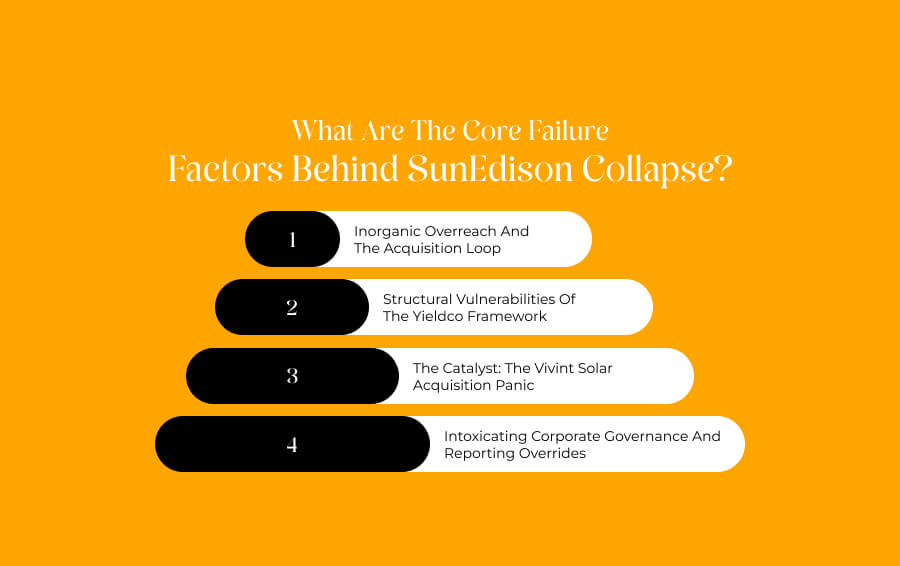
Behind this huge financial collapse are several core factors. Let’s look at them closely:
1. Inorganic Overreach And The Acquisition Loop
Under CEO Ahmad Chatila, SunEdison pivoted away from organic solar asset development toward relentless, debt-fueled international acquisitions.
Furthermore, the company spent billions purchasing wind and solar developers globally.
Of course, this includes a major $2.4 billion acquisition of wind-power developer First Wind in early 2015.
By scaling too quickly across disparate international jurisdictions, the company inflated integration overhead.
Additionally, it stretched its operational focus. So, this left it structurally fragile when macro market conditions shifted.
2. Structural Vulnerabilities Of The Yieldco Framework
To sustain its capital-intensive buying spree, SunEdison pioneered a complex financing model utilizing YieldCos.
They created subsidiary corporate spin-offs designed to own and operate completed, cash-generating renewable energy assets.
SunEdison launched two public YieldCos:
- TerraForm Power (NASDAQ: TERP): Tasked with holding mature domestic solar and wind assets.
- TerraForm Global (NASDAQ: GLBL): Built to manage emerging-market clean energy contracts.
The strategic purpose of these vehicles was to buy completed utility projects from the parent company (SunEdison).
Therefore, this provided a steady stream of dividend payouts to public investors.
In addition, it freed up liquidity for SunEdison to build more projects.
However, a lethal structural conflict of interest quickly emerged.
As SunEdison's development costs spiraled out of control, it began treating the legally distinct YieldCos as private credit lines.
The parent company pressured the subsidiaries to buy unfinished or underperforming projects.
This simply injected quick cash back onto SunEdison's balance sheet. But it severely eroded public investor confidence.
3. The Catalyst: The Vivint Solar Acquisition Panic
The structural vulnerabilities collapsed entirely in July 2015, when SunEdison announced a definitive agreement to acquire residential solar installer Vivint Solar for approximately $2.2 billion.
Public markets immediately rebelled against the transaction.
Institutional investors and hedge funds realized that entering the highly fragmented, high-churn residential solar segment would require immense capital that SunEdison simply did not possess.
The announcement triggered an aggressive sell-off of SunEdison and TerraForm stock.
As the parent company's share price plummeted from over $30 to under $3 in a matter of months, it lost its primary financial mechanism: the ability to raise cheap equity capital by issuing new stock.
Deprived of public funding and saddled with massive near-term debt covenants, SunEdison's liquidity evaporated.
4. Intoxicating Corporate Governance And Reporting Overrides
As the cash deficit widened through late 2015, internal executives and financial officers raised alarms regarding imminent liquidity cliffs.
Rather than pivoting strategy or curtailing acquisitions, corporate leadership marginalized internal critics.
The company delayed its mandatory SEC financial disclosures, leading to structural downgrades from credit rating agencies.
Ultimately, the lack of corporate transparency triggered formal SEC investigations.
Additionally, it prompted the U.S. Department of Justice (DOJ) as well.
Both wanted to determine whether executives intentionally misled the market about actual cash reserves before the collapse.
The Ultimate Asset Post-Mortem: What Happened To The Yieldcos
While SunEdison's parent equity was completely wiped out in bankruptcy court.
This leaves the original shareholders with absolutely nothing, but its underlying clean energy assets retained high fundamental value.
In 2017, Canadian asset management giant Brookfield Asset Management stepped in.
Brookfield bought TerraForm Global outright for $787 million and acquired a controlling stake in TerraForm Power.
Therefore, this eventually merged it fully into Brookfield Renewable Partners.
Managed under strict capital discipline rather than reckless financial engineering, TerraForm survived, pivoted its growth strategy, and expanded its portfolio.
This proves that SunEdison’s core failure was entirely an operational and structural financing disaster, not an issue with the baseline utility of solar or wind technology.
Forensic Accounting Breakdown: Project Caching Vs. Cash Depletion

The hidden mechanic behind SunEdison’s immediate bankruptcy was an extreme disconnect between reported non-cash assets and actual liquid cash reserves.
The parent firm relied on an accounting trick where it recognized massive immediate paper profits the moment it offloaded an uncompleted construction project to its YieldCos.
However, because the projects were unfinished, they generated zero real operational cash flow.
SunEdison was simultaneously burning through over $1 billion a quarter in hardware manufacturing overhead and construction costs.
By the time internal auditors raised flags, the company’s internal ledger had misappropriated over $231 million from its own subsidiaries.
So, this uses long-term project capital to plug immediate, short-term debt margins.
This creates an explicit accounting lesson: Paper profits and aggressive asset valuations mean nothing if a corporation lacks the net liquid cash flow to meet its weekly debt-servicing requirements.
Core Strategic Lessons For Modern Tech And Cleantech Industries
| Strategic Imperative | The SunEdison Mistake | Sustainable Operational Correction |
|---|---|---|
| Growth Velocity | Prioritized inorganic scale and market share at the absolute expense of cash-flow health. | Scale should match real, baseline operational margins and positive cash generation. |
| Capital Allocation | Leveraged complex, multi-tiered financial structures to mask immediate structural losses. | Maintain corporate transparency with clear, independent balance sheets for subsidiaries. |
| Vetting Protocols | Executed cross-border acquisitions rapidly with minimal localized due diligence. | Implement strict risk assessments; optimize existing assets before taking on new debt. |
| Risk Management | Fired or ignored senior executives who raised alarms about liquidity positions. | Establish an independent board audit committee to protect whistleblower channels. |
Timeline Of The Corporate Fall
- 2014: SunEdison launches its first YieldCo, TerraForm Power, achieving massive initial valuation success on Wall Street.
- Early 2015: Acquires First Wind for $2.4 billion, shifting aggressively into multi-asset global utility development.
- July 2015: Announces the ill-fated $2.2 billion Vivint Solar acquisition, triggering immediate investor panic and stock deterioration.
- Late 2015: Appoints an independent committee to investigate internal financial reporting discrepancies amid whistleblower complaints.
- March 2016: The Vivint Solar deal collapses entirely; TerraForm Global publicly warns that SunEdison faces an imminent risk of bankruptcy.
- April 2016: SunEdison officially files for Chapter 11 bankruptcy protection, rendering public equity shares worthless.