







Three Arrows Capital Case Study: Hyper-Leverage And The Crypto Contagion

three arrows capital

The asset management sector requires strict risk mitigation parameters, diversified portfolio allocation, and structural buffer liquidity.

When managing alternative digital asset portfolios, investment funds must balance directional bets with real downside risk modeling.

A primary historical baseline for structural collapse within the web3 ecosystem is Three Arrows Capital (3AC).

Founded in 2012 by former classmates Su Zhu and Kyle Davies, 3AC transitioned from traditional foreign exchange trading to become the premier crypto hedge fund, managing over $10 billion in assets at its valuation peak.

However, its aggressive market footprint ended in a catastrophic corporate implosion.

In June 2022, a British Virgin Islands court ordered the liquidation of the fund, preceding its Chapter 15 bankruptcy filing in New York.

This exhaustive case study evaluates the strategic overreach, uncollateralized debt architectures, and interconnected counterparty defaults that triggered a systemic multi-billion-dollar financial meltdown.

The Three Arrows Capital Scam: Evaluating The Responsible Factors
The Three Arrows Capital Scam

Like all the historic financial disasters, this one too has some of the most obvious yet striking reasons behind it.

Let us take a closer look at what these factors really are:

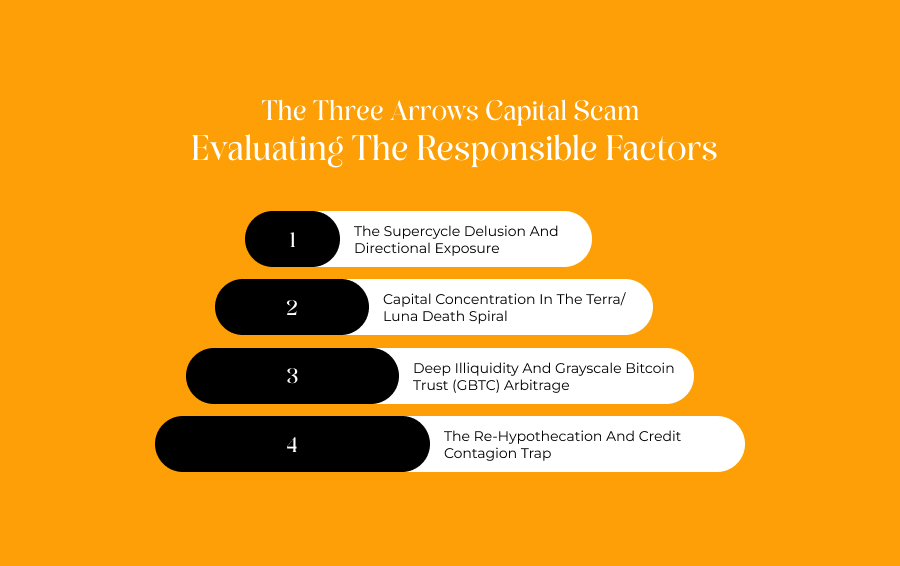
1. The Supercycle Delusion And Directional Exposure

The core strategic flaw of Three Arrows Capital was its absolute structural dependence on a continuous upward market trajectory.

It is a thesis Su Zhu publicly promoted as the crypto "Supercycle."

3AC abandoned market-neutral hedging protocols.

Therefore, this transformed the hedge fund into a massive, unidirectional long bet on digital assets.

When the macroeconomic environment shifted toward quantitative tightening, this unhedged exposure left the fund completely defenceless against downside corrections.

2. Capital Concentration In The Terra/Luna Death Spiral

The primary catalyst for 3AC's downfall occurred in May 2022.

The fund had deployed over $200 million into locked Luna (LUNC) to back the algorithmic stablecoin ecosystem TerraUSD (UST).

When the UST algorithm broke its peg, it triggered a rapid death spiral that completely erased over $40 billion in market value in less than a week.

3AC's direct equity positions in the asset plummeted from hundreds of millions to zero, instantly wiping out a massive portion of the fund's liquid capital reserves.

3. Deep Illiquidity And Grayscale Bitcoin Trust (GBTC) Arbitrage

To compound its vulnerabilities, 3AC locked up massive amounts of capital in the Grayscale Bitcoin Trust (GBTC).

The fund had previously executed a profitable arbitrage trade by exploiting the premium value of GBTC shares relative to spot Bitcoin.

However, as institutional market dynamics shifted, the premium inverted into a severe discount.

3AC found itself holding massive, illiquid positions in GBTC shares that it could not sell on the open market without realizing devastating capital losses.

Therefore, this trapped its remaining assets during a severe liquidity crisis.

4. The Re-Hypothecation And Credit Contagion Trap

SunEdison relied on complex subsidiaries.

However, Three Arrows Capital relied on a web of institutional counterparty debt. 3AC operated as a central borrower.

So, they took billions in uncollateralized or under-collateralized loans from prominent crypto lenders, including:

  • Genesis Trading
  • Voyager Digital
  • BlockFi
  • Celsius Network

Crucially, 3AC engaged in aggressive re-hypothecation. They used the exact same borrowed capital pools to secure secondary and tertiary loan agreements across different lenders.

When the values of 3AC's underlying assets collapsed, lenders issued immediate margin calls.

Because 3AC had already deployed this capital into illiquid venture investments and locking protocols, it could not fulfill its payment demands.

Therefore, this triggered a cascading wave of multi-billion-dollar defaults that bankrupted its lenders.

Forensic Accounting Breakdown: Phantom Assets Vs. Real Liabilities

Forensic Accounting Breakdown

The underlying driver of 3AC's swift collapse was an extreme gap between reported asset values and liquid balance-sheet realities.

· Venture Caching Overvaluation

3AC counted equity stakes in early-stage web3 start-ups and highly illiquid NFT portfolios.

One of the most common examples of this is their Starry Night collection. This is taken at theoretical "mark-to-market" valuations.

Additionally, these positions looked highly lucrative on paper during a bull market.

However, they had near-zero open-market liquidity during a downturn.

· The Creditor Deficiency Grid

When the BVI liquidators took corporate control, they uncovered a massive accounting deficit.

The fund owed $3.5 billion to over 20 institutional creditors.

In addition, there were digital asset broker Genesis holding the largest individual claim at $1.2 billion.

Furthermore, 3AC had actively used fresh, unsecured institutional loan capital to pay out minor margin calls on secondary desks.

Also, this ran a hidden liquidity carousel until the entire credit ecosystem froze.

The Global Crackdown On Crypto Shadow Banking

The structural failures of 3AC acted as the primary catalyst for an aggressive global regulatory clampdown on the crypto "shadow banking" sector.

Prior to the collapse, firms like 3AC operated in regulatory blind spots by continually shifting their legal domiciles across:

  • Singapore
  • Dubai
  • The British Virgin Islands

After the contagion, international regulators shifted from observation to aggressive enforcement.

The Monetary Authority of Singapore (MAS) officially banned both founders from the country's regulated financial sector for nine years.

Moreover, they tightened compliance mandates for all localized digital asset funds.

Globally, the collapse accelerated the enforcement of strict liquidity coverage ratios (LCR).

Additionally, there was a traceable impact on explicit transparency mandates for re-hypothecated assets.

Furthermore, it influenced how specific yielding protocols were classified under traditional securities laws.

3AC effectively ended the era of unregulated institutional crypto credit.

Core Lessons For Modern Wealth Management And Digital Asset Funds

Risk Mitigation ImperativeThe Three Arrows Capital FailureInstitutional Corrective Action
Delta NeutralityAbandoned risk hedging in favor of highly concentrated, directional market long bets.Maintain strict delta-neutral or multi-asset market hedging corridors.
Collateral IntegrityRe-hypothecated identical assets across multiple uncoordinated lending desks.Implement transparent, real-time cryptographic proof-of-reserves tracking.
Liquidity ProfilingLocked short-term borrowed capital into long-term, highly illiquid venture equity.Ensure maturity-matching constraints; limit illiquid assets to a fixed equity tier.
Counterparty VettingLeveraged personal reputation and social prestige to bypass standard credit due diligence.Require automated, smart-contract-enforced over-collateralization parameters.

The Dynamics Of The Three Arrows Capital Collapse Explained

The downfall of Three Arrows Capital stands as an institutional reminder that massive scale can never substitute for disciplined risk management.

3AC did not implode due to a lack of technical trading competence.

Rather, it collapsed because it substituted sound financial math for ideological market delusions.

Additionally, it utilized unsecured leverage to fund illiquid assets.

For asset managers, wealth advisors, and decentralized financial innovators, Three Arrows Capital remains the permanent baseline warning.

They now know that leverage amplifies profits during an expansion.

But unhedged leverage guarantees systemic destruction during a contraction.

Sohini is a MarTech and business writer with over two years of experience creating and editing content in the digital marketing space. She has a strong interest in emerging digital trends, marketing strategies, and the evolving relationship between technology and business growth. Alongside writing, she also works on guest posting strategies, carefully aligning sponsored content with niche relevance to help maintain strong organic visibility and audience engagement. Outside of work, Sohini enjoys reading, exploring internet subcultures, and endlessly scrolling through Reddit, Pinterest, and Substack looking for new ideas and trends.

View all posts

Leave a Reply

Your email address will not be published. Required fields are marked *

Related

most successful Shark Tank rejects

11 Most Successful Shark Tank India Rejects: In-Depth Business Profiles

The baseline metric of success on Sony Entertainment Television’s Shark Tank India has historically been a live, televised handshake. Also, it features a distinguished panel of Indian venture capitalists. However, there is an objective analysis of the domestic consumer and tech markets. It proves that leaving the studio floor empty-handed can serve as a massive, unintended launchpad for long-term growth. A television rejection often becomes a powerful lesson in operational resilience when an Indian founder refuses to: Surrender massive equity slices Accept predatory loan terms Bow to lowball valuations In India, evaluating the most successful Shark Tank India rejects reveals systemic blind spots within fast-paced pitch ecosystems. The panel frequently prioritizes immediate cash flows, hyper-trendy D2C plays, or personal network protections. Also, it occasionally misses major shifts in: Macro Industrial Infrastructure Deep-Tech Assistive Innovations Foundational Unit Economics This granular corporate audit conducts an in-depth analytical review of 11 most successful Shark Tank rejects. The Top 11 Most Successful Shark Tank Rejects: Getting Into The Details These are multi-crore Indian brands that successfully bypassed the panel to dominate their respective markets. 1. Zypp Electric Zypp Electric’s founders: Akash Gupta and Rashi Agarwal Zypp Electric at Shark Tank: Season 1, Episode 17 Investment: Asked for ₹2.2 Crores for 1% equity; left empty-handed with no deal from the Sharks (later raised Series C funding rounds on an institutional scale) Zypp Electric operates a high-density, tech-enabled EV-as-a-service last-mile delivery fleet tailored for India’s booming quick-commerce and e-commerce sectors. The company provides electric two-wheelers, integrated battery-swapping infrastructure, and trained delivery riders to enterprise giants like Zomato, Swiggy, Zepto, Blinkit, and Amazon. · The Post-Tank Strategic Pivot The Sharks flatly rejected the company's valuation, claiming an asset-heavy vehicle fleet was an unscalable cash drain. Instead of backing down, the founders utilized the broadcast to showcase their enterprise utility to institutional funds. Zypp moved away from loose retail rentals to lock down massive, multi-year B2B corporate logistics contracts. · Modern Valuation And Market Stance Proving the Sharks completely miscalculated the economics of green logistics, Zypp raised a massive Series C funding round led by global energy icon ENEOS. The company’s operational fleet exceeds 21,000 active EVs, anchoring its market valuation at over ₹3,000 Crores. 2. Recode Studios Recode Studios’ founders: Dheeraj Bansal and Rahul Sachdeva Recode Studios at Shark Tank: Season 2, Episode 1 Investment: Asked for ₹1 Crore for 1% equity; rejected by the panel on television despite stellar, highly profitable bootstrapped sales metrics. Recode Studios designs, manufactures, and distributes premium-grade mass-market cosmetics, skincare, and beauty utilities. The brand targets tier-2 and tier-3 Indian urban centers. Additionally, it utilizes an aggressive pricing strategy that undercuts mainstream international cosmetic houses. Consequently, it delivers identical chemical parity and wear longevity. · The Post-Tank Strategic Pivot Despite presenting highly profitable numbers with over ₹15 Crores in bootstrapped sales, the Sharks completely refused to invest. This was due to personal friendships with rival D2C cosmetics founders on the panel. Recode instantly flipped this rejection into a powerful public relations asset. Moreover, they leaned into a transparent "consumer-backed, elite-rejected" marketing campaign across social channels. · Modern Valuation And Market Stance The massive wave of organic public support accelerated their expansion of physical retail locations. Recode successfully expanded its distribution network to operate over 250+ physical store layouts and counter modules across India. So, it maintains a highly profitable, self-sustaining financial trajectory completely independent of mainstream capital networks. 3. Moonshine Meadery Moonshine Meadery’s founders: Rohan Rehani and Nitin Vishwas Moonshine Meadery at Shark Tank: Season 1, Episode 34 Investment: Asked for ₹80 Lakhs for 0.5% equity; walked away empty-handed due to unviable, heavy valuation cut counter-demands. Moonshine Meadery is a pioneering alcobev brand that created India's very first licensed, commercial craft meadery. The company sources pure, raw honey from local apiaries and ferments it with fruits and spices to produce a premium, gluten-free alcoholic beverage line targeting the rapidly growing alcobev segment. · The Post-Tank Strategic Pivot While the panel praised the product's taste and branding precision, they backed away due to the complex regulatory red tape, inter-state excise structures, and long distribution timelines tied to the Indian liquor market. The founders flatly rejected the Sharks' heavy counter-demands for valuation cuts. They systematically optimized their regional manufacturing loops, focusing on high-margin metro hubs like Mumbai, Pune, and Bengaluru. · Modern Valuation And Market Stance Moonshine successfully expanded its international distribution footprint, locking down exports to Europe and North America. By retaining absolute control over their proprietary fermentation equations, they independently secured their corporate valuation at the ₹160+ Crore ceiling. 4. Urban Monkey Urban Monkey’s founder: Yash Gangwal Urban Monkey at Shark Tank: Season 1, Episode 35 Investment: Asked for ₹1 Crore for 1% equity; rejected flatly by the investor panel on the studio floor. Urban Monkey structures, curates, and scales premium lifestyle products centered entirely around underground Indian street culture. The brand manufactures: Highly Stylized Skateboarding Apparel Graphic Streetwear Tees Modular Corduroy Waist Bags Premium Snapback Caps Therefore, it aims to build an authentic brand community around local hip-hop artists, street skaters, and break-dancers. · The Post-Tank Strategic Pivot The investment panel dismissed the pitch. It labeled localized streetwear an unscalable, micro-niche category with highly volatile consumer loyalty. The brand chose to skip traditional fashion marketing channels entirely. Instead, they built an exclusive, high-margin direct-to-consumer (D2C) online framework. Moreover, they scaled through organic product placements in top Indian hip-hop music videos and at underground, independent cultural events. · Modern Valuation And Market Stance Urban Monkey emerged as the definitive style statement for Indian street youth. In fact, it has been frequently worn by major pop culture celebrities. By bypassing traditional multi-brand retail margins, the company maintains high profit margins. Furthermore, it sustains massive multi-crore annual organic revenues nationwide. 5. Livofy Livofy’s founder: Sahil Pruthi Livofy at Shark Tank: Season 1, Episode 18 Investment: Asked for ₹1.5 Crores for 1.25% equity; the founder flatly rejected the Sharks' heavy 16% equity dilution counter-demand and walked out deal-less. Livofy is an advanced health-tech application that leverages: Customized nutrition plans Targeted coaching modules Machine learning algorithms So, it assists users in managing chronic lifestyle conditions. The platform targets metabolic health, delivering clinical remediation tracks to reverse PCOS, obesity, Type 2 diabetes, and elevated thyroid indices. · The Post-Tank Strategic Pivot Four out of five Sharks wanted to fund the company, but attempted to force a predatory 16% equity dilution counter-offer on the table. Recognizing that surrendering such a massive chunk of early equity would ruin his long-term funding leverage, founder Sahil Pruthi walked away. He used the massive broadcast publicity to expand his market positioning, rebranding the company from Keto India to Livofy to reach a broader wellness demographic. · Modern Valuation And Market Stance Moving forward on his own terms, Pruthi raised over $550,000 USD (approximately ₹4.5 Crore) in subsequent seed rounds from institutional angel funds, thereby protecting his founder wealth while scaling his health-tech engine among global NRIs. 6. Morriko Pure Foods Morriko Pure Foods’ founders: Tanuja Shah and Pramod Shah Morriko Pure Foods at Shark Tank: Season 1, Episode 34 Investment: Asked for ₹1 Crore for 3% equity; left empty-handed after refusing to compromise their business core or lower their valuation parameters. Morriko Pure Foods operates a specialized food-processing framework that manufactures fruit and vegetable snacks that are: Clean-Label Preservative-Free Zero-Added-Sugar The company utilizes proprietary, state-of-the-art solar dehydration technology to preserve full nutritional value. Therefore, it aims to serve health-conscious snackers and clean-eating consumers. · The Post-Tank Strategic Pivot The Sharks attempted to alter the company's baseline operational model, demanding steep drops in retail valuation and a shift toward cheaper, sugar-infused candy formulations to maximize short-term retail velocity. The founders flatly refused to compromise their healthy brand core. Instead, they focused on high-margin niche wellness e-commerce portals, organic grocery networks, and high-volume corporate pantry supply channels. · Modern Valuation And Market Stance Morriko established itself as an essential clean-label partner for global corporate offices and fitness chains. By building a dedicated, loyal audience that values genuine product purity over low-grade chemical pricing, the brand scales its multi-crore manufacturing infrastructure across regional health channels completely ad-free. 7. ExperientialEtc ExperientialEtc’s founders: Karan Bhardwaj and Sameer Bhatia ExperientialEtc at Shark Tank: Season 2, Episode 40 Investment: Asked for ₹2 Crores for 4% equity; left with no deal as the panel passed due to technology scalability doubts. ExperientialEtc is a high-end visual tech company that structures and deploys disruptive, immersive marketing campaigns for enterprise brands. The agency manufactures, programs, and rents high-density kinetic light walls and 3D holographic displays. Additionally, it works with interactive projection-mapping fixtures. Also, it creates augmented-reality environments to maximize crowd engagement at physical venues. · The Post-Tank Strategic Pivot The investment panel struggled to comprehend the scalability of specialized, high-cost spatial tech, dismissing the pitch as an unpredictable event-management service rather than an enterprise software asset. The founders pivoted by embedding their hardware rigs into a comprehensive, high-margin corporate licensing model. They signed long-term retainer accounts with blue-chip global firms requiring recurring high-tech trade show displays and premium brand launches. · Modern Valuation And Market Stance The company has an ironclad reputation as a premier high-tech agency, serving major global corporate tech events in: Dubai Singapore Mumbai Additionally, it generates stellar multi-crore service margins annually. 8. Torch-It Torch-It’s founder: Hunny Bhagchandani Torch-It at Shark Tank: Season 1, Episode 29 Investment: Asked for ₹2.5 Crores for 1% equity; rejected by the Sharks, who focus-tested the hardware model as low-margin charity rather than an enterprise asset. Torch-It functions as a highly awarded deep-tech social enterprise that engineers assistive mobility hardware. Also, it works with integrated AI software to empower visually impaired citizens worldwide. Furthermore, their flagship product line uses predictive ultrasonic sensor arrays and spatial machine learning algorithms. Therefore, this will help map physical obstacles. In fact, this will guide users safely with precise haptic vibration feedback patterns. · The Post-Tank Strategic Pivot The Sharks viewed the social-impact device as low-margin charity rather than a viable enterprise asset, passing on the investment. Founder Hunny Bhagchandani leveraged his television exposure to secure institutional backing directly from the Government of India. Also, he gets good support from corporate social responsibility (CSR) capital funds and international accessibility NGOs. · Modern Valuation And Market Stance Torch-It expanded its core technology stack to produce over 40+ distinct AI-enabled assistive solutions, including the Jyoti AI Smart Glasses. The organization operates as a highly successful, self-sustaining assistive tech provider, deploying tens of thousands of units across Africa, South Asia, and the Middle East. 9. Shades of Spring Shades of Spring’s founders: Nidhi Gupta and Anup Kumar Shades of Spring at Shark Tank: Season 2, Episode 10 Investment: Asked for ₹3 Crores for 1% equity; walked away empty-handed after the panel passed due to aggressive tech-forward pricing disagreements. Shades of Spring is an innovative, tech-enabled e-commerce platform that operates a direct-from-farm fresh-flower subscription network. Moreover, this connecting flower farms directly with urban homes via automated cold-chain logistics. By this, the platform completely bypasses traditional flower wholesale layers. Furthermore, it ensures that blooms arrive at local doorsteps significantly fresher than those from traditional florist shops. · The Post-Tank Strategic Pivot The panel reacted with intense skepticism to the company's valuation metrics. Moreover, the panel claimed that flowers were an unpredictable, seasonal commodity with zero long-term subscription retention. Furthermore, the founders ignored the criticism. They invested heavily in building automated sorting facilities. Also, they built a seamless, user-friendly mobile application interface to streamline recurring weekly orders. · Modern Valuation And Market Stance The startup proved the massive potential of the localized home-curation market. Today, Shades of Spring processes thousands of active subscription orders across major metropolitan areas. It maintains a highly profitable model and a valuation that meets its initial enterprise milestones. 10. Agri Tourism India Agri Tourism India’s founder: Pandurang Taware Agri Tourism India at Shark Tank: Season 1, Episode 31 Investment: Asked for ₹50 Lakhs for 5% equity; flatly rejected by the panel, who classified the rural network as an unscalable, offline project. Agri Tourism India operates a sustainable, community-driven eco-tourism aggregator model that connects urban travelers with working rural agricultural farms. The platform allows tourists to experience authentic rural farm stays, traditional local culinary methods, and sustainable harvesting practices, funneling alternative revenue lines straight to local farmers. · The Post-Tank Strategic Pivot The Sharks flatly dismissed the pitch, filing rural eco-tourism away as a slow, unscalable, and unmarketable offline lifestyle project. The founders stuck to their core vision, bypassing premium city marketing agencies to partner directly with local state tourism boards, environmental educational organizations, and international corporate eco-retreat planners. · Modern Valuation And Market Stance The platform scaled across multiple states, transforming thousands of remote rural farms into high-margin, self-sustaining hospitality centers. The company remains the definitive pioneer of Indian agritourism, proving that eco-friendly, asset-light community systems deliver excellent long-term financial stability. 11. SamparkMe SamparkMe’s founder: Saurabh Garg SamparkMe at Shark Tank: Season 2, Episode 45 Investment: Asked for ₹50 Lakhs for 5% equity; left with no deal after the Sharks claimed local drivers lacked the civic intent to adopt QR vehicular tools. SamparkMe designs, manufactures, and scales localized QR-based vehicular communication tags and security ecosystems. Additionally, this company places a secure, encrypted QR decal onto a vehicle’s windshield. Therefore, the system allows the public or parking officers to contact the owner anonymously in an emergency, such as: Double Parking Towing Fire Risks However, you can go forward with this without exposing private mobile phone numbers. · The Post-Tank Strategic Pivot The Sharks were highly critical of the app's community-driven model, with several panel members asserting that local citizens lacked the necessary "civic sense" to actively scan QR codes or respect drivers' anonymity. Founder Saurabh Garg ignored the panel's negative review. Then he pivoted his marketing strategy away from loose retail sales to focus on high-volume B2B corporate partnerships. Additionally, he associated with car insurance networks, luxury residential real estate projects, and premium commercial parking garages. · Modern Valuation And Market Stance SamparkMe successfully transformed into a reliable, everyday safety asset across India’s crowded tier-1 metros. The platform tracks a rapidly climbing active user base. Therefore, this proves that when privacy and vehicular safety are combined with zero-friction mobile software, Indian drivers will adopt smart civic tools at scale. The Most Successful Shark Tank Rejects Give Us A Lot To Learn The long-term success of these 11 startups proves that a televised rejection on Shark Tank India can serve as a massive, long-term corporate asset. When a founder protects their early company equity and stands firm on their true valuation, they retain the freedom and financial leverage to build a highly successful, self-sustaining business on their own terms.

READ MOREDetails
When did RadioShack close

RadioShack Case Study: The Double Bankruptcy And Structural Retail Fall

Corporate longevity requires swift adaptability, sharp omni-channel development, and controlled retail scaling. When customer shopping habits transition toward digital spaces, traditional storefront chains must re-engineer their physical utility. A primary historical baseline for structural collapse within the consumer retail sector is RadioShack. Founded in 1921, RadioShack evolved into an absolute neighborhood powerhouse. However, its aggressive brick-and-mortar footprint eventually encountered a severe liquidity crunch. To understand the finality of this retail demise, analysts must evaluate the exact timeline of when did radio shack close its main operations. The parent company did not drop its leases during a single fiscal cycle. Instead, the brand dissolved through a rare, two-stage bankruptcy process spanning from February 2015 to June 2017. The Timeline: When Did RadioShack Close? The destruction of RadioShack's commercial footprint occurred in two distinct, cascading corporate waves. The First Wave: The 2015 Collapse The first major structural default occurred on February 5, 2015. Facing massive debt and negative earnings since 2012, RadioShack was officially delisted from the New York Stock Exchange. Immediately after the filing, the company entered an agreement to close more than 1,700 underperforming locations. The hedge fund Standard General then purchased the remaining corporate assets for $26.2 million under an affiliate named General Wireless. The Co-Branded Transition To sustain the remaining stores, General Wireless partnered directly with telecom provider Sprint. They converted roughly 1,500 properties into co-branded tech hubs. Sprint managed the highly concentrated mobile phone sales desks inside the properties. Meanwhile, RadioShack handled parts, wiring components, and basic consumer electronics hardware. The Second Wave: The 2017 Final Liquidation This hybrid co-branded business framework proved too optimistic. Poor mobile phone conversions and low retail traffic continued to burn through available cash reserves. Consequently, on March 8, 2017, the parent company filed for bankruptcy protection a second time in two years. This final restructuring triggered immediate liquidation notices across the country. By June 2017, RadioShack closed its final 1,000 corporate-owned stores permanently. This massive liquidation effectively wiped the brand off the physical American retail map, leaving the company to survive strictly as an online e-commerce platform. RadioShack Corporate Performance Matrix At its absolute commercial peak, RadioShack maintained an unrivaled retail density across North America. Over time, bad timing, changing tech trends, and bad financing mechanics completely inverted the firm's balance sheet: Evaluation CategoryPeak Retail Architecture (1999)Bankruptcy Reality & Final Liquidation (2015–2017)Market IdentityEvaluated as the ultimate global neighborhood hub for specialized parts and consumer electronics.Consolidated as a permanent symbol of stagnant corporate culture and rapid physical retail decline.Store FootprintOperated a massive network of over 8,000 corporate locations across multiple countries.Erased all corporate-owned storefronts, leaving only a tiny handful of independent dealers.Consumer AccessAn astounding 94% of the United States population lived within a 5-minute drive of a store.Shoppers completely abandoned locations in favor of lower pricing and instant online ordering.Product ConcentrationDiversified across early home computers, radio kits, components, and batteries.Over-concentrated in low-margin mobile devices, which generated 50% of total sales revenue.Financial HealthGenerated over $5 billion in annual revenue with highly profitable hardware margins.Suffered 11 consecutive quarterly losses before facing total delisting and restructuring. The Strategic Missteps Behind The Downfall These are some of the core reasons behind RadioShack's fall. Pay attention, as these allegations had a huge impact on the end of this reputable company: 1. Severe Store Cannibalization During its peak growth phase, RadioShack expanded its real estate footprint aggressively without analyzing geographic spacing. By 2014, the brand operated roughly 4,300 North American properties located entirely too close to each other. For example, Sacramento, California held 25 individual locations crammed within a tight 25-mile radius. This dense packing caused individual stores to steal revenue directly from neighboring branches, multiplying rental overhead while producing zero net traffic gains. 2. Lethal Product Concentration In Mobile Units To secure immediate revenue spikes in the early 2000s, corporate leadership pivoted sharply toward mobile phones. By 2014, smartphone units and carrier plans accounted for 50% of total company sales. This high product concentration proved to be an existential trap. When telecom carriers cut back on third-party dealer commissions, RadioShack’s core profit model vaporized, leaving them exposed to low-margin cell phone upgrade cycles. 3. Complete E-Commerce Irrelevance As shopping behavior migrated online, RadioShack failed to build a functioning digital ecosystem. Digital marketplaces like Amazon made it effortless to source niche components with a single click. Because RadioShack offered uncompetitive pricing and struggled with frequent brick-and-mortar inventory shortages, consumers stopped visiting stores entirely. The company remained tethered to expensive commercial leases while its customer base moved online. 4. Intoxicating Credit Blocks And Management Churn Turnaround efforts were constantly disrupted by executive instability. From 2005 to 2014, the board cycled through seven different chief executive officers, destroying any hope of long-term strategic consistency. Furthermore, when the company secured a $250 million term loan from Salus Capital in 2013, the restrictive credit contract backfired. When cash flow deteriorated in 2014, executives attempted to close 1,100 failing stores to preserve capital. However, Salus Capital legally blocked the closures because it lacked confidence in the turnaround path, trapping the brand in cash-burning locations and accelerating bankruptcy. Core Lessons For Modern Omni-Channel Businesses Operational ImperativeThe RadioShack MistakeSustainable Strategic CorrectionFootprint OptimizationBuilt overlapping brick-and-mortar spaces that cannibalized existing local store revenue.Maintain strict demographic distance limits; favor high-utility central hubs.Inventory DiversificationAllowed a single low-margin item (mobile phones) to command half of all sales.Balance high-volume core electronics with high-margin unique private label assets.Digital IntegrationStood by as an outdated analog hub while consumer buying trends shifted online.Implement real-time local inventory tracking linked directly to immediate home delivery.Debt Covenant ManagementSigned credit agreements that legally prevented them from closing unprofitable branches.Maintain operational flexibility in financing terms to allow rapid down-scaling. When Did Radioshack Close And Why: The Historic Collapse Explained The fall of RadioShack highlights that massive physical market density cannot save a business model that fails to evolve alongside technological change. The electronics icon did not fail because customers stopped buying cables, adapters, or computer parts. It collapsed because it drifted away from its specialized core audience, over-leveraged its balance sheet into thin mobile device lines, and completely missed the e-commerce transition. For modern business owners, RadioShack stands as a permanent warning: if your brand lacks a clear online and offline purpose, digital convenience will inevitably make your storefront obsolete.

READ MOREDetails
FTX Collapse

The Structural Collapse Of The FTX Crypto Exchange And Its Impact: A Case Study

On 11 November 2022, FTX, the world’s third-largest cryptocurrency derivatives exchange, valued at $32 billion at its peak, officially filed for Chapter 11 bankruptcy protection. Founded by Sam Bankman-Fried, the platform positioned itself as a highly secure, institutional-grade trading platform. However, the exchange’s underlying operational framework was structurally compromised by a severe lack of internal accounting checks and massive regulatory non-compliance. This case study analyzes how a secret, multibillion-dollar asset-liability mismatch and illegal balance-sheet commingling systematically hollowed out the platform's liquidity. The crisis unfolded over a seven-day window following an explosive public balance sheet leak. When customers launched a highly synchronized, panic-driven digital withdrawal run, they exposed an $8 billion deficit in customer capital. This cash vacuum forced immediate bankruptcy filings and triggered global contagion across decentralized markets. Furthermore, it led to sweeping criminal indictments for its core executive leadership team. The Corporate Alchemy Of The Ftt-Alameda Loop The structural collapse of FTX was not a standard macro market casualty or an unpredictable investment drop. Instead, it was an intentional, systemic corporate fraud built around an artificial token-collateral loop and the illegal routing of user deposits. When users deposited fiat cash or major crypto tokens (like Bitcoin and Ethereum) on the FTX exchange, internal operating scripts routed those assets off the platform's ledger to Alameda Research, a private crypto hedge fund owned by Sam Bankman-Fried. Alameda used this stolen customer cash to execute high-risk venture bets, purchase luxury real estate, and finance political donations. To hide this massive hole in user accounts, Alameda left billions of dollars' worth of FTT. FTX’s in-house utility token, in the exchange's treasury vaults as replacement collateral. FTX’s developers wrote custom code that granted Alameda a secret $65 billion backdoor line of credit. Therefore, this ensured the hedge fund could continuously draw down customer cash. This setup created an extreme concentration of risk. The entire exchange was backed not by liquid cash reserves but by an illiquid token that FTX had printed out of thin air and artificially valued on the open market. Granular Timeline Of The Strategic Meltdown The operational collapse scaled with unprecedented velocity, stripping a global multi-billion-dollar enterprise of its entire liquid asset base in less than a week: Strategic Phase TimelineFinancial EventUnderlying Systemic Impact2 November 2022CoinDesk leaks Alameda’s balance sheet, exposing that the $14.6B fund was backed almost entirely by illiquid FTT tokens.Triggers immediate risk-mitigation evaluations among global institutional funds.6 November 2022Binance CEO Changpeng Zhao (CZ) announces on social feeds that Binance will liquidate its entire $580M holding of FTT tokens.Sparks a massive digital run, crashing the FTT token market value instantly.7–8 November 2022FTX faces a devastating $6 billion mobile app withdrawal run by panicked retail and corporate users.The exchange runs completely out of liquid cash reserves and halts all customer asset withdrawals.9 November 2022Binance signs a non-binding letter of intent to buy FTX, but backs away 24 hours later due to un-auditable corporate books.Destroys any hope of an institutional bailout, leaving the exchange completely insolvent.11 November 2022Sam Bankman-Fried resigns, and incoming CEO John J. Ray III takes control of the bankrupt corporate shell.Chapter 11 bankruptcy filings are executed across 130 affiliated corporate entities. Structural Vulnerability Matrix: Root Causes Of The Failure An institutional post-mortem of the FTX Group highlights three distinct, compounding risk management flaws that left the platform completely defenseless against a market shock: · Complete Absence Of Corporate Governance The exchange operated without an independent board of directors, lacking external oversight on executive choices. Corporate cash controls were managed via an unsecured group chat app. Furthermore, this is where executives approved multi-million-dollar asset allocations using emojis. Therefore, they left no professional audit trail. · Flawed Internal Financial Controls The company completely lacked a dedicated internal accounting department. John J. Ray III, who famously managed the liquidations of Enron, stated under oath that he had never seen such a complete failure of corporate records. Additionally, he noted that the company used automated consumer software to track corporate cash balances. · Extreme Institutional Conflict Of Interest The boundaries between exchange operator (FTX) and market speculator (Alameda) were completely erased. Alameda was granted a permanent exemption from the platform's automated liquidation engine. This meant that while standard retail users were instantly liquidated during market drops to protect the platform's capital. Alameda could hold massive, bleeding-negative balances indefinitely, shifting its trading losses directly onto the exchange's users. The Digital Mechanism: A Smart-Contract And Social-Media Driven Run A defining characteristic of the FTX collapse was the speed of the panic, accelerated by modern communications and digital banking channels. Traditional historical bank runs unfolded over weeks or months, slowed down by the physical logistics of brick-and-mortar branches. FTX, conversely, was a light-speed digital bank run. The second the Binance liquidations hit social feeds, user panic spread instantly across public social networks and private messaging channels. Fearing immediate account freezes, thousands of global users logged into their mobile trading apps simultaneously to initiate electronic withdrawals. Because the platform's liquid cash reserves had already been secretly drained to cover Alameda's high-risk trading debts, the exchange could not process the massive $6 billion withdrawal load. The sudden run exposed the underlying fraud in hours, freezing customer accounts and cutting off access to individual wealth worldwide. Systemic Contagion And Post-Crisis Regulatory Remediations The fallout from the FTX collapse sent shockwaves through the global decentralized finance sector. This forced international authorities to implement sweeping structural reforms: · Market Contagion Waves The collapse triggered a domino effect across the industry, driving immediate insolvencies among major digital asset lenders such as: BlockFi Genesis Global Voyager Digital Additionally, it wiped over $200 billion in valuation from the broader digital asset markets. · The Enforcement Crackdown International regulatory bodies shifted away from passive tracking to aggressive enforcement actions. Authorities launched sweeping investigations into offshore exchange structures. Therefore, this resulted in a 25-year federal prison sentence for Sam Bankman-Fried for historic wire fraud and money laundering. · Mandatory Corporate Audits Modern regulated digital asset platforms moved quickly to restore investor confidence by adopting strict Proof of Reserves (PoR) frameworks. These systems require third-party cryptographic audits to demonstrate that an exchange maintains 1:1 liquid-asset backing for all customer deposits at all times. Lessons For Corporate Treasury And Capital Allocation Analyzing the failure of the FTX group highlights several essential risk management rules for modern corporate treasuries and venture capital investors: · Enforce Strict Institutional Custody Diversification Never leave your operating capital or digital assets parked long-term on an exchange ledger. Utilize institutional-grade, multi-signature cold storage infrastructure where your team controls the cryptographic keys, ensuring absolute protection against platform freezes. · Execute Rigorous Due Diligence On Governance Frameworks: Venture capital firms poured over $2 billion into FTX without demanding an independent board seat or a formal accounting audit. Modern investment groups must treat a lack of transparent accounting controls or independent oversight as an immediate disqualification flag. · Eliminate Token-Collateral Exposures Never build your corporate treasury around illiquid, self-printed tokens or unhedged digital asset baskets. Ensure your liquid reserves are held in transparent, top-tier cash instruments—such as short-term sovereign bills—to insulate your balance sheet from sharp market downturns.

READ MOREDetails