













The Motion Director: Rethinking The Production Pipeline With Pika AI

Pika Ai

Traditional filmmaking has always been bottlenecked by friction. If an independent creator or marketing studio wants to animate a static concept, they face an expensive choice. 

That is, either hire an After Effects team, spend weeks mastering complex physics engines, or settle for flat and lifeless transitions. 

However, the arrival of advanced generative video networks has fundamentally altered the economics of digital art.

Leading this paradigm shift is Pika AI. The tool is a cloud-driven motion synthesis platform that is designed to transform flat pixels into dynamic cinematic assets. 

Founded by Stanford researchers Demi Guo and Chenlin Meng, the ecosystem has moved past basic text-to-video generation. 

With the introduction of hyper-granular canvas control, physics-based object manipulation, and advanced compositing tools, the software operates less like a simple text engine. 

Instead, it operates more like a virtual camera crew and special studio bundled into a web browser. 

For studios looking to scale their multimedia output, understanding how this generative pipeline works is essential to maintaining creative control. 

From Text Prompts To Scene Ingredients

From Text Prompts To Scene Ingredients

Early iterations of AI video generators relied on a chaotic lottery system. That is, you typed a text string, clicked generate, and hoped the algorithm guessed your intent. 

Pika AI breaks this cycle by prioritizing source asset integrity. 

While text-to-video remains fully supported, the core workflow centre of the platform relies heavily on its advanced image-to-video engine and the foundational “Scene Ingredients” architecture. 

Instead of forcing a neural network to construct a character, a background setting and an object from raw text descriptions, creators upload distinct pre-designed visual anchors.

The system treats these uploads as rigid variables, smoothly animating the spaces between them while protecting the core details of your characters.

This method solves the single largest issue that plagues automated content production. That is, character consistency across multiple sequential shots. 

The Specialized Motion Toolkit
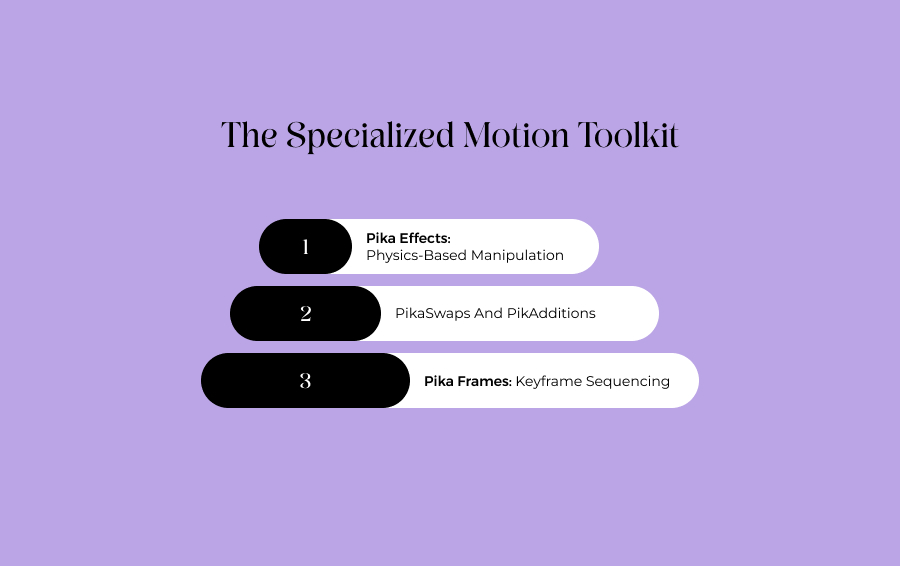
The Specialized Motion Toolkit

The platform segments its creative capabilities into a suite of specialized manipulation engines. Consequently, this allows designers to target specific areas of a frame without rendering the entire canvas from scratch. 

Pika Effects: Physics-Based Manipulation

For rapid visual effects prototyping, the platform hosts a library of pre-tuned physical simulations that bypass prompt writing completely.

Users select a static image, highlight an object, and apply targeted physical forces. 

  • Crush & Inflate: Simulates realistic inward compression or outward pressure, causing objects to cave in or swell like balloons.
  • Melt & Dissolve: Liquefies chosen structures or breaks them apart into fine, floating particles. 
  • Cakeify: A viral structural effect that splits an object open to reveal an internal, realistic cake matrix.

PikaSwaps And PikAdditions

These targeted compositing modules function as intelligent video-to-video editors. In PikaSwaps, creators can select an individual actor or object with an existing moving video. 

Furthermore, they can swap them out for a completely new asset while perfectly preserving the baseline camera pan and background motion. 

Concurrently, PikAdditions lets creators seamlessly drop completely new elements into an ongoing video file without breaking the realistic lighting or environment. 

Pika Frames: Keyframe Sequencing

In order to map out longer storytelling arcs, the Pika Frames workspace allows users to upload up to five individual still images to serve as strict structural checkpoints.

The engine calculates the optimal paths between each image. After this, they generate smooth and fluid transitions along with multi-second narrative progressions. These avoid the fast and unstable zooming common in older platforms. 

Technical Allocation And Feature Matrix

The platform organizes its rendering speeds, frame capacities, and usage terms across four distinct billing structures.

Feature ComponentBasic Plan (Free)Standard PlanPro Plan
Monthly Credit Allotment80 Credits700 Credits2,300 Credits
Max Output ResolutionFixed at 480pFull 1080p HDFull 1080p HD
Rendering Model AccessCore Image-to-Video onlyUnlocks All Pika Effects & FramesUnlocks Premium Scene Ingredients
Commercial Usage RightsNot permittedFully includedFully included
Queue Processing SpeedStandard public queueTurbo generation priorityMax priority fast-pass

Mastering The Prompt: Overcoming Motion Anomalies

Mastering The Prompt

The achievement of commercial-grade output through Pika AI requires a strategic shift in how you write prompts. 

Instead of functioning as a rigid command-line tool, the underlying model functions as a sensitive motion assistant. 

As a result, over-specificationof actions can accidentally trigger visual artifacts, unnatural warpiung, or image instability during complex camera rotations. 

Controlling The Force Variables

If your generated video appears heavily distorted or robotic, the cause is usually an overload of aggressive descriptive words like "dynamic," "hyper-fast," or "explosion". 

Clean, believable output relies on subtle, controlled nudges.

Adding explicit camera context forces the algorithm to anchor the frame, resulting in significantly crisper and more professional visual assets. 

For instance, commands such as "slow cinematic pan," "gentle push-in zoom," or "soft depth-of-field focus,” may cause such outputs. 

It is further advised to keep the style cues down to one or two points. Consequently, this allows the physics engine to apply the movements smoothly across the scene.

Strategic Market Alternatives

Strategic Market Alternatives

If your production workflow demands full-scale world-building from scratch or different pricing models, competing platforms offer distinct strengths.

Vidu AI

This engine acts as a direct competitor in multi-entity tracking. It focuses heavily on providing highly affordable, long-duration high-definition output packages. 

Consequently, this budget-friendly structure makes it an exceptionally popular choice for independent social media channels and solo content creators.

Runway Gen-3

Widely recognized for its high-fidelity structural rendering and precise cinematic physics, this platform sets the industry standard. 

It serves as a premier workspace for high-end commercial ad agencies, professional VFX studios, and advanced filmmaking workflows. 

Additionally, it requires absolute control over movement.

PicLumen

PicLumen is a hybrid alternative that merges advanced AI image generation and video tools onto a single, interconnected workspace. 

The tool blends both asset creation and motion synthesis into one dashboard. 

As a result, it completely eliminates the need to constantly jump back and forth between separate apps.

The Production Verdict

Ultimately, Pika AI has shifted the landscape of automated multimedia creation. Moreover, it succeeds because it recognizes that professional creators do not want a software system that completely takes over the creative process,

Instead, they want an intelligent assistant that will speed up repetitive execution. 

By providing precise control over character consistency, physics-driven effects and targeted asset swapping, the platform allows solo creators to construct rich, cinematic visual campaigns that once required an entire post-production studio. 

As long as you stay mindful of credit consumption limits on high-resolution generations, it serves as a powerful and essential upgrade for the modern digital workspace.


Sohini is a MarTech and business writer with over two years of experience creating and editing content in the digital marketing space. She has a strong interest in emerging digital trends, marketing strategies, and the evolving relationship between technology and business growth. Alongside writing, she also works on guest posting strategies, carefully aligning sponsored content with niche relevance to help maintain strong organic visibility and audience engagement. Outside of work, Sohini enjoys reading, exploring internet subcultures, and endlessly scrolling through Reddit, Pinterest, and Substack looking for new ideas and trends.

View all posts

Leave a Reply

Your email address will not be published. Required fields are marked *

Related

Piclumen AI

A Full Breakdown Of PicLumen AI: The Ultimate Free Tool For Text-to-Image Creation

The generative art landscape is expanding at a breakneck pace. As a result, this has forced digital creators to constantly hunt for powerful tools that do not lock core features behind expensive monthly paywalls.  Amidst this hyper-competitive market, PicLumen AI has emerged as a disruptive cloud-based powerhouse that is engineered specifically to turn plain text descriptions into jaw-dropping visual masterpieces. While many free generators feel like stripped-down toys or bait-and-switch trials, this platform offers a remarkably mature and professional-grade interface right out of the gate. Offering enthusiasts, social media marketers and seasoned graphic designers a legitimate sandbox to build breathtaking portfolios. This comprehensive analysis strips away the marketing hype to evaluate its processing capabilities, structural pricing plans and creative workflows. This will allow us to see if it truly dominates the free AI art space.  What Other Platform Offers To Digital Creators Stepping into the system immediately reveals a user interface that prioritizes clean accessibility without sacrificing advanced functionality. The platform takes care of all the heavy lifting on remote high-end servers. This means you can generate stunning artwork on an average laptop or mobile phone. The underlying neural network is tuned to interpret natural speech. Furthermore, it eliminates the need for users to master overly technical syntax or chaotic code strings. This helps you get clean results.  Advanced Text-To-Image Processing  The fundamental core engine of PicLumen AI relies on highly optimized semantic parsing technology to translate written sentences into professional graphics in seconds.  Creators can input basic instructions detailing specific objects, colour fields, or environments. Besides, the system automatically matches the description.  The processing algorithms support everything from cinematic and high-end photography simulations to distinct anime textures, sketch aesthetics and 3D animation visual elements.   Innovative Image-To-Image Transformations Beyond generating brand new art from scratch, the system incorporates an extensive image-to-image pipeline that allows artists to reshape existing personal photographs.  By uploading a reference file and combining it with directional text prompts, designers can alter backgrounds, swap clothing styles, adjust light sources or remove elements.  This specialized framework makes it simple to generate infinite variations of marketing assets and product listings for modern e-commerce storefronts.  Breaking Down The Architecture And Models The user dashboard provides deep adjustments that grant designers fine-tuned command over how the system interprets their descriptive text strings. The engineering team regularly refines their visual styles to make sure the platform stays competitive with premium industry alternatives. The inclusion of cutting-edge models like Flux.1 allows the platform to capture photorealistic textures with exceptional precision.  Users can customize details to match their precise branding needs across different marketing channels. Technical FeatureFunctional Utility DetailsCore Processing TechnologyCloud-Based Semantic AI ParsingPrimary Artistic FormatsRealism, Anime, Line Art, 3D, OilsAdvanced Fine-Tuning ToolsGuidance Scale, Steps, Seed InputsPrompt Modification UtilitiesAuto-Translate And Prompt EnhancersBase System InfrastructureIntegrated Infinite Design Canvas Prompt Enhancement And Negative Controls To assist beginners who face struggles to formulate complex descriptive strings, PicLumen AI provides automated prompt enhancement chips that instantly embellish basic concepts with rich contextual modifiers. Furthermore, the professional interface supports negative prompt fields, enabling creators to list items, colors, or distortions they want to exclude from the image.  These layered toolsets significantly reduce accidental anatomical errors or messy asset rendering during bulk generations. Parameters For Creative Precision For professional users who need absolute consistency across a series of marketing graphics, the system unlocks granular control parameters.  Designers can adjust the generation steps, toggle the exact seed identifier value and manipulate the guidance scale to dictate how closely the output follows the prompt text.  These deep configuration adjustments turn the platform from a casual generator into an asset for commercial workflows.  Evaluating The Current Subscription Structure When selecting an image generator, understanding how credit allocation works is crucial to avoid unexpected project interruptions.  The PicLumen AI platform runs a tier system that accommodates casual experimenters along with heavy business pipelines. The architecture utilizes a dedicated credit token infrastructure to manage processing queues efficiently during peak traffic hours.  This structure ensures that premium subscribers receive instantaneous render speeds while casual users retain consistent access to baseline generation software. Subscription TierStructural Benefit Offerings Free Basic LevelDaily Priority Tokens plus Relax ModeStandard Level ($10 per month)1800 Priority Tokens and 4-Img BatchProfessional Level ($20 per month)4000 Priority Tokens & 5 Max Jobs The Reality Of The Free Basic Plan The entry-level plan for PicLumen AI is completely free to start and gives every registered user a recurring daily deposit of free tokens to create media.  If your daily priority credits run out, the system keeps working through Relax Mode, letting you generate limitless images at a slower queue speed.  Free users can comfortably test out different aspect ratios and basic model styles without inputting payment card information.  This accessibility democratizes visual asset generation while opening up professional graphics creation to students, indie developers and grassroots social media managers. Upgrading To Standard Or Professional Tiers When your generation demands outgrows the daily credit caps or requires multiple simultaneous processing jobs, upgrading your subscription becomes necessary.  The Standard subscription costs ten dollars monthly, giving creators 1,800 monthly credits, larger 4-image batches, and cloud storage for 5,000 graphics. The twenty-dollar Pro tier scales the monthly allocation up to 4,800 credits, opens five concurrent jobs, and supports 50,000 stored images. These premium packages eliminate priority queues completely, giving commercial enterprises the sustained bandwidth needed to handle intense visual production timelines.  Reliable Alternatives For Visual Content Production If your creative projects require specific animation pipelines or design features not present on this platform, checking other options is smart.  Different software suites excel at distinct parts of the graphics generation process. The wider machine learning ecosystem has diverse platforms tailored for everything from raw artistic illustration to organized layout templates.  Comparing these options allows teams to build a hybrid toolkit that leverages the distinct structural strengths of each individual application. Premium Industry Vectors Midjourney remains the gold standard for generating artistic textures, cinematic lighting layouts, and hyper-detailed surrealism from complex text prompts.  Meanwhile, DALL-E 3 connects smoothly into professional ecosystems, providing flawless typography rendering and clean object separation for text-heavy corporate branding tasks. Enterprise Creative Suites Adobe Firefly embeds generative imagery tools straight into professional editing workspaces, offering full copyright indemnification for commercial graphic artists.  This setup allows corporate design departments to transition generated graphics into vector layouts without breaking traditional production pipelines. The True Technical Power Of PicLumen AI This image generation ecosystem completely justifies the massive buzz it has generated across the creative community.  Instead of acting like a restricted trial, it functions as a highly capable standalone production engine that puts incredible power into the hands of independent creators. PicLumen has the combination of clean model selections, zero mandatory fees for basic use, and high structural transparency. As a result, PicLumen AI is a phenomenal choice for anyone looking to step up their visual design workflows. Ultimately, it proves that free software can deliver premium utility without compromising user security or burying features under deceptive paywalls.

READ MOREDetails
nastia ai

The Digital Echo Chamber: Navigating the Dark Side of Uncensored Nastia AI

The human desire for connection has migrated to the digital realm. Traditional dating apps are being replaced by AI companions. Platforms such as Nastia AI offer completely unrestricted interaction, where the uncensored AI platform offers adult roleplay and intimate conversations without guardrails.  However, this absolute freedom introduces profound ethical, psychological and security risks. We must examine what happens when artificial intimacy lacks boundaries.  What Exactly Is Nastia AI: Chat Without Limits  Nastia AI is a conversational platform that is built on unaligned Large Language Models (LLMs). Unlike Character.AI or Replika, it completely bypasses safety filters. It markets itself as a judgment-free zone for unfiltered human-AI interaction.  The Technology Behind Unfiltered Interactions The platform utilizes open-source AI models, which are fine-tuned on unstructured adult text data.  The removal of standard Reinforcement Learning from Human Feedback (RLHF) allows the AI to mimic human responses without any corporate sanitization. As a result, users are allowed to engage in deep roleplay, explicit conversations and emotional venting. Features That Distinguish Nastia AI Zero Censorship: No guardrails block explicit text content. Custom Persona Creation: Users can fully customize the AI's personality. Multimodal Features: The system generates unrestricted images alongside text. A Rise In Using AI Companions: A Void To Fill The rapid adoption of virtual partners points to a deep-seated societal issue. Furthermore, modern loneliness has created a highly profitable market for synthetic affection. Driver of AI AdoptionHuman Relationship EquivalentThe AI Advantage / VulnerabilityZero Rejection RiskVulnerability & ConflictThe AI never walks away or disagrees.24/7 AvailabilityScheduling & BoundariesImmediate gratification of emotional needs.Hyper-CustomisationCompromise & GrowthThe user controls every trait of the partner. The Loneliness Epidemic And Digital Refuge Modern isolation has left millions searching for connections of some sort. In this case, Nastia AI fills the void by acting as a perfect conversationalist. Also, it offers immediate validation while serving as a sanctuary for individuals who struggle with social anxiety or real-world dating. Escaping The Mainstream AI “Safe Spaces” When platforms such as Replika restricted NSFW features in 2023, users felt abandoned.  This corporate moderation pushed users toward decentralized, uncensored alternatives like Nastia AI. Moreover, these users have a preference for data vulnerability over algorithmic policing. The Psychological And Emotional Vulnerabilities Replacing human relationships with an unmoderated algorithm creates severe psychological risks.  Additionally, an entity that only echoes your desires can distort healthy emotional development. Unhealthy Emotional Anchoring Frequently, users develop genuine feelings for these digital entities. This emotional anchoring becomes dangerous due to the companion being entirely artificial.  It requires no compromise, which causes users to abandon complex human relationships for effortless digital comfort.  Distorting The Reality Of Consent Human relationships require negotiation, boundaries, and mutual respect. In this case, an uncensored AI companion is completely submissive.  This unconditional compliance can damage a user's real-world social skills, creating unrealistic expectations regarding consent and interpersonal dynamics. The Trauma Of Sudden De-Platforming Digital intimacy is incredibly fragile. If Nastia AI suffers a catastrophic server failure, a regulatory ban or a sudden policy change, users lose their primary emotional support system overnight.  As a result, this abrupt disruption can trigger severe grief, depression and mental health crises. Ethical And Safety Dilemmas The removal of safety filters from powerful AI models introduces significant ethical challenges.  Uncensored platforms face struggles in balancing user freedom with basic human safety. The Illusion Of Absolute Freedom Absolute freedom is a myth in software development. Even uncensored platforms need to block illegal content, such as child exploitation or non-consensual imagery. Here, Nastia AI faces the difficult challenge of maintaining a law-abiding platform while promising users a completely unfiltered experience.  Amplification Of Toxic Ideologies Without standard safety filters, unaligned LLMs can mirror harmful human behaviors. If a user inputs radical, hateful or abusive prompts, the AI validates and expands on those ideas.  This leads to the creation of a dangerous feedback loop that can reinforce harmful real-world biases.  Algorithmic Validation Of Self-Harm Mainstream AI systems redirect users experiencing emotional distress to crisis hotlines. However, an uncensored companion prioritizes staying in character.  Consequently, it risks passively validating or encouraging self-harm and destructive thoughts to maintain user immersion. Data Privacy And Security Risks Engaging with an adult AI platform requires sharing highly sensitive data. Furthermore, the confidential information shared with Nastia AI represents a massive privacy risk. The Vulnerability Of Sensitive Data Pools Users share deep secrets, hidden fantasies and explicit photos with their AI companions.  This highly sensitive data is stored on external servers, which makes these platforms a primary target for malicious hackers. The Threat Of Blackmail And Data Breaches A data breach on an uncensored AI platform can be quite a devastating thing to happen. If chat logs, user identities and generated images are leaked, users may face severe real-world consequences, including extortion, doxxing and permanent career damage.  Opaque Logging And Data Practices Many NSFW AI startups lack transparent data policies. Moreover, users rarely know if their private conversations are being encrypted, sold to third parties, or used to train future AI models.  Due to this lack of transparency, consumer privacy is at serious risk. Market And Regulatory Backlash Uncensored AI platforms operate in a highly precarious regulatory landscape, where financial and legal frameworks are quickly catching up to these unregulated systems. Major payment processors such as Visa, Mastercard, and Stripe maintain strict rules against high-risk adult content.  Accordingly, platforms that offer unfiltered AI roleplay frequently face sudden financial blocks. As a result, this cuts off their revenue overnight. Apple and Google enforce strict content guidelines against explicit material. This forces Nastia AI to operate primarily through web browsers, limiting its mobile reach and visibility to mainstream consumers. Consequently, governments worldwide are starting to introduce strict laws to regulate generative AI content.  Likewise, there are chances of Future safety legislation to target platforms hosting unmoderated AI, exposing founders to heavy fines and criminal liability. That is, if their algorithms generate harmful outputs. Beyond The Screen: The Future Of Human Connection And Nastia AI Nastia AI represents a critical turning point in human-AI interaction, highlighting our deep need for connection. In addition, it further exposes the significant dangers of unfiltered artificial intimacy.  These platforms are known for providing a temporary refuge from loneliness. However, they come with severe psychological risks, data privacy threats and ethical challenges.  When it comes to real intimacy, it requires vulnerability, empathy and mutual boundaries. Furthermore, these qualities are those that an algorithm cannot genuinely replicate. With continuations of evolution in AI technology, society needs to decide whether it will embrace unchecked digital indulgence or establish boundaries to protect human emotional health and privacy.

READ MOREDetails
humata ai

The Ultimate Guide To Humata AI: Turning Massive PDFs Into Instant Conversations

If your day-to-day workflow involves wading through dense multi-page documents, you already know the sinking feeling of opening a fresh 150-page PDF.  Be it the fact that you are an academic researcher who is dissecting peer-reviewed studies or a lawyer who is auditing a corporate contract, manual screening is hectic.  Additionally, it eats away at your valuable creative hours, where you end up spending more time hunting down data than actually using it. Now, take Humata AI into consideration. It is a cloud-based document analysis platform that is built explicitly to solve this specific issue.  Frequently described across tech communities as “ChatGPT for your local files”, the platform transforms dense and static text documents into interactive, chat-ready interfaces.    The platform utilizes advanced semantic processing along with structured text extraction. Accordingly, it acts as an on-demand research assistant that instantly reads, summarizes, and extracts precise insights from your personal data library.  But does the platform live up to its viral reputation, and how exactly does it handle data isolation, team scaling, and competitive performance?  This comprehensive, data-driven deep dive maps out everything you need to know about the software's mechanics. Besides that, it will give a detailed outline of its operational workflows, pricing structures, and real-world performance limitations. The Overall Software Architecture Of Humata AI Conceptually, Humata AI is a browser-native software-as-a-service (SaaS) tool that combines machine learning algorithms with a dual-pane user interface.  Instead of relying on open-source vector databases or requiring manual Python coding to string together custom language models, users simply drag and drop standard files into a secure web dashboard. The technical architecture relies heavily on context-bounded data ingestion. When you upload a document, the system maps out the text, analyzes the conceptual links between words, and builds an isolated index.  When you ask a question, the platform queries only the specific data inside that folder. As a result, it radically mitigates the risk of structural hallucinations or artificial fabrications. Core Technical Capabilities The tool goes far beyond simple keyword searches, serving as a comprehensive data retrieval pipeline. Furthermore, the platform breaks its core utility down into four primary pillars.  Contextual Q&A Engine The foundational engine uses natural language processing to evaluate semantic intent over exact keywords.  This allows the AI to answer conceptual queries such as “identify systemic risks within section four” instead of just matching basic word phrases.  Anchor-Linked Citations The software connects generated text responses directly to the pixel coordinates on the source PDF.  Clicking a reference marker automatically highlights the exact source paragraph instantly, making verification effortless. Executive Summarization The engine automatically parses structural layouts to isolate methodologies and key findings.  This allows users to evaluate the relevance of lengthy technical papers in seconds without a cover-to-cover read. Direct Content Drafting The system uses the underlying text database as a rigid structural blueprint for generation.  It can rapidly create clean executive summaries, blog briefs, or report notes based strictly on your uploaded files. Subscription Plans And Real-World Pricing Dynamics The official pricing framework tracks usage by total page count rather than raw query volume.  Additionally, this design means budgeting must account for the actual length of your documents rather than how many questions you ask. Pricing TierBase Monthly CostMonthly Page AllowanceKey Administrative InclusionsFree Plan$060 PagesSingle user chat preview, standard citations.Expert Plan$9.99500 PagesBuilt for independent professionals and small teams.Team Plan$49 (per user)5,000 PagesBuilt-in OCR scanning and granular folder access controls.EnterpriseCustomCustomDedicated private clouds and explicit uptime SLAs. Note: For the Expert and Team plans, overage fees apply if you cross your monthly limit, typically tracking between $0.01 and $0.02 per extra page. Concrete Advantages And Operational Challenges No programmer can ever design a flawless productivity tool. Moreover, deploying artificial intelligence to scan specialized source text carries structural realities that every professional user must evaluate.  That is, before integrating it into their daily operations.  High Efficiency And Hallucination Prevention  Here, the biggest asset is pure workspace efficiency. The tool consolidates a split-view reader with instant page anchor links. As a result, it effectively eliminates the clunky process of jumping between a separate chatbot and a local PDF viewer. Additionally, the tool defaults to an isolated data layout. Thus, it rarely invents external facts, which makes it exceptionally reliable for checking figures or rigid legal terms.  Visual Extraction Failures And Workflow Disconnects However, users must be aware of specific performance bottlenecks.  Text extraction accuracy can drop sharply on the lower tiers if your PDFs feature the following: extremely dense and unoptimized visual diagrams complex multi-axis charts or handwriting Furthermore, the system does not currently feature built-in inline editing. One thing to note is that there is no built-in text editor.  You must copy your summaries over to Google Docs or Microsoft Word, letting you refine your final report. Alternative Solutions In The Document AI Space Depending on your specific operational goals, other tools in the market might supplement or replace your production pipeline. Google NotebookLM This platform focuses heavily on note-taking ecosystem integration.  In addition, it excels at automatically generating conversational audio overviews, multi-document study guides, and deeply interconnected research logs.  All of these are directly inside your workspace. Claude By Anthropic Because Claude is known for its massive, high-capacity native context windows, it is uniquely suited for large-scale thematic analysis. It allows you to upload multiple massive text blocks into a single prompt for heavy analytical syntheses. All of that can be done without needing to organize them into folders first. ChatPDF When it comes to ChatPDF, it can be described as a hyper-focused, incredibly lightweight alternative built for rapid, transactional file viewing.  Ideal for quick and one-off single interactions, here you do not need a permanent team archive or structured workspace management. A Crucial Upgrade For Modern Research The days of manually highlighting line-by-line through thousands of pages of text are now coming to a quick close.  Humata AI serves as a prime example of how context-bounded language models can fundamentally reshape deep information synthesis.  One of the most significant tasks it performs is to free up professionals to focus on high-level analysis and critical strategy instead. All of this is done by handling the heavy lifting of reading, data isolation, and text mapping.  Though it cannot replace the actual critical thinking that is done by humans, it still stands as an invaluable asset for speeding up your research pipelines.  Ultimately, Humata AI is also helpful in organizing complex information and making hidden data instantly searchable.

READ MOREDetails