









RadioShack Case Study: The Double Bankruptcy And Structural Retail Fall

Published on: 31 August 2026 Last Updated on: 01 September 2026
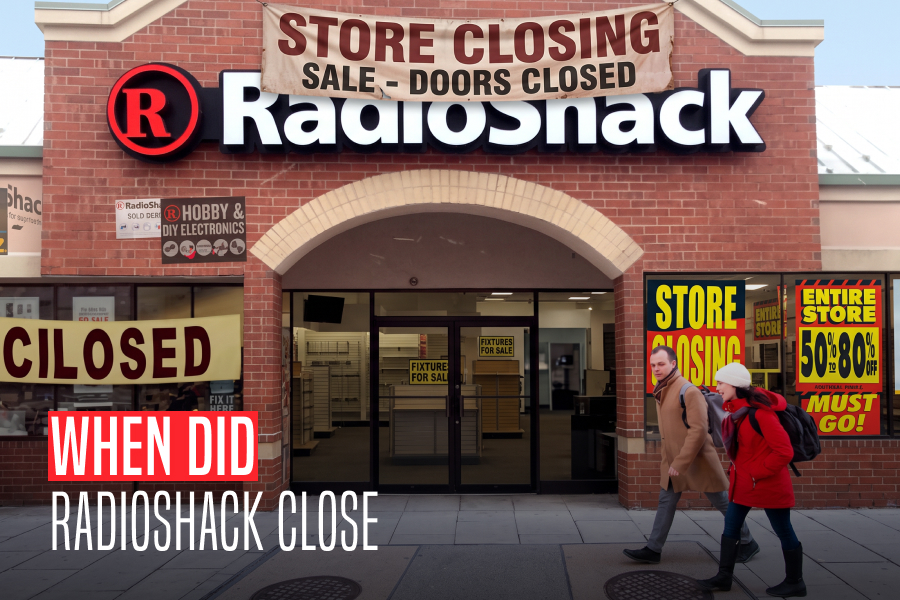
When did RadioShack close

Corporate longevity requires swift adaptability, sharp omni-channel development, and controlled retail scaling.

When customer shopping habits transition toward digital spaces, traditional storefront chains must re-engineer their physical utility.

A primary historical baseline for structural collapse within the consumer retail sector is RadioShack.

Founded in 1921, RadioShack evolved into an absolute neighborhood powerhouse.

However, its aggressive brick-and-mortar footprint eventually encountered a severe liquidity crunch.

To understand the finality of this retail demise, analysts must evaluate the exact timeline of when did radio shack close its main operations.

The parent company did not drop its leases during a single fiscal cycle.

Instead, the brand dissolved through a rare, two-stage bankruptcy process spanning from February 2015 to June 2017.

The Timeline: When Did RadioShack Close?
The Timeline When Did RadioShack Close

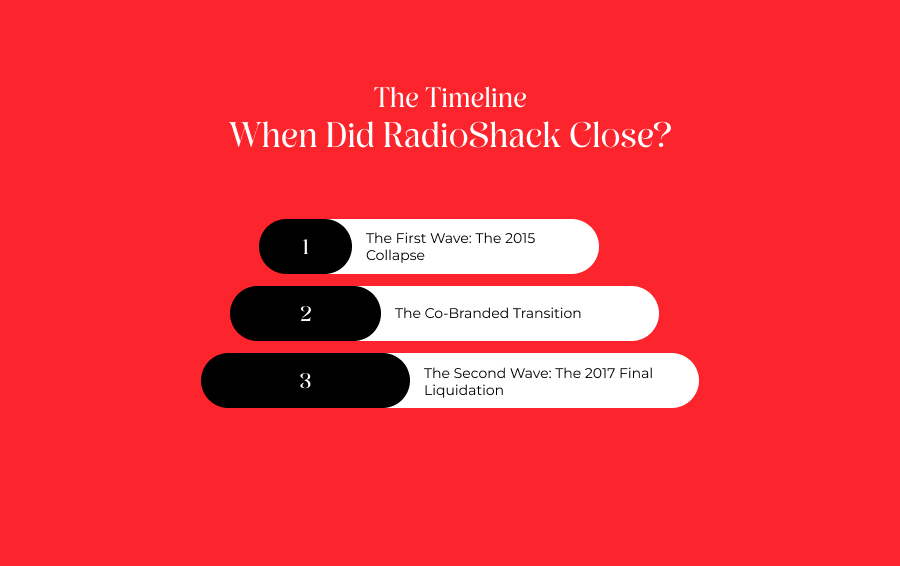
The destruction of RadioShack's commercial footprint occurred in two distinct, cascading corporate waves.

The First Wave: The 2015 Collapse

The first major structural default occurred on February 5, 2015.

Facing massive debt and negative earnings since 2012, RadioShack was officially delisted from the New York Stock Exchange.

Immediately after the filing, the company entered an agreement to close more than 1,700 underperforming locations.

The hedge fund Standard General then purchased the remaining corporate assets for $26.2 million under an affiliate named General Wireless.

The Co-Branded Transition

To sustain the remaining stores, General Wireless partnered directly with telecom provider Sprint.

They converted roughly 1,500 properties into co-branded tech hubs.

Sprint managed the highly concentrated mobile phone sales desks inside the properties.

Meanwhile, RadioShack handled parts, wiring components, and basic consumer electronics hardware.

The Second Wave: The 2017 Final Liquidation

This hybrid co-branded business framework proved too optimistic.

Poor mobile phone conversions and low retail traffic continued to burn through available cash reserves.

Consequently, on March 8, 2017, the parent company filed for bankruptcy protection a second time in two years.

This final restructuring triggered immediate liquidation notices across the country.

By June 2017, RadioShack closed its final 1,000 corporate-owned stores permanently.

This massive liquidation effectively wiped the brand off the physical American retail map, leaving the company to survive strictly as an online e-commerce platform.

RadioShack Corporate Performance Matrix

At its absolute commercial peak, RadioShack maintained an unrivaled retail density across North America.

Over time, bad timing, changing tech trends, and bad financing mechanics completely inverted the firm's balance sheet:

Evaluation CategoryPeak Retail Architecture (1999)Bankruptcy Reality & Final Liquidation (2015–2017)
Market IdentityEvaluated as the ultimate global neighborhood hub for specialized parts and consumer electronics.Consolidated as a permanent symbol of stagnant corporate culture and rapid physical retail decline.
Store FootprintOperated a massive network of over 8,000 corporate locations across multiple countries.Erased all corporate-owned storefronts, leaving only a tiny handful of independent dealers.
Consumer AccessAn astounding 94% of the United States population lived within a 5-minute drive of a store.Shoppers completely abandoned locations in favor of lower pricing and instant online ordering.
Product ConcentrationDiversified across early home computers, radio kits, components, and batteries.Over-concentrated in low-margin mobile devices, which generated 50% of total sales revenue.
Financial HealthGenerated over $5 billion in annual revenue with highly profitable hardware margins.Suffered 11 consecutive quarterly losses before facing total delisting and restructuring.

The Strategic Missteps Behind The Downfall
The Strategic Missteps Behind The Downfall

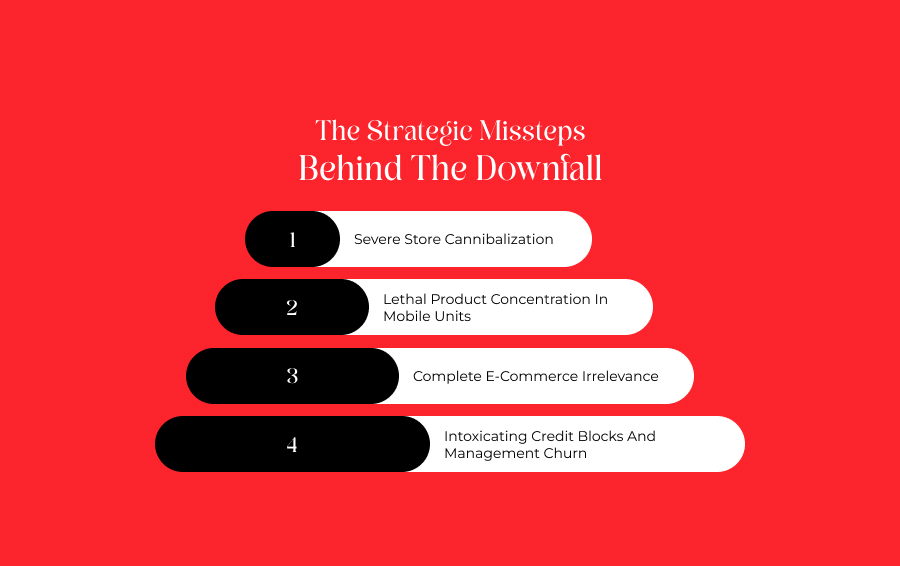
These are some of the core reasons behind RadioShack's fall.

Pay attention, as these allegations had a huge impact on the end of this reputable company:

1. Severe Store Cannibalization

During its peak growth phase, RadioShack expanded its real estate footprint aggressively without analyzing geographic spacing.

By 2014, the brand operated roughly 4,300 North American properties located entirely too close to each other.

For example, Sacramento, California held 25 individual locations crammed within a tight 25-mile radius.

This dense packing caused individual stores to steal revenue directly from neighboring branches, multiplying rental overhead while producing zero net traffic gains.

2. Lethal Product Concentration In Mobile Units

To secure immediate revenue spikes in the early 2000s, corporate leadership pivoted sharply toward mobile phones.

By 2014, smartphone units and carrier plans accounted for 50% of total company sales.

This high product concentration proved to be an existential trap.

When telecom carriers cut back on third-party dealer commissions, RadioShack’s core profit model vaporized, leaving them exposed to low-margin cell phone upgrade cycles.

3. Complete E-Commerce Irrelevance

As shopping behavior migrated online, RadioShack failed to build a functioning digital ecosystem.

Digital marketplaces like Amazon made it effortless to source niche components with a single click.

Because RadioShack offered uncompetitive pricing and struggled with frequent brick-and-mortar inventory shortages, consumers stopped visiting stores entirely.

The company remained tethered to expensive commercial leases while its customer base moved online.

4. Intoxicating Credit Blocks And Management Churn

Turnaround efforts were constantly disrupted by executive instability.

From 2005 to 2014, the board cycled through seven different chief executive officers, destroying any hope of long-term strategic consistency.

Furthermore, when the company secured a $250 million term loan from Salus Capital in 2013, the restrictive credit contract backfired.

When cash flow deteriorated in 2014, executives attempted to close 1,100 failing stores to preserve capital.

However, Salus Capital legally blocked the closures because it lacked confidence in the turnaround path, trapping the brand in cash-burning locations and accelerating bankruptcy.

Core Lessons For Modern Omni-Channel Businesses

Operational ImperativeThe RadioShack MistakeSustainable Strategic Correction
Footprint OptimizationBuilt overlapping brick-and-mortar spaces that cannibalized existing local store revenue.Maintain strict demographic distance limits; favor high-utility central hubs.
Inventory DiversificationAllowed a single low-margin item (mobile phones) to command half of all sales.Balance high-volume core electronics with high-margin unique private label assets.
Digital IntegrationStood by as an outdated analog hub while consumer buying trends shifted online.Implement real-time local inventory tracking linked directly to immediate home delivery.
Debt Covenant ManagementSigned credit agreements that legally prevented them from closing unprofitable branches.Maintain operational flexibility in financing terms to allow rapid down-scaling.

When Did Radioshack Close And Why: The Historic Collapse Explained

The fall of RadioShack highlights that massive physical market density cannot save a business model that fails to evolve alongside technological change.

The electronics icon did not fail because customers stopped buying cables, adapters, or computer parts.

It collapsed because it drifted away from its specialized core audience, over-leveraged its balance sheet into thin mobile device lines, and completely missed the e-commerce transition. For modern business owners, RadioShack stands as a permanent warning: if your brand lacks a clear online and offline purpose, digital convenience will inevitably make your storefront obsolete.

Sohini is a MarTech and business writer with over two years of experience creating and editing content in the digital marketing space. She has a strong interest in emerging digital trends, marketing strategies, and the evolving relationship between technology and business growth. Alongside writing, she also works on guest posting strategies, carefully aligning sponsored content with niche relevance to help maintain strong organic visibility and audience engagement. Outside of work, Sohini enjoys reading, exploring internet subcultures, and endlessly scrolling through Reddit, Pinterest, and Substack looking for new ideas and trends.

View all posts

Leave a Reply

Your email address will not be published. Required fields are marked *

Related

what happened to WeWork

What Happened To WeWork: A Case Study On It’s Collapse And Restructuring

WeWork officially emerged from Chapter 11 bankruptcy in June 2024 after restructuring its corporate operations. Additionally, this wiped out $4 billion in legacy debt. Moreover, it shed over $12 billion in long-term commercial lease liabilities. The financial unraveling of this shared-office pioneer serves as a definitive case study in: Venture capital overvaluation Weak board governance High-risk real estate arbitrage This case study details the systemic failures, the judicial reorganization process, and the brand's modernized operating model. What Happened To WeWork: Unravelling The Collapse Dynamics In November 2023, WeWork Inc., once valued at a private market peak of $47 billion USD, filed for voluntary Chapter 11 bankruptcy protection. Founded on the promise of transforming global office culture through technology, the company’s hyper-expansion strategy was heavily exposed to rigid real estate liabilities. When the global pandemic triggered a massive, permanent shift toward remote and hybrid work models, WeWork's fixed lease costs completely overwhelmed its volatile desk-subscription revenues. Using federal bankruptcy frameworks, court-appointed restructuring teams systematically dismantled the company's unprofitable locations. WeWork successfully completed its financial reorganization in mid-2024. Additionally, it had successfully converted billions in debt into equity. Moreover, it cut its long-term financial obligations in half to emerge as a lean, corporate-focused flexible space aggregator. High-Density Case Timeline: The Collapse And Stabilization The multi-year corporate descent and subsequent operational restructuring of WeWork can be mapped across four distinct economic phases: Strategic Corporate PhaseCritical Financial MilestoneUnderlying Operational MechanismThe Tech Bubble Peak (2019)Valuation hits $47 billion USD driven by massive SoftBank capital injections.The Core Valuation Error: Masked a low-margin commercial real estate leasing business as a hyper-scalable software platform.The IPO Failure (Late 2019)The initial public offering attempts collapse following a deep forensic audit of its S-1 filing.Governance Deficit: Public disclosure of chaotic founder self-dealing, massive luxury spending loops, and unhedged net losses.The Bankruptcy Filing (Nov 2023)Official execution of Chapter 11 protection filings across US and Canadian corporate boundaries.The Liquidity Vacuum: Saddled with over $13 billion in rigid lease lines right before a global macro shift to remote work models.The Post-2024 RebirthEmerges from bankruptcy under new executive leadership, shedding its massive legacy debt.Lean Operational Footprint: Canceled non-viable lease contracts, erased $4 billion in debt, and secured $450M in fresh capital. What Happened To WeWork: Analyzing The Core Strategic Failures WeWork’s fundamental business model rested on a dangerous real estate experiment. The company signed rigid, long-term 10- to 15-year commercial lease commitments with traditional office-building landlords. They then divided the physical real estate into trendy, micro-co-working layouts. Furthermore, they leased them to early-stage startups and freelance contractors on short-term monthly subscription contracts. When a major macroeconomic shift occurs—such as the massive shift to work-from-home models—desk subscription revenues drop immediately. However, WeWork's billions of dollars in fixed lease liabilities remained completely unmovable, hollowing out its cash position in months. Venture capital giant SoftBank poured billions into the platform, treating a brick-and-mortar property leasing company as a hyper-scalable software asset. This endless flow of private capital allowed early leadership to scale up non-profitable locations globally without auditing their core unit economics. Furthermore, the complete lack of independent corporate board oversight enabled chaotic spending loops and unsustainable real estate acquisitions to proceed completely unchecked. The Reorganization Mechanism: The Restructuring Solution WeWork did not shut down its physical doors entirely. Rather, the enterprise used judicial frameworks to strip away its broken legacy infrastructure: · Real Estate Portfolio Remediation Under Chapter 11 protection, WeWork systematically audited its global commercial footprint. The company terminated or renegotiated over 300 non-viable corporate leases, saving more than $12 billion in future lease liabilities. · Debt-to-Equity Capital Restructuring The platform wiped out $4 billion in legacy debt obligations. Therefore, this converted those liabilities into equity stakes for its senior institutional backers (including SoftBank and Yardi Systems). This strategy cleared the company's balance sheet of toxic debt and brought in $450 million in fresh operating capital to fund long-term growth. · Enterprise Asset Shift Moving past high-turnover individual hot-desk sales, the modernized WeWork prioritizes long-term office hub allocations for Fortune 500 corporate teams seeking flexible satellite offices. Comprehensive Structural Comparison: Then vs. Now Operational Parameter BaselineThe Legacy WeWork ArchitectureThe Modernized WeWork FrameworkMarket Valuation StandardAn inflated, highly speculative $47 Billion tech bubble.Pragmatic, real estate asset market valuations.Primary Financial FocusRapid, high-cost global footprint expansion.Profit-per-square-foot margin optimization.Lease Architecture ModelHigh-risk, long-term fixed commercial contracts.Risk-sharing management partnerships with property landlords.Primary Client Base MixIndependent freelancers and unstable early startups.Established corporate enterprises and distributed hybrid teams. What Happened To WeWork Explained The story of what happened to WeWork delivers a critical risk-management lesson to the modern commercial landscape: speculative capital infusions cannot cure broken unit economics. A business cannot hide legacy real estate debt beneath high-tech marketing copy indefinitely. Following its restructuring, the slimmed-down WeWork operates as a viable option for businesses looking to scale down their long-term office liabilities. To build proper financial resilience in your own enterprise, organizations in 2026 need to decouple their core cash flows. This step is very important in order to protect them from rigid long-term debt liabilities. Also, this will help you to maintain agile spatial operational footprints and base your corporate expansions on hard unit profitability metrics rather than speculative investor trends.

READ MOREDetails
FTX Collapse

The Structural Collapse Of The FTX Crypto Exchange And Its Impact: A Case Study

On 11 November 2022, FTX, the world’s third-largest cryptocurrency derivatives exchange, valued at $32 billion at its peak, officially filed for Chapter 11 bankruptcy protection. Founded by Sam Bankman-Fried, the platform positioned itself as a highly secure, institutional-grade trading platform. However, the exchange’s underlying operational framework was structurally compromised by a severe lack of internal accounting checks and massive regulatory non-compliance. This case study analyzes how a secret, multibillion-dollar asset-liability mismatch and illegal balance-sheet commingling systematically hollowed out the platform's liquidity. The crisis unfolded over a seven-day window following an explosive public balance sheet leak. When customers launched a highly synchronized, panic-driven digital withdrawal run, they exposed an $8 billion deficit in customer capital. This cash vacuum forced immediate bankruptcy filings and triggered global contagion across decentralized markets. Furthermore, it led to sweeping criminal indictments for its core executive leadership team. The Corporate Alchemy Of The Ftt-Alameda Loop The structural collapse of FTX was not a standard macro market casualty or an unpredictable investment drop. Instead, it was an intentional, systemic corporate fraud built around an artificial token-collateral loop and the illegal routing of user deposits. When users deposited fiat cash or major crypto tokens (like Bitcoin and Ethereum) on the FTX exchange, internal operating scripts routed those assets off the platform's ledger to Alameda Research, a private crypto hedge fund owned by Sam Bankman-Fried. Alameda used this stolen customer cash to execute high-risk venture bets, purchase luxury real estate, and finance political donations. To hide this massive hole in user accounts, Alameda left billions of dollars' worth of FTT. FTX’s in-house utility token, in the exchange's treasury vaults as replacement collateral. FTX’s developers wrote custom code that granted Alameda a secret $65 billion backdoor line of credit. Therefore, this ensured the hedge fund could continuously draw down customer cash. This setup created an extreme concentration of risk. The entire exchange was backed not by liquid cash reserves but by an illiquid token that FTX had printed out of thin air and artificially valued on the open market. Granular Timeline Of The Strategic Meltdown The operational collapse scaled with unprecedented velocity, stripping a global multi-billion-dollar enterprise of its entire liquid asset base in less than a week: Strategic Phase TimelineFinancial EventUnderlying Systemic Impact2 November 2022CoinDesk leaks Alameda’s balance sheet, exposing that the $14.6B fund was backed almost entirely by illiquid FTT tokens.Triggers immediate risk-mitigation evaluations among global institutional funds.6 November 2022Binance CEO Changpeng Zhao (CZ) announces on social feeds that Binance will liquidate its entire $580M holding of FTT tokens.Sparks a massive digital run, crashing the FTT token market value instantly.7–8 November 2022FTX faces a devastating $6 billion mobile app withdrawal run by panicked retail and corporate users.The exchange runs completely out of liquid cash reserves and halts all customer asset withdrawals.9 November 2022Binance signs a non-binding letter of intent to buy FTX, but backs away 24 hours later due to un-auditable corporate books.Destroys any hope of an institutional bailout, leaving the exchange completely insolvent.11 November 2022Sam Bankman-Fried resigns, and incoming CEO John J. Ray III takes control of the bankrupt corporate shell.Chapter 11 bankruptcy filings are executed across 130 affiliated corporate entities. Structural Vulnerability Matrix: Root Causes Of The Failure An institutional post-mortem of the FTX Group highlights three distinct, compounding risk management flaws that left the platform completely defenseless against a market shock: · Complete Absence Of Corporate Governance The exchange operated without an independent board of directors, lacking external oversight on executive choices. Corporate cash controls were managed via an unsecured group chat app. Furthermore, this is where executives approved multi-million-dollar asset allocations using emojis. Therefore, they left no professional audit trail. · Flawed Internal Financial Controls The company completely lacked a dedicated internal accounting department. John J. Ray III, who famously managed the liquidations of Enron, stated under oath that he had never seen such a complete failure of corporate records. Additionally, he noted that the company used automated consumer software to track corporate cash balances. · Extreme Institutional Conflict Of Interest The boundaries between exchange operator (FTX) and market speculator (Alameda) were completely erased. Alameda was granted a permanent exemption from the platform's automated liquidation engine. This meant that while standard retail users were instantly liquidated during market drops to protect the platform's capital. Alameda could hold massive, bleeding-negative balances indefinitely, shifting its trading losses directly onto the exchange's users. The Digital Mechanism: A Smart-Contract And Social-Media Driven Run A defining characteristic of the FTX collapse was the speed of the panic, accelerated by modern communications and digital banking channels. Traditional historical bank runs unfolded over weeks or months, slowed down by the physical logistics of brick-and-mortar branches. FTX, conversely, was a light-speed digital bank run. The second the Binance liquidations hit social feeds, user panic spread instantly across public social networks and private messaging channels. Fearing immediate account freezes, thousands of global users logged into their mobile trading apps simultaneously to initiate electronic withdrawals. Because the platform's liquid cash reserves had already been secretly drained to cover Alameda's high-risk trading debts, the exchange could not process the massive $6 billion withdrawal load. The sudden run exposed the underlying fraud in hours, freezing customer accounts and cutting off access to individual wealth worldwide. Systemic Contagion And Post-Crisis Regulatory Remediations The fallout from the FTX collapse sent shockwaves through the global decentralized finance sector. This forced international authorities to implement sweeping structural reforms: · Market Contagion Waves The collapse triggered a domino effect across the industry, driving immediate insolvencies among major digital asset lenders such as: BlockFi Genesis Global Voyager Digital Additionally, it wiped over $200 billion in valuation from the broader digital asset markets. · The Enforcement Crackdown International regulatory bodies shifted away from passive tracking to aggressive enforcement actions. Authorities launched sweeping investigations into offshore exchange structures. Therefore, this resulted in a 25-year federal prison sentence for Sam Bankman-Fried for historic wire fraud and money laundering. · Mandatory Corporate Audits Modern regulated digital asset platforms moved quickly to restore investor confidence by adopting strict Proof of Reserves (PoR) frameworks. These systems require third-party cryptographic audits to demonstrate that an exchange maintains 1:1 liquid-asset backing for all customer deposits at all times. Lessons For Corporate Treasury And Capital Allocation Analyzing the failure of the FTX group highlights several essential risk management rules for modern corporate treasuries and venture capital investors: · Enforce Strict Institutional Custody Diversification Never leave your operating capital or digital assets parked long-term on an exchange ledger. Utilize institutional-grade, multi-signature cold storage infrastructure where your team controls the cryptographic keys, ensuring absolute protection against platform freezes. · Execute Rigorous Due Diligence On Governance Frameworks: Venture capital firms poured over $2 billion into FTX without demanding an independent board seat or a formal accounting audit. Modern investment groups must treat a lack of transparent accounting controls or independent oversight as an immediate disqualification flag. · Eliminate Token-Collateral Exposures Never build your corporate treasury around illiquid, self-printed tokens or unhedged digital asset baskets. Ensure your liquid reserves are held in transparent, top-tier cash instruments—such as short-term sovereign bills—to insulate your balance sheet from sharp market downturns.

READ MOREDetails
Silicon Valley Bank collapse

Why Did The Silicon Valley Bank Collapse: Examining The Asset-Liability Breakdown

Silicon Valley Bank (SVB) is the 16th largest commercial banking institution in the United States. On 10 March 2023, it was officially closed by regulators following an unprecedented liquidity crisis. For over four decades, SVB functioned as the primary financial anchor for the global technology, venture capital, and life sciences startup ecosystems. However, its specialized business model left its balance sheet highly vulnerable to sudden market shifts. This case study analyzes how a severe asset-liability mismatch, combined with aggressive macroeconomic interest rate hikes, created a massive hole in the bank's finances. When management attempted a forced, uncoordinated sale of assets to raise cash, it sparked immediate panic across highly connected venture capital networks. The resulting panic triggered the first light-speed, mobile-app-driven bank run in human history, with depositors attempting to withdraw $42 billion in a single 10-hour window. This institutional breakdown forced emergency regulatory interventions from the Federal Reserve to safeguard global market stability. The Silicon Valley Bank Collapse Speaks Of An Asset-Liability Trap The collapse of Silicon Valley Bank was not caused by high volumes of bad loans or toxic credit defaults. Instead, it was a structural failure. Additionally, it was driven by a classic Asset-Liability Mismatch (ALM) that left the bank completely exposed to rapid shifts in interest rates. During the tech boom of 2020 and 2021, venture-backed startups flooded SVB with massive amounts of liquid cash. Therefore, this caused total deposits to balloon from $61 billion to over $189 billion in less than 24 months. In addition, short-term corporate lending demand could not keep pace with this sudden wall of capital. Therefore, SVB’s treasury department made a fateful investment choice. Then, it parked $91 billion of this excess cash in long-term, fixed-rate Held-to-Maturity (HTM) mortgage-backed securities and US Treasuries. This allocation strategy assumed that macroeconomic interest rates would remain low indefinitely. However, throughout 2022, the Federal Reserve launched an aggressive monetary tightening cycle to combat rising inflation. This rapidly raised benchmark interest rates. As interest rates soared, the open-market value of SVB’s older, low-yield fixed-rate bonds depreciated significantly. Because these assets were locked in the HTM accounting box, these massive multi-billion-dollar losses remained hidden on paper. It stayed this way until the tech funding market began to dry up. Therefore, this forced startups to draw down their accounts and forced SVB to find immediate cash. How Does The Timeline Look? The operational lifecycle of the crisis shows how a stable financial institution can spiral into complete insolvency in less than 48 hours: Milestone DateFinancial EventUnderlying Systemic ImpactMid-2021SVB invests over $90B in fixed-rate bonds at an average yield of 1.56%.Locks up vital cash reserves into long-term assets right before a major inflation cycle.Full-Year 2022Federal Reserve raises interest rates from 0% to over 4.25%.Triggers massive, unhedged paper losses across SVB's long-term bond portfolio.8 March 2023SVB liquidates $21B in available bonds at a crushing $1.8 billion net loss.Management announces an uncoordinated $2.25B emergency stock sale to plug the hole, triggering widespread market alarm.9 March 2023Prominent VC firms order their portfolio companies to withdraw their funds immediately.Sparks a massive digital run, with customers initiating $42 billion in electronic withdrawal orders in 10 hours.10 March 2023Regulatory agencies step in to freeze operations and protect assets.The DFPI revokes the bank's operating license and places SVB into official FDIC receivership. What Are The Root Causes Behind The Silicon Valley Bank Collapse? These three are the primary causes of this major shutdown. Let’s look at each of these closely. 1. Extreme Deposit Concentration Risk This case is completely different from traditional commercial banks that diversify their ledgers across: Retail Consumers Varied Manufacturing Lines Multiple Distinct Industries SVB's client base was almost entirely concentrated within the venture capital and tech startup ecosystem. Furthermore, an overwhelming 90% of SVB’s total deposits exceeded the standard $250,000 FDIC insurance limit. This lack of baseline security meant that when tech funding slowed down, clients began drawing down their accounts simultaneously. Also, this left the bank highly vulnerable to a sudden herd mentality. 2. Complete Lack Of Interest Rate Hedging As the Federal Reserve launched its historic interest rate hikes, SVB's asset managers failed to adjust their strategy. In fact, throughout 2022, the bank systematically reduced or completely canceled its interest rate swap derivatives. Therefore, the standard financial instruments institutions use to hedge against bond value drops. This left its multi-billion-dollar bond portfolio completely exposed, turning a macroeconomic rate adjustment into a fatal capital drop. 3. Severe Corporate Governance Silos The bank's internal safety checks failed due to leadership gaps. SVB operated without an official Chief Risk Officer (CRO) for nearly eight months during the exact window when the Federal Reserve was aggressively raising interest rates. This internal vacuum allowed the asset-liability mismatch to expand completely unchecked by internal risk auditors. The Digital Mechanism: The First Smartphone Bank Run A defining characteristic of the SVB collapse was the speed of the panic, accelerated by modern communications and digital banking channels. Traditional bank runs were physically constrained by real-world logistics—customers had to stand in lines outside brick-and-mortar branches, which naturally slowed the withdrawal rate. SVB, conversely, was the first entirely digital bank run. The second the bank announced its balance sheet losses, prominent venture capital funds flagged the risk on private WhatsApp groups, Slack channels, and public social networks. Fearing immediate capital freezes, fund managers advised their founders to withdraw capital immediately. Because tech founders are highly connected and online, they initiated multi-million dollar wire transfers simultaneously via mobile apps and online portals. This light-speed panic pulled $42 billion out in a single day—accounting for a quarter of the bank's total deposit base—and completely broke the bank's liquidity routing systems. Comprehensive Lessons For Modern Corporate Treasuries Analyzing the SVB collapse highlights several essential risk-management rules for modern financial officers and corporate team leaders: · Implement A Multi-Bank Diversification Strategy Never park your entire operating capital within a single financial institution, no matter how specialized they are in your sector. Secure your funds by spreading your cash reserves across multiple systemic banks using automated sweep accounts to maximize your FDIC insurance coverage. · Maintain Strict Liquidity Buffer Allocations Ensure your internal treasury guidelines require that at least 20–30% of your total corporate reserves be held in highly liquid, short-term cash equivalents. These can be overnight deposits or short-term Treasury bills. Both of which can be accessed instantly without triggering market-sale penalties. · Enforce Active Macro Hedging Mandates Board-level risk committees must enforce strict, ongoing evaluation cycles to track shifts in macroeconomic interest rates. Ensure your internal treasury policies are actively aligned with changing central bank rates, using interest rate swaps to insulate long-term asset values against sudden market shifts.

READ MOREDetails