WeWork officially emerged from Chapter 11 bankruptcy in June 2024 after restructuring its corporate operations.
Additionally, this wiped out $4 billion in legacy debt. Moreover, it shed over $12 billion in long-term commercial lease liabilities.
The financial unraveling of this shared-office pioneer serves as a definitive case study in:
Venture capital overvaluation
Weak board governance
High-risk real estate arbitrage
This case study details the systemic failures, the judicial reorganization process, and the brand's modernized operating model.
What Happened To WeWork: Unravelling The Collapse Dynamics
In November 2023, WeWork Inc., once valued at a private market peak of $47 billion USD, filed for voluntary Chapter 11 bankruptcy protection.
Founded on the promise of transforming global office culture through technology, the company’s hyper-expansion strategy was heavily exposed to rigid real estate liabilities.
When the global pandemic triggered a massive, permanent shift toward remote and hybrid work models, WeWork's fixed lease costs completely overwhelmed its volatile desk-subscription revenues.
Using federal bankruptcy frameworks, court-appointed restructuring teams systematically dismantled the company's unprofitable locations.
WeWork successfully completed its financial reorganization in mid-2024.
Additionally, it had successfully converted billions in debt into equity.
Moreover, it cut its long-term financial obligations in half to emerge as a lean, corporate-focused flexible space aggregator.
High-Density Case Timeline: The Collapse And Stabilization
The multi-year corporate descent and subsequent operational restructuring of WeWork can be mapped across four distinct economic phases:
Strategic Corporate Phase
Critical Financial Milestone
Underlying Operational Mechanism
The Tech Bubble Peak (2019)
Valuation hits $47 billion USD driven by massive SoftBank capital injections.
The Core Valuation Error: Masked a low-margin commercial real estate leasing business as a hyper-scalable software platform.
The IPO Failure (Late 2019)
The initial public offering attempts collapse following a deep forensic audit of its S-1 filing.
Governance Deficit: Public disclosure of chaotic founder self-dealing, massive luxury spending loops, and unhedged net losses.
The Bankruptcy Filing (Nov 2023)
Official execution of Chapter 11 protection filings across US and Canadian corporate boundaries.
The Liquidity Vacuum: Saddled with over $13 billion in rigid lease lines right before a global macro shift to remote work models.
The Post-2024 Rebirth
Emerges from bankruptcy under new executive leadership, shedding its massive legacy debt.
Lean Operational Footprint: Canceled non-viable lease contracts, erased $4 billion in debt, and secured $450M in fresh capital.
What Happened To WeWork: Analyzing The Core Strategic Failures
WeWork’s fundamental business model rested on a dangerous real estate experiment.
The company signed rigid, long-term 10- to 15-year commercial lease commitments with traditional office-building landlords.
They then divided the physical real estate into trendy, micro-co-working layouts.
Furthermore, they leased them to early-stage startups and freelance contractors on short-term monthly subscription contracts.
When a major macroeconomic shift occurs—such as the massive shift to work-from-home models—desk subscription revenues drop immediately.
However, WeWork's billions of dollars in fixed lease liabilities remained completely unmovable, hollowing out its cash position in months.
Venture capital giant SoftBank poured billions into the platform, treating a brick-and-mortar property leasing company as a hyper-scalable software asset.
This endless flow of private capital allowed early leadership to scale up non-profitable locations globally without auditing their core unit economics.
Furthermore, the complete lack of independent corporate board oversight enabled chaotic spending loops and unsustainable real estate acquisitions to proceed completely unchecked.
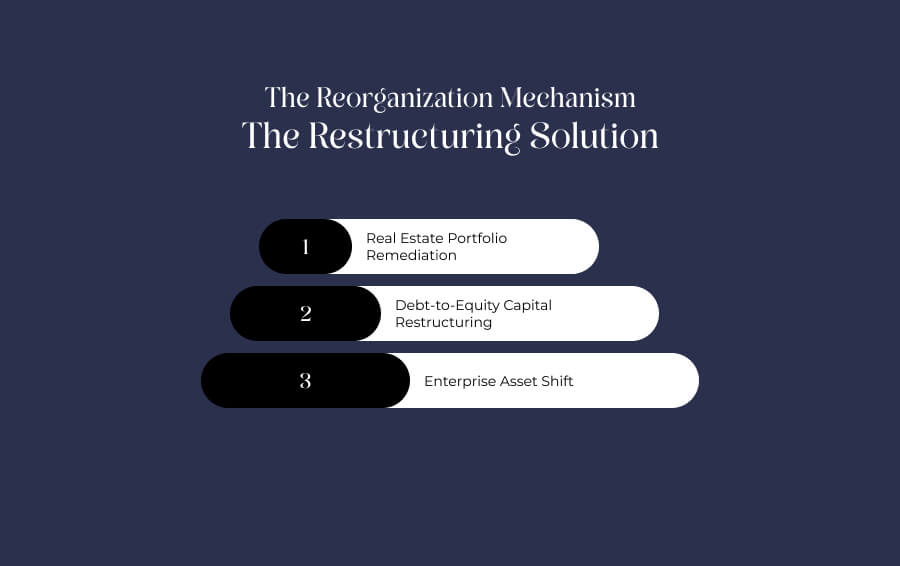
The Reorganization Mechanism: The Restructuring Solution
WeWork did not shut down its physical doors entirely.
Rather, the enterprise used judicial frameworks to strip away its broken legacy infrastructure:
· Real Estate Portfolio Remediation
Under Chapter 11 protection, WeWork systematically audited its global commercial footprint.
The company terminated or renegotiated over 300 non-viable corporate leases, saving more than $12 billion in future lease liabilities.
· Debt-to-Equity Capital Restructuring
The platform wiped out $4 billion in legacy debt obligations.
Therefore, this converted those liabilities into equity stakes for its senior institutional backers (including SoftBank and Yardi Systems).
This strategy cleared the company's balance sheet of toxic debt and brought in $450 million in fresh operating capital to fund long-term growth.
· Enterprise Asset Shift
Moving past high-turnover individual hot-desk sales, the modernized WeWork prioritizes long-term office hub allocations for Fortune 500 corporate teams seeking flexible satellite offices.
Comprehensive Structural Comparison: Then vs. Now
Operational Parameter Baseline
The Legacy WeWork Architecture
The Modernized WeWork Framework
Market Valuation Standard
An inflated, highly speculative $47 Billion tech bubble.
Pragmatic, real estate asset market valuations.
Primary Financial Focus
Rapid, high-cost global footprint expansion.
Profit-per-square-foot margin optimization.
Lease Architecture Model
High-risk, long-term fixed commercial contracts.
Risk-sharing management partnerships with property landlords.
Primary Client Base Mix
Independent freelancers and unstable early startups.
Established corporate enterprises and distributed hybrid teams.
What Happened To WeWork Explained
The story of what happened to WeWork delivers a critical risk-management lesson to the modern commercial landscape: speculative capital infusions cannot cure broken unit economics.
A business cannot hide legacy real estate debt beneath high-tech marketing copy indefinitely.
Following its restructuring, the slimmed-down WeWork operates as a viable option for businesses looking to scale down their long-term office liabilities.
To build proper financial resilience in your own enterprise, organizations in 2026 need to decouple their core cash flows.
This step is very important in order to protect them from rigid long-term debt liabilities.
Also, this will help you to maintain agile spatial operational footprints and base your corporate expansions on hard unit profitability metrics rather than speculative investor trends.
Sohini is a MarTech and business writer with over two years of experience creating and editing content in the digital marketing space. She has a strong interest in emerging digital trends, marketing strategies, and the evolving relationship between technology and business growth. Alongside writing, she also works on guest posting strategies, carefully aligning sponsored content with niche relevance to help maintain strong organic visibility and audience engagement. Outside of work, Sohini enjoys reading, exploring internet subcultures, and endlessly scrolling through Reddit, Pinterest, and Substack looking for new ideas and trends.
The clean energy sector requires immense capital expenditure.
Also, we must agree that another important factor is highly disciplined project management.
Additionally, you must pay attention to predictable, long-term cash flow matching.
Therefore, this is something to consider when firms are expanding global infrastructure footprints.
In fact, they must prioritize concrete balance sheet liquidity over ambitious growth projections.
A primary historical baseline for structural corporate failure in this space is SunEdison, Inc.
Originally a silicon wafer manufacturer spun out of Monsanto (MEMC Electronic Materials), SunEdison transformed itself through aggressive acquisitions into the world’s largest renewable energy development company.
However, its rapid ascent culminated in one of the most spectacular failures in corporate history.
On April 21, 2016, SunEdison filed for Chapter 11 bankruptcy protection.
There, it listed a staggering $20.7 billion in assets alongside $16.1 billion in liabilities.
This exhaustive case study dissects strategic miscalculations and flawed financial engineering architectures.
Also, this blog will point out the governance of blind spots and structural lessons of the collapse.
SunEdison Corporate Operational Profile
Evaluation CategoryPeak Growth Architecture (2013–2015)Bankruptcy Reality And Failure Triggers (2016)Market IdentityEvaluated as a premier global clean-energy champion and Wall Street darling.Consolidated as a permanent cautionary tale of extreme financial engineering and insolvency.Growth StrategyInorganic expansion funded entirely via aggressive corporate debt and acquisitions.Severe liquidity crisis driven by an inability to service rapid debt margins.Capital VehicleDeployed two twin YieldCo vehicles: Terraform Power and Terraform Global to pool assets.YieldCo structures faced intense public market scrutiny and deep investor panic.Regulatory StandingFueled by extensive federal subsidies, state grants, and low-interest capital injection.Subject to sweeping investigations by the U.S. Department of Justice (DOJ) and the SEC.Valuation PeakEnterprise value soared past $10 billion; stock appreciated over 2,200% at its zenith.Erased 99% of total equity valuation within a tight nine-month market window.
What Are The Core Failure Factors Behind SunEdison Collapse?
Behind this huge financial collapse are several core factors. Let’s look at them closely:
1. Inorganic Overreach And The Acquisition Loop
Under CEO Ahmad Chatila, SunEdison pivoted away from organic solar asset development toward relentless, debt-fueled international acquisitions.
Furthermore, the company spent billions purchasing wind and solar developers globally.
Of course, this includes a major $2.4 billion acquisition of wind-power developer First Wind in early 2015.
By scaling too quickly across disparate international jurisdictions, the company inflated integration overhead.
Additionally, it stretched its operational focus. So, this left it structurally fragile when macro market conditions shifted.
2. Structural Vulnerabilities Of The Yieldco Framework
To sustain its capital-intensive buying spree, SunEdison pioneered a complex financing model utilizing YieldCos.
They created subsidiary corporate spin-offs designed to own and operate completed, cash-generating renewable energy assets.
SunEdison launched two public YieldCos:
TerraForm Power (NASDAQ: TERP): Tasked with holding mature domestic solar and wind assets.
TerraForm Global (NASDAQ: GLBL): Built to manage emerging-market clean energy contracts.
The strategic purpose of these vehicles was to buy completed utility projects from the parent company (SunEdison).
Therefore, this provided a steady stream of dividend payouts to public investors.
In addition, it freed up liquidity for SunEdison to build more projects.
However, a lethal structural conflict of interest quickly emerged.
As SunEdison's development costs spiraled out of control, it began treating the legally distinct YieldCos as private credit lines.
The parent company pressured the subsidiaries to buy unfinished or underperforming projects.
This simply injected quick cash back onto SunEdison's balance sheet. But it severely eroded public investor confidence.
3. The Catalyst: The Vivint Solar Acquisition Panic
The structural vulnerabilities collapsed entirely in July 2015, when SunEdison announced a definitive agreement to acquire residential solar installer Vivint Solar for approximately $2.2 billion.
Public markets immediately rebelled against the transaction.
Institutional investors and hedge funds realized that entering the highly fragmented, high-churn residential solar segment would require immense capital that SunEdison simply did not possess.
The announcement triggered an aggressive sell-off of SunEdison and TerraForm stock.
As the parent company's share price plummeted from over $30 to under $3 in a matter of months, it lost its primary financial mechanism: the ability to raise cheap equity capital by issuing new stock.
Deprived of public funding and saddled with massive near-term debt covenants, SunEdison's liquidity evaporated.
4. Intoxicating Corporate Governance And Reporting Overrides
As the cash deficit widened through late 2015, internal executives and financial officers raised alarms regarding imminent liquidity cliffs.
Rather than pivoting strategy or curtailing acquisitions, corporate leadership marginalized internal critics.
The company delayed its mandatory SEC financial disclosures, leading to structural downgrades from credit rating agencies.
Ultimately, the lack of corporate transparency triggered formal SEC investigations.
Additionally, it prompted the U.S. Department of Justice (DOJ) as well.
Both wanted to determine whether executives intentionally misled the market about actual cash reserves before the collapse.
The Ultimate Asset Post-Mortem: What Happened To The Yieldcos
While SunEdison's parent equity was completely wiped out in bankruptcy court.
This leaves the original shareholders with absolutely nothing, but its underlying clean energy assets retained high fundamental value.
In 2017, Canadian asset management giant Brookfield Asset Management stepped in.
Brookfield bought TerraForm Global outright for $787 million and acquired a controlling stake in TerraForm Power.
Therefore, this eventually merged it fully into Brookfield Renewable Partners.
Managed under strict capital discipline rather than reckless financial engineering, TerraForm survived, pivoted its growth strategy, and expanded its portfolio.
This proves that SunEdison’s core failure was entirely an operational and structural financing disaster, not an issue with the baseline utility of solar or wind technology.
Forensic Accounting Breakdown: Project Caching Vs. Cash Depletion
The hidden mechanic behind SunEdison’s immediate bankruptcy was an extreme disconnect between reported non-cash assets and actual liquid cash reserves.
The parent firm relied on an accounting trick where it recognized massive immediate paper profits the moment it offloaded an uncompleted construction project to its YieldCos.
However, because the projects were unfinished, they generated zero real operational cash flow.
SunEdison was simultaneously burning through over $1 billion a quarter in hardware manufacturing overhead and construction costs.
By the time internal auditors raised flags, the company’s internal ledger had misappropriated over $231 million from its own subsidiaries.
So, this uses long-term project capital to plug immediate, short-term debt margins.
This creates an explicit accounting lesson: Paper profits and aggressive asset valuations mean nothing if a corporation lacks the net liquid cash flow to meet its weekly debt-servicing requirements.
Core Strategic Lessons For Modern Tech And Cleantech Industries
Strategic ImperativeThe SunEdison MistakeSustainable Operational CorrectionGrowth VelocityPrioritized inorganic scale and market share at the absolute expense of cash-flow health.Scale should match real, baseline operational margins and positive cash generation.Capital AllocationLeveraged complex, multi-tiered financial structures to mask immediate structural losses.Maintain corporate transparency with clear, independent balance sheets for subsidiaries.Vetting ProtocolsExecuted cross-border acquisitions rapidly with minimal localized due diligence.Implement strict risk assessments; optimize existing assets before taking on new debt.Risk ManagementFired or ignored senior executives who raised alarms about liquidity positions.Establish an independent board audit committee to protect whistleblower channels.
Timeline Of The Corporate Fall
2014: SunEdison launches its first YieldCo, TerraForm Power, achieving massive initial valuation success on Wall Street.
Early 2015: Acquires First Wind for $2.4 billion, shifting aggressively into multi-asset global utility development.
July 2015: Announces the ill-fated $2.2 billion Vivint Solar acquisition, triggering immediate investor panic and stock deterioration.
Late 2015: Appoints an independent committee to investigate internal financial reporting discrepancies amid whistleblower complaints.
March 2016: The Vivint Solar deal collapses entirely; TerraForm Global publicly warns that SunEdison faces an imminent risk of bankruptcy.
April 2016: SunEdison officially files for Chapter 11 bankruptcy protection, rendering public equity shares worthless.
The baseline metric of success on Sony Entertainment Television’s Shark Tank India has historically been a live, televised handshake.
Also, it features a distinguished panel of Indian venture capitalists.
However, there is an objective analysis of the domestic consumer and tech markets.
It proves that leaving the studio floor empty-handed can serve as a massive, unintended launchpad for long-term growth.
A television rejection often becomes a powerful lesson in operational resilience when an Indian founder refuses to:
Surrender massive equity slices
Accept predatory loan terms
Bow to lowball valuations
In India, evaluating the most successful Shark Tank India rejects reveals systemic blind spots within fast-paced pitch ecosystems.
The panel frequently prioritizes immediate cash flows, hyper-trendy D2C plays, or personal network protections.
Also, it occasionally misses major shifts in:
Macro Industrial Infrastructure
Deep-Tech Assistive Innovations
Foundational Unit Economics
This granular corporate audit conducts an in-depth analytical review of 11 most successful Shark Tank rejects.
The Top 11 Most Successful Shark Tank Rejects: Getting Into The Details
These are multi-crore Indian brands that successfully bypassed the panel to dominate their respective markets.
1. Zypp Electric
Zypp Electric’s founders: Akash Gupta and Rashi Agarwal
Zypp Electric at Shark Tank: Season 1, Episode 17
Investment: Asked for ₹2.2 Crores for 1% equity; left empty-handed with no deal from the Sharks (later raised Series C funding rounds on an institutional scale)
Zypp Electric operates a high-density, tech-enabled EV-as-a-service last-mile delivery fleet tailored for India’s booming quick-commerce and e-commerce sectors.
The company provides electric two-wheelers, integrated battery-swapping infrastructure, and trained delivery riders to enterprise giants like Zomato, Swiggy, Zepto, Blinkit, and Amazon.
· The Post-Tank Strategic Pivot
The Sharks flatly rejected the company's valuation, claiming an asset-heavy vehicle fleet was an unscalable cash drain.
Instead of backing down, the founders utilized the broadcast to showcase their enterprise utility to institutional funds.
Zypp moved away from loose retail rentals to lock down massive, multi-year B2B corporate logistics contracts.
· Modern Valuation And Market Stance
Proving the Sharks completely miscalculated the economics of green logistics, Zypp raised a massive Series C funding round led by global energy icon ENEOS.
The company’s operational fleet exceeds 21,000 active EVs, anchoring its market valuation at over ₹3,000 Crores.
2. Recode Studios
Recode Studios’ founders: Dheeraj Bansal and Rahul Sachdeva
Recode Studios at Shark Tank: Season 2, Episode 1
Investment: Asked for ₹1 Crore for 1% equity; rejected by the panel on television despite stellar, highly profitable bootstrapped sales metrics.
Recode Studios designs, manufactures, and distributes premium-grade mass-market cosmetics, skincare, and beauty utilities.
The brand targets tier-2 and tier-3 Indian urban centers.
Additionally, it utilizes an aggressive pricing strategy that undercuts mainstream international cosmetic houses.
Consequently, it delivers identical chemical parity and wear longevity.
· The Post-Tank Strategic Pivot
Despite presenting highly profitable numbers with over ₹15 Crores in bootstrapped sales, the Sharks completely refused to invest.
This was due to personal friendships with rival D2C cosmetics founders on the panel.
Recode instantly flipped this rejection into a powerful public relations asset.
Moreover, they leaned into a transparent "consumer-backed, elite-rejected" marketing campaign across social channels.
· Modern Valuation And Market Stance
The massive wave of organic public support accelerated their expansion of physical retail locations.
Recode successfully expanded its distribution network to operate over 250+ physical store layouts and counter modules across India.
So, it maintains a highly profitable, self-sustaining financial trajectory completely independent of mainstream capital networks.
3. Moonshine Meadery
Moonshine Meadery’s founders: Rohan Rehani and Nitin Vishwas
Moonshine Meadery at Shark Tank: Season 1, Episode 34
Investment: Asked for ₹80 Lakhs for 0.5% equity; walked away empty-handed due to unviable, heavy valuation cut counter-demands.
Moonshine Meadery is a pioneering alcobev brand that created India's very first licensed, commercial craft meadery.
The company sources pure, raw honey from local apiaries and ferments it with fruits and spices to produce a premium, gluten-free alcoholic beverage line targeting the rapidly growing alcobev segment.
· The Post-Tank Strategic Pivot
While the panel praised the product's taste and branding precision, they backed away due to the complex regulatory red tape, inter-state excise structures, and long distribution timelines tied to the Indian liquor market.
The founders flatly rejected the Sharks' heavy counter-demands for valuation cuts.
They systematically optimized their regional manufacturing loops, focusing on high-margin metro hubs like Mumbai, Pune, and Bengaluru.
· Modern Valuation And Market Stance
Moonshine successfully expanded its international distribution footprint, locking down exports to Europe and North America.
By retaining absolute control over their proprietary fermentation equations, they independently secured their corporate valuation at the ₹160+ Crore ceiling.
4. Urban Monkey
Urban Monkey’s founder: Yash Gangwal
Urban Monkey at Shark Tank: Season 1, Episode 35
Investment: Asked for ₹1 Crore for 1% equity; rejected flatly by the investor panel on the studio floor.
Urban Monkey structures, curates, and scales premium lifestyle products centered entirely around underground Indian street culture.
The brand manufactures:
Highly Stylized Skateboarding Apparel
Graphic Streetwear Tees
Modular Corduroy Waist Bags
Premium Snapback Caps
Therefore, it aims to build an authentic brand community around local hip-hop artists, street skaters, and break-dancers.
· The Post-Tank Strategic Pivot
The investment panel dismissed the pitch.
It labeled localized streetwear an unscalable, micro-niche category with highly volatile consumer loyalty.
The brand chose to skip traditional fashion marketing channels entirely.
Instead, they built an exclusive, high-margin direct-to-consumer (D2C) online framework.
Moreover, they scaled through organic product placements in top Indian hip-hop music videos and at underground, independent cultural events.
· Modern Valuation And Market Stance
Urban Monkey emerged as the definitive style statement for Indian street youth.
In fact, it has been frequently worn by major pop culture celebrities.
By bypassing traditional multi-brand retail margins, the company maintains high profit margins.
Furthermore, it sustains massive multi-crore annual organic revenues nationwide.
5. Livofy
Livofy’s founder: Sahil Pruthi
Livofy at Shark Tank: Season 1, Episode 18
Investment: Asked for ₹1.5 Crores for 1.25% equity; the founder flatly rejected the Sharks' heavy 16% equity dilution counter-demand and walked out deal-less.
Livofy is an advanced health-tech application that leverages:
Customized nutrition plans
Targeted coaching modules
Machine learning algorithms
So, it assists users in managing chronic lifestyle conditions.
The platform targets metabolic health, delivering clinical remediation tracks to reverse PCOS, obesity, Type 2 diabetes, and elevated thyroid indices.
· The Post-Tank Strategic Pivot
Four out of five Sharks wanted to fund the company, but attempted to force a predatory 16% equity dilution counter-offer on the table.
Recognizing that surrendering such a massive chunk of early equity would ruin his long-term funding leverage, founder Sahil Pruthi walked away.
He used the massive broadcast publicity to expand his market positioning, rebranding the company from Keto India to Livofy to reach a broader wellness demographic.
· Modern Valuation And Market Stance
Moving forward on his own terms, Pruthi raised over $550,000 USD (approximately ₹4.5 Crore) in subsequent seed rounds from institutional angel funds, thereby protecting his founder wealth while scaling his health-tech engine among global NRIs.
6. Morriko Pure Foods
Morriko Pure Foods’ founders: Tanuja Shah and Pramod Shah
Morriko Pure Foods at Shark Tank: Season 1, Episode 34
Investment: Asked for ₹1 Crore for 3% equity; left empty-handed after refusing to compromise their business core or lower their valuation parameters.
Morriko Pure Foods operates a specialized food-processing framework that manufactures fruit and vegetable snacks that are:
Clean-Label
Preservative-Free
Zero-Added-Sugar
The company utilizes proprietary, state-of-the-art solar dehydration technology to preserve full nutritional value.
Therefore, it aims to serve health-conscious snackers and clean-eating consumers.
· The Post-Tank Strategic Pivot
The Sharks attempted to alter the company's baseline operational model, demanding steep drops in retail valuation and a shift toward cheaper, sugar-infused candy formulations to maximize short-term retail velocity.
The founders flatly refused to compromise their healthy brand core.
Instead, they focused on high-margin niche wellness e-commerce portals, organic grocery networks, and high-volume corporate pantry supply channels.
· Modern Valuation And Market Stance
Morriko established itself as an essential clean-label partner for global corporate offices and fitness chains.
By building a dedicated, loyal audience that values genuine product purity over low-grade chemical pricing, the brand scales its multi-crore manufacturing infrastructure across regional health channels completely ad-free.
7. ExperientialEtc
ExperientialEtc’s founders: Karan Bhardwaj and Sameer Bhatia
ExperientialEtc at Shark Tank: Season 2, Episode 40
Investment: Asked for ₹2 Crores for 4% equity; left with no deal as the panel passed due to technology scalability doubts.
ExperientialEtc is a high-end visual tech company that structures and deploys disruptive, immersive marketing campaigns for enterprise brands.
The agency manufactures, programs, and rents high-density kinetic light walls and 3D holographic displays.
Additionally, it works with interactive projection-mapping fixtures.
Also, it creates augmented-reality environments to maximize crowd engagement at physical venues.
· The Post-Tank Strategic Pivot
The investment panel struggled to comprehend the scalability of specialized, high-cost spatial tech, dismissing the pitch as an unpredictable event-management service rather than an enterprise software asset.
The founders pivoted by embedding their hardware rigs into a comprehensive, high-margin corporate licensing model.
They signed long-term retainer accounts with blue-chip global firms requiring recurring high-tech trade show displays and premium brand launches.
· Modern Valuation And Market Stance
The company has an ironclad reputation as a premier high-tech agency, serving major global corporate tech events in:
Dubai
Singapore
Mumbai
Additionally, it generates stellar multi-crore service margins annually.
8. Torch-It
Torch-It’s founder: Hunny Bhagchandani
Torch-It at Shark Tank: Season 1, Episode 29
Investment: Asked for ₹2.5 Crores for 1% equity; rejected by the Sharks, who focus-tested the hardware model as low-margin charity rather than an enterprise asset.
Torch-It functions as a highly awarded deep-tech social enterprise that engineers assistive mobility hardware.
Also, it works with integrated AI software to empower visually impaired citizens worldwide.
Furthermore, their flagship product line uses predictive ultrasonic sensor arrays and spatial machine learning algorithms.
Therefore, this will help map physical obstacles. In fact, this will guide users safely with precise haptic vibration feedback patterns.
· The Post-Tank Strategic Pivot
The Sharks viewed the social-impact device as low-margin charity rather than a viable enterprise asset, passing on the investment.
Founder Hunny Bhagchandani leveraged his television exposure to secure institutional backing directly from the Government of India.
Also, he gets good support from corporate social responsibility (CSR) capital funds and international accessibility NGOs.
· Modern Valuation And Market Stance
Torch-It expanded its core technology stack to produce over 40+ distinct AI-enabled assistive solutions, including the Jyoti AI Smart Glasses.
The organization operates as a highly successful, self-sustaining assistive tech provider, deploying tens of thousands of units across Africa, South Asia, and the Middle East.
9. Shades of Spring
Shades of Spring’s founders: Nidhi Gupta and Anup Kumar
Shades of Spring at Shark Tank: Season 2, Episode 10
Investment: Asked for ₹3 Crores for 1% equity; walked away empty-handed after the panel passed due to aggressive tech-forward pricing disagreements.
Shades of Spring is an innovative, tech-enabled e-commerce platform that operates a direct-from-farm fresh-flower subscription network.
Moreover, this connecting flower farms directly with urban homes via automated cold-chain logistics.
By this, the platform completely bypasses traditional flower wholesale layers.
Furthermore, it ensures that blooms arrive at local doorsteps significantly fresher than those from traditional florist shops.
· The Post-Tank Strategic Pivot
The panel reacted with intense skepticism to the company's valuation metrics.
Moreover, the panel claimed that flowers were an unpredictable, seasonal commodity with zero long-term subscription retention.
Furthermore, the founders ignored the criticism.
They invested heavily in building automated sorting facilities.
Also, they built a seamless, user-friendly mobile application interface to streamline recurring weekly orders.
· Modern Valuation And Market Stance
The startup proved the massive potential of the localized home-curation market.
Today, Shades of Spring processes thousands of active subscription orders across major metropolitan areas.
It maintains a highly profitable model and a valuation that meets its initial enterprise milestones.
10. Agri Tourism India
Agri Tourism India’s founder: Pandurang Taware
Agri Tourism India at Shark Tank: Season 1, Episode 31
Investment: Asked for ₹50 Lakhs for 5% equity; flatly rejected by the panel, who classified the rural network as an unscalable, offline project.
Agri Tourism India operates a sustainable, community-driven eco-tourism aggregator model that connects urban travelers with working rural agricultural farms.
The platform allows tourists to experience authentic rural farm stays, traditional local culinary methods, and sustainable harvesting practices, funneling alternative revenue lines straight to local farmers.
· The Post-Tank Strategic Pivot
The Sharks flatly dismissed the pitch, filing rural eco-tourism away as a slow, unscalable, and unmarketable offline lifestyle project.
The founders stuck to their core vision, bypassing premium city marketing agencies to partner directly with local state tourism boards, environmental educational organizations, and international corporate eco-retreat planners.
· Modern Valuation And Market Stance
The platform scaled across multiple states, transforming thousands of remote rural farms into high-margin, self-sustaining hospitality centers.
The company remains the definitive pioneer of Indian agritourism, proving that eco-friendly, asset-light community systems deliver excellent long-term financial stability.
11. SamparkMe
SamparkMe’s founder: Saurabh Garg
SamparkMe at Shark Tank: Season 2, Episode 45
Investment: Asked for ₹50 Lakhs for 5% equity; left with no deal after the Sharks claimed local drivers lacked the civic intent to adopt QR vehicular tools.
SamparkMe designs, manufactures, and scales localized QR-based vehicular communication tags and security ecosystems.
Additionally, this company places a secure, encrypted QR decal onto a vehicle’s windshield.
Therefore, the system allows the public or parking officers to contact the owner anonymously in an emergency, such as:
Double Parking
Towing
Fire Risks
However, you can go forward with this without exposing private mobile phone numbers.
· The Post-Tank Strategic Pivot
The Sharks were highly critical of the app's community-driven model, with several panel members asserting that local citizens lacked the necessary "civic sense" to actively scan QR codes or respect drivers' anonymity.
Founder Saurabh Garg ignored the panel's negative review.
Then he pivoted his marketing strategy away from loose retail sales to focus on high-volume B2B corporate partnerships.
Additionally, he associated with car insurance networks, luxury residential real estate projects, and premium commercial parking garages.
· Modern Valuation And Market Stance
SamparkMe successfully transformed into a reliable, everyday safety asset across India’s crowded tier-1 metros.
The platform tracks a rapidly climbing active user base.
Therefore, this proves that when privacy and vehicular safety are combined with zero-friction mobile software, Indian drivers will adopt smart civic tools at scale.
The Most Successful Shark Tank Rejects Give Us A Lot To Learn
The long-term success of these 11 startups proves that a televised rejection on Shark Tank India can serve as a massive, long-term corporate asset. When a founder protects their early company equity and stands firm on their true valuation, they retain the freedom and financial leverage to build a highly successful, self-sustaining business on their own terms.
Do you remember Vine? Yes, I am talking about that app where we used to spend hours completely glued to our phones watching six seconds' worth of content.
I still remember the exact hypnotic rhythm of clicking open an app just to watch a six-second loop change my entire day.
If you have grown up online in the mid-2010s as I have, then you know exactly what I am talking about.
We didn’t just watch these videos. Instead, we lived in an era entirely defined by the iconic phrases “Welcome to Chilli’s,” or “Look at all those chickens,”.
For millennials and Gen Z, Vine was not just a video-uploading platform. Instead, it was a collective cultural heartbeat. Moreover, it was a collective cultural heartbeat.
To sum it up more specifically, it was lightning in a digital bottle. It crammed up flawless comedic timing, music trends, and surreal internet humor into a fraction of a second.
However, suddenly the loop stopped for all of us. The app didn’t just slowly fade away. It had completely vanished. Meanwhile, it left behind a graveyard of dead links with a digital culture permanently altered.
Most business analyses look back at our favorite era and offer a superficial and lazy diagnosis: “It was a six-second gimmick and Instagram simply copied it.”
However, that narrative completely misses the mark.
To have a full and true understanding of the collapse behind an ecosystem we loved, you need to look past the surface. Also, you have to ask the ultimate question. Why did Vine shut down when it had over 200 million monthly active users?
The death of the app was not an accident of shifting consumer taste, but a systemic case study in structural corporate failure. Moreover, it is an absolute refusal to protect a digital supply chain.
Let's dive into the failure of the platform to understand the difference between viral user engagement and a sustainable business model.
The Anatomy Of A Collapse: Year-By-Year Timeline
To map out the core factors behind why did Vine shut down, you need to look at how quickly its cultural explosive growth disconnected from its corporate management.
Instead of just a slow fade, it was a series of sharp and institutional missteps that happened over less than five years. ṣ
The Timeline At A Glance
Year Key Milestones & Structural ShiftsCore Impact on Ecosystem2012Founded by Hofmann, Yusupov, & Kroll; bought by Twitter for $30M pre-launch.Placed an unreleased project inside a massive public company prematurely.2013Official iOS launch; explodes to 40M users. Instagram fires back with 15s of videos.Established Vine as market leader but invited massive Big Tech competition.2014Hits 100M+ users, dominating cultural trends. Zero native ad infrastructure built.Burning millions in hosting costs while generating zero profit.2015Top 1% creators demand $21.6M total to stay. Twitter rejects the ultimatum.Massive talent exodus; content pipeline dries up almost overnight.2016User engagement drops. Twitter faces Wall Street pressure and cuts Vine.Official sunset announced as part of a 9% Twitter corporate layoff.2017Application servers taken offline permanently. Musical.ly acquired by ByteDance.The loop stops, paving the ultimate infrastructure runway for TikTok.
2012: The Premature Sale
In June 2012, three tech founders, Dom Hoffman, Rus Yusupov and Colin Kroll, had come together to build a simple app. Furthermore, it was designed to stitch short video clips together, and it was named Vine.
Before even being launched to the public, Twitter’s executive team had noticed the prototype. Consequently, terrified of missing the mobile video wave, Twitter bought Vine in October 2012 for a reported $30 million.
This structural move proved to be fatal. Moreover, it placed an unreleased and experimental product inside a massive, publicly traded tech company.
The company was still trying to figure out its own identity, sowing the earliest seeds of why did Vine shut down.
2013: Lightning In A Digital Bottle
Vine officially launched on the iOS App Store in January 2013. Furthermore, the response was also explosive.
Within months, it hit 13 million active users while scaling to an astonishing 40 million by the end of the year. Besides this, it also went on to become the fastest-growing video app in the world.
However, the mainstream tech giants were watching.
In June 2013, Instagram dropped a massive counter-strike. This was a native 15-second video feature.
While Instagram videos didn’t loop yet, that extra length gave users more room to breathe.
This led to a direct and silent battle for the future of mobile video. This accelerated the timeline of why did vine shut down.
2014: The Peak Of The Loop
By 2014, Vine was a cultural powerhouse. Moreover, it was driving global internet trends, launching mainstream music hits while creating a brand-new class of digital celebrities.
The app hit over 100 million active users. Millions of Gen Z and Millennial teens spent hours scrolling through their feeds every day. As a result, this turned 6-second loops into an entirely new comedic language.
However, beneath the surface, a major issue was growing. That is, the app still had no way to run ads.This meant it had been burning through millions of dollars in hosting costs while making zero profit. Consequently, this illustrated the financial reality of why did vine shut down.
2015: The Secret Los Angeles Ultimatum
This was the definitive breaking point for the platform.
By mid-2015, Vine’s ecosystem was top-heavy. Here, just the top 1% of creators generated over 90% of the platform’s total views.
Recognizing their immense leverage, a group of 18 premier Vine stars staged a coordinated intervention at the Graffiti Cafe in Los Angeles.
2016: The Content Desert And the Axe
By early 2016, the mass migration of talent had left the app empty. With the top stars gone, user engagement plummeted.
Moreover, the main feed had gone stagnant.
At the same time, the parent company, Twitter, had started to face intense pressure from Wall Street due to slowing user growth and dropping stock prices.
Facing a financial crunch, Twitter laid off 9% of its workforce in late 2016. Additionally, costing an estimated $10 million a month to maintain without generating any revenue, Vine turned out to be the first project cut,
On October 27, 2016, Twitter officially announced that it was shutting down the app.
2017: The Servers Go Dark
In January 2017, the mobile application was officially taken offline. In addition, the servers were wiped. The live and looping ecosystem was turned into a static read-only desktop archive.
An entire generation’s digital history was frozen in place. Consequently, less than a year later, ByteDance would buy a lip-syncing app called Musical.ly. Furthermore, they would go on to merge it with their own software and launch TikTok.
They used the exact short-form video blueprint that Vine had built. However, they failed to protect it.
Short-Form Evolution: The Architectural Landscape Compared
To map out exactly why did Vine shut down while later short-form models captured a global footprint, you need to look at the structural, financial and mechanical differences across generations of apps.
This comparison highlights how completely different these tools are under the hood.
Feature DimensionThe Vine Platform (Historical)TikTok (Modern Paradigm)Instagram Reels (Ecosystem Fit)YouTube Shorts (AdSense Pivot)Max Content Length6 Seconds strictly.15s to 10+ Minutes (Expanded).15s to 90 Seconds.Up to 60 Seconds.Core Feed Discovery EngineFriend network and chronological feeds.Personalized interest-based feed.Friend network mixed with interest recommendations.Subscriber pool mixed with dynamic recommendations.Built-In Video Editing StackBasic multi-clip stitch camera tool.Built-in filters, green screens, audio effects.Audio syncing tracks and layout templates.Simplified multi-clip camera, audio tracks.Native Payout ArchitectureNone ($0 native money pool for creators).Creator Rewards Program, Marketplaces.Seasonal cash bonuses and branded badges.Shared Shorts ad revenue partner program.Direct E-Commerce LayerNon-existent.In-app shopping tabs and product links.Integrated shopping tags in video.Affiliate marketing extensions.Primary In-App Ad UnitNone (Relied entirely on individual feeds).Full-screen video ads between scrolls.Sponsored clips inside main feeds.Video commercials between scrolls.
The Algorithmic Shift: Friend Networks Vs. Pure Interests
The core structural reason behind why did Vine shut down, whereas TikTok conquered the market, comes down to the way they decide what video to show you next.
Vine relied on a Friend Network framework, whereas TikTok built its success on a personalized interest feed.
The Vine Model: The Friend Network App
The overall feed logic of Vine was built around a traditional follow system.
That is, the content you saw was determined almost entirely by who you actively chose to follow. Moreover, if a user followed twenty people, their feed was restricted strictly to the content created or re-shared by those specific twenty accounts.
However, there were two fatal product issues.
The Empty Feed Problem For New Users
When a new user downloaded Vine, their feed was completely empty.
Additionally, they had to manually hunt down and follow popular accounts before the app became fun to use.
This caused one issue. If the new users did not know who to look for, they left.
The Winner-Takes-It-All Problem For Creators
Since growth was tied to your network, early creators who gained followers quickly became permanently locked at the top of the app.
On the contrary, new and highly talented creators posting incredible six-second videos were completely invisible. That is because they did not have an existing audience to pass their clips along.
The TikTok Model: Personalized Interest Feed
By completely abandoning the friend network model, TikTok was able to do something different.
When you open the app, the primary view is the “For You” feed. Additionally, TikTok does not care who you are aware of or who you follow. Instead, it treats your natural behavior and interests as a vote.
Consequently, it automatically runs every newly uploaded video through a quick test.
The Small Test Group: The video is pushed out to a small trial of a group of 100 to 500 everyday users.
The Real-Time Evaluation: The app silently measures how many users watch the video to the very end, how many let it loop multiple times and how many share it.
The Automatic Push: If the video scores well with the small test group, the app will automatically push it to a larger group of 10,000 users. Eventually, it will be pushed to millions.
Elimination Of The Empty Feed Issue
This completely eliminated the empty feed problem. Additionally, TikTok tracks passive signals every millisecond you spend scrolling.
Also, it measures whether you watched a video all the way to the end. Besides these algorithmic analyses, it further checks whether you hesitated over a clip for a few seconds before scrolling past.
It also examined whether you stayed to watch multiple videos using the exact same background song.
By turning content into a pure meritocracy, any random video could go viral overnight regardless of how many followers the creator had.
Each time a user opens the app, they receive a stream of highly addictive content that is tailored exactly to their immediate mood.
A Structural Breakdown Of The Infrastructure War: Why Did Vine Shut Down
The core product design mistake was treating short-form video as an isolated novelty. Contrarily, there was an opportunity to turn it into a functional business ecosystem around it.
When Instagram entered the landscape, it brought Facebook’s massive corporate infrastructure. Along with it, they also integrated deep engineering talent pools and mature ad-buying networks. This was a pinnacle point behind why did Vine shut down.
The Revenue Void
Vine’s six-second loop format made traditional video commercials impossible without ruining the user experience.
Since leadership resisted overlay ads or sponsored feed placements early on, the platform failed to generate revenue before its operational costs spiked.
Moreover, the absence of native monetization made Vine into a bleeding asset for Twitter.
By late 2015, Twitter was facing severe financial pressure from Wall Street due to flat user growth and dropping stock prices.
Since Vine cost an estimated $10 million per month to run while bringing in zero native revenue, Twitter’s board viewed the app as an unsustainable project. Furthermore, they chose to cut it during company-wide layoffs.
Lack Of Creator Tools
While Vine pioneered the format, it left the creative environment incredibly bare.
Moreover, the application offered basic in-camera capture with almost no editing tools, filters or audio modification systems.
When Instagram launched its video engine, it introduced stabilizers, filters and a more robust discovery grid.
Despite that, Vine stayed rigid while its competitors evolved.
Twitter Cannibalization And Executive Flight
The internal issues at Vine were further aggravated by poor management from its parent company. Additionally, the two engineering teams never successfully integrated.
In January 2015, Twitter launched its own native video player directly inside the main app timeline.
This move led to the creation of internal competition for attention and ad revenue. As a result, Vine was left isolated.
Frustrated by creative disagreements with Twitter’s leadership, all three of the original co-founders had abandoned the company shortly after the acquisition.
The Sudden Rise Of Musical.ly: Shifting The Paradigm
The creator base at Vine started to fall apart slowly. As a result, a major platform shift occurred that fundamentally changed the short-form video landscape.
This was the sudden rise of Musical.ly. Launched in 2014 by Alex Zhu and Luyu Yang, the app did not try to copy the dry skit-based comedy ecosystem of Vine.
Instead, it focused on a highly specific repeatable action. That is, 15-second lip-syncing videos paired with popular commercial music.
With this structural shift, everything changed for certain primary reasons.
Lowering The Barrier To Entry
Vine had a significant issue for many creators. That is, it can be incredibly difficult to create a hilarious and perfectly timed 6-second comedy sketch.
On the other hand, lip-syncing or dancing to a trending pop song requires far less creative effort. This enabled everyday users to become content producers instantly.
The Audio Loop System
Instead of just using sound as an afterthought, Musical.ly treated sound as the core organizing principle of the platform.
Additionally, users can tap the audio track on any video to instantly see everyone else using the exact same sound snippet.
The Path To TikTok
In November 2017, less than a year after Vine officially went dark, a massive shift occurred. The Chinese tech giant, ByteDance, acquired Musical.ly for an approximate amount of $1 billion.
Moreover, they merged its entire user database directly into their own app. As a result, this caused the creation of the global footprint for TikTok.
Monetization Engineering: How TikTok And Reels Sustained
Modern short-form video platforms did not succeed because their content was better. Instead, they survived because they built sustainable financial models.
Furthermore, this model fixed Vine’s core monetization design flaws, showing us by omission why did Vine shut down.
The Programmatic In-Feed Ad Unit
TikTok and Instagram Reels bypassed the commercial issue of Vine entirely. That is by making ads look exactly like native user content.
By placing vertical and skippable video ads directly inside the primary scrolling feed every 4 to 5 videos, these platforms created an ad model that scaled cleanly without hurting user retention.
Diversified Revenue Pipelines
Modern platforms treat creator payout systems as a foundational part of their business model instead of an afterthought.
The Ad-Revenue Split: Automated systems place ads directly adjacent to a creator’s constant feed. Moreover, it shares a clean slice of this ad money back out to the account holder.
Live Stream Virtual Gifting: TikTok built a massive tipping system inside their live-streaming feature. Here, users buy digital coins to tip creators in real-time. Thus, the platform is given a clear cut of each transaction.
Social Commerce Integration: By linking shopping checkouts straight into short video clips, modern apps transformed video from a simple entertainment tool into a high-conversion digital storefront.
Strategic Lessons: What Vine Could Have Done Differently
If the executive leadership of Vine had understood the platform’s underlying business mechanics, they could have avoided the question of why did vine shut down by using some clear strategies.
Pivot To A 15-To-30 Second System Early
The strict 6-second limit was brilliant for establishing the app’s initial identity. However, it became a cage for creators.
As the platform grew, the expansion of the time limit early on would have given creators room for complex storytelling.
Additionally, it would have also been perfect for creating enough visual space to run native advertising options smoothly.
Launch An Ad-Network Revenue Split
Instead of rejecting the 2015 LA creator ultimatum out of hand, Vine should have fast-tracked an ad-revenue system.
For instance, copying YouTube’s playbook would have given the app a clear percentage of ad revenue straight to the talent. Additionally, the top creators would have stayed on the platform permanently.
Build A Unified Music Matrix
Vine should have recognized the massive cultural wave of lip-syncing and dance trends happening on its platform early on.
By signing licensing deals with major record labels to build a native in-app music library, Vine could have blocked Musical.ly from ever taking over that market space.
The Phantom Successors and Ghost Codebases
The void left by Vine sparked multiple attempts to revive its specific magic.
Additionally, the structural evolution of Vine's core team eventually led to the launch of Byte in January 2020, created by Vine co-founder Dom Hofmann.
Byte returned to the classic 6-second looping framework, attempting to capture nostalgic purists. Subsequently, it was acquired by Clash in 2021. Later, it was rebranded to Huddles.
However, these platforms failed to capture mass-market traction because TikTok had already established a dominant monopoly across the social video landscape.
Nostalgia for the platform even reached the highest levels of corporate tech ownership.
Following his 2022 acquisition of Twitter (now X), Elon Musk ran a highly publicized poll about reviving Vine and instructed engineering teams to actively review the platform's historical code base.
Despite the viral interest, a live app relaunch has not occurred.
A modern revival faces an uphill infrastructure battle against deeply entrenched platforms like TikTok, Instagram Reels, and YouTube Shorts, which have spent years perfecting what Vine left unfinished.
The Immutable Laws Of The Attention Economy
Vine’s trajectory proves that audience retention is not a corporate moat. Additionally, having 200 million monthly active users means nothing if your underlying product cannot generate cash.
Monetization is a core infrastructure requirement instead of an expansion feature to be figured out down the line.
In the attention economy, your creators are your primary supply chain.
If you fail to design a reliable, sustainable path for your top talent to make a living, your competitors will happily build a payroll system to steal them away.
Vine pioneered the grammar of modern mobile media, but its collapse stands as a warning to tech builders.
That is, pioneering a format is meaningless if you lack the infrastructure to sustain the people who create it.