













On 10 June 2022, Didi Global Inc., the undisputed market leader of the Chinese ride-hailing industry, officially de-listed its American Depositary Shares (ADS) from the New York Stock Exchange (NYSE).
Just eleven months prior, the tech giant completed a massive $4.4 Billion Initial Public Offering (IPO).
There, it priced its enterprise market valuation at an elite $68 Billion.
However, the company's aggressive timeline created an immediate, catastrophic regulatory collision with state data security authorities.
This case study analyzes how a severe data sovereignty conflict unraveled a dominant tech infrastructure asset.
Not just that, this incident is also a failure to prioritize national security compliance.
The structural breakdown began within 48 hours of the high-profile US market debut.
The regulators launched a comprehensive cybersecurity review.
Additionally, they ordered all major Chinese app store platforms to remove Didi's digital applications.
Moreover, this operational lockdown exposed the intense vulnerabilities faced by cross-border tech enterprises.
The crisis concluded with a mandatory delisting and a massive $1.2 Billion regulatory penalty fine.
In addition, there was a complete restructuring of how international markets evaluate Chinese technology stocks.
Didi Global Traces The Friction Between Global Capital And Data Sovereignty
The collapse of Didi Global’s American market presence was not caused by a drop in user demand or a failure in its ride-hailing unit economics.
Instead, it was a structural structural failure driven by a direct collision between global fundraising timelines and state enforcement of digital borders.
Furthermore, the core mechanism of the crisis rested on the strategic value of high-density geographic data.
As a massive logistics and transport infrastructure app processing billions of rides annually, Didi’s data servers hold immense amounts of sensitive national information.
This includes detailed real-time mapping files, user movement metrics across major government hubs, and biometric driver identification databases.
Right before the listing execution, the Cyberspace Administration of China urged Didi to delay its US market debut to ensure compliance with strict new data protection frameworks.
Fearing that a delay would sour international investor sentiment and hurt its valuation, Didi management rushed the IPO forward anyway.
This choice triggered immediate state action.
Regulators viewed the rush as a direct threat to data sovereignty, concerned that foreign disclosure rules could expose sensitive domestic transport mapping networks to outside intelligence auditing.
Timeline Of The Regulatory Meltdown
The operational unwind scaled with unprecedented speed, stripping a multi-billion-dollar tech powerhouse of its international public market status in less than a year:
| Strategic Phase Timeline | Financial Event | Underlying Systemic Impact |
|---|---|---|
| 30 June 2021 | Didi executes its $4.4B IPO on the NYSE, marking the largest US listing by a Chinese company since Alibaba. | Investor sentiment peaks, pushing early trading market caps past $70 Billion. |
| 2 July 2021 | The CAC launches an official cybersecurity review into Didi to protect national security and public data assets. | Rushes a wave of stock liquidations as international markets react to regulatory risk. |
| 4 July 2021 | Regulators order local app store networks to completely remove Didi's applications from public download platforms. | Blocks new user registration loops, cutting off the company's vital growth engine. |
| December 2021 | Under intense regulatory pressure, Didi’s corporate board announces immediate plans to delist from the US. | Begins a long compliance transition to move its secondary listing to the Hong Kong Stock Exchange. |
| June 2022 | Didi officially terminates its active trading on the NYSE and pays a record $1.2 Billion state penalty fine. | Marks the definitive conclusion of the uncoordinated cross-border listing experiment. |
Analyzing The Root Causes Of The Didi Global Failure
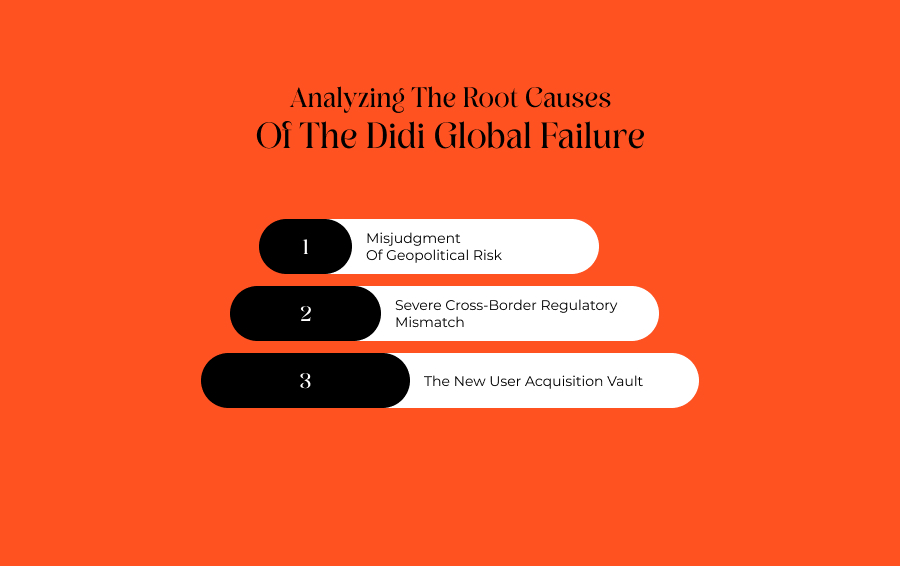
An institutional post-mortem of Didi Global highlights three distinct, compounding risk management flaws.
These had left the platform completely defenseless against a data compliance check:
· Misjudgment Of Geopolitical Risk
Didi’s leadership treated their corporate expansion pipeline as a traditional tech sprint, assuming that immense consumer scale and strong financial metrics would insulate them from state data rules.
They failed to realize that in the modern tech ecosystem, national data security completely overrides short-term shareholder convenience.
· Severe Cross-Border Regulatory Mismatch
The enterprise ran directly into conflicting legal rules.
While the US Holding Foreign Companies Accountable Act (HFCAA) required foreign listings to open their internal accounting books to American regulators, China’s data laws explicitly barred local tech firms from transferring sensitive local user data across international borders, creating an impossible regulatory trap.
· The New User Acquisition Vault
When regulators ordered the removal of Didi’s apps from local stores, the company lost its ability to onboard fresh consumers during a high-growth market cycle.
This structural restriction allowed nimbler local competitors to aggressively chip away at Didi's market share, proving that a digital platform cannot survive long-term app store blocks.
Lessons For Corporate Governance And Risk Management

Post this fiasco, the companies wanted to learn from this and analyzing the structural failure of Didi Global.
Therefore, they looked at how this case highlights several essential risk management rules for modern chief financial officers.
Also, these are the ways it equally affects multinational tech developers:
· Align Business Timelines With Regulatory Clearances
Never execute a high-profile public listing or corporate merger while active government reviews are still pending.
Rushing a financial exit ahead of final regulatory sign-offs exposes your brand to severe asset freezes and sudden operational stops.
· Implement Strict Data Separation Architecture
If your tech business processes high-density user or location data across multiple national lines, build completely isolated, localized cloud server infrastructure.
Storing domestic user histories safely within their native country limits prevents cross-border data leakage and satisfies national compliance rules.
· Build Agile Diversification Networks
Never rely on a single public stock exchange or consumer download platform to secure your company's value.
Maintain multi-layered listing strategies across regional hubs and build alternative web-access corridors to shield your active consumer traffic from sudden app store bans.
The Dynamics Behind The Didi Global Scam Explained
The failure of Silicon Valley Bank was an operational asset-liability mismatch, and the collapse of FTX was institutional fraud.
But the story of Didi Global is a case study on the overriding power of national data sovereignty in the modern digital age.
Didi did not fall due to weak user engagement or bad ride-hailing margins, but because its leadership underestimated state regulatory determination to protect domestic data assets.
Following its delisting and subsequent compliance re-alignment, the restructured company serves as a vital reminder that tech scale can never outrun national security mandates. For modern corporate leaders, the ultimate lesson is clear: eliminate compliance shortcuts, ground your global expansions in strict data transparency, and execute your long-term business strategy with absolute data-driven certainty.