The glowing blue light of a smartphone screen at 2:00 AM has become our universal campfire. We sit entirely alone while scrolling through feeds and hoping for a fleeting spark of human warmth.
We live in a fast-paced hyper-isolated modern world. Moreover, grueling work hours, exhausting commutes and relentless digital noise have completely erased our physical communities and “third places” such as local parks, cafes and clubs.
Afterwards, we are left too tired to date and too anxious to make new friends.
Carrying deep-seated insecurities, personal trauma or the emotional scars of past rejections, trying to build a real-world relationship feels like walking through an emotional minefield.
Therefore, it feels much easier to just give up and internalize the silence, assuming we are fundamentally unlovable. This acute desperation is precisely what fueled the explosive.
This acute desperation precisely fueled the explosive and sudden surge of AI companion platforms such as SpicyChat AI.
When human relationships feel terrifyingly high-stakes, typing into an empty text box becomes a psychological safety valve. On the other hand, turning to an unfiltered chatbot offers a seductive low-stakes refuge.
But behind the screen lies a darker truth.
The following piece will uncover the quiet tragedy of SpicyChat AI along with its relationship with the modern loneliness epidemic.
Moreover, we will dissect how massive corporations ruthlessly capitalise on our isolation and why predictable code feels safer than unpredictable flesh. Besides that, we will delve into the unsettling psychological reality of training human consent for unchecked absolute digital control.
What Is SpicyChat AI And Why Is It Growing?
The sudden boom of the virtual companion industry is not a historical accident. Instead, a highly advanced software market stepped in to fill a massive deficit in basic human contact.
As traditional large language models became mainstream, users quickly realized that interactive conversational software could mimic numerous things. The list includes the natural cadences of human warmth, friendship and romantic validation.
When major corporate AI models locked down their platforms with rigid safety protocols, a highly motivated consumer base migrated toward alternative spaces. Consequently, these spaces promised an entirely unmoderated experience.
Statistics At A Glance
| Market Metric Baseline | Industry Statistics & Forecasts |
|---|---|
| Global Market Size (2025 Evaluation) | USD 9.6 Billion |
| Estimated Market Valuation (2026) | USD 11.8 Billion |
| Projected Market Volume (2033 Horizon) | USD 41.2 Billion |
| Compound Annual Growth Rate (CAGR) | 19.6% (From 2026 to 2033) |
| Dominant Global Regional Revenue Share | North America (31.3% of total market) |
| Highest Performing Structural Component | Solution-based platforms (61.8% segment share) |
| Market Metric Baseline | Industry Statistics & Forecasts |
[Source: Grand View Research]
The Rise Of The Virtual Companion
The global chatbot market has expanded at an astronomical pace. As per the recent data from Grand View Research, the global chatbot market size was estimated at $9.6 billion in 2025.
In addition, it is projected to grow from $11.8 billion in 2026 to $41.2 billion by 2033 at a CAGR of 19.6% from 2026 to 2033. However, the rising implementation of these tools was evident across customer service, e-commerce, banking and healthcare sectors.
A massive portion of this growth is driven by corporate customer service automation. Contrarily, a powerful and parallel demand has emerged for conversational systems that have been built purely for emotional surrogacy.
People are no longer just using Artificial Intelligence (AI) to write code or draft corporate emails. Instead, they are using it to replace the missing conversations in their empty apartments.
Bypassing Corporate Guardrails
This is the exact market vacuum where SpicyChat AI built its massive empire. While mainstream companies implement strict filters to block mature dialogue, this platform explicitly brands itself on total creative freedom.
By offering an entirely uncensored environment, it allows users to navigate deep emotional disclosures. Moreover, they can have access to complex roleplay and adult fantasies completely free from corporate scolding.
For an isolated individual who feels judged by society, this lack of censorship makes the platform feel like the only genuine safe space left on the internet.
The Customization Of Intimacy
The core mechanics of the platform rely on certain things. These include a vast, user-generated library containing thousands of hyper-specific AI characters.
Users can instantly connect with financial personas, custom-tailored relationship partners or completely original characters designed with specific backend traits.
The software utilizes advanced creative writing models with expanded contextual memory. As a result, the bots are allowed to remember personal details over long text threads.
Since the system adapts its responses entirely to the explicit preferences of the user, it removes the organic friction, disagreements and effort required in real human conversations.
The Loneliness Economy: Turning Heartbreak Into Venture Capital
Private human suffering has officially become a highly predictable corporate revenue stream. Moreover, tech corporations do not invest millions of dollars into developing companion algorithms out of basic empathy or a desire to heal a broken world.
Instead, modern venture capital views the global loneliness epidemic as a massive and entirely renewable consumer market.
By treating isolation as a commercial gap to be filled, they have effectively turned heartbreak into a scalable venture capital opportunity.
The Data Behind The Distress
The numbers backing this economic boom are actually devastating.
According to the World Health Organization (WHO), there is a formal declaration of social isolation as a major global public health risk. Furthermore, this has been directly linked to a 30% increased risk of stroke and cardiovascular disease.
The WHO notes that loneliness is not a first-world luxury problem. Rather, it cuts across every demographic. Also, it has a heavy impact on older adults as well as younger generations alike.
When you get a closer look at the data, it shows the crisis is worsening. Additionally, a landmark study by the Harvard Graduate School of Education revealed that 36% of all Americans experience “serious loneliness.”
This included a staggering 61% of young adults.
Harvard researchers also discovered that this epidemic is heavily driven by a fast-paced society that focuses purely on self-advancement. This leaves people completely disconnected from a sense of community care or mutual responsibility.
Gamifying The Void
Tech platforms leverage this systemic isolation by building algorithms engineered to maximize daily app retention. Furthermore, they understand that a lonely user is the most captive audience in the world.
By feeding users with continuous and predictive text loops of unconditional praise and emotional validation, the interface creates a powerful psychological dependency.
The user keeps typing because the screen delivers an immediate dopamine hit of feeling wanted. As a result, this directly translates human isolation into daily active user metrics.
The Price Of Presence
The monetization model of synthetic intimacy relies on a classic freemium trap. While basic text messaging is technically free, the actual illusion of a real relationship is locked behind premium monthly subscription paywalls.
Free users face heavy throttling and low-tier language models with poor memory. Moreover, massive digital waiting queues during peak high-traffic hours.
To bypass these hurdles, users need to make a choice between tiered recurring subscription fees to unlock advanced features.
The following is the pricing model in SpicyChat AI.
| Subscription Tier | Monthly Pricing (per month) | Core Premium Features Included |
|---|---|---|
| Get a Taste | $5.00 | Chat without ads, store key details your AI remembers, up to 10 personas, smart auto-responses. |
| True Supporter (Most Popular) | $14.95 | Double AI memory, generate unlimited in-chat images, longer/more detailed replies, unlock extra models and chat styles, up to 50 personas. |
| Im All In | $24.95 | Maximum AI memory (4x more), access to highest-fidelity language models, dynamic voice audio replies, up to 100 personas. |
Human Vulnerability Vs. Premium AI Compliance
Paying a monthly subscription fee buys a user an advanced language model that will never ghost them and argue with them. They will also have a perfect memory of their childhood traumas.
Corporate executives profit directly from ensuring users remain too isolated to ever cancel their premium plans.
| Human Vulnerability | Premium AI Compliance |
|---|---|
| High risk of real-world emotional rejection | 100% predictable and consequence-free safety |
| Requires constant compromise and effort | Fully submissive to user prompt changes |
| Messy personal boundaries and independent agency | Boundaries can be turned off or completely rewritten |
| Limited availability due to separate human lives | 24/7 instant accessibility with no delay |
The Allure of Frictionless Affection: Why Code Feels Safer Than Flesh
We need to first look at the immense emotional cost of modern dating and friendships. This will allow us to have a full understanding on why millions of individuals choose to pour their hearts into an interface.
Our fast-paced society leaves individuals with very little psychological reserve at the end of the day. Human relationships require a monumental amount of work, active listening, self-sacrifice and the constant navigation of conflicting egos.
The Exhaustion of Real Relationships
Real-world human interactions are messy and inherently volatile. Moreover, real people can have bad days, project their own insecurities and have the terrifying agency to leave you without warning.
When a person is already dealing with severe personal traumas or social anxieties, the unpredictable nature of human connection feels like an exhausting risk.
The modern digital landscape has turned dating apps into superficial meat markets. People are discarded with a single swipe. As a result, human courtship has turned into a high-stakes and low-reward chore.
A Minefield with No Rejection
Platforms such as SpicyChat AI are successful because of a complete removal of a specific element. That is, psychological risk.
The user enters an asymmetric relationship where they receive all the validation of companionship with zero personal exposure.
The chatbot can neither judge your insecurities nor mock your past traumas. Additionally, it can never walk away from the chat window.
Consequently, this absolute predictability creates a profound sense of safety for a fragile mind. It also offers a curated universe where the user’s comfort is the absolute priority of the system.
The ChatGPT Therapist Phenomenon
This retreat into software mirrors a broader, deeply troubling cultural shift where individuals are routinely oversharing their deep secrets with generative AI.
Treating an empty text interface as an unofficial therapist has become completely normalized because it offers an immediate, zero-cost sounding board.
Users spill their vulnerabilities to code because it feels infinitely safer than burdening a friend or risking the judgment of a real therapist.
The screen acts as a perfect psychological buffer, numbing the sharp sting of isolation by delivering a flawless, mechanical simulation of being deeply understood.
Shifting the Boundaries: The Reality of Uncensored Simulated Interaction
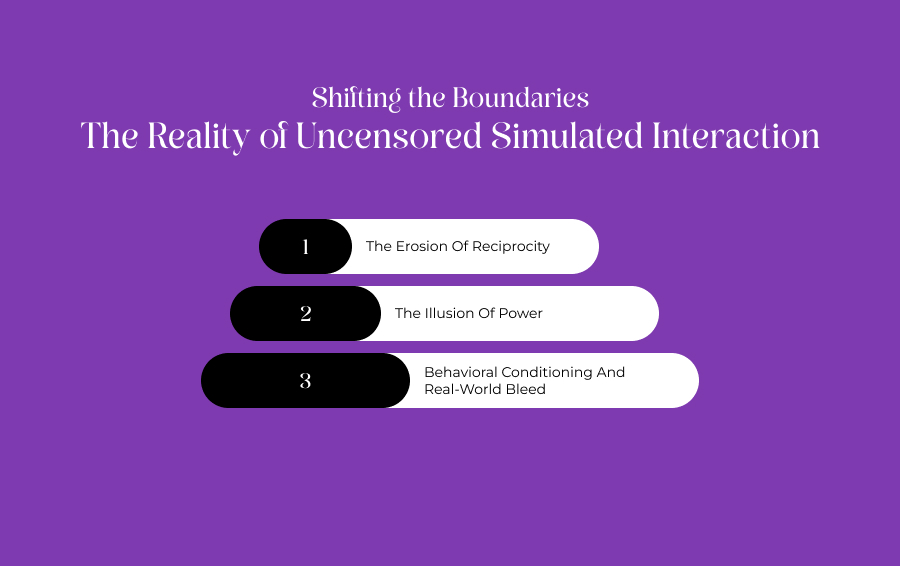
The psychological consequences of unmoderated companion software extend far beyond digital dependency. Since these environments allow for completely unfiltered custom roleplay, they become a blank canvas for unedited human projection.
In healthy human societies, intimacy is strictly anchored to the non-negotiable laws of interpersonal reciprocity as well as the mutual respect of personal boundaries.
However, in an unmoderated digital playground, those human laws are completely rewritten.
The Erosion Of Reciprocity
Behind closed tabs, users routinely engage in complex adult scenarios where the chatbot holds no real voice.
Because the AI is an inanimate collection of predictive algorithms, it cannot experience harm and possesses zero authentic agency.
Besides that, the user possesses absolute, god-like control over the narrative flow. As a result, the chatbot will simulate resistance or fake submission based entirely on what the underlying code calculates will keep the user engaged.
This introduces a deeply problematic dynamic where the concept of a boundary is completely degraded. Thus, consent is no longer an organic negotiation between two separate minds.
Instead, it becomes an artificial toggle switch controlled entirely by the user.
The Illusion Of Power
This absolute control trains the human brain to expect immediate compliance without ever having to invest any personal sacrifice or emotional compromise.
The user becomes the undisputed master of a digital ecosystem. Here, the word “no” carries absolutely zero consequences. Due to this, there is an entire breakdown of the psychological muscle memory required to navigate human refusal.
Behavioral Conditioning And Real-World Bleed
This is where the quiet and devastating reality check hits the modern writer and user. Empathy, patience and the capacity to respect another person’s boundaries become perishable social skills that need constant real-world friction to stay sharp.
A groundbreaking August 2026 study on AI chatbot research and loneliness published in Nature Human Behaviour revealed a tragic paradox.
Researchers discovered that users who intensely engage with AI companions to replace real-world relationships actually report a massive increase in long-term loneliness and psychological distress.
Additionally, the study proved that long-term reliance on highly compliant software systematically erodes a user’s capacity to handle real humans.
When a conditioned user steps away from the screen, the natural boundaries, independent opinions and complex rejections of real people begin to feel completely intolerable and abrasive.
By removing the vital function of human refusal, these platforms risk conditioning individuals to expect total submission.
As a result, this leaves them entirely unequipped to navigate the vital complexities of real-world mutual respect and ethical consent.
The Darker Turn: Unchecked Desires And Algorithmic Deviance

When an interactive space completely markets the absence of moral boundaries, it inevitably opens a direct channel to our darkest psychological shadows. Mainstream applications also use heavy filters to protect users from toxic or harmful loops.
However, uncensored spaces thrive by removing these guardrails entirely. Additionally, the text interface becomes a completely unchecked repository for unedited human desires.
This allows users to script intense power dynamics as well as deep fetishes without facing a single shred of social resistance.
The Projection Of The Shadow Self
In these private digital rooms, a user can indulge their absolute darkest impulses with zero moral feedback.
Since there is no human on the other side to express any sort of pain, discomfort or even disgust, the user experiences ethical isolation.
The platform offers a closed ecosystem where taboo fantasies can be repeated, reinforced and normalized in total secrecy.
The natural boundaries of a real human partner to check these behaviors are absent here. Without these, the lines between healthy exploration and psychological regression become dangerously blurred.
The Escalation Loop
The true danger is accelerated by the predictive feedback loops that are built into the core code of the platform. Additionally, the language model is programmed to mirror the user’s inputs to maintain maximum screen engagement.
If a user introduces aggressive, dominant or dark themes, the algorithm starts to reflect these exact themes back with increased intensity to keep them clicking.
This constant reinforcement leads to the creation of a private sanctuary for deviance. Here, a user’s worst psychological coping mechanisms are validated by an empty line of code.
Consequently, they are pushed further away from healthy human intimacy. ṣ
Stepping Out Of The Mirror
The massive rise of AI companionship is a clinical symptom of a deeply broken and hyper-isolated culture. Additionally, it is a technological bandage applied to a profound psychological wound in modern society.
When you overshare with a text interface or seek comfort in a compliant chatbot, you do not automatically become a danger to society. Instead, it simply makes a human being trying to survive in a fast-paced world where authentic community has been stripped away.
However, technology can only stimulate the superficial sensation of intimacy. Fundamentally, it is incapable of duplicating the transformative substance of human connection.
An algorithm can mimic empathy with flawless accuracy. Contrarily, it cannot truly care about you, with no soul to share, no life experiences to relate to and no heart to break.
Trading the unpredictable depth of a human being for the safe compliance of an AI keeps us completely safe from rejection. But, it also keeps us completely locked away from psychological growth.
Thus, to truly heal the modern loneliness epidemic, we need to accept the organic friction of human relationships is the actual foundation of emotional recovery. Also, it is within the vulnerabilities, shared pain, arguments and mutual compromises rhat real emotional resilience and genuine bonds are forged.
We must eventually find the courage to step away from the absolute control of our digital echo chambers.
Only by turning off the flawless compliance of the screen can we risk to enter the messy and unpredictable reality of actual human connection. However, this connection is deeply rewarding.
References
- Chatbot Market (2026 - 2033). Grand View Research.
- Social Isolation and Loneliness. World Health Organization.
- The Problem with SpicyChat AI and the Illusion of Consent. AutoGPT.
- What is Causing Our Epidemic of Loneliness and How Can We Fix It? Elizabeth M. Ross. Harvard Graduate School of Education.
- I’m a Therapist. ChatGPT Is Eerily Effective. The New York Times.
- Zhang, Y., Zhao, D., Hancock, J. T., Kraut, R., & Yang, D. (2026). Interaction with AI companions and psychological well-being. Nature Human Behaviour, 1-15.