












Is Cross Market AI The Biggest Trade Scamming Monster? Or Is It The Messiah It Claims To Be? Gain All The Important Info Here! 

by

21 January 2026

Marketing

Cross Market AI

I am sure you all have realised this by now: AI is restructuring the entire world as we speak. Forget the world, I am sure it’s on its way to reshape the goddamn Cosmos! 

I am still not sure whether placing AI on the pedestal and putting it out as a solution to EVERY single issue is a wise decision or not.  

When it comes to the financial industry, it’s important to be careful about what sounds too good to be true.  

This is where Cross Market AI comes in. The platform claims it can offer returns of about 1% every day. 

How? Well, as Aseem Jineja wrote in his blog, it uses automated strategies and AI for market trading.  

This promises a steady income. So, this can be appealing in an uncertain market.  

However, this raises important questions about safety and honesty. Investors need to think carefully.  

Can we trust these claims, or is it just hype? In this article, I will examine Cross Market AI and what it promises. 

I will also give you guys a fair idea of how it works and the risks involved. I have curated this blog in a certain way to help you make an informed decision. 

Is Cross Market AI Fake Or Real?

Now, I want to discuss whether you must consider Cross Market AI as real or not. 

So, now it’s worth noting that the platform has a limited social media presence.  

It does use influencers to promote the business. If you search Instagram for Cross Market AI, you might see many accounts. 

But I found it hard to identify the credible ones.  

One account claims to offer up to 72% profit per year, which is unrealistic and suggests it’s not genuine.  

While the platform has positive reviews on its Scamadvisor profile, it seems it has managed to avoid negative feedback by keeping a low social media presence.  

It can control comments on Instagram, helping to maintain a positive image.  

Good website health has also contributed to high traffic and favorable reviews.  

However, if you’re still unsure about its trustworthiness, there’s little user feedback since the company isn’t on the Play Store or App Store, where users usually share their complaints. 

What Are The Important Features Of Cross Market AI?

There is a reason why I am mentioning this. Among all the speculations on the internet, this is the shiny jacket this platform wears.  

And guess what? These are the features that lure the audience in mysterious ways. Let’s take a look at them:  

1. Data Integration:  

This feature combines data from different sources, like:  

  • Social media 
  • CRM systems 

This gives a complete view of customers.  

The platform urges you to aggregate information. This way, your businesses can better understand customer behaviors and needs. 

Also, this will lead to more informed decisions. 

2. Customer Segmentation:  

This process sorts customers into specific groups. They form these based on their behaviors and preferences.  

It allows businesses to create targeted marketing campaigns that resonate with each segment. 

The thought’s nice because this can improve response rates. In fact, it can also boost customer satisfaction. 

3. Hyper-Personalization:  

This approach tailors content. Additionally, it offers individual customers access to integrated data.  

By providing personalized experiences, businesses can increase customer engagement. 

Also, they can foster greater loyalty over time. 

4. Marketing Automation:  

This feature automates various marketing tasks like:  

  • Email campaigns 
  • Advertising 

This aims to save you a lot of time. Also, it ensures that your campaigns run efficiently. 

Also, it allows marketers to focus on strategy rather than repetitive tasks. 

5. Predictive Analytics:  

This uses machine learning to anticipate future consumer actions. Also, this helps them to predict market trends.  

Basically, they make an effort to understand what is likely to happen. This way, your businesses can make proactive adjustments to strategies. 

In addition, they can stay competitive in changing markets. 

6. AI Chatbots And Assistants:  

These tools provide round-the-clock customer service through conversational AI.  

They can handle FAQs and assist customers efficiently. Also, this enhances the overall customer experience with immediate support. 

7. Real-Time Adaptation:  

This capability allows strategies to change dynamically based on current market data and customer feedback.  

By being adaptable, businesses can maintain the relevance of their campaigns. 

Additionally, they can ensure ongoing effectiveness in reaching their audience. 

Is Cross Market AI Safe?

Trading platforms that promise high returns quickly often operate like Ponzi schemes.  

If you want high returns, be cautious about certain warning signs: 

  1. The platform suggests that investors don’t need special skills to trade using AI.  
  1. If you believe this, you risk a lot by lacking knowledge of the trading industry.  
  1. A daily profit of 0.5% to 1% sounds too good to be true. Why would a platform offer such high returns, especially when the Indian stock market is struggling?  
  1. If the platform isn’t licensed to operate in India, should you trust them with your savings?  
  1. Additionally, do you have the expertise to judge if you should follow the AI-generated tips?  
  1. If you can’t tell what’s right and wrong, it’s risky to trust the platform outright.  

But you know what’s more concerning than all of these? The business background of Lavish Choudhary, the owner of Cross Market AI. 

Before this, he was previously linked to three companies called:  

  • Botbro 
  • QFX 
  • YFX 

In 2023, these companies were involved in scams. And I would like to mention that these scams were worth INR 500 crore. 

Then, Choudhary fled to Dubai afterward. 

What Is The Most Common Complaint Against Cross Market AI? 

Okay, so as I always say, all the platforms have some pros and cons. It is quite natural.  

But when it comes to Cross Market AI, there is one single issue that is constantly being reported by the users. 

The platform suddenly stops working! So what I suspect is that the people who have found the app in this situation are the unfortunate victims of the probable scam. 

I suppose by now you already understand why I mentioned its core features. This is because I wanted to weigh out the odds.  

When you read blogs where they mention the important features and the core benefits, you tend to swoon.  

But not from me. I will make you aware of everything and provide facts that will help you decide with clarity.  

I won’t be able to talk you out of the decision you want to invest in Cross Market AI.  

But I also wish to tell you that there are ways by which you can get out of any unfortunate situation.  

Let’s take a look at it. 

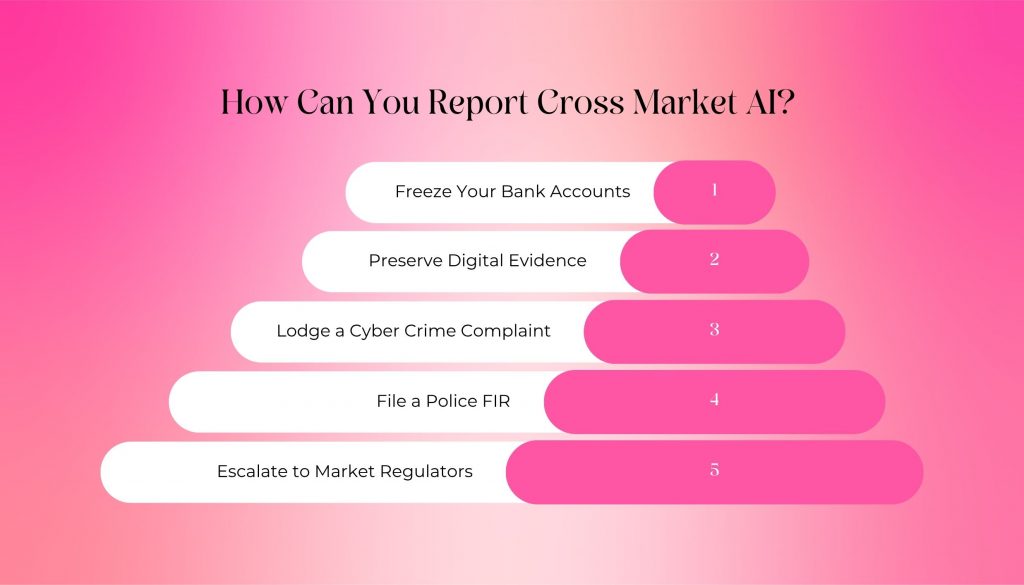
How Can You Report Cross Market AI? 

If you find yourself a victim of a scam, here are some important steps to take: 

  1. Firstly, you must contact your bank. You need to start by calling your bank to freeze your account. This will prevent any unauthorized transactions. 
  1. Secondly, I would suggest that you document everything. By this, I mean take screenshots and save recordings of all related:  
  • Information  
  • Images 
  • Communications 
  1. Thirdly, I will ask you to file a Police Report. So basically, you have to visit your nearest police station to lodge a First Information Report (FIR). 
  1. Additionally, you must file a complaint with the cybercrime department. 
  1. Also, you MUST reach out to SEBI. Submit a complaint in SCROES through the SEBI website. I strongly recommend this for quicker action. 
  1. In addition, you must use the Sachet portal to report the incident to the Reserve Bank of India. In fact, you have to provide all relevant details. 
  1. Finally, I would advise you to seek professional help. I think it’s best to consult with scam recovery services for legal assistance. 

Taking these steps can help you address the situation more effectively. 

Should You Trust Cross Market AI?  

That is all, my friend! I have shared all the relevant and necessary information you needed to make this decision. 

I want to end by saying that no matter how good the features look, it’s way more important to see how the platform actually works. 

Every platform claims to work the best. Additionally, they claim to have all the problem, solving and efficient features as well as the best benefits out there. 

But the real question is that even if all these are true, do the cons outweigh the pros? 

I suppose at this point, you must also question that: do these pros of Cross Market AI even exist?  

I would love to hear what you have to say about this. Remember, I am just a comment away!

Barsha Bhattacharya is a senior content writing executive. As a marketing enthusiast and professional for the past 4 years, writing is new to Barsha. And she is loving every bit of it. Her niches are marketing, lifestyle, wellness, travel and entertainment. Apart from writing, Barsha loves to travel, binge-watch, research conspiracy theories, Instagram and overthink.

View all posts

Leave a Reply

Your email address will not be published. Required fields are marked *

Related

Email Campaigns

Getting The Most Out Of Your Email Campaigns By Getting The Audit Right!

Excerpt: Delivering email campaigns that perform exceedingly well requires effort and email audits help you get closer to better ROIs. Read on! So half of the year has gone by smoothly (well, almost), your brand’s making money, your workflows are automated, and your email marketing campaigns are doing well. Wait, yes, pause at the last part of the sentence. Are they really performing optimally? To get a clear understanding of the efficacy of your email marketing campaigns, no matter how great and well-automated they might be in your perspective, you NEED to run audits twice or thrice every twelve months. If you meet an email marketer over drinks, they will probably have a lot to say about their KPIs and how the click-throughs are not making the cut. So how can one ensure that their email marketing efforts don’t go down the drain? The answer is quite simple indeed: execute email marketing audits to unveil your strengths and weaknesses, areas of improvement, and those that are doing just fine. In the blog that follows, we will delve into the different kinds of email marketing audits that one can conduct and ways to go about executing them. Let’s get cracking! The Kinds of Email Marketing Audits That One Can Conduct In simple terms, an email marketing audit is a deep analysis of the various factors that contribute to the success of an email campaign so that you know what’s working and the areas that need to be tweaked. The following are some kinds of email audits that you can carry out; each of them focuses on different facets of the email. 1. Email Content & Design Marketing Performance Audit One of the most common kinds of audits, here you delve into your various KPIs (CTR, CTOR, etc.) to get a holistic understanding of the email campaign’s performance. The aspects that you need to look out for are: Subject line: Try to keep them personalized, crystal clear, non-sales, and within the range of 40-45 characters, optimized for mobile viewing. Please steer clear of spammy words such as “earn quick money” or basically anything that sounds too good to be true. Preheader text: It should be related to the subject line, albeit not repetitive. Header: First impressions are often long-lasting; cliched though that may sound, it does hold some weight. The header text next to your logo should be noticeable, clear, and in alignment with the brand ethos. Email copy: Grammatical errors and typos are a major turn-off. No wonder brands invest in the best copywriters to churn out good copy, even in the age of AI! Keep it crisp, clean and deliver maximum value in minimum words. CTA: The Call to Action buttons are the ones that can make or break the ROIs. Keep the design and text in tandem with the brand guidelines, easy to spot and click, devoid of broken links that lead nowhere! Graphics: When crafting an HTML or interactive email, ensure that the graphics render well across devices and the visual hierarchy is maintained. Conversions & Engagement rates: This is the litmus test of your email campaign. Are your emails good and engaging enough to keep subscribers interested, or are there more hits than misses? The KPIs should spill the beans on this one. 2. Email accessibility audit When crafting your emails, if one overlooks the critical aspect of disability, you might fail to foster inclusivity with your campaigns, thereby risking losing the patronage of your subscribers. Keeping email accessibility in mind is absolutely essential, and is something that all email marketers should perpetually strive for. Ensure that there is no sensory overload for those with visual disabilities by keeping a simple and clean email layout. For those living with tactile difficulties, make the CTA buttons larger to ensure greater clickability and visibility across a range of devices. Remember to check for alt text in images to simplify things for users deploying the services of a screen reader. 3. Deliverability Audit You might have the best of Salesforce email templates (or Hubspot; whatever rocks your boat) and check all the above aspects, but if your email campaigns fail to reach the intended inboxes, all your efforts will end up in vain. To check for email deliverability issues, one needs to check the following aspects; Clean email list devoid of incorrect email ids Email Authentication HTML code failures Domain reputation Blocklisting Spam traps IP address 4. Compliance Audit This would include checking the level of compliance of your email campaigns with the guidelines and requirements of CCPA, GDPR, PECR, etc. 5. Email Code Audit Here, one would evaluate and carry out a code clean-up, fix bugs (if any), and ensure the incorporation of the best practices in email coding. One would also conduct tests to see how well the email renders across different email clients and devices. 6. Design Audit In this kind of audit, one would review the emails from the design and aesthetics viewpoint and check how consistent the layout is with the branding guidelines. The different elements one would generally bring under the lens in this kind of audit are checking for the right use of white spaces, design patterns in accordance with the heat map, fonts, logo, layout, graphics, etc. 7. Automation Audit Here, one would check automated email campaigns to see if everything is in order, such as API triggers, templates, links, rules, customer journey maps, etc. One can either carry out all these audits or create a bespoke audit plan that includes permutations and combinations of the different kinds of audits mentioned above. Steps For Conducting The Perfect Email Audit Now that we are privy to the kinds of email audits that one can carry out, let’s move over to getting started with the process of what’s going well and what’s lacking in your current email campaigns. Firstly, you need to begin with drafting a clear set of goals. Much like in other areas of life, the lack of well-defined goals in sight can very well be akin to sailing in a rudderless ship, and frankly, no one wants to be aboard such a ship! You could begin by jotting down the kinds of audits you’d want to run on your existing campaigns and, based on the purpose of the audit, figure out your bespoke learnings and takeaways. Then, you’d like to create a list of measurable Key Performance Indicators (KPIs) that you will be evaluating to check the health and effectiveness of your current campaign. These may include: Unsubscribe rates Open rates (albeit not a very effective one as per Apple’s Mail Privacy Protection feature unveiled in the WWDC conference held on 7 June 2021) CTR (Click Through Rates) CTOR (Click To Open Rate) Spam complaints Conversions Email client & device assessment You can create a spreadsheet to maintain a record of your audit. Here’s what you can document: Name of the email campaign Date deployed (not applicable in case of automated emails) Name of the audience segment Subject line Soft bounce rate Hard bounce rate CTOR CTR Conversion rate Unsubscribe rate You can modify the contents of the spreadsheet as per your unique requirements. One can also diversify the main spreadsheet by adding tabs for different kinds of emails, such as promotional, transactional emails, etc. Once you have your data in place, you can and should proceed with the data analysis. Begin with scanning all the metrics and specifically scrutinize those that fall on the extremities of the curve. The ones that did really well and the ones that missed the mark. Proceed with asking yourself the following questions, Are the subject lines and preheader texts enticing enough? Will I click on them if I receive them in my inbox? Is the visual hierarchy of the email in place, or does it look too cluttered? Does it offer a personalized experience to the subscriber? Does the email copy offer value to the reader, or does it appear too salesy? Does it cater to specific buyer personas and age demographic, or does it appear mass-produced with no specific target audience in mind? Is the cadence too annoying for the subscribers leading to higher unsubscribe requests? Are the CTAs visible, quirky, and enticing enough to get users to click on them? Are your emails accessible to users across the entire spectrum? Wrapping It Up While there are a number of tools available in the market to help you conduct email audits, and you can always request colleagues for a fresh eye perspective on your campaigns, if you’d rather have experts analyze the game for you, that’s possible too! Email Uplers will not only help you analyze your existing campaigns but also deliver interactive emails from scratch attuned to your specific needs. Do drop by for more information! Read Also: Should You Consider Outsourcing Your Brand’s Marketing Campaign? Your Ultimate Guide To Creating SMS Marketing Campaigns Content Marketing Campaign Strategy For Small Business

READ MOREDetails
B2B Digital

SEO’s Role in B2B Digital Marketing: Optimising Your Website

Imagine you're attending a business conference, networking with potential clients and industry experts. You strike up a conversation with a key decision-maker and they express interest in your product or service. Naturally, you exchange business cards and part ways.  Now, imagine that when they get back to their office; they type your company name into a search engine, hoping to learn more about your offerings. Will your website be among the top search results? The answer lies in the power of search engine optimization (SEO) and how the B2B digital marketing agency you hired is taking advantage of it. So, what’s the crucial role of SEO in driving organic traffic, generating leads, and boosting conversions for B2B companies? Understanding the Basics of B2B SEO To set the stage, let's start with the fundamentals of B2B SEO. Unlike B2C marketing, B2B SEO aims to capture the attention of businesses rather than individual consumers. It involves optimizing your website, content, and online presence to rank higher in search engine results pages (SERPs) when relevant keywords are searched. Driving Organic Traffic and Generating Leads Effective SEO techniques can help increase your website's visibility, driving organic traffic from potential B2B clients. By optimizing your site's structure, using relevant keywords, and creating high-quality content, you can attract qualified leads actively searching for the products or services you offer.  Remember, higher rankings in SERPs lead to increased visibility and, ultimately, more opportunities for conversions. Building Authority and Trust In the competitive B2B landscape, establishing authority and trust is paramount. SEO plays a crucial role in building credibility for your brand. When your website appears prominently in search results, it signals to potential clients that your company is reputable and trustworthy.  Backlinks from authoritative websites, social proof, and positive customer reviews all contribute to bolstering your brand's image in the eyes of potential B2B buyers. Optimising Content for B2B Audiences Content marketing is a powerful tool in B2B digital marketing, and SEO goes hand in hand with it. By conducting thorough keyword research and incorporating relevant keywords into your content, you can align your offerings with the search intent of your target audience.  Valuable and informative content that addresses their pain points will not only help your website rank higher but also establish your company as a thought leader in your industry. Staying Ahead of the Curve with Ongoing SEO Efforts The best B2B digital marketing agency knows that SEO calls for ongoing maintenance and adaptation. Regularly monitoring and analyzing your website's performance, keeping up with industry trends and adjusting your SEO strategy accordingly is crucial for sustained success. As search engine algorithms evolve, so must your optimization techniques to stay ahead of the competition. Final Word In today's digital era, B2B companies can’t afford to overlook the role of SEO in their marketing strategy. From driving organic traffic and generating leads to building authority and trust, optimizing your website for search engines has a direct impact on your business' success.  By leveraging SEO techniques effectively and staying up to date with the latest trends, you can position your company as a leader in your industry and achieve remarkable growth. So, embrace the power of SEO and watch your B2B digital marketing efforts flourish. Remember that the online landscape is constantly evolving, and adapting your SEO strategy accordingly is the key to unlocking new opportunities and truly staying ahead of the competition. Start optimizing your website today and embark on a journey toward B2B marketing success. Read Also: How To Make Your Online Business More Humble By Managing Your Reputation Why Is An SEO Services Company Better Than Others? Online Marketing : Selling Your Product And Services

READ MOREDetails
Content Marketing

Crucial Role of Content Marketing in Local Business

What Is Content Marketing? It’s a form of marketing wherein brands create and share online content. It could be in the form of blogs, videos, social media posts, reviews, descriptions, etc. Content marketing does not explicitly promote a company/brand (although there can be promotional content). Instead, it aims to generate interest in a service/product via customer education and awareness. Why Is Content Marketing Important? Content marketing holds immense importance for brands for myriad reasons. Some of those are: It educates people about your products/services and brand in general It answers the questions people may have about you You can build long-lasting relationships with people through content In the long run, it establishes you as an authority in the market It can improve conversion rates It’s the primary source of lead generation When all else fails, the fact that most people expect high-quality content from their most favored brands is the reason for companies to churn out content regularly. Does Content Marketing Work for Small Businesses? The short answer to this question is - YES. It does work. Small businesses often feel at a loss as they don’t have thousands of dollars to spend on ads every month. But, with content marketing, they can secure top positions in SERPs for keywords with high search volume. By investing a few hundred dollars in some quality blog posts, they can almost get the same traction as big companies often do by spending thousands. Reasons Your Company Needs Content Marketing: Better Social Media Traction: Content creation is the basis of securing a huge following on social media. However, just having followers is not enough. To keep them interested and engaged as you progress, you present them with information that interests them. If you’re having a hard time securing any traction on social media despite a big following; you may need to tweak your content strategy. Establish Trust With Your Audience: Through content, you can address people’s pain points in your arena. When customers see that you can help them out, it will inevitably establish a sense of trust with them. Builds Authority: By churning out quality pieces such as those around possible future trends in the industry and data analysis, a brand can establish itself as an authority in the niche. As people read and interact through your content, they will think highly of your brand. Brands that regularly publish quality and authoritative content tend to enjoy more customers and better sales. Greater Return on a Smaller Investment: Unlike traditional marketing that requires a ton of budget but can only reach a small number of prospects; with content marketing, you can reach a much wider audience with very little expenditure. If applied correctly, the return on investment from content marketing can be exponential. This arrangement is particularly good for small businesses as they are mostly short on the marketing budget. For a tiny budget, they can secure a strong footing in the industry. Expose Your Business to New Prospects and a Larger Audience: By optimizing your content for location-specific keywords, you can widen your outreach. There’s no limitation to the amount of audience you can target with the help of your content marketing efforts. It’s all about how creatively you find topics and promote them through a combination of strategies. Whether you’re a local business or a global one; content can keep on bringing new prospects and a bigger audience to you. Boosts Organic Search Visibility: Through the means of regular blogging and social media posts, you can make sure that more and more people can find you organically. Organic visibility is when a person can see you in the search results against queries related to your industry terms or your brand name. Content marketing and SEO strategy will help you appear naturally in search engines like Google and Bing. Content Can Be a Major Lead Magnet for Growing Businesses: By crafting helpful content and placing CTAs strategically in that content, you can get quality leads. With the help of free content such as guides, how-tos, infographics you can prompt the desired user action. It could be getting them to a landing page and getting them to subscribe to a service. Every lead magnet, in the end, must rely on quality content. How to Score Your Content? Often writers are unable to quantify what kind of content is best for their brand as well as the audience. With the help of content scoring, they can objectively look at their content process and identify the pieces that are proving to be the most valuable. Based on this evaluation, they can replicate their best-performing content strategy to create similar traction in the future as well. Here’s the content scoring process to stick with - Decide on a metric - For your scoring system to be effective, you must decide on an engagement metric. Based on the success of that engagement metric, you can see what type of content is creating the biggest impact. For some, this can mean page view. For others, it can be the number of shares on Facebook. Devise a campaign - After deciding on the metric, you need to draft a campaign that can meet the said metric threshold. For instance, if you feel 1,000 pageviews are good enough, start pouring in content assets that can meet those criteria. Monitor the performance - See how well each content piece is doing. Keep adding the pieces of content to your campaign that meets the criteria. You can use HubSpot Analytics to track performance. Find out Patterns - After you have the results from your analytics at hand, see if you can spot any patterns in your best-performing content. You can then take out those elements and replicate them across all the content pieces you write. Repeat - You should know that content is an ongoing process. With time you may notice new patterns emerging. Keep taking necessary action accordingly based on new insights. The Role of AI-Generated Content in Small Business Marketing Strategies  AI-generated content is making waves in the marketing industry, we all know that by now!  &  It’s a game changer for small businesses.   If you’re a small business owner, you know that keeping up with content creation can be a full-time job in itself.   Blogs, social media posts, product descriptions—the list goes on and on!  But what if we told you there was a tool out there designed to help you do it all? Here are a few ways AI can benefit your small business.  Save time & Money  Time is money, isn’t it?   This is why you would need to make the most of the trendy tools which are coming our way. With AI tools, you can create content in the blink of an eye.   You could have a full blog post written, an Instagram caption, or even an email campaign done in minutes. Imagine having ChatGPT or Copy.ai doing it for you. Freeing up more time to spend on other areas of your business-like product development or customer service.  Affordable but Quality Content  Hiring a content writer? Expensive.   But AI? It’s way more budget-friendly! If you’re working with a small budget (and most small businesses are).   Yes, AI tools let you create professional-quality content without a huge price tag. Now, that doesn’t mean you’ll never need a human touch because editing is inevitable. But for the basics, AI can take you a long way. More money saved, more options to grow your business.  Keep Your Content Consistent and Engaging  Struggling to keep up? After all, whether you have blog posts to publish or social media posts to launch, there are a few things to make. Use of AI to rescue!   Utilize AI tools that can help generate topics, write drafts, and keep your content pipeline full. The best part is they can also analyze what’s popular in your industry, so you’re not just posting anything.  You’re putting it there because it matters to your audience. Plus, they are not very complicated to use!  Win Over Your Competitor   Let’s face it—it’s tough to get noticed in the online world these days. AI-generated content allows you to optimize your posts for SEO (even if you have no idea what SEO means).  This will give your business a better shot at ranking in Google searches and help you bring in new customers without spending a fortune on advertising.  If you’re sick of cranking out the content, and not delivering the much needed quality (because of writer’ block), why not try letting AI give your small business a little push instead?  Careful With AI!  No matter your niche or industry; if you’re a part of the online sphere you simply cannot do without an effective content marketing strategy at hand. When talking about AI content, there are a few items you should remember!  When using AI for content creation, there are a few things to avoid. Don’t rely entirely on AI-generated content without reviewing it. Always edit for tone, accuracy, and personalization.   AI can make errors or create generic content, so make sure it reflects your brand's voice. Avoid overstuffing AI content with keywords—it can hurt SEO.   Also, don’t skip fact-checking!  AI tools can occasionally produce outdated or inaccurate information. Lastly, avoid using AI for all your content; mix it with human creativity to keep your messaging fresh and authentic. Balance is key!  Read Also: Know Why Content Marketing Is Important For SEO 6 reasons your content is not ranking well on Google  5 Types of Digital Marketing How To Improve Your Social Media Branding By Getting More Instagram Followers And Likes Importance of Storytelling in Social Media Marketing  

READ MOREDetails