
How To Choose Las Vegas Booth Rentals For A Customizable Trade Show In 2026 

Published on: 25 May 2026 Last Updated on: 02 June 2026
Las Vegas booth rentals

According to the recent marketing reports, more than 90 percent of trade show attendees are looking for new products and suppliers. 

Additionally, half of these attendees can make purchasing decisions.  

Therefore, this is a great opportunity for all the exhibitors. They mainly aim to generate leads here.  

But they can also use this event to increase brand awareness. In fact, they can also build professional relationships.  

These goals align well. Therefore, trade shows are among the most effective marketing and networking options for businesses.  

Companies can either buy displays or create them in-house. But renting trade show booths in Las Vegas is becoming a popular choice.  

More businesses see the value in this option.  

But then again, if someone is looking for the most aligned and reputable booth build support in Las Vegas, what attributes should one keep in mind? 

Also, what is this whole Las Vegas booth rentals thing? Too many questions? Just this one blog will answer them all! 

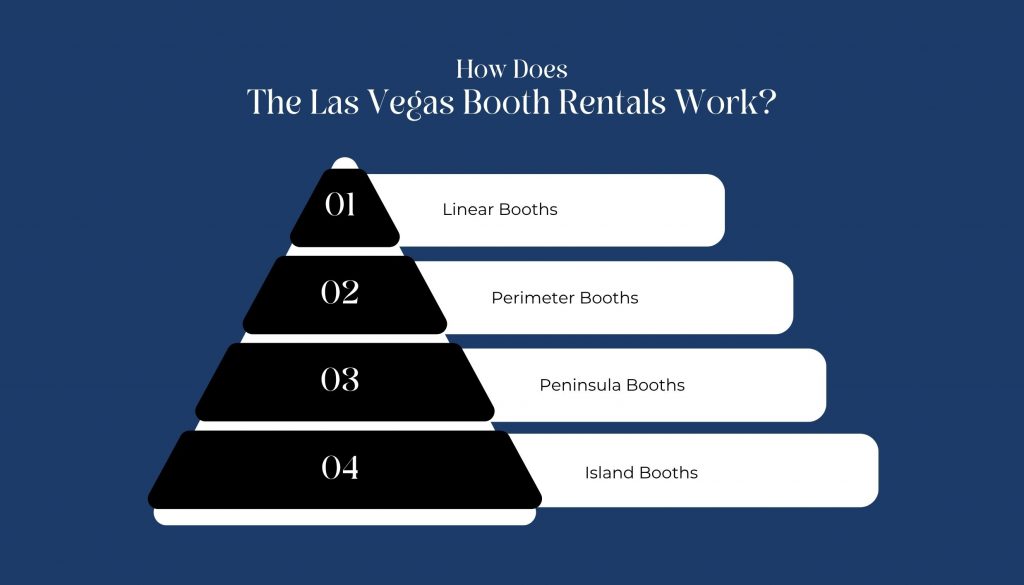
How Does The Las Vegas Booth Rentals Work?
Trade show booth rentals in Las Vegas provide exhibitors with a comprehensive solution offers a variety of pre-built and custom modular displays for the duration of an event.  

In addition, when you are planning for a trade show, it's essential that you determine the appropriate type and size of the booth. 

This is because there are numerous options available to cater to different needs.  

1. Linear Booths  

Linear booths are arranged in a straight line and typically measure 10 feet wide by 10 feet deep, with a height of 8 feet.  

These booths have one side that faces the aisle, making them ideal for straightforward presentations.  

2. Perimeter Booths  

Perimeter booths are located along the outer edges of trade show venues. Although these booths offer greater height options, they have only one aisle-facing side.  

This positioning can be advantageous for visibility within the venue.  

3. Peninsula Booths  

Peninsula booths can either back onto linear booths or connect with other peninsula booths, providing aisle exposure on three sides.  

These booths usually consist of at least four connected booth spaces, offering a more open environment for showcasing products.  

4. Island Booths  

Island booths are unique in that they are accessible from all four sides.  

Therefore, this creates standalone display areas. Additionally, this also comes with fewer restrictions compared to other booth types.  

Generally taller than the other varieties, island booths provide ample space for exhibitors. 

So, this helps you to effectively present their brands and products. 

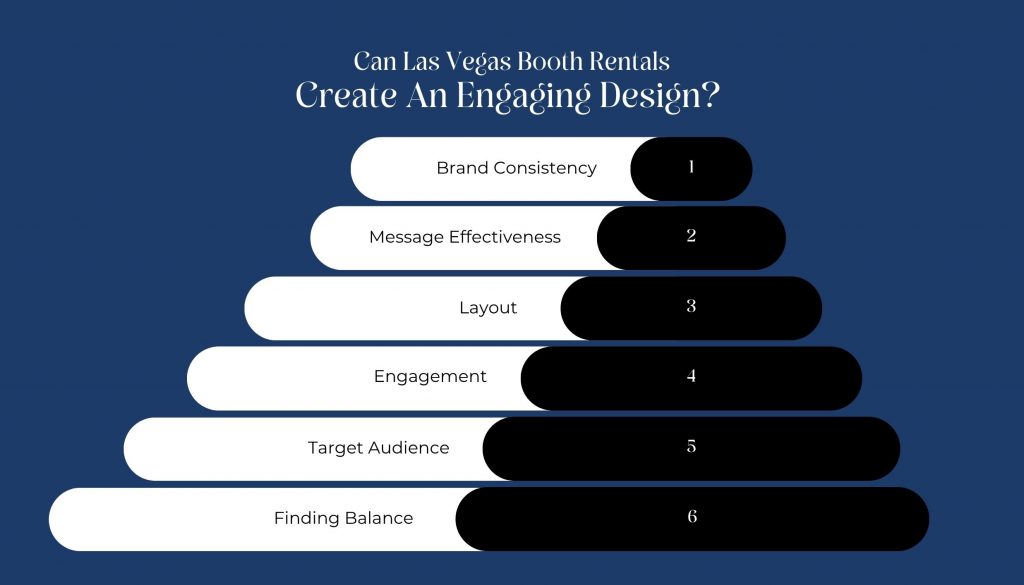
Can Las Vegas Booth Rentals Create An Engaging Design?
This is one of the most important parts of a customized trade show. You will need to brief the booth on your specific layout requirements, structural components, and graphic presentation goals 

When creating a trade show booth, especially in a vibrant location like Las Vegas, there are several key elements to consider to ensure that your display is effective and engaging.  

1. Brand Consistency  

It's essential that your booth accurately reflects your brand’s identity.  

This includes maintaining a cohesive message, using your logos appropriately, and adhering to your established color schemes.  

2. Message Effectiveness  

The way your message is delivered is crucial.  

Attention should be paid to the size of the fonts used, the prominence of your messages, and their overall positioning within the exhibit.  

These factors can significantly influence how well your booth communicates its purpose.  

3. Layout  

The design of your booth should consider its size and configuration.  

Various focal points may emerge as part of the overall design, and understanding how these interact can enhance the viewer's experience.  

4. Engagement  

Incorporating engaging elements can greatly enhance visitor interest.  

Features such as factors, giveaways, interactive touchscreen displays, and other dynamic components help keep prospects' attention longer compared to traditional static exhibits.  

5. Target Audience  

While it's beneficial to attract as many attendees as possible, focusing on qualified leads is more effective and productive.  

Understanding your target audience and designing your exhibit with their preferences in mind is essential, as these preferences vary widely across industries and market segments.  

6. Finding Balance  

Trade shows present valuable opportunities for businesses, so it’s important to include a variety of elements and features in your display.  

However, overcrowding the space can be counterproductive.  

Striking a balance between dynamic features and open space is vital to creating an inviting and effective exhibit. 

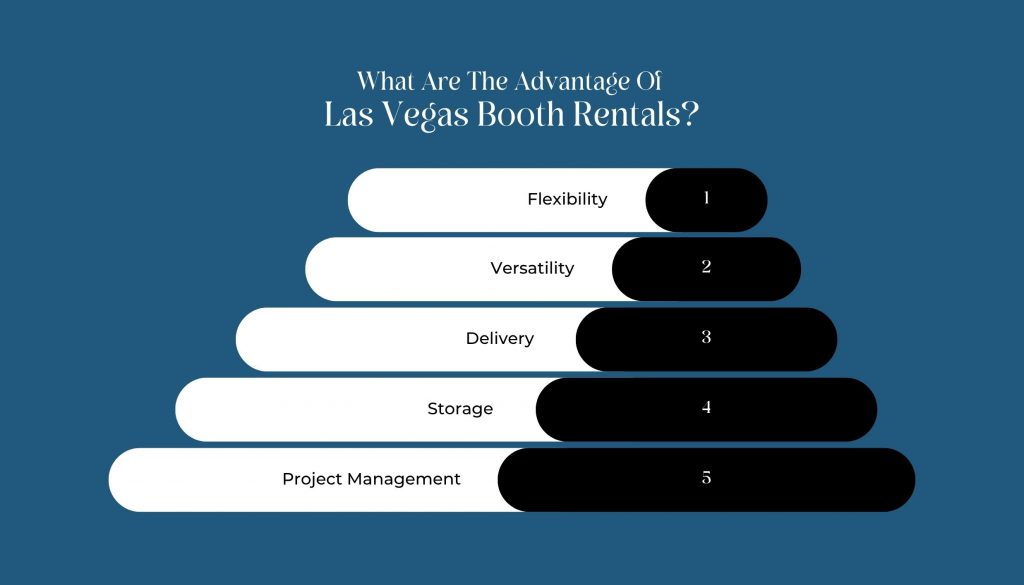
What Are The Advantage Of Las Vegas Booth Rentals?
As an exhibitor, you will experience a number of benefits from these trade show booth rentals ranging from streamlined logistics to professional installation.  

Of course, one of the best benefits is that this option is extremely cost-effective. However, that’s not all.  

Let’s check out all the benefits: 

1. Flexibility  

Public opinions are always changing. To be effective, your marketing campaigns should change, too.  

Rentals let you easily update displays to match your latest marketing efforts and product launches. 

This way, you maintain consistency without spending extra on exhibit changes.  

2. Versatility  

Owning a display limits you to the same booth size and setup for every event.  

Rentals allow you to use different sizes and layouts for different trade shows.  

You can also appear at multiple trade shows at the same time.  

3. Show-Site Logistics and Delivery  

If you own your trade show displays, you have to handle all the logistical issues like freight coordination and drayage windows.  

Rentals take care of delivery, so you don’t have to worry about getting your exhibit to its destination on time and in good condition.  

4. Storage And Maintenance 

Storing displays requires space and can also lead to extra costs. Not all storage areas are safe from damage.  

It can be frustrating to invest in a high-quality display, only to find it damaged when the next trade show comes around.  

With rentals, you don’t have to worry about storage.  

5. Project Management And Installation  

Every Las Vegas trade show booth rental includes a dedicated project manager.  

This person will keep you updated on progress and ensure that every part of the project follows your timeline and meets your expectations and complies with strict venue move-in regulations. 

Planning Your Las Vegas Exhibit Experience 

The Las Vegas booth rentals infrastructure is designed to help exhibitors execute a great and efficient event on the show floor. 

Additionally, no matter which one you connect to, they will help you make better decisions regarding booth sizes, graphic scales the designs and everything else.  

In fact, even if you are too busy or confused to provide them with any options, all you have to do is just tell them about your brand and its message.  

They will curate everything else accordingly. So, why wait? Begin coordinating your customizable trade show booth rental for your upcoming business exhibit today! 

Read Also:

Barsha is a seasoned digital marketing writer with a focus on SEO, content marketing, and conversion-driven copy. With 8+ years of experience in crafting high-performing content for startups, agencies, and established brands, Barsha brings strategic insight and storytelling together to drive online growth. When not writing, Barsha spends time obsessing over conspiracy theories, the latest Google algorithm changes, and content trends.

View all posts

Leave a Reply

Your email address will not be published. Required fields are marked *

Related

Rich text editor

Build Vs. Buy: The True Cost Of Rolling Your Own Rich Text Editor For An Edtech Platform

At some point in every EdTech company's growth, an engineer says, "We could build our own editor."  The reasoning sounds solid. Open-source editors are free. You get full control. You can customize exactly what you need. Six months later, that engineer is maintaining a cross-browser text rendering engine. So, they don’t waste time anymore building the features that make your LMS valuable.  This article breaks down the true cost comparison between building on an open-source rich text editor and adopting a commercial solution. Additionally, it also draws specific attention to the long-term total cost of ownership (TCO). In fact, you will also get to learn a lot about security and feature velocity. Key Takeaways Building an open-source fork drains roughly $126,000 over three years in direct engineering time compared to a fraction of that for commercial licenses. Maintaining a custom cross-browser text rendering engine requires 10 to 20 hours per month of unplanned reactive work that directly delays core roadmap features. Managing security patches for XSS vulnerabilities in an open-source fork introduces significant FERPA compliance risks and deployment bottlenecks. Commercial editors reduce integration time from several months to a few days while handling browser compatibility and performance optimization automatically. Rolling your own solution only makes sense if the editor itself is your primary product rather than a supporting infrastructure layer. What Are The Two Divisions Of A Rich Text Editor? The pathways of a rich text editor are divided into two major sections. Let’s see what they are: The "Build" Path: What It Actually Involves Most teams that "build" a rich text editor don't write one from scratch. This feels like a shortcut, but it creates a distinct set of costs that compound over time. 1. Initial Integration: 2-6 Months Open-source editors provide a foundation, not a finished product. So, your team needs to build the toolbar UI. In addition, you must also implement paste handling for Microsoft Word and Google Docs.  Also, you need to add image upload and management.  After you are done with these, your next steps will be to: Create table editing functionality Configure HTML sanitization for security Design the mobile editing experience The engineering salary data from Levels gives us striking information. FYI, a mid-senior frontend engineer in the U.S. costs approximately $150,000-$200,000 annually, including benefits.  If that engineer spends four months on editor integration, the initial cost is $50,000-$67,000 in engineering time alone. Also, they must keepin mind that they're not building anything else during that period. 2. Ongoing Maintenance: 10-20 Hours Per Month Browser vendors ship updates continuously. Chrome's release schedule delivers a new version roughly every four weeks.  Your editor fork needs to be tested against every browser update. When something breaks (and it will), someone on your team needs to diagnose and fix it.  We call it reactive, unplanned work. It interrupts sprint cycles and delays roadmap items. For EdTech platforms specifically, you also need to maintain compatibility with institutional browsers.  Many universities standardize on specific browser versions. In addition, some K-12 districts use managed Chromebooks with delayed update cycles.  So, I am sure that your editor needs to work across this range. 3. Security Patching: High Stakes, Unpredictable Timing Rich text editors handle user-generated HTML. That makes them a target for cross-site scripting (XSS) attacks.  Additionally, the OWASP Top 10 lists injection attacks as a persistent web application risk. Also, the rich text editors are a common vector. When an XSS vulnerability is discovered in your editor's upstream open-source project, you need to evaluate the patch. Additionally, you must also merge it into your fork (resolving any conflicts with your customizations). In turn, test it across your supported browsers and deploy it.  If you've diverged significantly from the upstream project, merging patches can take days. For EdTech platforms handling student data protected by FERPA, a delayed security patch carries compliance risk beyond the technical vulnerability itself. The "Buy" Path: What It Actually Costs Commercial rich text editors charge a license fee in exchange for a production-ready product with ongoing maintenance, security updates, and support. 1. License Cost Commercial editors typically charge annual license fees. It starts at a few hundred dollars for basic plans. Additionally, it scales to a few thousand for enterprise features.  Also, you must compare this to the $50,000+ in engineering time for initial integration of an open-source fork. Then, you will see that the license fee is a rounding error. The relevant comparison is not "free vs. paid." It's "your team's time vs. the vendor's team's time."  When you buy, the vendor's engineering team handles browser compatibility, security patches, performance optimization, and feature development. Your team focuses on your product. 2. Integration Time: Hours To Days A commercial editor with dedicated framework wrappers and production-ready features integrates in hours, not months.  Paste handling, table editing, image management, mobile support, and HTML sanitization come built in. Your team configures rather than builds. There are certain EdTech-specific requirements like:  Math equation support Track changes Collaborative editing For these, the commercial editors offer tested integrations with tools like MathType and real-time collaboration plugins, and as for students with dysgraphia or motor challenges, pairing in a math writing software removes the handwriting barrier entirely. Building these integrations from scratch on an open-source foundation adds months to your timeline. 3. Ongoing Maintenance: Near-Zero With a commercial editor, browser compatibility testing, bug fixes, and performance improvements are the vendor's responsibility.  Your team's maintenance burden drops to applying version updates. Now this should be low-friction. But it will only happen if the vendor provides clear migration guides. Also, he has to maintain backward compatibility. What Are The Components Of A Three-Year TCO Comparison? Here's a simplified comparison for an EdTech platform with a five-person frontend team. 1. Open-Source Fork Path Initial integration costs four months of one engineer's time, roughly $60,000.  Ongoing maintenance runs 15 hours per month at $85 per hour (loaded cost), totaling $15,300 per year.  Security patch response averages 20 hours per quarter at the same rate, adding $6,800 per year.  Opportunity cost from delayed features is harder to quantify, but real. Over three years, direct costs alone total approximately $126,300. Additionally, the engineer hours lost to editor maintenance could have shipped two to three significant product features. 2. Commercial Editor Path License costs run $1,000-$2,000 per year, depending on plan and deployment model.  Initial integration takes two to five days of one engineer's time, roughly $3,400-$8,500.  Ongoing maintenance is limited to applying updates. So, it is estimated at two hours per quarter. Additionally, it totals $680 per year. Over three years, direct costs total approximately $10,000-$16,000. The difference is roughly $110,000 in direct engineering costs over three years. In addition, you will see that the real value is in the features your team ships. It is not in the editor's work that they avoid. Making The Decision For The Rich Text Editor Ask your team three questions. First, how many engineering hours did we spend on editor-related work in the last six months?  Second, what features would we have shipped with those hours? Third, what is our editor's current XSS vulnerability exposure? In addition, you must also ask, how quickly can we patch it? If the answers to these questions make you uncomfortable, the build vs. buy decision has already been made.  But the only remaining question is how quickly you can make the switch.

READ MOREDetails
Forecast Accuracy

Improving Forecast Accuracy Across The Supply Chain

Have you heard about forecast accuracy? It is one of the most critical factors that influences operational success.  This happens when your predictions align closely with actual demand. Then, the organizations can minimize costs quite effectively. In addition, it also helps you to optimize inventory. In fact, it allows you to enhance customer satisfaction.  But why should you achieve this balance? And more importantly, how? Well, focusing on the latter, I would say you will require a structured approach. This approach must combine data, collaboration, and technology. What Is Forecast Accuracy? Forecast accuracy measures how close predicted demand is to actual sales or usage.  Additionally, it is typically expressed as a percentage. So, it reflects how effectively an organization anticipates future needs.  But why should you focus on accurate forecasting? This is because it does a lot for us. It: Reduces waste Prevents stockouts  Supports efficient production scheduling Now, I want to especially warn you regarding inaccurate forecasts. It can lead to  Overproduction Excess Inventory  Missed Opportunities So, I suggest that you recognize the sources of error very diligently. By this, I mean sources such as poor data quality or misaligned assumptions. I can assure you that it helps supply chain teams refine their processes. What Are The Key Factors That Influence Forecast Accuracy Performance? Several variables affect how precisely demand can be predicted. Understanding these influences allows planners to make informed improvements. 1. Data Quality   Firstly, you must ensure high standards of data quality. It is way more important than you think it is. You see, clean and consistent data form the foundation for reliable statistical analysis and modeling.  In addition, it involves regular data validation. Also, you have to go through a cleansing process. This will help you to remove inaccuracies and discrepancies.  So ultimately, it will lead to more trustworthy insights that can drive informed decision-making. 2. Market Variability   The landscape of consumer behavior is increasingly dynamic. Additionally, there are rapid shifts. These are influenced by:  Trends Economic Factors Seasonality These ongoing changes can pose significant challenges to traditional forecasting methods that rely on historical data patterns.  So, how to navigate this uncertainty effectively? Firstly, businesses must adopt more agile forecasting techniques. In addition, they also need to ensure that these account for varying consumer preferences and market conditions. 3. Collaboration   Also, you ned to foster strong cross-functional communication among:  Sales Operations Procurement Teams  I can assure you that this is essential for achieving alignment within the organization.  So, you need to actively share insights and data. Then, these departments can better understand each other's objectives and challenges. Therefore, it can lead to improved decision-making. Also, it will lead to streamlined processes. Additionally, you will see a unified approach to addressing customer needs. 4. Technology Integration   The incorporation of advanced technological tools plays a pivotal role in optimizing the efficiency of: Data collection  Analysis  Scenario modeling  In addition, you also have to ensure that you are working with the right software and platforms. When this happens, organizations can automate data processes and gain real-time insights. Also, it helps you to conduct sophisticated analyses that help predict outcomes.  This integration not only enhances analytics capabilities. But it also allows teams to explore various scenarios. In fact, you will come across strategies with greater confidence. Leveraging Forecast Accuracy Technology For Better Predictions Let us first understand exactly how modern forecasting works. I would start explaining this by stating its source of reliance first. It relies on specialized systems. And guess what? These systems that I am talking about analyze patterns across multiple data sources.  So, I suggest that you always choose well-designed demand planning software. Trust me, it can consolidate historical data and market trends seamlessly.  In addition, it will also help you to put external factors into a single, actionable view.  This integration supports more accurate and timely decision-making. Moreover, these tools can adjust to new information quickly. Therefore, it allows planners to recalibrate models as conditions change.  Also, I think this agility is particularly valuable when I am responding to supply disruptions. It also works when I am working with evolving consumer preferences. Collaborative Planning And Continuous Improvement Improving forecast accuracy is not solely a technical challenge. But it is also a cultural one.  I always ensure that my teams are sharing information transparently and aligning on key metrics.  In addition, I also conduct regular review meetings and performance tracking. This way, I foster accountability and learning. Continuous improvement requires examining forecast errors. Additionally, you also need to keep identifying patterns. In fact, you also have to adjust models accordingly.  Establishing a feedback loop between departments strengthens trust and ensures that decisions are based on the most current insights. Aligning Forecast Accuracy With Broader Supply Chain Goals Now, I have some personal tactics that you can follow to align forecasting with a broader set of goals. A Forecast Accuracy should support strategic objectives such as:  Sustainability  Service level optimization  Financial efficiency In addition, I also feel that accurate forecasts help balance supply and demand. Therefore, it has definitely helped me reduce excess inventory and minimize transportation inefficiencies. So, I suggest that you, too, start aligning planning objectives with business goals. Only this way can organizations ensure that forecasting contributes directly to growth and resilience.  Also, when you do this effectively, this alignment transforms forecasting from a reactive task into a proactive strategy driver. Building Resilience Through Forecast Accuracy Resilient supply chains depend on reliable forecasts to manage uncertainty.  This is why I always suggest that companies use precise data and collaborative methods. Only then can they anticipate challenges and adapt quickly.  In addition, I think it also adds better visibility across the entire planning horizon. So, it further enhances confidence and stability. Ultimately, improving forecast accuracy is a continuous journey.  So, you must move forward with disciplined processes. In fact, I also promote integrated technology a lot. And for that finishing touch? I incorporate cross-functional collaboration. Boom! This way, organizations can create forecasting systems that support both short-term performance and long-term success.

READ MOREDetails
how to find your family tree

7 Creative Ways To Find Missing Branches On Your Family Tree

Today’s topic: How to find your family tree?  Pulling everything together in a different way can reveal patterns you were missing.  Cross-referencing sources against events in other family members' lives can lead you to breakthroughs you weren't expecting.  These seven methods treat that wall as a puzzle, not a dead end. 1. Think In Clusters, Not Individuals: Census records provide a wealth of information for genealogists, ranging from names and ages of family members to where ancestors were born to the value of their property.  However, one of the most genealogically useful (and yet overlooked) aspects of census records is the neighbors. This data can be very important when we can't find anything about our ancestors.  The Jones family living nearby could give us a clue about where they are from. Families often migrated together with relatives or friends from their home communities.  By examining neighborhood clusters across multiple census years, you can track migration patterns and even identify maiden names through neighboring siblings. 2. Follow The Collateral Lines: In case your direct ancestor didn't leave a paper trail, there's a chance that their siblings did.  A brother or sister of your ancestor who filed a land claim, a cousin listed in a probate document, or a sibling's marriage or birth can help you use newspapers and obituaries to trace ancestors and your family history.  These collateral lines carry the same surnames, the same geographic patterns, and often the same witnesses and neighbors. When your ancestor leaves no trace, their siblings and cousins often provide the missing pieces through their own records.  By reconstructing entire family groups, you can discover maiden names, migration routes, and family connections that would otherwise remain hidden. 3. Use The Spaces Between The Records: Unsuccessful searches are not a waste of time; they're part of the research process.  If you don't find a particular ancestor in the tax rolls of a given county from 1845 to 1852, for example, you've learned something. He or she either arrived after 1852 or left before 1845.  Do the same with where you do find him or her, and you can often pin down a migration window to a few years. Negative evidence is still evidence—it helps you narrow possibilities and focus your search. Every "not found" result eliminates options and clarifies the timeline of your ancestor's movements.  By systematically documenting what records don't contain your ancestor, you create boundaries that define when and where they must have been.  Combined with positive findings from other locations, these gaps often reveal precise migration dates and help you prioritize which records to search next. 4. Look At Religious Archives Beyond Baptismal Records Churches had more meticulous records than government institutions, and for many genealogists, their research ends with a baptismal certificate.  But different denominations also had "Letters of Transfer" that were paper notes, which congregants departing from one church could bring to another in a new town. These letters transferred members in a way no government paper could.  A family that doesn't appear in a county's civil record likely appears in a church transfer register, with the date of their arrival and their place of origin varying.  Church membership records, meeting minutes, and discipline records can also reveal family relationships and exact migration dates.  These documents often name entire family groups and specify their origins, providing details that civil records never captured.  Also, this will help you significantly in your journey towards knowing how to find your family tree.  5. Dig Into Local Newspapers: Nearly 27% of Americans have used an online service to search for their family history, which means most people are researching the same digitized databases. What they're looking for is in the local newspaper archives. The local newspaper was created by people who knew the community.  Small-town newspapers regularly printed sections called "Local Happenings" in which they featured out-of-town visitors, family reunions, and who spent the vacations.  They have never been indexed. You have to read them. One of the most effective ways to find ancestors who have not left a death certificate is to look for other family members named in the record.  An obituary of a sibling will often give the names and locations of relatives who survive, offering you two or three new tracks that you did not have before. 6. Check Unclaimed Property Databases: This is an unexpected one.  Occasionally, when someone relocates abruptly or passes away and doesn't have family in the immediate area, they'll abandon utility deposits, lost-balance bank accounts, or uncollected checks.  Most places have open resources that list this unclaimed property, occasionally including the last known mailing addresses and dates. It won't be your golden genealogical record, but it can be proof that your ancestor resided in a certain location at a certain time - precisely the type of fact-checking proof you need to collapse a brick wall.  These mundane financial records can pinpoint exact addresses and timeframes that other sources fail to provide.  Unclaimed property databases are often searchable online and may provide the crucial link between locations or fill gaps in your timeline. 7. Match Your DNA Results To The Fan Club: DNA matching can become frustrating rather quickly.  This is particularly true within populations known for endogamy. Moreover, it is often involved in cousin marriages and the repetition of surnames. Also, the number of centimorgans alone may not provide you with much information. This is where the FAN club comes in. By treating an ancestor's friends, associates, and neighbors as a defined group, you will gain a supportive framework for analyzing those DNA cousins.  If your DNA cousin shares the same surname as someone repeatedly associated with your ancestor. That's no random, low odds coincidence. It is where you want to follow that through land, church, and local records. How To Find Your Family Tree? The Records Are There If You Know Where To Look There is a solution to every difficult research problem. Maybe it's an obscure document that identifies the correct individual.  Perhaps it's a church transfer letter or an account left long forgotten in a bank.  What's important is the method and the mindset, not the site. Stop looking for the person, and instead, look for other people and records connected to their world.  The missing relatives usually show up. Shift your focus from direct searches to the community and network surrounding your ancestor.  By reconstructing their entire social world, you'll often find your ancestor embedded within records you would have otherwise overlooked.

READ MOREDetails