Published on: 02 March 2021
Last Updated on: 12 May 2026
The rates of falls and staircase-related injuries among the elderly continue to increase.
A Queensland government health report states that 100,000 people are hospitalized due to falls. The main causes include slipping, tripping, and stumbling, especially on stairs. Almost 10% of ambulance calls in Victoria attend to elderly patients who have fallen.
This article examines stair safety for senior citizens and how to proactively stop falls.
We explore safety features like stair treads and guard rails. And how the right lighting will protect the physically vulnerable.
Learn about stair safety and consider the elderly by reading these 3 tips. Then make falls and trips a thing of the past.
1. Safety Rails for Staircases:
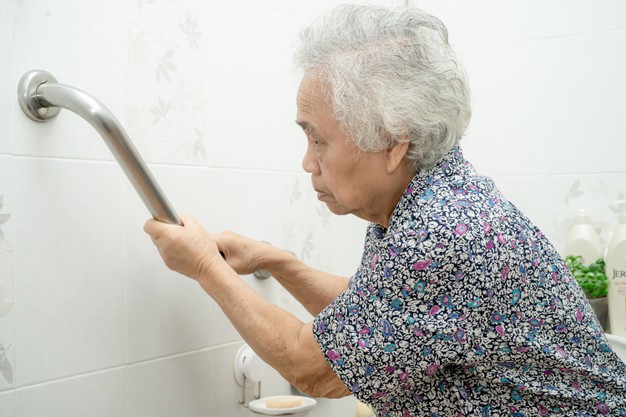
Stair safety guardrails act as an invaluable support aid when mounting or dismounting stairs.
According to the government's WorkSafe guide, each stairway should include at least one handrail. If the stairs are wider than 100cm then two handrails are required on either side.
Slippy rails or those too large to grip are worse than useless.
A power grip style that's rectangular or circular allows the person to hold tight and use the stairs with confidence. There should be no obstructions to allow free movement. And the rails need to be visually significant so they're easy to see.
2. Stair Treads for Elderly Relatives:
Stair treads are the horizontal part of a stair on which a person steps on.
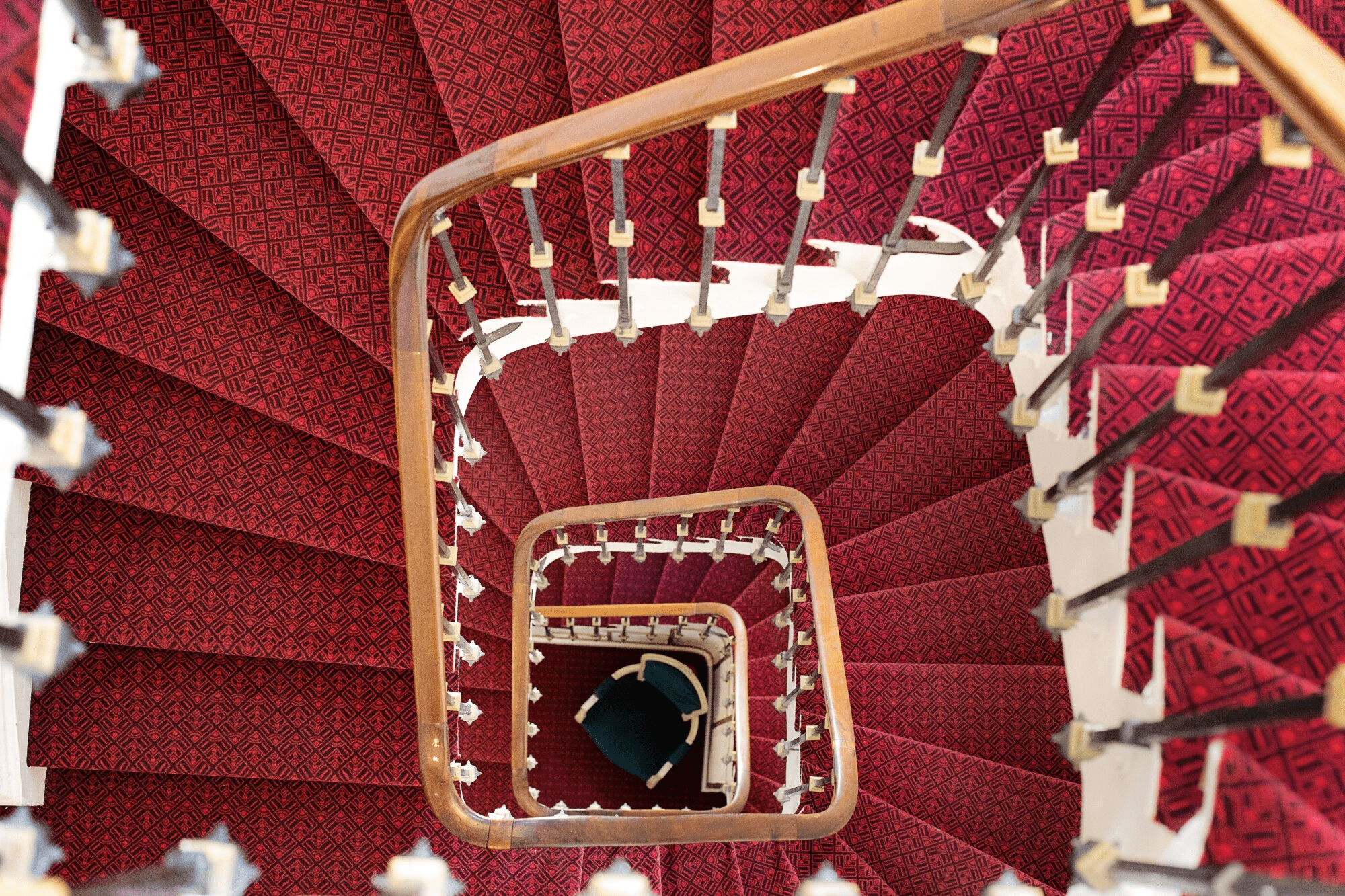
Treads are often carpeted in elderly residential homes and houses. However, this type of material can rise or bump making the tread a tripping hazard.
Non-slip treads provide a safer environment. Methods include:
rubber or abrasive treads
anti-slip tape
slip-resistant nosing
Nosing is the edge of the stair where footfall is greatest. Stairs without firm nosing will see a higher number of falls. Therefore, it's essential to include adequate nosing that is easily seen and strong enough to take a person's full weight.
Staircase installers offer a full range of stair treads available in different colors and finishes. There are multiple nosing options on offer too but ask for the right type to suit the intended setting.
3. Improve Lighting and Remove Tripping Hazards:
Stairs should always have a high illumination level. Especially when contrasted to adjacent spaces.
Shadows and low areas of light can disrupt visibility. Remove them by installing low-glare overhead lights or a stair lighting kit. Make sure to have light switches on the upper and lower levels too.
Additionally, remove any tripping hazards from the staircase.
Items like clothing or books must never block the stairs. Carers should inspect the staircase regularly and remove all items. Training in care homes should provision for this along with general safety guidelines.
Making Stairs Safer for Seniors:
Senior staircase safety should include increasing visibility, removing hazards, and upgrading staircases.
Stair injuries can be grave and life-threatening in nature for seniors. You can suffer from injuries that might require medical procedures like hip replacement surgery or one for the knee. This is one reason why staircase safety is advocated.
Adding non-slip stair treads and dual handrails not only acts as safety features but can boost confidence. Adding extra light will help too.
Make an elderly person more comfortable in their home by following these tips. Reduce falls and increase the quality of life through simple staircase additions.
Read Also:
Content Rally wrapped around an online publication where you can publish your own intellectuals. It is a publishing platform designed to make great stories by content creators. This is your era, your place to be online. So come forward share your views, thoughts and ideas via Content Rally.
As senior citizens age, their energy, mobility, and cognitive abilities decline gradually. This increases the risk of the seniors tripping and falling or developing physical and mental health challenges.
The health and safety risks are higher if they are not in a safe environment or have nobody to care for them.
So, safety and peace of mind are priorities for seniors due to their vulnerability. This explains why many seniors move to retirement communities to enjoy freedom, comfort, and safety with their peers.
But how do senior living communities improve physical security and safety? Do they prioritize seniors’ emotional support and mental well-being? This article will discuss how senior living communities are a safe haven for seniors.
Safety Guidelines to Prevent Accidents
Families with elderly parents wonder if they should entrust the safety of their loved ones to senior living communities.
Moving to a senior living facility means transitioning to a new environment with new residents and caregivers. It also means changing the routine, which could increase safety risks.
However, the management of senior living homes and caregivers develop and follow comprehensive safety guidelines. Since preventing falls is a top priority in the facility, seniors do not have to worry about trip and fall or slip and fall accidents due to unsafe conditions.
The facility has nonslip floors, well-lit walkways, handrails to provide support, and mobility aids to prevent accidents.
Social Environment
Isolation is a common challenge for seniors in their homes, especially living alone at home. However, retirement homes provide social settings, such as standard rooms and dining halls.
This is a place where the residents meet and interact as they eat and watch television. Also, residents can engage in their favorite hobbies or adventure, which fosters social engagement.
Safety and Security Systems and Protocols
The leading senior living communities have security cameras and alarm systems to reduce the chances of something wrong happening to seniors.
The cameras are strategically installed to prevent intruders from accessing the facility and identify residents who might need help around the facility.
The entrances have access control systems that ensure only people with codes or keycards can enter the premises.
The caregivers and security guards undergo rigorous training to understand safety protocols and respond to emergencies appropriately. These measures reduce the risk of security and safety issues that could put seniors at risk.
Medical Management Services
Seniors with health problems might need medication at specific times daily. Since some have memory problems, they might struggle to take the appropriate medicine in the correct dosage. So, they might skip medication or take more than the prescribed dose.
Senior living communities understand the health risks associated with medical prescription issues; they have medical management systems in place.
For instance, they have reminders to help energetic seniors to take medication at the correct times. They also hire trained caregivers to help some take medication, thus ensuring consistency and reducing the risk of health complications.
Support Staff for Every Complicated Task
Some seniors need help with food preparation and cleaning tasks. They can avoid these tasks and allow caregivers and support staff to do everything for them.
Some senior communities also provide transport services to different places so the residents do not have to drive cars or struggle to use public transport.
Senior living facilities create a safe haven for seniors with diverse health and emotional needs. They observe safety protocols and create a social environment with trained staff to address the unique needs of the residents.
With these benefits in mind, seniors reluctant to move to a senior living community can now boldly welcome this hassle-free lifestyle.
Proper At-Home Safety Measurements For Seniors
The senior living community designs are specifically tailored for seniors. They consider things like single-floor living, wide doorways, and hallways, and they take a few steps to navigate to get in and out of the home.
Each of the communities has their own designs. You can find the home safety features such as:
Providing grip bars inside and outside of showers, bathtubs, and even toilets.
Ensuring there are no trip hazards or any objects where the seniors might get bumped into.
Raised toilets.
Keeping the paths illuminated with bright lights and windows.
Better flooring with advanced slip-resistant technology.
Proper safety lock facilities in pools and spas.
Unique electric controls with better access for wheelchairs.
Apart from these, there are some senior living communities that come with features like intercom access or emergency call systems. There are frequent wellness checks as well, which are mainly conducted by the staff.
Moreover, the communities also provide advanced care needs. They offer better assistance for bathing and moving, helping them to prevent any injuries or falls.
Ensuring Fewer Risks And More Convenience
Another way to help seniors stay safe is to provide a convenient and hassle-free lifestyle. You can find some communities, including dining room meals.
As we know, even basic tasks such as cooking can be dangerous at times. Thus, the seniors, along with their loved ones, seek out communities where they can get a proper home-cooked meal.
There are several other communities that provide services like housekeeping or transportation as well. Not being involved in cosmetic chores can help to decrease the chances of tripping or falling.
There are also some senior living communities that can provide on-site wellness clinics that help the seniors stay healthy. Senior communities with more advanced care need professionals 24/7. In such cases, wellness centers play a huge role.
Ensure better safety of your loved ones!
If you have a senior parent or parents staying in your home and you are concerned about their safety while they are living on their own, then it is time to consider the facilities of the senior living communities.
Start looking for it online, as there are many senior living communities that can provide a healthy lifestyle for seniors while ensuring their safety and keeping them away from harm.
Read More...
Senior-Friendly Exercise Routines: Enhancing Quality Of Life Guide
Senior Staircase Safety: What You Need to Know
5 Best Ways For Seniors To Pass The Time
Nonprofit organizations deserve your support. If you have enough time and resources, you should support them. Look for organizations that take steps to save the environment. These are the reasons why your support will go a long way.
They have clear goals:
Not all groups that protect the environment have the same goals. Some of them focus on animal conservation. Others are about preventing water pollution.
You can even find organizations that help train future leaders who will challenge people in authority. Choose whatever is closest to your heart and help in whatever way you can. Look at the mission of these organizations and see how you can be of help.
You can start from home:
If you don't see yourself helping these organizations yet, you should start from home. Some practices will make you understand the value of environmental protection even more.
For instance, you can partner with reputable recycling companies like langleyrecyclingkc.com to dispose of used materials. The items you let go of will be recycled. Considering the many benefits of recycling, you're doing the right thing.
Eventually, if you see the value of environmental protection, you will consider supporting these organizations. If you don't want to go alone, convince your friends to be with you. You might know people who share the same concern.
There are results:
If you believe the steps you take at home bear no results, it's understandable. You can help environmental groups in addition to what you do at home. If you join these organizations, you will see drastic changes. It motivates you to do more since you know that your actions have positive results.
It’s a wise use of your time:
When you have free time, and you wish to relax, it's good for you. Everyone deserves time to be alone and not worry about anything.
However, if you have more time in your hands, use it properly. Taking steps to protect the environment is one of them. It feels satisfying since you're doing something not just for yourself. Environmental protection helps create a better world for the future generation. If you have children, you will understand its value even more.
These people volunteer their time and resources:
Most people running these nonprofit organizations don't get paid well. They're doing the right thing out of their love for the cause. They're also passionate about protecting the environment.
If some of them can devote their entire time and resources to keep the organization going, you can do the same. You don't have to be there full-time, but there are ways to support.
Nonprofit organizations succeed because of people who are willing to lend a hand. Besides, there are different ways to lend a hand. If you have enough financial resources, you can donate.
If you have skills in promoting the organization, you can use them. Ask these organizations how you can be of help and volunteer whenever you're free. The people running them will appreciate whatever you can offer.
Read Also:
Why Environmental Air and Noise Monitoring Is Really Worth Families Health
Dangers Of Chemical Spills On Humans, Buildings, And Environment
Having silly debates on the internet and having heated arguments and virtual bloodshed over it has become pretty common nowadays. Very few seem to have a common ground regarding such heated debates. However, one such debate that gained comical notoriety was this question - are there more doors or wheels in the world?
Well, if you want to find the answer to this question, then you are in the right place. If you want some solid evidence as to which option is the right answer (unbiased of course), then read this post till the end.
How Many Doors Are There In The World?
When it comes to the viability of what will be considered as how many doors are there in the world for this poll, all doors are considered here. This includes, but is not limited to various forms of doors (even the unexpected ones).
For this debate, I will be considering doors as “doors” that connect two spaces together. It can be between spaces. Therefore, the doors in your room, windows, oven, car, house, and everything that resembles one will be taken into consideration. This includes:
Residential household doors
Vehicle doors
Toy vehicle doors (only if openable)
Cabinet doors
Drawer doors
Cupboard doors
Bunker doors
Windows doors
Oven doors
How Many Wheels Are In The World?
What type of wheels must be considered for this poll is subjective. However, for its discussion on this post, all wheels will be considered here. This includes actual wheels that are present in vehicles, along with other wheels present in car toys, trolleys, and more.
For the sake of simplicity, any circular wheels that help in moving objects around will be considered as a wheel. In addition, circular objects that simply rotate might also be considered wheels, though this is subjective. This includes the wheels in hand-drawn carts, pulleys, and lots more.
Therefore, for this discussion, such wheels in “how many wheels are in the world” will be taken into account:
Vehicle wheels
Toy car wheels (Hot Wheels anyone?)
Cartwheels
Skateboard wheels
Wheelchair wheels
Lawn Mower wheels
Gear cogs and wheels in machines
Since When Did People Care About Debate This Anyway?
People will always care about any pointless debate on social media since they are fun and you get to flex your knowledge online.
The debate about how are there more wheels or doors in the world was first started online on Twitter. It was first started by Ryan Nixon from New Zealand. He randomly made a poll post on Twitter asking users “is there more doors or wheels in the world?” This Twitter poll was posted on 5th March 2022.
However, since it's social media, who knew this question would cook up such a storm?
Even though Ryan has only 2,000 followers on Twitter, more than 220,000 votes were cast on this poll. This left Ryan flabbergasted and surprised at the overwhelming response. Later, many claimed that this poll spread like wildfire, and it was shared with thousands of people on other social media platforms as well. Sharing this post on WhatsApp and TikTok also made it pretty popular as well.
So, according to Ryan’s poll, are there more wheels than doors?
Doors VS Wheels: Who Wins In This World?
So, in the end, who is the winner of the debate: are there more wheels or doors in the world?
The answer is - there are more wheels in this world than doors.
According to the original Tweet made by Ryan, the poll also provided the same answer. As per the results of this poll, 54% of the votes said wheels while 46% said doors.
When it came to the question, there was an entirely new war brewing regarding this question. Those who said wheels argued that each car has four (or more) wheels - including the millions of toy cars as well. In addition, each door has wheels on them - the door hinges. Here, one even argued that each door is a wheel in itself, but it’s not the same the other way around!
On the other hand, many “Team Door” followers claimed that doors can be mystical as well - referring to the door to our hearts and minds as well. While each person has various opinions regarding this question, we should be happy with the answer provided by the poll for now.
Frequently Asked Questions (FAQs):
Many people interested in finding out if are there more doors or wheels in the world answer have asked various questions. Here are my answers to those questions.
Q1. What Does Team Doors VS Team Wheels Mean On TikTok? Ans: When people asked about “are there more doors or wheels in the world statistics” through TikTok, the opinions of people differed. Those who thought that there were more wheels joined Team Wheels. On the other hand, those who thought that there are more doors in the world joined Team Doors. Q2. Do Doors Have Wheels On Them? Ans: Yes, it’s true that doors have wheels on them. This statement is true because all doors have hinges in them. You can consider hinges to be a wheel since they are circular in shape and rotate too!
Final Verdict: Are There More Doors Or Wheels In The World?
So, are there more doors or wheels in the world?
The answer is there are more wheels in this world compared to doors. This is because there are millions of automobiles in this world, with all of them having two to six wheels. Plus, the greatest argument ever here is that all doors have wheels on them - the door hinges.
If you want answers to such silly (but interesting) debates, why not start a fire yourself in the comments below?
Read Also:
How to Check If Your Car Tires Are Good?
Why Should you Consider Security Doors for Your House?
How To Choose The Best Wheels And Tires For Your Vehicle?













 Stair safety guardrails act as an invaluable support aid when mounting or dismounting stairs.
According to the government's WorkSafe guide, each stairway should include at least one handrail. If the stairs are wider than 100cm then two handrails are required on either side.
Slippy rails or those too large to grip are worse than useless.
A power grip style that's rectangular or circular allows the person to hold tight and use the stairs with confidence. There should be no obstructions to allow free movement. And the rails need to be visually significant so they're easy to see.
Stair safety guardrails act as an invaluable support aid when mounting or dismounting stairs.
According to the government's WorkSafe guide, each stairway should include at least one handrail. If the stairs are wider than 100cm then two handrails are required on either side.
Slippy rails or those too large to grip are worse than useless.
A power grip style that's rectangular or circular allows the person to hold tight and use the stairs with confidence. There should be no obstructions to allow free movement. And the rails need to be visually significant so they're easy to see.
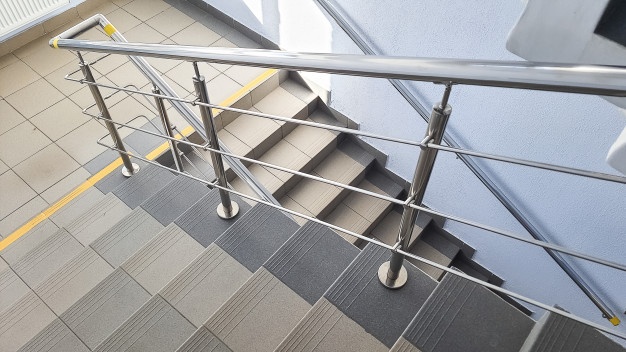 Stair treads are the horizontal part of a stair on which a person steps on.
Treads are often carpeted in elderly residential homes and houses. However, this type of material can rise or bump making the tread a tripping hazard.
Non-slip treads provide a safer environment. Methods include:
Stair treads are the horizontal part of a stair on which a person steps on.
Treads are often carpeted in elderly residential homes and houses. However, this type of material can rise or bump making the tread a tripping hazard.
Non-slip treads provide a safer environment. Methods include:
 Stairs should always have a high illumination level. Especially when contrasted to adjacent spaces.
Shadows and low areas of light can disrupt visibility. Remove them by installing low-glare overhead lights or a stair lighting kit. Make sure to have light switches on the upper and lower levels too.
Additionally, remove any tripping hazards from the staircase.
Items like clothing or books must never block the stairs. Carers should inspect the staircase regularly and remove all items. Training in care homes should provision for this along with general safety guidelines.
Stairs should always have a high illumination level. Especially when contrasted to adjacent spaces.
Shadows and low areas of light can disrupt visibility. Remove them by installing low-glare overhead lights or a stair lighting kit. Make sure to have light switches on the upper and lower levels too.
Additionally, remove any tripping hazards from the staircase.
Items like clothing or books must never block the stairs. Carers should inspect the staircase regularly and remove all items. Training in care homes should provision for this along with general safety guidelines.