











There’s a certain charm to every Boba tea recipe out there.
Since I was a child, I have wanted to see how boba is made. I was so curious about the way the tea turns out.
It looks playful, with those pearls sitting at the bottom and tea layered above.
But the appeal runs deeper than its appearance.
Now, every single cafe is trying to use this hype to their advantage. In fact, I have seen so many Boba tea stalls and small cafes.
Honestly, this business module is blooming! And for good reasons. Boba tea tastes quite amazing.
Additionally, I think every cup carries a delectable mix of craft and chemistry.
This is something that will feel both indulgent and oddly comforting to you.
To understand why boba has become such a fixture in global food culture, let’s start from the very beginning.
I will take you through the recipe, starting from right where the pearls take shape.
What Are The Different Parameters Of A Boba Tea Recipe?
The boba tea recipe only has three major layers. Once you crack the code, maybe you will start your own boba tea business!
1. It All Starts With Tapioca, Not Tea
The heart of how you make boba isn’t the tea at all. Rather, it’s the pearls.
So, you have to make boba pearls from tapioca starch. You derive this starch from cassava root.
These small spheres surprisingly begin as a simple dough. The process feels almost old-fashioned:
- Firstly, you mix the starch with hot water.
- Secondly, sometimes you fold in brown sugar into the mixture.
- Then, it forms into a pliable mixture that’s soft to the touch.
- From there, you roll the dough into long strands. Then, you can cut it into small pieces.
- Lastly, you shape the dough into balls.
They aren’t always perfectly uniform. But that slight irregularity gives them some character that they really need.
Plus, cooking changes everything. Here’s how:
- You boil the pearls until they soften and turn translucent. As this helps them develop that signature chew.
- Once you’ve drained them, they don’t go straight into the drink.
- Instead, they rest in a sugar syrup (often brown sugar), which deepens their flavor and keeps them from sticking together.
- That final soak is what gives boba its rich, almost caramel-like note before it even meets your tea.
2. Bringing The Drink Together: Layer By Layer
Once the pearls are ready, the rest of the drink comes together with careful balance:
Tea Base
It begins with a strong tea base (commonly black). Though green and oolong teas also feature prominently.
Strength
Plus, you have to brew the tea with enough intensity. This will help it hold its own against the sweetness and milk.
Cooling It Down
After you have completely brewed the tea, it is time for the cooling process. You have to cool it down using ice.
A Splash Of Milk
Then, you have to add the milk. You can add either dairy or plant-based. It entirely depends on your preference.
Adding Some Sweetness
At last, sweeteners follow. Additionally, they range from simple syrup to richer sugar blends.
Hence, you are creating a drink that leans more towards a dessert than a traditional tea.
3. The Final Assembly
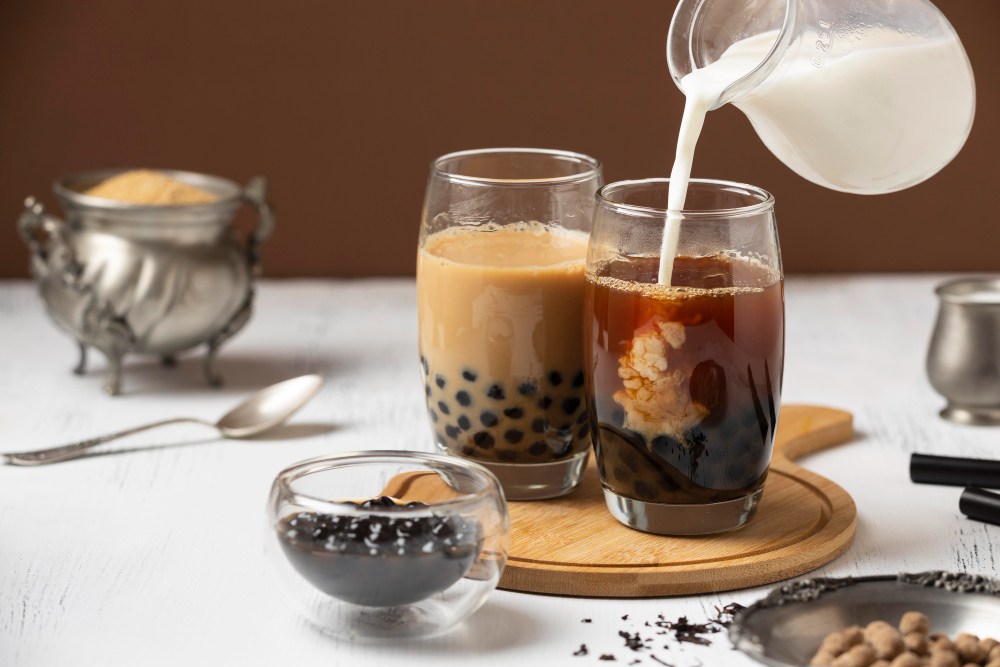
For the assembly, the pearls will settle at the bottom of the cup. Then, you have to put it in the ice.
After that, you have to pour the tea mixture over the top.
Then, you will get such a result that is so perfectly layered. In fact, it will be both visually beautiful and amazing in taste.
Also, the wide straw isn’t just an accessory. Rather, it’s essential.
It’s basically designed to carry both liquid and the pearls into your mouth in just one sip. This entire method keeps the drink interactive and never static.
Boba Tea Recipe Experimentation With Toppings: Turning One Drink Into Many
How boba is made now invites a decent bit of variation.
Additionally, I would like to mention that this variation happens largely through its toppings.
These modern versions often include additions that may shift your tea drinking experience entirely:
- Firstly, they use popping boba. This one is filled with fruit juice that bursts on contact.
- Additionally, they mix some jelly-based toppings, such as coconut or grass jelly
- Also, they mix in certain alternative textures, like aloe or taro-based inclusions.
What Is The Secret Behind The Addiction To A Boba Tea Recipe?
Amongst the various reasons behind boba tea’s appeal, here are the notable ones:
Texture:
The pearls, often described as having a “QQ” consistency, create a gentle resistance when you chew them.
That combination of drinking and chewing at once makes the experience feel more engaging.
Sweetness:
Many boba drinks contain notable amounts of sugar, which can lead to a pleasurable response in the brain.
That’s why we often go for repeat consumption.
Customisation:
You literally have options to adjust sugar levels, swap milk types, or experiment with toppings.
That way, no two drinks need to be identical.
Overall, these additions and unique flavors try to introduce some contrast, be it soft, chewy, or crisp.
It is this variety that allows boba to adapt to your unique taste buds, whether you prefer something traditional or slightly experimental.
The Boba Tea Recipe Is Getting A Huge Hype, Thanks To The Drink’s Popularity
In 2026, you will find almost everyone asking for the Boba tea recipe. Some are asking to start a business.
Also, some of them are asking to make an addition to their cafe menu.
Additionally, there are a lot of people who are asking for the recipe so that they can make this at home.
The rise in the popularity of Boba tea signals how much food and culture are an intricate part of the market.
In fact, they affect how customers view a product. This means that when you are buying Boba, you are not just buying it because it tastes good.
Rather, you are also buying this for the cultural significance.