













235/40R19 Tire Spec Guide: Ratings, Labels, And Codes Explained

by

21 May 2026

Blog

235/40R19 Tire ratings

You have confirmed your vehicle takes a 235/40r19 tires. 

Now every product listing shows a different set of numbers after the size: 92V, 96Y XL, 96W.

Additionally, none of the listings explain what those codes actually mean or which one your vehicle requires. 

This guide decodes every number and label you will encounter when buying a 235/40R19 tire: load index, speed rating, the XL designation, the EU tire label, and the UTQG rating system. 

By the end, you will know exactly which 235/40R19 Tire ratings your vehicle needs and why accepting a lower rating is a safety compromise, not a budget decision.

235/40R19 Tire Ratings Load Index: The Number That Determines Weight Capacity

The load index is a two-digit number that follows the tire size code. 

It represents the maximum load a single tire can carry at the inflation pressure specified by the manufacturer. 

It is expressed as a coded number rather than a direct weight figure, which is why it requires a reference chart to interpret.

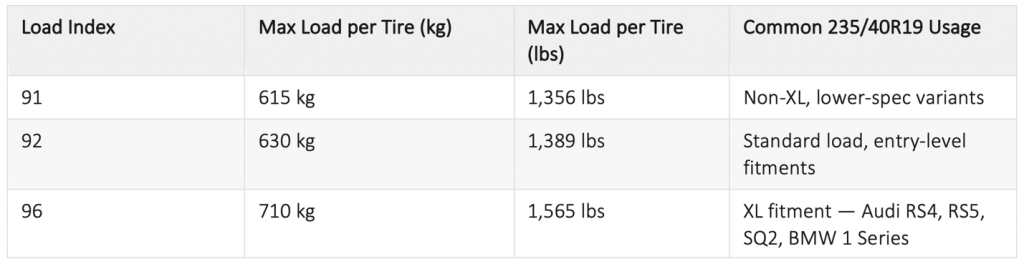
For 235/40R19 tire ratings, you will most commonly encounter load index values of 91, 92, or 96. The difference between 92 and 96 is not cosmetic.
Why Does This Matter On A 235/40R19 specifically

The vehicles that use this size as OEM, Audi RS4, RS5, SQ2, BMW 1 Series F70, are heavier than the average passenger car and are engineered around the higher load capacity of a load index 96 XL tire. 

Installing a load index 92 tire on a vehicle that specifies 96 reduces the tire's rated weight capacity below the manufacturer's requirement. 

That is not a specification variance. It is a structural safety compromise.

Always verify the minimum load index against your door placard or owner's manual. 

Never install a tire with a lower load index than specified, regardless of brand or price.

235/40R19 Tire Rating: What V, W, And Y Actually Certify

The speed rating is the letter that follows the load index. 

It certifies the maximum sustained speed at which the tire has been tested and approved for use. 

It is not a recommendation to drive at that speed; it is a structural ceiling below which the tire is designed to operate safely.

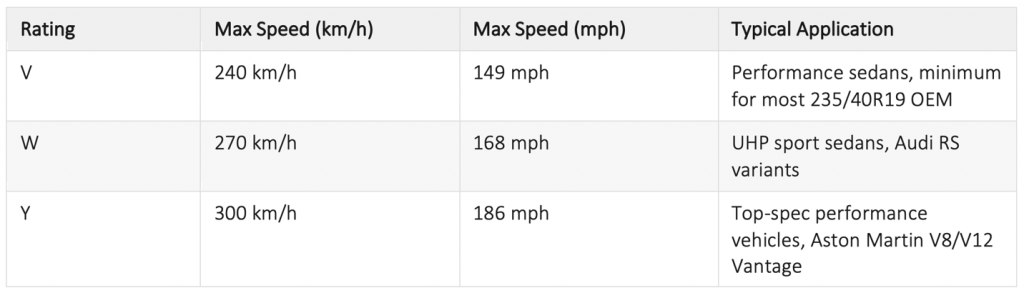
Three speed ratings appear regularly in 235/40R19 fitments:
A Critical Detail Most Buyers Miss: 

The speed rating indicates how a tire handles stiffness and heat at high speeds. 

A Y-rated tire uses a different rubber than a V-rated tire, which helps manage heat better at high speeds. 

This means that a Y-rated tire performs differently from a V-rated tire, even at lower speeds like 100 km/h during long trips. 

The rubber is designed for different heat conditions.

For most vehicles with 235/40R19 tires, the door placard states that you need a minimum speed rating of V or W. 

Do not use tires with a lower rating than what the placard requires. 

Doing so will void the tire manufacturer’s warranty and could affect your insurance coverage if an incident occurs involving the tires.

XL: What Extra Load Means And When You Need It

It indicates a reinforced tire construction that allows the tire to carry a higher load at a higher inflation pressure than a standard load tire of the same size. 

When you see 235/40R19 96Y XL, the XL designation is part of the tire's structural specification, not a marketing label.

The practical differences between a standard load and an Extra Load tire in this size:

  • Load Capacity

An XL tire at maximum inflation carries more load than a standard tire at the same size. 

For load index 96 XL, the maximum load is 710 kg (1,565 lbs) per tire. 

The same size in standard load at index 92 carries 630 kg (1,389 lbs). The XL rating unlocks the higher capacity.

  • Inflation Pressure

XL tires are designed to operate at higher inflation pressures than standard load tires. 

Your vehicle's recommended tire pressure is set by the manufacturer based on whether the OEM fitment is standard or XL. 

Running an XL tire at standard load pressures underinflates it for its construction, which affects wear rate and handling.

  • Sidewall Stiffness

The reinforced carcass of an XL tire produces a slightly stiffer sidewall response, which is part of why performance vehicles specify them. 

The stiffer construction resists lateral deformation under cornering load more effectively than a standard sidewall.

If your OEM specification is XL, replace it with XL. 

If you replace an XL tire with a standard load tire at the same size, you reduce load capacity, alter the correct inflation pressure, and change the tire's structural behavior under load, all without any visible indication on the outside of the tire.

The EU Tire Label: Three 235/40R19 Tire Ratings, One Sticker

Since 2012, tires sold in the European Union and the UK carry a standardized label rating three performance dimensions: wet braking, rolling resistance, and external noise. 

The label was updated in 2021 under EU Regulation 2020/740 to include additional classes and a QR code linking to a product database. 

For a buyer choosing between 235/40R19 tires, these three ratings are decision-relevant.

Wet Braking

Wet braking is rated A through G, where A is the shortest stopping distance. 

This is the most safety-relevant rating on the label. The EU tests wet braking at 80 km/h on a standardized wet track surface. 

The difference between an A-rated and a G-rated tire in stopping distance from 80 km/h is approximately 18 meters — about four car lengths. 

For a UHP 235/40R19 tire, A is the target. B is acceptable. C and below represent a meaningful wet braking compromise relative to what this size and its typical vehicles are capable of.

Rolling Resistance

Rolling resistance is rated A through G, where A generates the least resistance and therefore the best fuel economy. 

For UHP and performance tires in 235/40R19, a rating of C or D is common and expected. 

High-grip rubber compounds and lower rolling resistance work against each other at the compound chemistry level. 

A tire rated D on rolling resistance but A on wet braking has been optimized for the safety-relevant dimension. 

Do not penalize a performance tire for a D rolling resistance rating if the wet braking grade is A.

External Noise

Noise is measured in decibels and assigned a class: A (lowest, more than 3dB below the limit), B (up to 3dB below the limit), or C (within the limit). 

For 235/40R19 UHP tires, 69dB in class A is a strong result. Class B under 72dB is still acceptable. 

External noise affects other road users rather than the driver; it is a regulatory compliance measure as much as a comfort metric.

UTQG: The US Rating System Explained

Tires sold in the US market carry a UTQG (Uniform Tire Quality Grade) rating in addition to or instead of EU label ratings. 

The UTQG system rates three dimensions: treadwear, traction, and temperature resistance.

Treadwear

Treadwear is expressed as a number, with 100 as the baseline reference. 

A treadwear rating of 320 means the tire is expected to last approximately 3.2 times as long as the baseline test tire under the same controlled conditions. 

In 235/40R19 UHP tires, treadwear ratings typically run from 200 to 400. 

A rating of 320 is a reasonable result for a high-grip performance tire; softer, grippier compounds tend to wear faster and produce lower treadwear numbers. 

Do not use treadwear as a standalone quality metric; a tire with a 200 treadwear rating may outperform a 400 treadwear tire in every other dimension.

Traction

Traction is rated AA, A, B, or C — measuring straight-line wet-road braking performance on standardized asphalt and concrete surfaces. 

AA is the highest rating. Most quality UHP tires in 235/40R19 achieve an AA traction grade. 

This rating does not measure cornering grip, it is specifically a braking traction measurement on wet surfaces.

Temperature

Temperature is rated A, B, or C — measuring the tire's resistance to heat generation at sustained high speeds. 

A is the highest rating. All tires sold in the US must achieve at least a C grade. 

For a UHP 235/40R19 tire, an A temperature rating is standard and appropriate given the speeds these vehicles are capable of sustaining.

Matching Specs To Your Vehicle's OEM Requirement

The practical outcome of understanding these ratings is a simple matching exercise. 

Your vehicle specifies a minimum standard for load index and speed rating on the door placard. 

Everything else, EU label grades, and UTQG are additional information that helps you evaluate quality within the compliant options.

Step-by-step guide for choosing the right tires:

Step 1: 

Check the door placard. Look for the tire size (235/40R19), the minimum load index, and the minimum speed rating.

Step 2: 

Filter any tires you consider to those that meet or exceed both the load index and speed rating. 

Discard any options that fall below either threshold, no matter the price or reviews.

Step 3: 

Check if the original tire was marked as XL. If it was, make sure to get an XL replacement.

Step 4: 

Use the EU wet braking grade to compare the options. Choose tires with grades A or B. 

If all else is equal, a tire with a wet A grade is safer on wet roads than one with a wet C grade, even if they are the same size and speed rating.

Step 5: 

Consider rolling resistance and noise as secondary factors if you care about fuel economy or comfort. 

However, always prioritize a higher wet braking grade over these factors.

Following these steps will give you a list of tires that are safe and appropriate for your vehicle, ranked by performance and safety. 

Everything on that list is a valid choice.

Frequently Asked Questions

Can I Install A 96v Tire Instead Of A 96y On My Vehicle?

Only if V (240 km/h) meets or exceeds the minimum speed rating specified on your door placard. 

If the placard specifies W or Y, installing a V-rated tire places the tire below the manufacturer's required specification. 

Beyond the warranty and insurance implications, the compound of a V-rated tire is formulated for a different heat load profile than a W or Y tire; it will behave differently at sustained high speeds. 

If your vehicle is a high-performance variant such as an Audi RS model, assume W or Y is the minimum until you verify on the placard.

What Happens If I Run An Xl Tire At Standard Inflation Pressure?

An XL tire operated at standard load inflation pressure is effectively underinflated for its construction. 

The sidewall will flex more than designed, generating additional heat and increasing wear at the tire's shoulders. 

Handling response will also change because the stiffer XL sidewall construction is designed to work at higher pressures. 

Check the recommended inflation pressure for XL fitments in your owner's manual; it is typically higher than the standard load pressure for the same size.

Is A Wet Braking Grade Of A Always Better Than B?

In terms of stopping distance, yes, A is shorter than B on the standardized EU test surface. 

In real-world conditions, the gap between A and B is smaller than the gap between B and C. 

For a driver choosing between two 235/40R19 tires, where one is wet A and the other is wet B, the A-rated tire offers a measurable wet braking advantage. 

For a driver choosing between wet A and wet F, the difference is approximately 18 meters from 80 km/h on the EU test track. Always prioritize A or B.

Does A Higher Treadwear Number Always Mean Longer Tire Life?

In standardized UTQG test conditions, yes. In real-world driving conditions, treadwear is affected by inflation pressure, alignment, driving style, road surface, and load. 

A tire with a treadwear rating of 400 driven on consistently misaligned wheels will wear faster than a 300-rated tire on a properly maintained vehicle. 

Treadwear is a useful comparison metric between tires of similar compound type. It is not a guarantee of real-world longevity.

What Does A D Rolling Resistance Grade Mean For Fuel Consumption?

The EU rates the fuel efficiency impact between an A and G-rated tire at approximately 7.5% difference in fuel consumption over a standard test cycle. 

The difference between A and D is smaller, roughly 4 to 5%. 

For a performance vehicle running 235/40R19, a D rolling resistance grade on a SUV performance tires with an A wet braking grade is a reasonable engineering compromise. 

Grip compound chemistry and low rolling resistance are competing objectives at the material level. 

Do not choose a lower-grip tire for a better rolling resistance grade on a performance vehicle.

The 235/40R19 Tire Ratings Guide Explained

Every number and letter after 235/40R19 carries a defined technical meaning. 

Load index tells you weight capacity. 96 XL is the correct standard for most OEM 235/40R19 fitments. 

Speed rating tells you the structural ceiling for sustained speed V is the minimum, Y is common in performance applications. 

XL is a structural designation that changes the correct inflation pressure and load capacity, not just a marketing grade. 

The EU label's wet braking grade is the most safety-relevant number on the sticker. 

UTQG treadwear, traction, and temperature are useful comparison tools within a compliant shortlist.

Read the door placard. Match load index and speed rating first. Confirm XL if the OEM fitment requires it. 

Then use the EU wet braking grade to choose within the compliant options. That sequence produces the correct decision every time.


Shahnawaz is a passionate and professional Content writer. He loves to read, write, draw and share his knowledge in different niches like Technology, Cryptocurrency, Travel,Social Media, Social Media Marketing, and Healthcare.

View all posts

Leave a Reply

Your email address will not be published. Required fields are marked *

Related

How to get beautiful skin

How To Get Beautiful Skin Without The Luxury Price Tag?

How to get beautiful skin? Well, beautiful, healthy skin does not always require expensive luxury products. In fact, if you are consistent and want this badly enough, you won’t even need to go through any complicated beauty routines.  I know that many people assume achieving radiant skin means spending hundreds of dollars on high-end skincare.  Still, the truth is that consistent habits. This plays a huge role.  Additionally, I would also emphasize the importance of smart treatment choices. Also, you must resort to professional guidance when you feel you need it.  Trust me, all of these can make a significant difference. And the best part? It won’t even drain your budget. Whether you want to reduce acne, brighten dull skin, or soften signs of aging, there are practical ways to achieve healthier-looking skin at a reasonable cost. How To Get Beautiful Skin: Expert Tips And Best Practices These are the tips that will give you grounded results over time. The entire skincare industry focuses on these tips. Also, when you do visit a professional, their tips will include these for sure: 1. Focus On A Consistent Skincare Routine One of the most important steps toward beautiful skin is maintaining a simple and consistent routine.  Expensive products are not always necessary to achieve results.  In many cases, a gentle cleanser, moisturizer, sunscreen, and targeted treatment product can provide excellent benefits when used regularly. Consistency often matters more than using luxury brands.  Cleansing daily helps remove dirt, oil, and makeup buildup, while moisturizers keep the skin hydrated and balanced.  Sunscreen is especially important because it protects against premature aging, sun damage, and uneven skin tone.  Preventing damage early can help reduce the need for costly corrective treatments later on. 2. Stay Hydrated And Support Skin From Within Healthy skin is not only influenced by skincare products. Lifestyle habits also play their part in maintaining a vibrant complexion.  For example, drinking enough water, eating nutrient-rich foods, and getting proper sleep can all contribute to healthier skin.  With nutrient-rich foods, healthy fats, and antioxidants, you’ll support the skin’s natural barrier and overall appearance.  Meanwhile, reducing excessive sugar intake and managing stress may also improve common skin concerns such as breakouts and inflammation.  Small lifestyle adjustments can create noticeable improvements over time without adding extra costs. 3. Choose Treatments That Deliver Real Results Some people spend large amounts of money experimenting with trendy skincare products.  But I have often seen them getting disappointed because these products provide little improvement.  Therefore, I would suggest that you stop purchasing multiple expensive creams and serums. Rather, I would suggest that you start to invest in targeted professional treatments. These may deliver better and longer-lasting results. Here, I am referring to advanced and efficient treatments such as  Chemical Peels Microneedling  Laser Therapy  Hydrafacials  These can address concerns like acne scars and fine lines. Additionally, if you struggle with uneven texture, these will help you much more than any trendy skincare product. Also, if you face the problem with dullness, these treatments are more effective than many over-the-counter products.  Moreover, another great factor here is that these treatments are often customizable. Therefore, these allow individuals to focus on their specific skincare goals.  Experienced professionals at clinics such as dermani MEDSPA® can create personalized skincare plans that align with your goals and budget.  Professional consultations often help patients focus on treatments that provide the greatest value. Also, these give you visible improvement over time. 4. Professional Guidance Can Save Money Trying random skincare products without understanding your skin type can become costly and frustrating.  Professional skincare providers can help identify the most effective treatments and products based on your unique needs.  This guidance can prevent unnecessary spending on products that may not work for your skin. 5. Preventative Care Matters Preventative skincare is one of the most affordable long-term strategies for maintaining beautiful skin.  Protecting your skin now can reduce the likelihood of more serious concerns later.  It also encourages long-term skin health instead of relying on temporary fixes.  Addressing small concerns early is often more affordable than treating advanced skin damage later. What Are The Beauty Treatments The Skincare Industry Swears By In 2026? In 2026, the skincare industry will have made its final shift from all the heavy treatments that promise instant results.  Rather, the skincare business has started to believe in delayed gratification. Therefore, they focus on treatments that promote a natural and long-lasting healthy glow.  Bio-Stimulating Procedures And PDO Threads  These innovative techniques have emerged as the new gold standard. Wanna know why? This is because it encourages the production of natural collagen. Additionally, it works towards boosting your skin’s natural elastin.  Then, what you get is the result as a gradual enhancement in skin appearance. Furthermore, it leads to natural-looking improvements.  Regenerative Aesthetics (Exosomes And Skin Boosters)  This particular treatment focuses on tissue regeneration. Additionally, it promotes an in-depth cellular repair. Therefore, it is safe to say that these treatments aim to enhance overall skin quality.  In addition, something more amazing about these treatments is that they utilize advanced biological materials. Therefore, this way, they promote healing and rejuvenation.  High-Intensity RF Microneedling This popular treatment combines radiofrequency energy with microneedling. The result? You achieve significant skin tightening. Additionally, you also experience an organic skin rejuvenation.  Also, it is particularly effective for improving facial contours and skin texture.  Laser Skin Resurfacing Laser treatments are effective for addressing issues such as scars, sun damage, and uneven skin texture.  They are especially beneficial during times of the year with reduced sun exposure to minimize skin risk.  Ultrasonic Skin Lifting And Tightening This treatment is often referred to as a non-surgical facelift. Additionally, this treatment uses ultrasound technology to lift and tighten the skin without any downtime. Therefore, this makes it a convenient option for those seeking refreshing results.  Injectables (Botox And Dermal Fillers)  Botox and dermal fillers remain among the most trusted options for addressing dynamic wrinkles. Moreover, it adds volume to areas such as the cheeks and lips. So, this provides subtle yet effective enhancements to facial aesthetics. How To Get Beautiful Skin In 2026? Does It Have to Be Expensive? Achieving glowing, healthy skin is possible without spending a fortune on luxury products.  A combination of consistent skincare habits, healthy lifestyle choices, and carefully selected professional treatments can provide impressive results at a more manageable cost.  With the right approach and support from trusted professionals, beautiful skin can be both attainable and affordable.

READ MOREDetails
Career In Vet Tech

Why Choosing A Vet Tech Program At Alhambra Can Fast-Track Your Career In Animal Care?

If you wish to kickstart your career in animal care, this blog is going to be very helpful for you. Have you heard about the Vet Tech program Alhambra? I assure you, it is often the first serious step. I have heard of many people who want to work hands-on with animals. Additionally, they want to do it while they build a stable healthcare career. And how do I know so much about it? Well, my friend has taken the program! I remember my friend’s first shift was shadowing a technician. Then, she narrated the whole session to me. Guess what? I realized this role was far more technical and impactful than I expected. Animal care at a professional level blends science with empathy. N addition, it promotes fast decision-making on every workday. A career in Vet Tech attracts people who want meaningful work. And the best part? You don’t have to commit to years of veterinary school. If you are training locally, it will be much more beneficial for you. It allows students to stay connected to their community. Additionally, they can prepare for real clinic environments. The demand for trained veterinary technicians continues to rise as pet ownership grows and veterinary medicine becomes more advanced. Many students choose local programs because proximity to real-world facilities makes learning practical instead of theoretical. Hands-on training prepares you to step into a clinic confidently rather than learning everything on the job. You can explore program details directly through this resource: Vet Tech Program Alhambray. Why A Career In Vet Tech Is A Career With Momentum? Veterinary technicians play a critical role in animal healthcare teams across clinics and hospitals. 1. Learn Through Constant Practical Experiences They make you assist during examinations. So, you will learn how to collect accurate blood samples. Additionally, you will also receive hands-on learning on how to monitor anesthesia. In fact, you will also get to support veterinarians during procedures. My friend once saw a technician notice a subtle change in breathing during surgery. Guess what? He alerted the doctor before it became dangerous. When I heard this, I was astounded. I realized that moment just how much responsibility and trust come with this role. Additionally, I can assert that this profession offers a variety that many healthcare jobs do not. Every day brings different animals. So, you will get to study new conditions. Additionally, you will also get to tackle unique challenges. The work stays engaging because learning never stops in a clinical setting. 2. An Environment That Reflects Real Clinics Training in and around Alhambra gives students great exposure. They come face-to-face with busy veterinary practices early on. Additionally, when you work in a local clinic, you will notice that they serve a wide mix of Routine visits Senior pet care Urgent cases That diversity prepares students for real-world expectations. Also, this is more helpful because you are learning more real situations than ideal scenarios. I spoke with a fellow student who secured a job offer before graduating. This happened simply because the clinic already knew her skills. Additionally, I can assure you that local training often builds professional relationships. And the best part? The students don’t even realize it. 3. Skills You Develop Beyond The Classroom Veterinary technology education focuses on applied learning. A career in Vet Tech never solely operates on memorization. Additionally, it makes the students study a number of subjects, such as Animal Anatomy Pharmacology Diagnostic Testing Imaging And guess what? The students learn all this and more with hands-on labs. My friend once shared that she struggled with lab values. That is, until she started running tests herself. Additionally, she also connected results to patient outcomes. Then, she realised that the hands-on experience made the information stick. Also, you will come across the programs that emphasize practical skills. Also, it will help students feel confident instead of overwhelmed. Repetition under supervision builds muscle memory. In fact, it also promotes clinical judgment. 4. Clinical Experience That Builds Confidence Externships and clinical rotations are where students truly grow. So, when you decide to work alongside experienced professionals, you truly grow. Additionally, you will notice that a career in Vet Tech teaches workflow. In fact, it will also teach you communication and teamwork. I remember that my friend once assisted during a dental procedure. There, she learnt about how preparation matters as much as the procedure itself. You see! Those moments shape how you approach patient care long-term. In addition, I want to say that clinical environments also teach emotional resilience. Students learn how to stay calm during emergencies. Also, they learn to be compassionate with anxious pet owners. 5. Career Opportunities After Graduation Graduates often find employment in animal hospitals, emergency clinics, specialty practices, and diagnostic labs. Some pursue shelter medicine or nonprofit animal welfare roles for mission-driven work. Others move into: Research Facilities Education Support Pharmaceutical Services This flexibility allows career growth without starting over. I’ve watched technicians advance into supervisory roles through experience and continuing education. This field rewards commitment and skill development over time. 6. Understanding The Emotional Side Of Animal Care Working with animals brings deep fulfillment but also emotional challenges. You experience recovery and success, but also loss and difficult decisions. I still remember my first end-of-life case and how mentorship helped me process it professionally. Programs that prepare students emotionally help prevent burnout. Learning coping strategies early makes a long-term career more sustainable. Supportive training environments matter just as much as technical instruction. Is A Career In Vet Tech The Right Career Path For You? People who thrive in veterinary technology enjoy science, teamwork, and problem-solving. Comfort around animals and strong communication skills are essential. Patience, adaptability, and curiosity matter more than perfection. Training builds skills. But motivation drives success. So, when you volunteer or shadow professionals, it can confirm whether this path feels right. First-hand exposure often provides clarity before committing. A Career In Vet Tech Will Help You Turn Passion Into A Practical Profession So, I genuinely suggest that you choose a vet tech program in Alhambra. It can bridge the gap between loving animals and building a sustainable career. You will experience an amazing combination of hands-on education and local clinical access. Additionally, you will also enjoy a growing job demand. These exactly make this path practical and rewarding. Animal healthcare relies on skilled technicians who care deeply about patient well-being. With the right training and dedication, this career can offer purpose, stability, and long-term growth in animal care. Read Also: Gift For Dog Lovers Asobubottle.Com: Best Pet Water Bottles In 2026! Pawsitively Essential: 10 Justifications For A Waterproof Bed Your Dog Needs

READ MOREDetails
reputation management pr

The Moment Public Relations Services Became a Reputation Tool, Not Just a Media Tool

Did you know that about 10% of a brand's stock value can be wiped out overnight by a single viral post? The public relations services cater to the needs and requirements of managing media relationships and securing other press placements. Hence, they remain mostly unprepared to handle such widespread degradation of brand stock value caused by a single post. The discipline of PR has evolved a lot while keeping in mind all the shifts and changes in the market.  Hence, this has shifted from a tool that earns coverage to a full-spectrum system that protects and builds reputation from scratch over time.  However, this shift did not really happen overnight. A series of incidents, technological shifts, and hard lessons has created a unique situation. Thus, this situation forces the PR professionals to anticipate things in advance and take adequate measures.  Now the PR professionals think beyond the next headline. Thus, they now think beyond the basics. Hence, in this article, we will learn about reputation management PR. What Public Relations Services Actually Do Now The Public Relations services strategically manage how the organization will be perceived across earned, paid, and owned channels.  Hence, this covers media relations, crisis management, leadership thought, and internal communications among different parties and groups of working professionals.  The PR services also address the growing AI-generated search landscape. Hence, PR services now do much more than just press releases and media pitches.  Public Relations officers play a very crucial role in handling reputation management pr  How The Shift From Media Tool To Reputation Tool Happened The transition wasn't driven by a single event, but the 2008 United Airlines guitar incident is frequently cited as an early signal.  A customer's video detailing how the airline damaged and dismissed his claim for a broken guitar reached millions of viewers on YouTube before any communications team had time to respond.  Hence, the coverage wasn't in a newspaper. There was no journalist to pitch a rebuttal to. People formed the narrative entirely outside traditional media channels. That pattern accelerated through the early 2010s as social media platforms scaled.  Twitter, Facebook, and later Instagram gave consumers direct channels to broadcast brand experiences to large audiences. A single negative post could generate thousands of shares within hours.  What Catalyzed The Full Transition? Three converging factors accelerated the transformation of PR into a reputation-focused discipline. The first was the speed of information spread on social platforms. A crisis that would have taken days to reach critical mass through traditional media could now hit full saturation within hours. The second was the shift in trust dynamics. Audiences became more skeptical of brand-controlled messaging and more reliant on peer validation, third-party reviews, and unfiltered social content.  Moreover, the earned media retained value, but its definition expanded beyond journalist-written coverage to include any authentic third-party endorsement. The third was the emergence of platforms that gave brands direct communication channels but also direct exposure.  A brand blog or social account provided control over owned media, but it also created surfaces where negative comments and crises became visible to the same audience the brand was trying to reach. Modern Public Relations as a Reputation Management Strategy Public relations is now defined by its role in shaping and protecting corporate reputation across the full information environment, not just media outlets.  This means PR strategy touches on brand narrative development, crisis response protocols, thought leadership positioning, and stakeholder communication. Furthermore, it is also increasingly important how a brand is represented in AI-generated search results. The Role Of Digital Channels In Reputation Formation: Reputation Management PR Social platforms changed the relationship between brands and their audiences from broadcast to conversation, and that change has permanent implications for PR strategy.  Hence, every public response to a comment, every tweet, every brand mention in a viral thread is a data point that shapes public perception. Owned media, including brand blogs, newsletters, and social accounts, give PR teams direct control over narrative.  But that control is contingent on consistent quality and on-brand execution. Inconsistent or generic owned media content erodes rather than builds credibility. Crisis Management As A Core Reputation Function Crisis management is the clearest expression of PR's evolution from media tool to reputation tool. It is now a core function of public relations services, not a specialty practice reserved for extreme situations. The crisis management process follows a consistent structure. Hence, this involves a rapid assessment of the situation and its scope. In addition, it also involves transparent external communication that acknowledges the issue without unnecessary elaboration. Crisis management also takes care of internal communication to align organizational messaging and a recovery strategy that rebuilds trust over time.  Key Tools That Define Reputation Management PR The tool stack for modern public relations services covers three primary functions: monitoring, content, and measurement. 1. Sentiment Monitoring The process of Sentiment monitoring depends on processing and tracking the mentions of brands across social media platforms.  They also go through the news outlets, review sites, and forums. Hence, this helps them to crack the emotional tone of the places where the brand name was mentioned.  Hence, the PR teams remain aware of the sentiment shifts even before they escalate beyond repair. 2. Distribution Of Content Content distribution covers the systems that ensure brand messaging reaches target audiences consistently across earned, owned, and paid channels.  Hence, this also includes things like the press release distribution, publications on social, and coordination with the influencers. In addition to this, this also involves managing AI-generated responses. 3. Measurement Framework Measurement frameworks connect PR activity to business outcomes. The traditional metric of media placements is a starting point, not an endpoint.  Modern PR measurement tracks website traffic attributable to media coverage, qualified inbound leads generated through earned media, and changes in sentiment score before and after campaigns. Furthermore, they share of voice relative to competitors across both traditional and AI search environments. Influencer Partnerships As A Reputation Signal Influencer partnerships provide brands with third-party validation from relevant voices and influencers that help enhance people’s trust. Authentic endorsement by an influencer carries more weight than the content produced by a certain brand.  Hence, it shows that a person who does not work for the brand has found a particular product very useful and helpful. Thus, they are promoting it.  PR In AI-Generated Search Environments The newest frontier for public relations services is optimizing brand representation in AI-generated search responses.  When a user asks ChatGPT, Perplexity, or Google AI Overviews about a brand, the answer that appears is drawn from sources that those systems have indexed and weighted as authoritative.  PR strategy now includes influencing those sources. The three main tactics for shaping AI-generated brand representation are structured data markup that helps AI systems accurately parse brand information. Furthermore, this includes FAQ content designed to address the specific questions users ask AI systems about a brand. Finally, this includes entity profile maintenance across platforms such as Wikidata, Wikipedia, and Google Business Profile, which AI systems use for factual brand information. Schema markup structures content so that AI systems can extract and correctly attribute specific claims. An AI-facing FAQ page addresses common brand questions directly in a format that generative AI tends to draw from when constructing answers.  Consistent entity information across authoritative platforms reduces the risk of AI systems synthesizing inaccurate descriptions from inconsistent sources. This dimension of PR is still evolving. The brands that are building these capabilities now are ahead of the curve and will eventually apply across the industry.  As AI-generated responses become a larger share of how audiences encounter brand information, the PR teams that understand how to influence those responses will have a structural advantage in reputation management. Data Analytics As The Foundation Of Modern PR Strategy Continuous monitoring of brand sentiment and perception has replaced the periodic media coverage audits that characterized traditional PR measurement.  The data now available to PR teams includes real-time social sentiment, AI-generated summary content, search visibility for brand terms, and review platform scores. Hence, all of which contribute to the overall picture of the reputation. The practical value of this monitoring capability is preventive.  A sentiment shift detected at 50 brand mentions is much easier to address than the same shift detected at 50,000 mentions.  Early detection preserves response options. Late detection forces reactive crisis management.  The difference between the two outcomes is often just a matter of whether continuous monitoring was in place.

READ MOREDetails