



How To Become An Ultrasound Technician? – Steps To Follow

by

14 November 2024

Job & Career

How To Become An Ultrasound Technician

How to become an ultrasound technician?

To become an ultrasound technician or medical sonographer, you must at least have an associate degree in sonography.

Moreover, you can also pursue a Diploma or Bachelor’s program. Even if you have a degree in any other healthcare field, you can pursue a degree in sonography. 

In this article, you will learn how to become an ultrasound technician or a medical sonographer. Moreover, this article will explain the role of this position. 

Apart from that, you will learn the roles, responsibilities, and specializations of an ultrasound technician. Hence, to learn more, read on to the end of the article. 

What Is the Job of an Ultrasound Technician? 

What Is the Job of an Ultrasound Technician

An ultrasound technician (medical sonographer) helps doctors and other medical professionals diagnose conditions through medical imaging. Here, the medical sonographer ensures that the diagnosis is precise, non-invasive, and pain-free. 

For example, an ultrasound technician can help expectant parents see the first images of a child. Generally, these healthcare workers work in teams. Their job includes detecting health conditions like clogged arteries, enlarged spleens, etc., that are potentially life-threatening.  

Basically, the ultrasound tech performs sonography by examining different processes of the human body. Apart from that, they check organ functions with the help of the sonography device. 

Here, they place a camera-like probe on a patient’s skin. This probe then records images and videos. Then, the ultrasound technician passes the patient data to the physician who ordered the test initially. 

Currently, as of 2024, an ultrasound technician is one of the most in-demand jobs. 

What Is Sonography?

Sonography uses sound waves to record and create images of a patient’s internal organs. Basically, it is a surface-level recording method that does not use radiation to create images.

Apart from that, some ultrasound technicians perform prenatal ultrasounds. However, you can use and apply sonography in many more ways in healthcare

For instance, sonography offers you a view of the function of the heart and blood vessels. Also, you can find out whether a patient has potential dysfunctions of abdominal organs.  

Hence, if you want to be an ultrasound technician, you must specialize in any one of those areas. 

Roles and Responsibilities of an Ultrasound Technician

Roles and Responsibilities of an Ultrasound Technician

If you want to work as an ultrasound technician, your task is more than just operating high-tech equipment. Here, you even need to explain various procedures to patients and answer their questions.  

For instance, you must operate and maintain different imaging equipment. Additionally, you need to record the patient’s medical data. Moreover, the job also requires you to analyze results before the doctor starts diagnosis. 

However, you do not need a medical degree to become an ultrasound technician. Despite that, it is one of the least stressful roles in the medical field. Apart from that, you will also get good pay if you are good at your job. The best part is that the job is in high demand in the medical field.  

Generally, in the United States, you will need to work in hospitals as an ultrasound technician. Apart from that, depending on the needs of your employer, you might work in a physician’s office, medical labs, or outpatient care centers.  

Basically, in most cases, you will be a part of the team, which consists of doctors, registered nurses, and medical professionals. Furthermore, the ultrasound tech salary ranges from $60,000 to $90,000 annually (approx.) 

On the other hand, there are some drawbacks too. This is because, in most cases, you might have to work in an environment with low light. Apart from that, you need to continuously stand and operate the machine. Moreover, in case of high demand, you will need to work on weekends and evenings as well. 

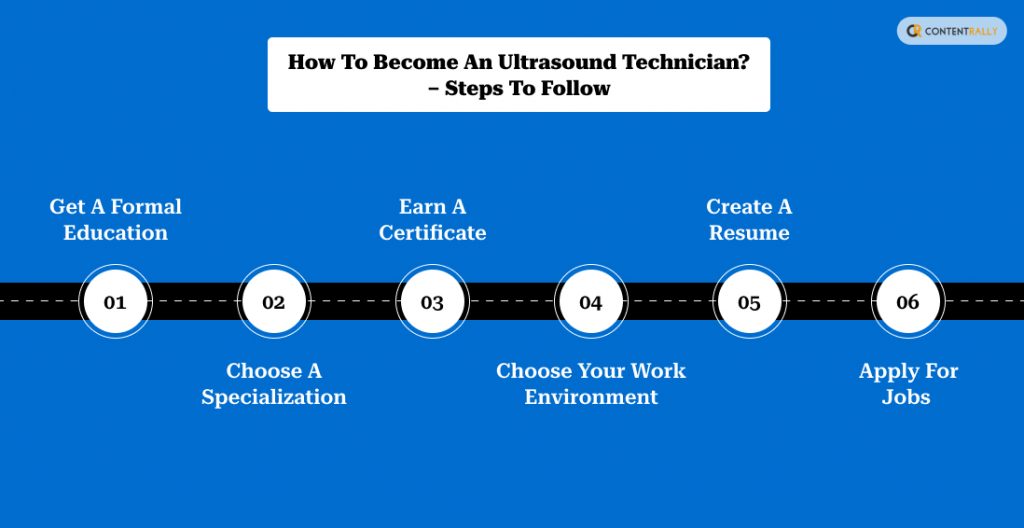
How To Become An Ultrasound Technician? – Steps To Follow 
How To Become An Ultrasound Technician? – Steps To Follow 

You will need approximately two years to become an ultrasound technician. In some cases, you might require a year more.

The following are some steps you must follow to become an ultrasound technician: 

1. Get A Formal Education 

If you want to become an ultrasound technician, you must receive a degree in the healthcare field. Although it is compulsory to have a degree in medicine, doing so will give you an advantage. Apart from that, you can also consider getting a degree in biology, health sciences, anatomy, and chemistry. 

For instance, you can choose to pursue a diagnostic medical imaging course that focuses strongly on sonography. On the other hand, you can also consider pursuing a bachelor’s degree or an associate degree. 

2. Choose A Specialization 

The healthcare sector is vast, and there are various fields in the sector. Hence, you must choose your specialty beforehand.

For instance, you can choose parental health or other specializations like cardiovascular field, abdominal, breast, neuro, gynecologic, and more. You will get an overview of major specializations in the next section of the article. 

Basically, you can specialize in more than one area. After you determine which specialty you prefer more, you can focus on earning proper certifications. 

3. Earn A Certificate 

To become an ultrasound technician, you have to earn technical certification after you complete your specialization. Generally, there are three recommended ways to complete your certification: 

  • American Registry for Diagnostic Medical Sonography (ARDMS
  • Cardiovascular Credentialing International (CCI
  • American Registry of Radiologic Technologists (ARRT

Here, you must choose one of these three since each of them has its own program and course. Any one of these programs will prepare you for a career in sonography.

Moreover, each program has its own requirements and timeline. Also, you need at least a year to complete your certification. 

4. Choose Your Work Environment 

Once you start working as an ultrasound technician, you will have enough opportunity to choose your work environment. For instance, you can work in a hospital setting, continue your private practice, or work in a medical laboratory.  

Therefore, when you are looking for career opportunities, you can search based on the environment where you prefer to work. 

5. Create A Resume 

After you choose your work environment, you must research your potential employers. Then, you need to choose your work settings and job openings. Once you do that, you must begin working on your resume. Here, you must consider getting some resume tips from a professional. 

Here are the factors you must consider when you are building your resume: 

📝Formal Education 

Here, you must include the name of your school, the degree, and the dates. However, do not include dates if you have graduated more than three years ago. Moreover, you can include details about your experiences with professional organizations and other leadership opportunities. 

📝Professional Experience 

In this section, you must describe your previous roles and responsibilities. However, if you have just finished school, include positions irrelevant to the healthcare field. Also, consider listing any relevant internship experience or coursework in a similar field. 

📝Skills 

In the skills section of your resume, highlight your personal and technical abilities. Moreover, to work as an ultrasound technician, here are some professional skills you must mention: 

  • Communication skills 
  • Organizational skills 
  • Attention to detail. 

Apart from these skills, list down your skills in sonography and your knowledge of dealing with machines. 

📝Certifications 

Include relevant certifications and their dates. This will show that you have field knowledge and the professional drive that potential employers are looking for. Moreover, some positions might also require you to have certain certifications. 

6. Apply For Jobs 

Once you complete your resume, you can apply for jobs in sectors that appeal to you. However, when you are applying for a certain position, make sure to align your resume and cover letter based on the position you are applying for. 

Apart from that, you can also consider building a network in the healthcare field. Thereby, you can get insights into hospitals, medical clinics, and healthcare organizations. As a result, you will have more information about openings. 

How to Become an Ultrasound Technician? – Major Specializations 

How to Become an Ultrasound Technician? - Major Specializations 

An ultrasound technician has exposure to four different sonography specializations. Also, each specialization has multiple sub-specializations.

The following are the major specializations you can choose from: 

A. General Sonography 

Here, you must know how to image internal organs, like liver, brain, kidneys, etc. The following are the subspecializations in this field: 

  • Neurosonology 
  • Obstetric and gynecology sonography 
  • Abdominal sonography 
  • Breast sonography 

B. Cardiac Sonography 

In cardiac sonography, you must specialize in taking images of the heart using echocardiography. The following are some of the major sub-specializations: 

  • Pediatric echocardiography 
  • Adult echocardiography 
  • Fetal echocardiography 

C. Vascular Sonography 

Here, you must become a specialist in taking images of veins and arteries. Basically, the goal is to look at the flow of blood and the status of blood vessels. 

  • Peripheral vascular sonography 
  • Carotid sonography 
  • Abdominal vascular sonography 

D. Musculoskeletal Sonography 

In this case, you need to be a specialist in getting images of muscles, tendons, joints, and ligaments.

Here are some sub-specializations you must consider: 

  • Soft tissue sonography 
  • Tendon and ligament sonography 
  • Joint sonography 

Pursue A Career In Sonography Now

Hence, you know how to become an ultrasound technician. First, you need to get a formal education in the healthcare field and then work on your specialization. After you specialize, you must get a professional certification. Consequently, you can apply for jobs as an ultrasound technician or a medical sonographer

Do you have more suggestions on how to become an ultrasound technician? Please share your ideas and opinions in the comments section below. 

Read Also:

A passionate writer and an avid reader, Soumava is academically inclined and loves writing on topics requiring deep research. Having 3+ years of experience, Soumava also loves writing blogs in other domains, including digital marketing, business, technology, travel, and sports.

View all posts

Leave a Reply

Your email address will not be published. Required fields are marked *

Related

Improve Your Resume

How to Get Noticed in Marketing: Improve Your Resume With These Tips

How many jobs have you applied for in the last few weeks — one, ten, or 110? And how many have responded to your emails — zero? Sending off online applications can feel like you’re throwing hard work into a dark, abysmal black hole. Marketing is a competitive field, and you're up against hundreds of others in the industry. How can you tell if the marketing managers see your applications? There's no way of confirming. You could try following up, but these people are busy, they may not have the time to email every applicant. While it’s stressful and time-consuming to apply for job after job, there are ways to make sure your application stands out from the others. Marketing and hiring managers look for specific qualities in resumes. Read on to discover what those qualities are and how to incorporate them into your resume. 1. Provide Online Samples of Your Work: If you say that you’re an excellent copywriter, prove it! Provide tangible evidence of your work so hiring managers can quickly get a sense of your style and skill level. Your best bet is to create a personal website where people can easily look through your portfolio, but if you currently don’t have one, provide a link to live samples instead. Include the link within the body of the resume, at the top, with the rest of your contact information. 2. Keep It Simple: When it comes to submitting applications, make sure that your marketing cover letter is as professional and personalized as possible. If you do not know how you should write one, it is best to take help from experts that can help you craft the most successful marketing cover letters. Hiring managers like nothing more than receiving a one-page resume to review. Anything longer can become tiring, and there's a high chance they won't even look beyond the first page. If you can't fit everything into the first page of a resume, there's too much unnecessary information. Marketing professionals want to see: Your Name and Contact Info Educational Credentials Previous Work Experience Relevant Skills You can briefly outline your roles and responsibilities at each former job, but the bulk of this will go in your cover letter. And, even better — during the interview. One sentence or two for each job you’ve had is all you need to include in the resume. The point is to show a future employer that you’re capable of condensing information and convey the necessary skills and experience for the position in question. There's no need to write a novel about each role you've had. 3. Custom Design: Show hiring managers what you’re made of and custom-design your resume. Are you a graphic designer? Create a unique template that only you could design. Get creative with the presentation. For example, promote yourself by turning your resume into an advertisement in the style of the company. Managers will notice this and want to learn more about you. 4. Work With a Recruitment Agency: To save yourself the pain of sending what feels like 100 resumes to hiring managers, work with a professional marketing recruitment agency. There are so many benefits of working with marketing recruiters — from getting one-on-one advice about resumes and cover letters to getting an insider’s look into marketing positions you didn’t even know existed. A recruiter will tailor your resume and help you find the job that you deserve. With a little help and a lot of patience, you’ll land that dream job in no time. Read Also: Tips on Building Your Resume for a Website Design Company How to Write an Effective Resume that Get Noticed? Cover Letter Sample to get a Resume

READ MOREDetails
no career interests me

“No Career Interests Me” – What To Do?

Finding a suitable job if no career interests me can be a little challenging if you’re not sure where to start. It is because sometimes, we don’t get what we deserve and what we get, we aren’t happy.  Choosing a career is very challenging for you because you may not know which career can change your life and living standards. Although, there are various types of career paths available for you that can interest you.  Building a career is the most difficult time of life and one finally has to decide a way that satisfies you in the long run. Besides, it is obvious that nothing can interest you because you may be looking for something that can improve your knowledge and lifestyle at the same time.  Things To Do When You Feel - ‘No Career Interests Me’ If a person fails to develop an interest in anything, then it is sure that it is not his/her weakness, but he/she might be lacking behind to find their inner self.  Besides, selecting the right career path can be a daunting task for many individuals. But, there’s no need to worry at all! We have grabbed top things to do when you feel that no career path interests me.  1. Identify Your Strengths Identifying your strengths can help you to know what are your plus points. Your strengths can give you a list of possible career ideas that you can use as inspiration in your job search.  To know about career options that would be appealing to you, you should check out career transition classes in dubai. They will be able to help you find opportunities that would be perfect for you. For example, if you are good at cooking, then you must look for jobs in the restaurant industry. Besides, if you like teaching, then you can consider jobs in the teaching industry.  2. Consider Your Hobbies Your hobbies and interests can help you turn a fruitful and engaging career path. For example, if you like playing football or cricket, then you consider becoming a cricketer or a footballer in the future. Convert your passion into profit. It’s time to think about your favorite pastime as a starting point in your career search.  3. Take A Break If you feel that no jobs are interesting to you, then I think it’s time to take a break. Instead, spend some time with yourself and figure out your personality. Here, I mean your strengths and weaknesses.  If you are not focused on finding a career path, then you may be more likely to find interesting tasks and activities that you enjoy in your daily life.  4. Talk To A Friend Your friends can help you to identify your strengths that can be useful in the workplace. They can also figure out the unknown interests that can help you in the long run.  Thus, talking to a friend is very important because they can help you to achieve your objectives in life.  5. Prioritize Yourself Another thing to do is to prioritize yourself when no job is suitable for you. Never do things that make you sad or disheartened.  Remind yourself about your goals and objectives and the things that you are willing to achieve in the future. In short, notice what energizes you and the activities that make you feel better.  6. Make A List of pros And Cons Once you have started to identify the right career path for yourself, you can make a list of all pros and cons to narrow your interests.  Organizing and writing the ideas can help you think in a creative way. Thus, this is one of the ways how you can know yourself deeply if no career is interesting to you.  Top Career Paths That You May Interests You To make things easy for you, we have listed the best career paths that may interest you in the long run.  Finance Consumer Services Career Path Clothing/Shoe/Accessory Stores Career Path Packaged Foods Career Path Electric Utilities Central Career Path  Business Services Career Path Hotels/Resorts Career Path Other Consumer Services Career Path Public Utility Career Path Energy Career Path Basic Industries Career Path Precious Metals Career Path  Oil & Gas Production Career Path Capital Goods Career Path Consumer Durables Career Path Industrial Machinery Components Career Path Technology Career Path Metal Fabrications Career Path Investment Managers Career Path Commercial Banks Career Path Major Pharmaceuticals Career Path Home Furnishings Career Path Homebuilding Career Path Telecommunication Career Path Quality Assurance Career Path Major Banks Career Path Photography Career Path Auto Parts O.E.M Career Path Steel/Iron Ore Career Path Medical/Dental Instruments Career Path Consumer Non-durables Career Path The Final Thoughts What to do if no career interests me? The answer to this question is already described above and now it’s time to identify your skills and abilities to achieve your future goals. Besides, let me know your doubts in the comment section below if you have any regarding the same. Read Also: Top 32 Good Career Paths That Pay Well – 2022 Updated

READ MOREDetails
Medical Field

Top 7 Reasons the Medical Field Will Always Be In Demand

Humans have always had to face illness, from the dawn of civilization onward to today. We’ve faced plague, chronic illness, sudden disease, injury, and more at the hands of other humans and natural processes. The unfortunate reality for us is that our mortality also means facing some of life’s most difficult challenges, and facing sickness is something none of us want to do. The healthcare field exists to help with those illnesses, providing treatment, recovery, and support. Why will the medical field always be in demand?  1. Unfortunately, Sickness Will Always Be A Reality: Some of the oldest diseases to plague mankind date back to about 8,000 B.C.E., long before humans ever stepped foot on the moon or discovered antibiotics. As long as there have been microbes and animals for them to attach to, there has been illness. The unfortunate truth for us is that illness and disease will always be a part of human life, short of a sci-fi-esque superpower that prevents all illnesses. Where there is an illness, there needs to be care—and our healthcare providers are there to provide it. There will always be jobs in the field. Even during economic downturns, people still get sick. New jobs open up as technology advances and healthcare techniques evolve. Even as things like AI and machine learning come into play, you simply can’t replace the people that operate on the frontlines of our healthcare industry, providing more than just care and medical knowledge to patients. 2. It Takes A Certain Kind Of Person To Do Specific Jobs In The Field: The truth about working in healthcare is that it’s simply not for everyone. Some jobs involve long hours, stressful environments, and can even expose you to potentially harmful conditions. Let’s take our frontline workers during the pandemic, for example. We’ve all seen the pictures on social media and in the news of healthcare workers with marks on their faces from wearing masks for hours on end, their tired eyes looking at us mournfully to please follow COVID guidelines. Working in such an environment isn’t everyone’s cup of tea. It takes a certain kind of compassion and empathy to put yourself at risk to help others. That’s not to say there’s anything wrong with not wanting to do that—it’s just not something that everyone can be happy about doing on a daily basis. This does create a certain demand, however. Since not just anyone can jump into scrubs and work a 12-hour shift in a hospital, there are often openings in the field. Not every job will require such dedication and personal risk, but you get the point. 3. The Industry Is Always Growing And Changing: As we learn to better understand the human body, disease, and illness, the healthcare industry evolves and changes. We’ve come a long way from the Greek theory of four humors, but that doesn’t mean we know everything, or will ever know everything. What it does mean is that there will always be new kinds of jobs added to the healthcare field as new technology and methods emerge. Even as AI becomes more prevalent in a number of industries, something like healthcare needs people. AI simply can’t match the caring, compassionate nature of an actual person providing care to someone who’s sick. It can’t console a family when their loved one is diagnosed with cancer. It can’t hold their hand while they undergo a serious operation. The bottom line is that the industry will always change and evolve, adding new jobs and techniques, but it will always need people. People are the core of the healthcare industry. 4. Training Is Becoming More Streamlined: The industry becomes more and more competitive as training programs become more streamlined. Now, you can complete training for certain positions entirely online. This leaves more flexibility and inclusivity in the industry, but can also mean more competition. You can obtain a medical billing and coding certification online in just under a year, setting you up to enter the field very quickly. But remember that others are also taking that path, potentially blocking you from your career if you’re not doing something that helps you stand out. 5. Not Every Job Requires A Degree: When you think of healthcare, you automatically think of doctors and nurses in scrubs and white lab coats, but the truth is, there are thousands of healthcare jobs out there, and many don’t require a degree. You can become a medical biller/coder/pharmacy tech or even a dental assistant without a degree. You’ll need to get certified and complete a training program, but you won’t be in a college setting for years on end, and you won’t be thousands in debt at the end of the program. A course in Basic Life Support (BLS) can be attended online, providing you with a legitimate certificate afterward. 6. We’re Unhealthy: The truth is that the United States is not a healthy nation. Heart disease is still the number one killer of adults in the US and in many parts of the world, and things like smoking, poor eating habits, and lethargic lifestyles contribute to this pandemic. We don’t eat well, many of us don’t get enough exercise, and we practice poor stress management habits; all of which contribute to poor public health. We like to think we’re number one at a lot of things, but the sad fact is that we only fall at about 35 on the world scale when it comes to health and healthcare. 35th place is far from being a winner. 7. The Pandemic Has Shown Us Its Shortcomings: If there’s any sort of “silver lining” in the COVID-19 pandemic of 2020, it’s that the sudden onslaught of the disease has brought into sharp focus the glaring problems that exist in our current healthcare system. The bottom line? We don’t have the right infrastructure, enough dedicated people, or a good insurance system to care for our citizens. We need people who are compassionate and willing to put themselves at personal risk for others, and that’s rare enough nowadays. Read Also: Ensuring Quality Healthcare with Correct Diagnoses Seeking a Healthy Career: 10 Tempting Medical Careers to Check Out

READ MOREDetails