












How to Use Iron Clothes With Steam

Published on: 15 June 2020 Last Updated on: 12 September 2024
Iron Clothes

Believe it or not, the amount of people that don’t know how to iron clothes is amazing. There’s no shame on it since most of us were thrown into society without really practicing skills that would definitely help us fight back as we become independent.

These skills include things like cooking a proper meal before going to work, knowing what groceries to buy without spending all our money on unnecessary things, being able to pay bills accordingly without becoming a mess, cleaning the house every now and then, and of course, knowing how to use steam irons and what to do to properly iron our clothes to not look like folded toilet paper.

Don’t worry though! In this guide, I’m going to teach you the essentials of how to iron, and how to deal with different types of fabric.

To be honest, ironing is not something as complicated as many think. It’s all about knowing what to do, which is what most people lack. The process may require a little preparation and patience, though, so be prepared to practice with different pieces of clothing to get the main idea.

One thing is sure, though. You have to be careful when using an iron because they can be harmful if dealt with without precautions!

How to Prepare for It

The first thing you’ll need is a flat surface where you can prepare your clothes to be ironed. Try to have everything neatly organized to avoid possible accidents, and if you can, try to do it on an ironing board.

Some clothing is too delicate for the heat produced by the heated metal of the device, so have a piece of fabric to protect these.

Read more: A Complete Guide on Using IRON on Transfer Paper

Connect the Iron

Irons can take some time before they are ready to be used. They usually show a sign that they are ready, so be sure to be attentive about them while you take care of the next step. Never try to do it before its ready, since it’ll lead to a slower and far less efficient process.

Know the Differences Between Materials, and Sort Them Beforehand
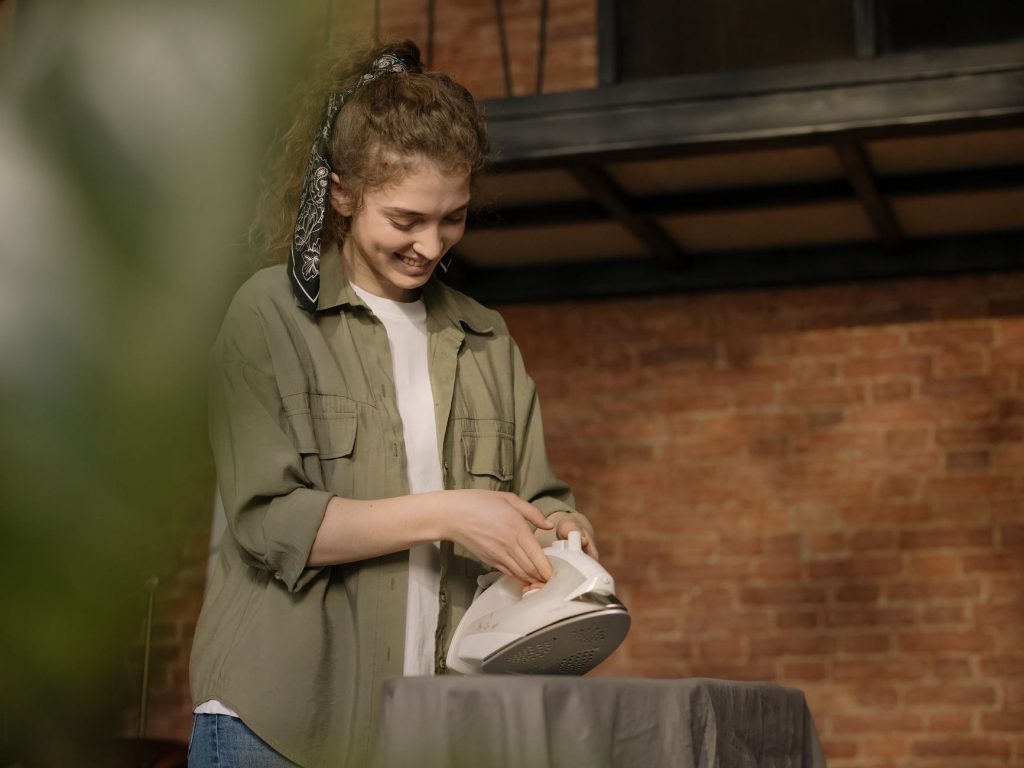
ironing

Depending on the type of fabric you are dealing with, you might want to change your approach while ironing. You can’t deal with a silk piece the same way you would deal with a cotton one, for example. Some pieces of clothing will require you to use the lowest setting of heat possible, while others may require even more heat.

Separate silk, wool, rayon, and acetate to be dealt with the lowest settings. Wool clothes may require the protection of another piece of fabric that was previously dampened, so take that in mind! For polyester, go with the medium heat setting, and for cotton, you can go either medium and high heat setting. Both of them should be dampened to be protected from the heat.

Before the iron is ready to go, you should have them sorted out.

How to Iron Clothes

When you deal with shirts with a collar, you should start with it. You can start with a pattern that follows the inside part of the collar, starting from the center of it, until you reach the edges. Then, fall back to the center, and keep moving between both sides.

Once you’ve finished with it, you can work the outside. Lay down the shirt in a way that you can flatten it with the iron with simple movements. After that, you have to work your way down, slowly moving the shirt. Then, work the sleeves then the cuffs.

Pants are much easier than shirts with a collar. You just have yo lay them down in a way that you can work both legs at the same time. Start with the waist, gently work with the pockets, and go your way down. Repeat the process until you are satisfied with the results, but make sure to be gentle and careful with the heat and the ironing.

Considering that there are way too many types of clothing to teach all of the proper methods and techniques to iron them accordingly, you should check this guide on how to do it without fail.

Safety Recommendations

Ironing can be a pretty dangerous process if you are not attentive while you do it. If you don’t take safety measures, you might harm yourself or others, so make sure to pay attention to this part of the guide.

The very first thing you should always make sure is that the iron is unreachable for children. Children can be curious and do things without knowing, so you will be the one to blame if you allow them to get closer while they are heated up.

This is important even after you’ve finished ironing. These devices tend to remain heated up even after disconnecting them, so you should still be attentive to any possible situation. I recommend you to wait at least 10 minutes before taking your guard off. Remember to check just in case. While it rests, don’t leave it face down. You might burn something or damage the iron if you do.

If an accident happens and you burn yourself or someone else gets burned, treat the burn with cool water for as much time as you can. 20 minutes should be more than enough. Don’t use things like butter or oil, since it might infect the injury. if the burn is too big, you should check yourself with a doctor.

Read Also:
Content Rally wrapped around an online publication where you can publish your own intellectuals. It is a publishing platform designed to make great stories by content creators. This is your era, your place to be online. So come forward share your views, thoughts and ideas via Content Rally.

View all posts

Leave a Reply

Your email address will not be published. Required fields are marked *

Related

Package Units

Here’s What Makes Package Units Better than the Other ACs

Package ACs are generally used as an all-in-one HVAC system for spaces like homes, industrial sites, warehouses, and events that do not have enough space for a furnace or an air handler. They are available at fixed-rate capacities. Some package unit has a rating capacity of 3, 5, or 7 and highly rated ones like 10 or 15 tons. Though they are commonly used in homes and small spaces, package units are also suitable for restaurants, telephone exchanges, and bigger venues. As the name suggests, all vital components found in a heating and cooling system are located in a single casing. All the crucial fixings, including the compressor, air handlers, cooling coil, and air filters, are housed in the unit, providing both heating and cooling capacities. Here’s What Makes a Package Unit Different from Other ACs One of the distinguishing features of a packaged air conditioner unit is the casing which is found on the outside of a house or building. The cabinet is directly connected to the existing ventilation system which circulates the chemical refrigerant inside. This setup is different from typical air conditioners of most homes in the country where the coils are located in a separate unit and connected through the refrigerant line. Split-type ACs have their evaporator coils indoors while the condenser coils are found outside of the structure. And because the unit is located outside the premise of a building, package units primarily act as space savers. They also offer the versatility of installation, especially for homes and buildings with limited backyard spaces. Package ACs can also be set up on the roof in the absence of suitable yard space. Why Should You Opt for a Packaged HVAC Unit? There are specific considerations when opting for package units rather than other cooling and heating alternatives. For one, a packaged AC offers convenient maintenance because all components are found in a single place. A technician only visits a single spot and services everything from there. Packaged air conditioners also emit a significantly lower indoor noise compared to a split-type AC and other alternatives. A well-maintained unit will not make enough noise to disturb your family; thus, providing your family the tranquility and comforts of ideal living space. Additionally, packaged air conditioners do not only provide sufficient cooling for small spaces, but they are also outfitted with heating coils. The combination of both an air conditioner and a central heating system removes the need for an additional indoor furnace. Different Types of Packaged Units There are several package units available in the market, and each has its advantages and flaws. As such, selecting the ideal AC unit has to go along with the area you live to avoid any inconvenience. Package AC A package unit has the air conditioner and air handler housed in a single casing. They can also be outfitted with heating capacities, so adding heating strips would provide you both with a cooling and heating system. Gas and Electric Package Systems This type of HVAC system runs on gas and combines the functions of an air conditioner and a gas furnace. This option is ideal for homeowners who do not have an existing heater. Dual-Fuel Systems If you live in an area where temperatures drop below negative three degrees, a dual-fuel system is the best HVAC system to install. It can turn your gas furnace on when the temperature drops the ideal warmth, helping you save on your utility bill. Talk with a professional to help you decide on the ideal AC unit to outfit your home or warehouse.  There are various types of package units with different capacities to outfit your space and give you the right warmth or cooling you need. Featured image Read Also: Here Are Some Things That You Should Know When You Use Storage Units Winter is Going! A Monthly Home Maintenance Checklist to Get You Ready for Spring 10 Amazing Air Conditioner to Try Right Now

READ MOREDetails
Organized After A Move

Tips To Unpack, Stay Organized After A Move

So you have finally moved into the house of your dreams. What next? Once your belongings are unloaded, you must figure out how to get organized after a move. This includes unpacking and organizing all of that stuff! Of course, this whole process can be a little too overwhelming. But Austin maid service has some organizing tips that might come in handy. Tips for Organizing a Move Before moving in, make sure the new home is completely spruced up to welcome its new members. This includes wiping down shelves, countertops, cabinets, and floors. The bathroom and kitchen should be completely clean and smell good. Once you have stepped into your new home, it’s time to unbox the essentials first. Forget everything else and unpack the essentials box that carries important stuff that you cannot do without. Little steps first Of course, you want to organize your new home right away. After all, it is your dream house and you wish to start enjoying your stay quickly. But it can be quite messy initially. If you try to start by organizing all rooms together, you may end up making no significant progress at the end of the day. So what next? Well, you must start with one room first and unpack your stuff accordingly. For a family of small kids, you may start with unpacking the nursery. Try to maintain a sense of normalcy so kids do not find moving overwhelming. Setup their rooms first and you can easily create a safe haven for them, where they can play and rest while you organize the rest of the space. After the kid’s room, you can start with the kitchen and your bedroom. Other rooms can still wait. Give rooms a purpose In order to stay organized after a move, the next step is to plan how to store your belongings. In this regard, you can assign different purposes for each room, including the pantry, basement, garage, hallway, and bathroom. Now start unpacking things and assign everything a new home. Start with larger items Bulky stuff takes up a lot of space. So start with arranging larger items. You do not want to hit a bed or dressing table every now and trip and fall. Move dining tables, beds, dressers, and solid pieces of furniture to their respective rooms. This should clear up space and make you feel a little relaxed. It’s absolutely fine to delay organizing the smaller stuff. Take some rest and then unpack smaller items, including books, clothes, utensils, and accessories. Install all larger kitchen appliances first. This includes the fridge, dishwasher, stove, food processor, washer, and dryer. Tackle the kitchen When looking for tips to organize home after a move, your priority should be to unpack the kitchen stuff. What is the most essential cookware? What else is most commonly used in the kitchen? You want to organize the essentials first. Organize those in easily accessible drawers. This includes pots and pans, coffee mugs, cereal bowls, and plates. Keep all dishwashing soaps and sponges handy. Do not forget the kitchen cleaning supplies as well. Unpack remaining rooms Once your most important rooms are in order, it’s time to organize the remaining space. Tackle one room at a time and then move to the next. It is a good idea to keep the task of organizing storage areas for last. Since home organizing after the move is a huge task that may take days, this will ensure you have a clean uncluttered space for dining and resting. The storage space can still wait. Don’t forget the entryway Organize this space once you are done with the cleaning aspect of all major rooms. If you continue to ignore this area, it might turn into a complete mess with a pile of stuff that you have been delaying organizing. So when you wish to get organized after a move, place a small basket by the door. This should collect all of the mail that reaches your new home. Bring some hooks to organize items that can be easily lost. This includes keys and dog leashes.  When installing hooks at the entryway, keep a few points for coats, jackets, and umbrellas. You don’t want this type of stuff to crowd your chairs and sofas. Place a shoe rack at the entryway. You do not want any viruses to enter your new abode with shoes, right? In these coronavirus times, it becomes even more important to drop your shoes at the door. Place a rug or mat at the entryway to avoid bringing dirt, snow, and slush into your abode. These tips for organizing after a move can make life a little easier for you and your family. You can always rely on dependable professional services for the job if the task seems a little overwhelming. Read Also: 10 Steps to Move in Your New House Moving home checklist: What you need to know Factors To Consider While Preparing For A Move

READ MOREDetails
Modern Flooring Designs

Ideas for Modern Flooring Designs for Home Improvement Plans

It is essential to make the right decisions when coming up with the design for a modern home. On the other hand, it is easy to transform old houses by the type of floor you decide to use. Most people will probably overlook it when planning for their house. The main reason is that homeowners do not know what they can choose for their homes. However, herringbone flooring can alter the floor's architectural design in your house to make them adaptable to your lifestyle. There are various types of materials that a person considers for flooring in buildings. The suitability of each option changes according to the room needs. For example, spaces where people visit a lot, like corridors and living rooms, can have wooden floors as they are resistant to wear. The bedrooms can differ from the rest of the house by using cozy materials for flooring. Ideas for Modern Flooring Designs The design of floors will mostly depend on the appearance that a homeowner wants. It will also depend on the budget for the home improvement plan. Here are some popular types of flooring systems; Wood Modern houses will utilize wooden floors for main rooms. It is an ancient technique that does not go out of style and remains a choice for many. Hardwood floors are durable and stylish. The raw material comes from indigenous trees like oak, maple, and walnut. Maintaining wooden floors is easy as you need to dust the spaces and use a recommended wood cleaner. Avoid exposing the floor to water as it can destroy the material if left wet. However, other artificial ones incorporate acrylic in making the floor resistant to water and moisture. Tiles Ceramic tiles are standard features in houses. It is a versatile material that is available in different colors to suit other preferences. There are different kinds of tiles, and it is crucial to ensure you purchase one to use on floors and not walls. The material is easy to clean and maintain. However,  it makes the house cold compared to other forms of flooring systems. Laundry spaces and the bathroom are ideal rooms for tiling. While there are many brands that you can choose form, few will be able to give you the quality, style, durability, and affordability as Zia’s ceramic tile collection. They have options to suit everyone’s budgets. Depending upon the wall color and the décor of the room, you can mix and match the tiles. Concrete These types of floors have been existing for a long but are still adaptable to new house designs. They are ideal for contemporary houses as one can polish them to get an elegant appearance. Modern building techniques refine concrete to come up with patterns as decorations. Vinyl PVC is the raw material for the Vinyl flooring system. Walking on the floors is much more comfortable than the other forms above. It also aids in keeping the house warm, and it is resistant to the negative impact of moisture on flooring systems. Laminate It uses fiber and plywood to develop a veneer that technicians install together to form the flooring system. Laminate floors have a plastic coat that can resemble wood or concrete. Conclusion Apart from the above types of flooring techniques, there are other options available. They include the use of bamboo and cork in flooring. You can also carpet the space. Read Also: How to Protect Your Wood Flooring in a Busy Household What you must know about wood flooring? How Long Does Vinyl Flooring Last? 7 Advantages of Reflective Epoxy Flooring Use Floor Polishing for Keeping Your Flooring Looking New List of Most Durable Kitchen Flooring Hardwood Timber Flooring: Gives a Classic Look to Your Home  

READ MOREDetails