












Best Small Business Loans To Look Into In 2024– Are You Eligible For The Loan?

by

12 September 2024

Finance

Small Business Loans

Planning to investigate some small business loans? What are the best options out there?

Most importantly, how can these loan options help you?

Contrary to popular belief, it is more complex than filling out a form and getting your loan approved. That too from the very first source!

There is eligibility, which you must fulfill from your end, and criteria that the small business loan providers must ensure.

These are subjective to individuals and the business they are trying to build.

For example, which provider should you go for when you need a quick loan of a larger or smaller amount?

So, without any further ado, let’s get into the blog post

What Are Small Business Loans?

What Are Small Business Loans

What are exactly small business loans? The criteria? Is it different than other forms of business loans?

Small business loans are classified under money lending for commercial purposes Like any other business loan.

There are several reasons why you would consider lending. Do not worry if it is for operational expenses and you fall short!

Not everyone accesses such loans just for their initial business investment or to extend their business to new grounds. In fact, it is common for people to underestimate their expenditure margin when they are starting their business.

In fact, in 2020, 56% of all small business loans were to manage operational costs. While only 31% of loans were for expansion opportunities.1 

The Best Small Business Loans

Here are the best small business loans to investigate:

1. SBA 7(a) Loan
SBA 7(a) Loan
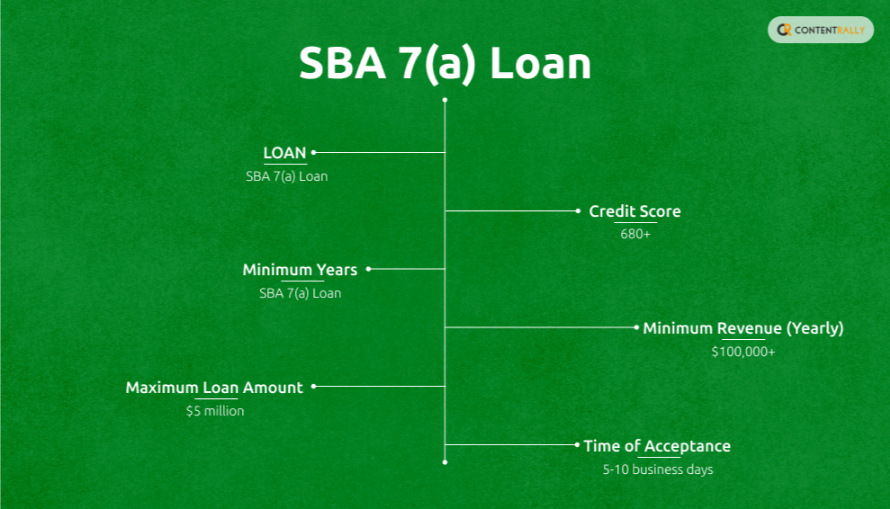
LoanCredit ScoreMinimum YearsMinimum Revenue (Yearly)Maximum Loan AmountTime of Acceptance 
SBA 7(a) Loan680+Two years$100,000+$5 million5-10 business days 

This government-backed loan program offers competitive rates and long terms for various needs.

Pros:

  • Low interest rates
  • Long repayment terms

Cons:

  • Lengthy application process
  • Strict qualification criteria

2. Kabbage Business Line Of Credit
Kabbage Business Line of Credit
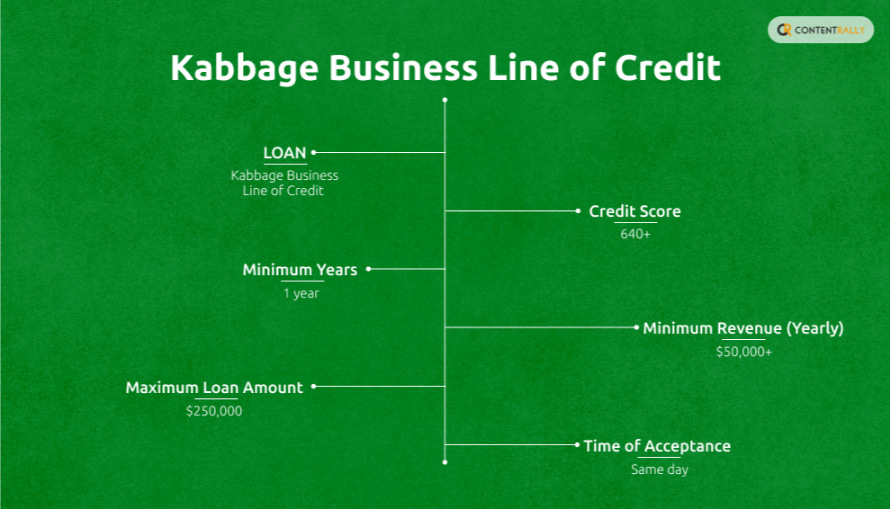
LoanCredit ScoreMinimum YearsMinimum Revenue (Yearly)Maximum Loan AmountTime of Acceptance
Kabbage Business Line of Credit640+1 year$50,000+$250,000 Same day 

This is a revolving line of credit with a quick application process for managing cash flow.

Pros:

  • Fast funding
  • Flexible access to funds

Cons:

  • High APR     
  • Limited revolving credit line (although that is how they advertise).

3. OnDeck Term Loan

OnDeck Term Loan
LoanCredit ScoreMinimum YearsMinimum Revenue (Yearly)Maximum Loan AmountTime of Acceptance
OnDeck Term Loan600+1 year$100,000+$250,000 24 hours 

This loan offers short-term loans with quick approval, which is ideal for fast access to capital.

Pros

  • Fast Funding
  • Discounts for repeat customers

Cons

  • High interest rates
  • Frequent repayments

4. BlueVine Business Line Of Credit
BlueVine Business Line of Credit
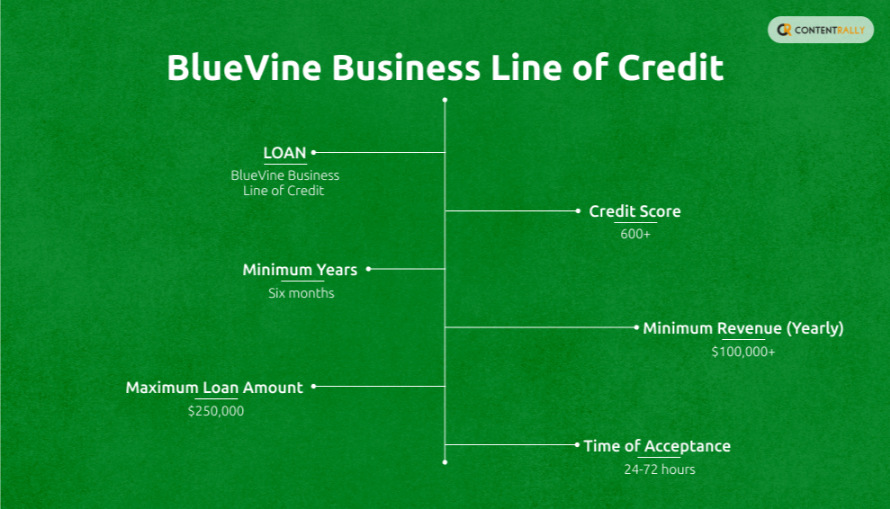
LoanCredit ScoreMinimum YearsMinimum Revenue (Yearly)Maximum Loan AmountTime of Acceptance
BlueVine Business Line of Credit600+Six months$100,000+$250,000 24-72 hours 

Flexible line of credit with fast approval, useful for managing cash flow.

Pros

  • Quick funding
  • No early repayment fees.

Cons

  • Higher rates for lower credit scores.
  • Limited to revolving credit.

5. Fundbox Line Of Credit
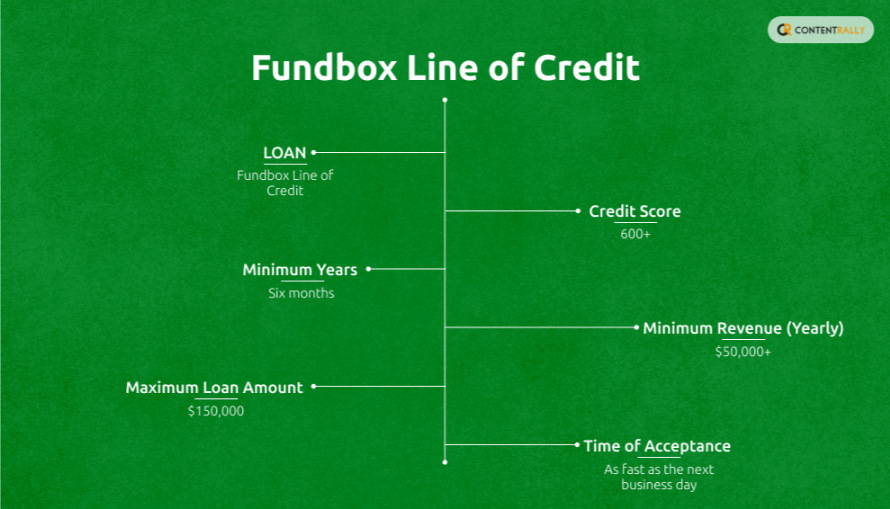
Fundbox Line of Credit
LoanCredit ScoreMinimum YearsMinimum Revenue (Yearly)Maximum Loan AmountTime of Acceptance
Fundbox Line of Credit600+Six months$50,000+$150,000 As fast as the next business day

It provides a simple, quick line of credit ideal for immediate cash flow needs.

Pros

  • Easy qualification
  • Quick access to funds

Cons

  • Lower Loan Amounts
  • Shorter Repayment terms

6. Lendio Loan Marketplace

Lendio Loan Marketplace
LoanCredit ScoreMinimum YearsMinimum Revenue (Yearly)Maximum Loan AmountTime of Acceptance
Lendio Loan Marketplace550+Six months$50,000+$5 million On the loan amount 

This type of loan is a great help to small business owners. Rather than just one loan, this is a marketplace that connects businesses with multiple lenders for various loan types.

Pros

  • Wide range of loan options.
  • Easy comparison of the offer.

Cons

  • Can receive multiple calls from lenders, which can be irritating.
  • Not all lenders have favorable terms.

7. American Express Business Loan
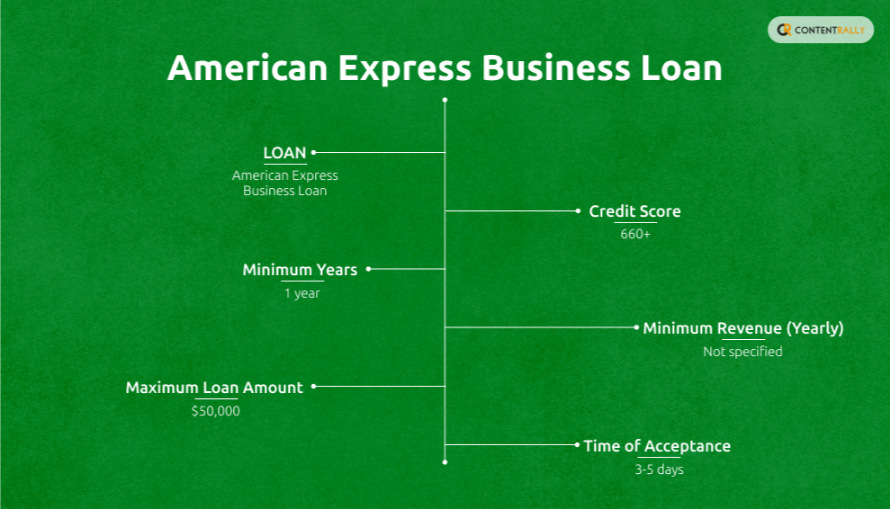
American Express Business Loan
LoanCredit ScoreMinimum YearsMinimum Revenue (Yearly)Maximum Loan AmountTime of Acceptance
American Express Business Loan660+1 yearNot specified$50,000 3-5 days 

This fixed-rate loan is available only to pre-approved American Express Business Card members.

Pros

Cons

  • Only available to pre-approved members.
  • Relatively small maximum loan amount.

Therefore, if you plan to get a small business loan in the foreseeable future, getting an American Express Business Card is better.

8. Accion Opportunity Fund

Accion Opportunity Fund
LoanCredit ScoreMinimum YearsMinimum Revenue (Yearly)Maximum Loan AmountTime of Acceptance
Accion Opportunity Fund550+1 yearNot specified$250,000 1-3 weeks 

Offers loans to underserved small business owners, including minorities and women.

Pros

  • Focus on underserved businesses.
  • Personalized support

Cons

  • Longer approval process.
  • It may have a higher interest rate.

9. Credibly Small Business Loan
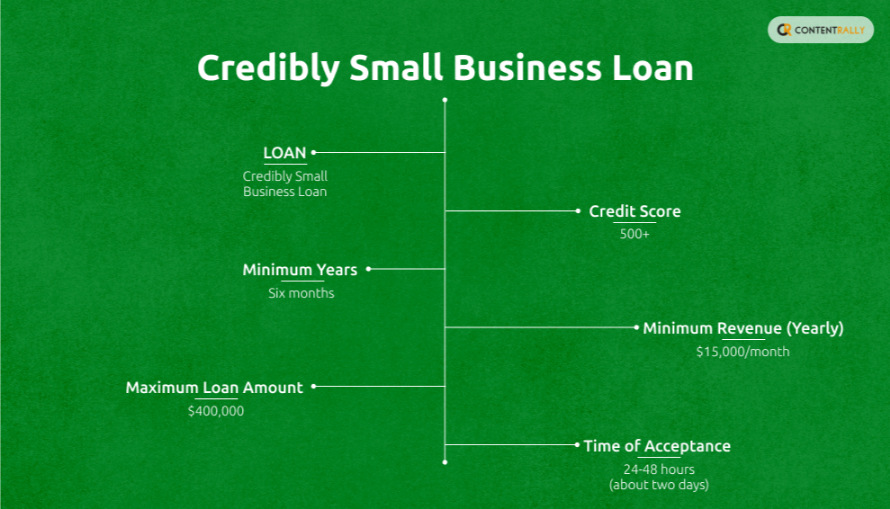
Credibly Small Business Loan
LoanCredit ScoreMinimum YearsMinimum Revenue (Yearly)Maximum Loan AmountTime of Acceptance
Credibly Small Business Loan500+Six months$15,000/month$400,000 24-48 hours (about two days) 

Provides working capital loans and merchant cash advances with flexible terms.

Pros

  • Fast funding
  • Flexible repayment options

Cons

  • Higher cost of financing.
  • Frequent repayments

Small Business Loans With Separate Criterions
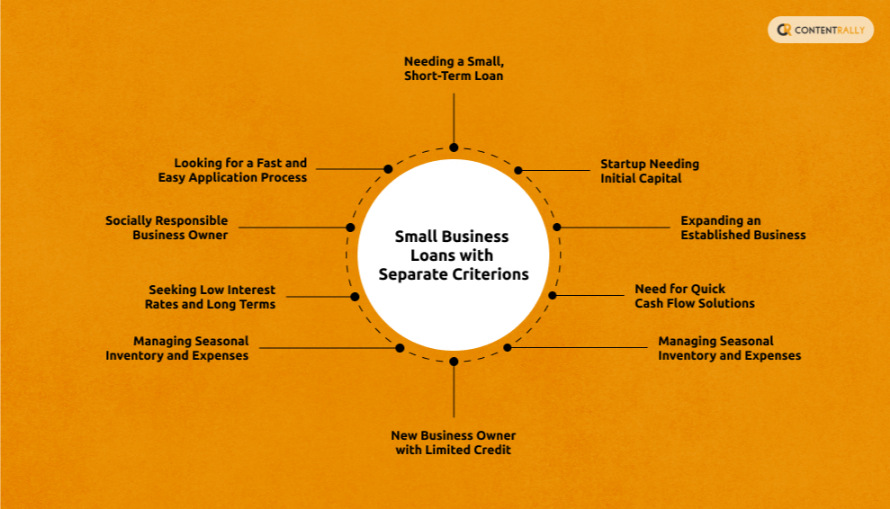
Small Business Loans With Separate Criterions

Now, we will be delving into the different criteria and which small business loan provider would be best!

1. Startup Needing Initial Capital

“I just started my business and need funds to get it. What are my options?”

Best Loan: Fundera by NerdWallet

Offers access to multiple loan options, including startup loans, even with lower credit scores and minimal business history.

2. Expanding An Established Business

“I’ve been in business for two years and want to expand. What loan should I consider?”

Best Loan: SBA 7(a) Loan

Ideal for established businesses needing significant funding for expansion, with favorable terms and interest rates.

3. Need For Quick Cash Flow Solutions

“I need quick access to cash to manage cash flow. What’s the fastest option?”

Best Loan: Kabbage Business Line of Credit

Offers quick application and approval processes, with funds available on the same day for urgent cash flow needs.

4. Managing Seasonal Inventory And Expenses

“My business is seasonal, and I need funds to purchase inventory before the busy season. What loan fits this need?”

Best Loan: OnDeck Term Loan

It provides short-term loans with quick funding, ideal for managing seasonal inventory purchases and expenses.

5. New Business Owner With Limited Credit

“I have a low credit score and a new business. Are there any loan options available for me?”

Best Loan: Credibly Small Business Loan

Accepts lower credit scores and offers working capital loans, making it accessible to newer businesses with limited credit.

6. Needing A Flexible Line Of Credit

“I want a flexible financing option. This is to cover unexpected expenses as they arise. What should I look for?”

Best Loan: BlueVine Business Line of Credit

It offers a flexible line of credit with fast approval. Plus, it is suitable for covering unexpected expenses.

7. Seeking Low Interest Rates And Long Terms

“I’m looking for a loan with low interest rates and long repayment terms. What’s the best choice?”

Best Loan: SBA 7(a) Loan

It is known for its low interest rates and long repayment terms. Therefore, it is ideal for businesses seeking cost-effective funding.

8. Socially Responsible Business Owner

“I want to support a loan provider that helps underserved communities. What are my options?”

Best Loan: Accion Opportunity Fund

Focuses on providing loans to underserved small business owners. In fact, it also includes minorities and women, with personalized support.

9. Looking For A Fast And Easy Application Process

“I need a loan. However, I don’t want to go through a long application process. Which loan is easy to apply for?”

Best Loan: Fundbox Line of Credit

Offers a simple, quick application process with funds available before the next business day.

10. Needing A Small, Short-Term Loan

“I need a small amount of money quickly for a short-term need. What’s the best option?”

Best Loan: American Express Business Loan

It provides small, fixed-rate loans with a quick approval process, which is ideal for short-term financial needs.

Related: How To Use An SBA Loan For Business Purchase

Eligibility For Small Business Loans
Eligibility For Small Business Loans

You might find the best loan provider. However, when it comes to eligibility, rejection can be common.

 Regarding personal loans, good mortgage lending (a property that you place as collateral when taking the loan) makes loan acceptance easier.

However, when it comes to business loans, the rules are a little different. The loan lender (bank or private) must closely investigate your business expenditure, cash flow, and profit margin.

If you do not have a steady personal and business credit score (unless you are building your business from scratch, in which case the rules will be different), getting your small business loan approved can be challenging.

Do not worry; this is not to scare you. However, ensure you take the time to investigate your and improve financial health.

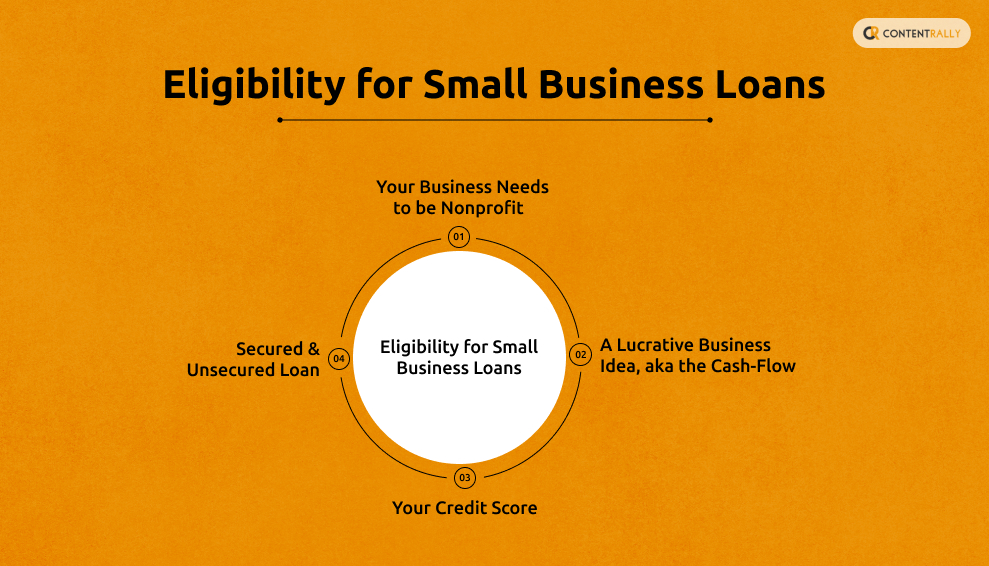
Here are some of the absolute eligibilities when it comes to small business loans.

1. Your Business Needs To Be Nonprofit

Unfortunately, you cannot have a nonprofit organization and demand a small business loan. Your business must be making some profit through a steady income.

2. A Lucrative Business Idea, Aka The Cash-Flow

Since business loans do not depend on collateral submission, lenders are mostly concerned about the business idea.

Most importantly, is there a demand for such business in the market?

Will there be enough opportunities to build a steady cash flow?

Is there any stock market share for businesses with the same ideation?

The loan they offer you will depend on the potential profit you can make from that base. Plus, it must be backed by solid data.

3. Your Credit Score

Although we have already mentioned the credit score for each loan provider, you need to be serious about your creditworthiness.

Any loan provider will scrutinize your personal and business credit score. Any suspicious activity (including something as simple as an unpaid credit card bill) can put you under the radar. Eventually, it does not make you a good candidate for a loan.

In other cases, your business credit score also plays a crucial role.

What is your total business income?

Is it holistic with your business expenditure?

What is your business credit card transaction history? Are you able to balance your bills alongside your monthly operational costs?

…and many more.

You must submit all your financial documents, especially if you are planning to expand through different business locations and real estate. How your business funds are handled becomes crucial in such a case.

Secured & Unsecured Loan

Starting a business? Want a small business loan? Then, you should understand the importance of collateral in such a business.

Most importantly, do you even need to submit collateral to get your loan sanctioned?

Secure business loans will charge you some collateral (cash money, real estate property, gold bonds, etc.).

Meanwhile, unsecured loans do not charge any collateral.

Which is better as Small Business Loans

As someone just starting a business, I know the advantages/disadvantages of both kinds of loans will depend on your criteria and loan amount.

So, let’s discuss the overall pros and cons of both!

Secured Loans
Secured Loan

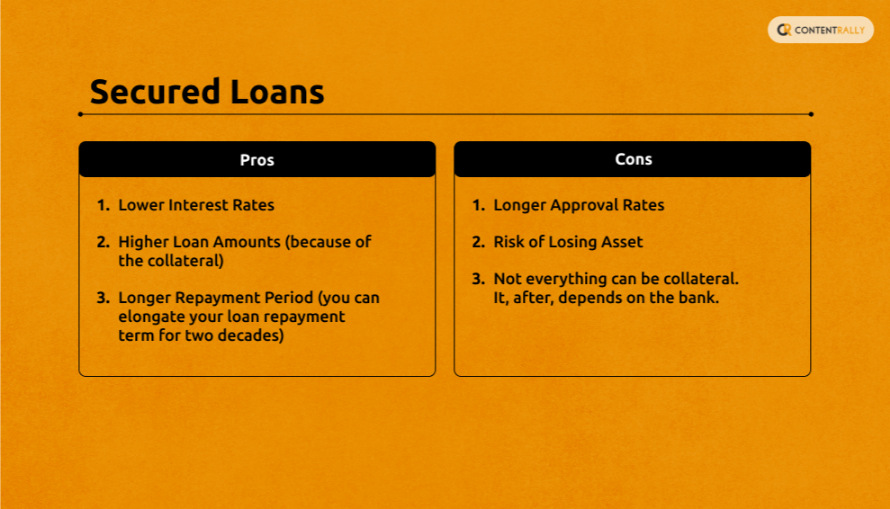
Let’s begin with the kind of loans that require collateral.

Pros Cons
Lower Interest RatesLonger Approval Rates
Higher Loan Amounts (because of the collateral)Risk of Losing Asset
Longer Repayment Period (you can elongate your loan repayment term for two decades)Not everything can be collateral. It, after, depends on the bank.
Unsecured Loans
Unsecured Loans

Now, let’s talk about loans without collateral.

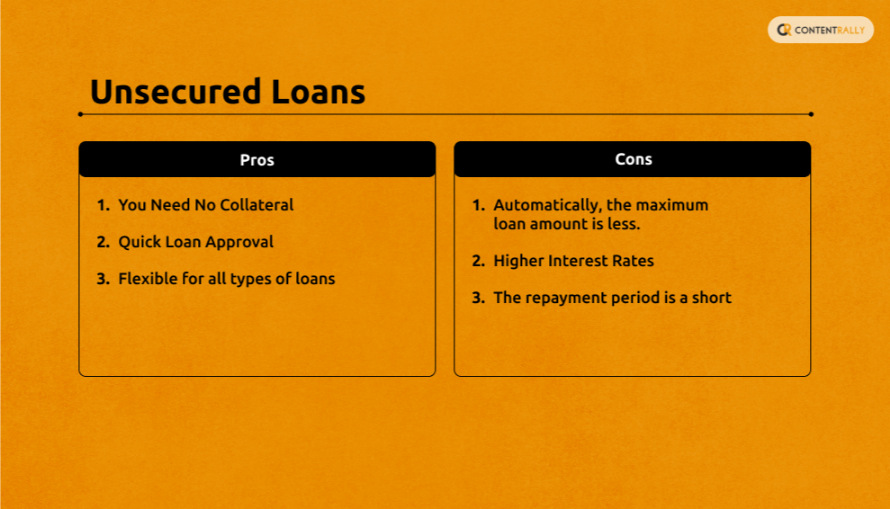
ProsCons
You Need No CollateralAutomatically, the maximum loan amount is less.
Quick Loan ApprovalHigher Interest Rates
Flexible for all types of loansThe repayment period is a short

When Should You Get What?

For the ease of your own understanding, here is when you should get what!

Secured Loans Might Be Better If
  • You need a larger loan amount.
  • Can provide valuable collateral.
  • You want lower interest rates and longer repayment terms.
  • If your business has significant assets that can be used as collateral.
Unsecured Loans Might Be Better If
  • You do not have assets to offer as collateral.
  • Need funds quickly.
  • You prefer not to risk losing business or personal assets.
  • The business needs a smaller loan amount.

You can check the listicle above for a good idea of which secure/unsecured small business loans would be better for you.

Types Of Small Business Loans

These are the types of small business loans which you should investigate:

  • Term Loans: You borrow a set amount and pay it back over time with fixed payments.
  • SBA Loans: The government backs these loans, giving you good terms for your business.
  • Business Lines of Credit: You get access to a credit line like a credit card.
  • Invoice Financing: You can get cash based on your unpaid invoices.
  • Equipment Loans: This loan helps you buy business equipment.
  • Merchant Cash Advances: You get an advance on your future credit card sales.
  • Microloans: These small loans are often given by nonprofits to help you start.
  • Commercial Real Estate Loans: Use these loans to buy or fix up your business property.
  • Personal Loans for Business: You can use your personal credit for business needs.
  • Franchise Loans: These loans help you start or grow a franchise business.

The Final Note!

The choice between a secured and an unsecured small business loan ultimately depends on your specific needs and circumstances.

a secured loan might be more suitable If you have valuable assets and prefer lower interest rates.

On the other hand, if you need quick access to funds and prefer not to put up collateral, an unsecured loan could be the better option.

Always consider the terms and conditions carefully and consult a financial advisor to make the best decision for your business.

Things to remember before you get a small business loan:

Have a solid, chalked-out plan for how you will repay it. You wouldn’t want to lose your collateral.

Do not take hasty loans because you have fulfilled a business milestone. Remember, a loan is not a temporary fix; it is a debt for years to come. Therefore, be careful before sanctioning a loan.

Finally, be candid about your financial decision. Keeping it discreet to get a quicker loan approval will only cause you trouble later.

What do you think? Should getting a small business loan come after so many considerations, or should it be a little easier?

Do let us know in the comment section below!

Read Also:

Content Rally wrapped around an online publication where you can publish your own intellectuals. It is a publishing platform designed to make great stories by content creators. This is your era, your place to be online. So come forward share your views, thoughts and ideas via Content Rally.

View all posts

Leave a Reply

Your email address will not be published. Required fields are marked *

Related

SMSF

SMSF And Lifestyle Planning: Tailoring Your Fund For Your Dream Retirement

The journey towards a fulfilling retirement is unique for everyone, and self-managed superannuation funds (SMSF Australia) are becoming a pivotal tool in achieving personalized retirement goals. This article delves into how you can align your SMSF with your individual lifestyle aspirations, ensuring that your retirement years are not just financially secure but also align with your vision of an ideal lifestyle. What Is a Self-Managed Super Fund? A self-managed super fund is a private super fund you generally manage yourself. The SMSMs are different, and they vary according to the diverse industry. When you manage your own fund, you put the money you normally would keep in retail.  What Are The Benefits Of The SMSFs The SMSFs can help you offer diverse options, including direct property, physical gold, managed portfolios, and collectibles like the artworks. Most superannuation funds allow you to invest assets like fixed interest, shares, and property via managed funds. However, we provide a range of benefits the SMSFs can offer you here. Estate Planning  With the help of the SMSFs, you have far greater flexibility when acquiring and selling investments. This particular hands-on approach can mean the market conditions can change if you can respond by adjusting the portfolio of investments. Pooling Your Super Another prime benefit you can reap with the SMSFs' help is the ability to pool your resources with three members. This increased pool may enable you to get diverse opportunities for investments, which may not be available with your SMSF.  Effective Management Of Tax With the help of the SMSF, you have far greater control over your investment decisions. It may enable you to manage the tax position. You may already know how important it is to effectively carry on with tax management. For instance, the current tax rate on the earnings from the superannuation funds is close to 15%. But there is no payable of tax within the funds as the assets wholly support an income stream like the pension. Aligning Financial Goals with Personal Aspirations Explore the critical steps to tailor your SMSF to reflect your personal aspirations, including income needs, travel dreams, healthcare considerations, and hobbies. We'll guide you through integrating these elements into a comprehensive SMSF strategy that supports your retirement vision. Identifying and Achieving Your Retirement Goals Understanding and clearly defining your retirement goals is the first step towards a satisfying retirement. In this section, we discuss how to align your SMSF with your unique retirement vision, emphasizing the need for a strategy that not only ensures financial security but also personal fulfillment. Mapping Your Ideal Retirement Lifestyle Discover how to effectively map out your ideal retirement lifestyle, considering factors like desired income, hobbies, and travel plans. We provide insights on how to adjust your SMSF investments to support these lifestyle choices, ensuring a retirement that is both financially stable and personally rewarding. Building a Robust Financial Foundation: SMSF Wealth Accumulation Strategies To achieve your retirement dreams, it's essential to build a solid financial foundation through effective SMSF wealth accumulation strategies. This section focuses on creating a strong financial base within your SMSF, exploring strategies that balance growth and security to support your long-term lifestyle goals. Tailoring Investments to Support Your Lifestyle Dreams Dive into the specifics of tailoring your SMSF investments to build a portfolio that not only grows wealth but also aligns with your lifestyle aspirations. From selecting the right asset mix to understanding market dynamics, we guide you through creating an investment strategy that supports your vision for retirement. What Is To Be Done Before Setting Up An SMSF? If you want to set up an SFSF, ensure it does a few things. Comparing The SMSFs with Other funds When accessing an SMSF or any other monetary benefit scheme, you must thoroughly compare it.  Members And Trustees  Firstly, the SMSFs possess a maximum of six members. All the members must be the trustee's directors. It also means that the members can have control and management over that of the SMSFs. But with the other super fund, there is no limit to the members. Generally, the licensed trustees are held responsible for managing the funds.  The trustees work to develop and implement the fund's investment strategy and make the investment decision. But with the other SMSFs, most allow you control over the risks.  Insurance  In the SMSFs, usually, the trustees must consider whether or not to purchase the insurance for their members. The premium of insurance may be higher than that of teh other funds for insurance. On the other hand, most insurance costs are lower. This is because the large funds get discounted premiums.  Considering the Cost, Time, And Skill Needed You need to possess teh time and also the skills so that you can manage the funds. As a trustee of the SMSF, you will be held accountable. You will have to make all the decisions linked with the investment.  Yes, it costs some money to build and, after that, run the SMSFs. Not only this, but the SMSFs' fees are higher than those of the other funds. What you need is to give shape to your investment strategy and thereafter review and update it on a regular interval. Therefore, you will have to bear all the expenditures relating to the audits.  With most SMSFs, you get facilities like legal fees, financial help, SMSF assets’ valuation, insurance for the members, and others.  Implementing Your Custom SMSF Strategy: Bringing Your Retirement Vision to Life Bringing your retirement vision to life requires a bespoke SMSF strategy that encompasses all aspects of your dream retirement. This final section offers practical advice on implementing your tailored SMSF plan, ensuring that it is adaptable, compliant, and aligned with your evolving life goals. Here, we outline the practical steps to implement your customized SMSF strategy, including considerations for healthcare needs, travel aspirations, and lifestyle choices. We also emphasize the importance of professional guidance in navigating the complexities of SMSF management to bring your retirement dream to fruition. Read Also: 3 Great Things About Living In Retirement Villages 4 Fun Jobs After Retirement That Offer You a Monthly Income The Importance Of Bond Insurance In Financial Planning

READ MOREDetails
Tips To Manage Payroll

7 Best Tips To Manage Payroll As A Large Business Owner

You can not say enough about how important it is for businesses, especially big ones, to manage their payroll well. As an essential component, a seamless payroll system ensures that employees are compensated accurately and timely, fostering a content and motivated workforce. However, managing payroll for a large business can often be a Herculean task, with numerous complexities and challenges. In this article, you will explore the seven best tips to help business owners streamline this critical process. 1. Put A Payroll Policy In Place To ensure smooth payroll management, establish a clear and comprehensive payroll policy. This document should outline the payment schedule, overtime rules, deductions, and other relevant policies. By doing this, you create consistency and transparency, reducing confusion among employees and promoting compliance. Further down the line, integrating an automated payroll system can significantly bolster these efforts. Such a system streamlines the execution of the established payroll policy by automating the calculation of deductions, taxes, and overtime, ensuring employees are paid accurately and on time. This integration reinforces the principles of consistency and transparency and alleviates the administrative load, allowing your team to dedicate more time to strategic priorities. 2. Set A Payroll Budget Add up all the costs of paying employees, like salaries, benefits, and taxes, to get a realistic payroll budget. This budget serves as a financial guide, helping you allocate resources effectively. To keep your business's finances stable, review and update the budget regularly to account for changes in staffing or pay. 3. Categorize Employees Categorize your employees based on their roles and responsibilities. Classify them as full-time, part-time, or temporary workers. This categorization is crucial for accurately calculating wages, benefits, and taxes. It also helps in compliance with labor laws and ensures that each employee receives the appropriate compensation and benefits based on their employment status. 4. Develop A Payroll Calendar Creating a payroll calendar is like having a roadmap for paying your employees. It helps you stay organized and ensures that everyone gets paid on time. With that in mind, break down the calendar into clear milestones, such as when to collect employee hours, process payroll, and distribute paychecks. This way, you can avoid last-minute rushes and keep your payroll process smooth. 5. Maintain Proper Compliance Compliance with employment laws is crucial, so stay updated on local, state, and federal payroll, taxes, and employee benefits regulations. This includes understanding minimum wage laws, overtime regulations, and tax withholding requirements. However, regularly review and update your payroll processes to align with any changes in legislation, preventing legal issues and fines. 6. Conduct Regular Audits Audits are like check-ups for your payroll system, so regularly review your financial records, tax filings, and payroll transactions to catch any errors or discrepancies. This helps maintain accuracy and ensures your employees receive the correct compensation. Addressing issues promptly can prevent financial discrepancies and maintain trust with your workforce. 7. Invest In An ESS This tool empowers employees to access their payroll information, update personal details, and view pay stubs independently. Aside from that, this reduces administrative burdens, enhances accuracy, and fosters transparency. Investing in ESS technology streamlines communication, saving time for both your HR department and employees. This modern approach can boost efficiency and employee satisfaction. Have An Effective Management In Payroll  Indeed, mastering the art of payroll management is pivotal for large businesses seeking sustained success and operational efficiency. By implementing the best practices outlined in these tips, you can confidently navigate the complexities of payroll on a larger scale. For specialized support tailored to the unique needs of large enterprises, explore the benefits of professional payroll services for large business. Take charge of your payroll processes and pave the way for a more efficient and successful future. 5+ practical payroll tips and tricks for businesses In case you are effectively managing payroll, several variables must be considered carefully. Below, I will discuss 5+ helpful payroll tips and tricks for businesses. 1) Get An EIN Any business with employees or plans to hire them must have an employee identification number (EIN). The IRS uses an EIN of the companies, through which you can track payroll tax payments and business income taxes. Furthermore, firms can hope to hire workers at some point with the advantage of obtaining an EIN sooner instead of later. One of the fastest ways to get an EIN is by fax, telephone, or mail. The app procedure is usually straightforward, requiring an applicant with a valid taxpayer identification number. 2) Accurately Classify Workers To expand workers properly and capitulate with IRS and other state requirements, you must categorize them correctly. Workers are complicated as employees or independent contractors and their requirements. That is why businesses must comply with the tax contribution along with withholding laws. But not other contractors. 3) Set A Budget This is important to understand clearly what affects payroll expenses. This will depend on your company’s expenses. Above all, businesses must always have enough cash to pay employees in total and timely. Payroll is one of the significant expenses that is often higher than other employers anticipate. For example, employers are legally required to match with Social Security and Medicare withheld from an employee’s pay. Furthermore, companies that offer benefits like health insurance can consider costs. 4) Create A Payroll Schedule You can set a payroll schedule that works with the cash flow of your business required to help discourage cash flow crunches. But it is also essential to comply with other federal and state laws. The pay period should also be consistent regardless of your choice. 5) Keep Policies Simple And Clear The more complicated the payroll regarding policies surrounding attendance and other benefits, the more complex the payroll procedure becomes. The less this is, the more employees can easily understand your policies. After all, establish guidelines that include exactly how and when employees can get paid and several other things. In this case, creating and maintaining a clear and concise payroll policy document and updating information are also necessary. 6) Be Transparent With Your Employees Employees can harm morale if this is due to miscalculated paychecks or confusion regarding how payroll policies are designed. This is also important in how they feel comfortable, and concerning any payroll-related problems with the manager, it will ensure all issues and other possibilities. Beyond damage control, consider transparent payroll policies that explain the payroll procedure. You should also keep the payroll management standardized across the entire information. 7) Keep Through Payroll Records This is a crucial practice if you want to keep the payroll records accurate. After all, this can help businesses get a better picture of several critical pieces of information, such as payroll costs, productivity levels, and tax payments. But certain payroll records are also required legally. Conversely, violations can also result in cost fines levied by the Labor Department and other state agencies. Read Also: CRMDialer: A Zoho Alternative 6 Top CRM For Small Businesses In 2019 Cold Calling Script For Successful Sales Persons

READ MOREDetails
Investing in Precious Metals

Investing in Precious Metals

Add precious metals to your investment portfolio for diversification and security, but make sure to select wisely as each type of metal and investment vehicle has its own set of benefits, risks, and drawbacks. Protection From Economic Uncertainty Gold and silver have long been seen as symbols of wealth and currency, providing safe investments during times of economic instability. Furthermore, these precious metals have numerous industrial uses including jewelry production and electronics manufacturing that keeps demand for them at an all-time high. This demand ensures their prices will always remain elevated. Gold and silver investments are also an excellent way to diversify your portfolio, according to many financial advisors. Diversifying includes stocks, bonds, mutual funds, and exchange-traded funds as an overall approach, but adding gold or silver may further lower risk by spreading out your investments across many asset classes. There are various methods of investing in these types of assets, from purchasing physical bullion (gold, silver and platinum coins and bars) to investing in mining companies that produce these products. You can click here to learn more about investing in mining companies. Both options provide tangible investments but some may incur higher storage and insurance costs. Furthermore, physical bullion is subject to higher capital gains tax rates when sold compared with other investments. Alternative purchasing options exist through rare earth elements royalty and streaming companies. These firms own the right to receive set quantities of these assets over time for a fee, offering diversification without incurring additional risks in owning physical bullion. An alternative approach to precious metal investment is investing through your 401(k) or another retirement account, providing diversification with tax-deferred savings benefits. However, before making any decisions related to your retirement plan it is advisable to seek guidance from an independent advisor. Others choose to partner with a well-known company like Goldco for their investments. It is important to do research on any company or advisor you are considering working with. Diversification Diversifying your portfolio is one of the main tenets of investing, as this helps reduce risk when stock markets crash or unexpected market events take place. One way of diversifying is adding precious metals as their price usually follows different market trends from stocks and bonds. You can click the link: https://www.investor.gov/what-diversification for more information. Investors can purchase physical rare earth elements such as gold, silver and palladium or invest in investment products derived from these assets - including mining stocks, streaming companies or royalty companies that generate revenue through sales of rare earth elements, ETFs and mutual funds that specialize in these types of investments, and futures contracts. All these options provide investors with the diversification benefits they seek, yet each presents unique risks and opportunities. Gold bullion, for instance, is one of the direct forms of investments, but requires significant storage space to hold. Furthermore, its initial costs may make entry more challenging. Precious metals-based investment products offer lower barriers to entry, but can still carry risks, including those related to mining companies' share prices falling due to cost overruns, mismanagement or financial issues. Gold and silver tend to increase in value during periods of economic unease as they serve as safe havens. Furthermore, their widespread applications such as jewellery making, electronics production and batteries make them likely safe bets as the world continues its advancement and progresses further. Investors can also use precious metals as a hedge against inflation and to preserve their purchasing power over time. As interest rates and printing of money by the Federal Reserve increase and cause the dollar's value to decline, the price of commodities such as gold and silver are impacted. Exchange Rates   Precious metals provide an alternative form of money that's resistant to inflation and economic uncertainty. Due to their intrinsic value and the "safe haven" reputation they enjoy as investments, physical bullion may make for an excellent addition to any portfolio - though investors should carefully consider their financial situation, strategy, and long-term goals before making decisions regarding these types of investments. Precious metals have become an increasingly popular investment choice among investors looking to protect their wealth against economic instability and inflation. Precious metals provide investors with an effective, stable way of diversifying their wealth as they are less volatile than stocks or other investments which may experience sudden drops. Furthermore, precious metals provide tangible assets which can easily be converted to cash. Investing in precious metals is an excellent way to safeguard against inflation and other economic risks; however, it is wise to conduct thorough market research before making decisions and consulting an expert about which options are suitable for your particular situation. Security Even though precious metals can be bought through traditional brokerage accounts, most investors prefer investing directly in physical precious metals by purchasing and storing physical precious metals themselves. While this method may be more costly than trading stocks or bond ETFs or mutual funds, having physical precious metals in your hands provides instantaneous access when economic uncertainty strikes - an invaluable asset during times of economic uncertainty. Physical precious metal investments offer another distinct advantage: They're private assets. You are the only one who knows exactly the details of your portfolio, which makes it more secure than many modern investments. This feature is especially advantageous for families that wish to shield their wealth from outside financial consultants or government agencies. Each metal has different economic sensitivities, technical properties and uses. Gold is often used for ornamental purposes in jewelry design while silver has multiple industrial applications including electrical appliances, medical applications and batteries. Meanwhile, palladium shares many of the characteristics found in platinum but has even greater industrial uses as it's used in automotive catalytic converters, ceramic capacitors in chargeable electronics systems, groundwater treatment processes and manufacturing processes. Though investing in precious metals may provide many advantages, it is also crucial to be aware of any associated risks. Diversifying your portfolio and finding a dependable broker or dealer is crucial when purchasing and selling precious metals. Read Also: Is Investment Bankers/Brokers/Service A Good Career Path In 2021? 5 Reasons Why Bitcoins Are Considered Reliable Investments 5 New Assets To Diversify Your Investments In 2021  

READ MOREDetails