








Cursor AI Review: The Ultimate AI Code Editor For Modern Software Engineering

Published on: 31 August 2026 Last Updated on: 01 September 2026
Cursor AI Review

The software development ecosystem is undergoing a massive shift. This is because traditional integrated development environments struggle to keep pace with rapid machine learning advancements.

Engineers long used static auto-completion and browser tabs to copy-paste code from external chats. 

Amid this changing technical landscape, Cursor AI has made a dramatic entrance. Additionally, it is a dedicated AI coding application built directly into the editor interface.

Built as a custom fork of Microsoft’s Visual Studio Code, this platform bridges the gap between raw text input and autonomous agentic task execution. 

This comprehensive analysis evaluates its architectural infrastructure, key workflow tools and cost metrics to see if it stands out from standard plugins 

What The Platform Offers To Engineers

Stepping into the system immediately reveals a user environment that prioritizes deep project context without introducing unnecessary UI clutter.

Since the software is built straight onto the open-source Visual Studio Code framework, developers can migrate their entire workspace with a single click.

Every extension, theme, custom configuration and keyboard shortcut transfers instantly, eliminating the friction of setting up a new workflow from scratch. 

The interface looks and feels familiar. However, it fundamentally changes the way code is generated. This tight structural integration allows teams to retain their productivity habits while scaling their technical throughput seamlessly. 

Advanced Full Codebase Indexing
Advanced Full Codebase Indexing

The true engineering baseline of Cursor AI relies on its ability to read, parse and continually index your entire repository. 

Traditional AI assistants only read the specific code snippet or active file currently visible on your screen. This often leads to broken code variations.

This editor continuously:

  • calculates structural relationships across your entire project directory
  • maps local dependencies
  • tracks database schemes
  • references custom utility modules

Additionally, when you ask a technical question, the system answers with absolute structural awareness of your real-world architecture.

Innovative In-Line Code Transformations 

The editor transforms repetitive editing chores through its lightning-fast inline command pipeline, accessible instantly through standard shortcuts.

By highlighting a block of code and triggering the prompt bar, programmers can dictate complex revisions using natural language text commands. 

Whether you need to convert a legacy JavaScript function into a modern TypeScript module, inject robust error handling, or write extensive unit tests, the system generates diff views directly on the screen. 

Developers can review, accept, or reject individual lines of code instantly without ever leaving their active window.  

Breaking Down The Interface And Agentic Models
Breaking Down The Interface And Agentic Models

The application dashboard grants developers precise command over which machine learning models drive their active programming sessions.

The engineering team behind the platform regularly integrates top-tier open-source and proprietary text frameworks to ensure maximum processing precision. 

Having direct access to multiple state-of-the-art code generation models enables teams to swap engines depending on the specific complexity of their current task.

This continuous operational flexibility keeps development teams at the absolute cutting edge of system design capability.

Multi-Model Chat Integration

The persistent sidebar panel within Cursor AI houses a powerful multi-model chat terminal designed to act as an on-demand senior pair programmer. 

Creators can toggle between elite models like Claude 3.5 Sonnet, GPT-4o, and Gemini 1.5 Pro on the fly to match their processing preferences.

The interface incorporates smart token-tagging systems. Here, typing a specific symbol lets developers attach target files, full directories, or live documentation pages straight into the chat prompt context window.

Consequently, this eliminates vague answers and delivers precise, compilable scripts.

Autonomous Composer And Agent Mode

The standout evolutionary leap inside the platform is its dedicated multi-file editing canvas, widely known as the Composer interface. 

While standard chatbots provide raw code output for one file at a time, this agentic system can plan and execute sweeping modifications across multiple dependent files simultaneously.

When handed a high-level goal, the AI agent enters an iterative thinking loop to create files, execute shell commands in your terminal, check for errors, and self-correct bugs automatically until the objective is fully met.

Evaluating The Technical Integration Specs

Understanding how the system interfaces with local development tools is vital for engineering teams planning an organization-wide deployment.

The core platform balances processing speed with security protocols to protect sensitive corporate source code. 

Technical FeatureFunctional Integration Details
Base System Architecture Open Source VS Code Fork Layout
Core Context EngineAutomatic Vector Codebase Indexing
Supported AI ModelsClaude 3.5, GPT 4o, Gemini Pro
Agent Command Capabilities  System Terminal Execution Controls
Privacy Protection OptionsLocal Zero Data Retention Switches

Privacy Modes And Corporate Security

For enterprises managing strict intellectual property requirements, Cursor AI provides dedicated privacy settings that prevent user code from being logged. 

Activating this zero-data-retention toggle will ensure that all code snippets, prompts and file structures are processed entirely in memory and never used to train future public models. 

This feature allows corporate teams to leverage advanced machine learning utilities while maintaining full compliance with data safety regulations. It also ensures the maintenance of internal security audits. 

Project-Specific Rule Configurations

The system allows development teams to enforce strict coding style guidelines across their repositories by utilizing a specialized dot-file configuration system.

By saving a custom instructions file in the root folder, engineers can explicitly define structural preferences, architectural rules and formatting constraints. 

The AI assistant automatically scans these parameters before producing any code modifications. As a result, it is guaranteed that all generated snippets match the naming conventions and architectural patterns of the existing codebase. 

Analyzing The Current Subscription Structure

Operating a modern development environment requires the evaluation of credit allowances to prevent workflow blocks during critical shipping cycles.

Additionally, the platform runs a structured pricing tier system that is designed to accommodate individual hobbyists up to global enterprise engineering departments.

The billing framework leverages premium fast-request token posts to manage priority queues while maintaining uninterrupted backend system access for all paid plans. 

The Value Of The Free Hobbyist Tier

The entry-level plan for Cursor AI is completely free to set up, giving new users full access to the base code editor workspace alongside a trial credit allocation. 

Free accounts receive a one-time pool of premium requests to test advanced models such as Claude 3.5 Sonnet, along with daily autocomplete suggestions. 

Once the initial premium tokens are exhausted, the editor retains its basic coding capabilities. This makes it an excellent playground for students and independent developers exploring AI-assisted programming workflows.

Moving To Pro And Business Tiers

When development velocity requires sustained daily model access, moving to the Pro subscription provides significant performance advantages. The Pro plan costs $20 monthly, offering unlimited code autocompletions. 

It also offers 500 fast-tier premium requests every single month. 

The Business tier scales corporate security options to $40 per user per month. In this plan, you can unlock:

  • centralized team billing
  • advanced administrative dashboards
  • enforced privacy modes across all active workstations

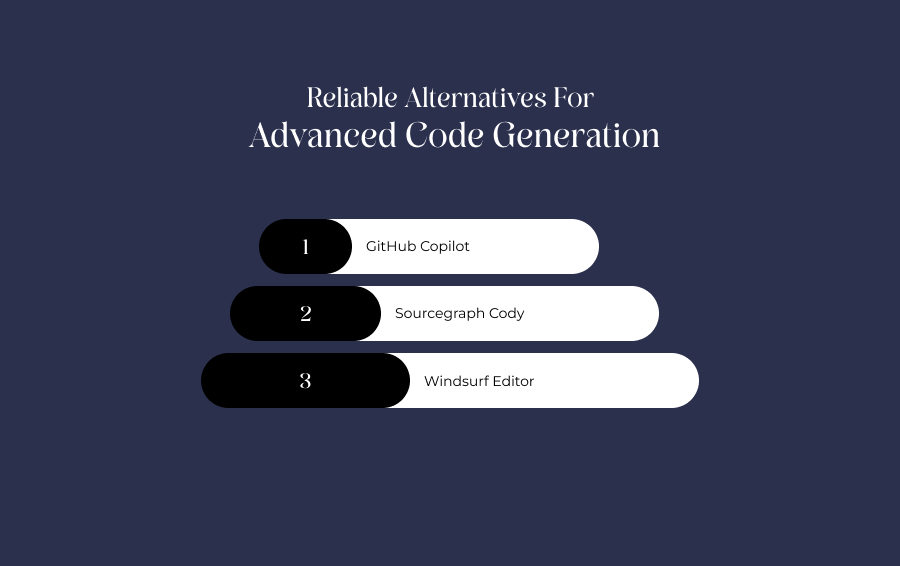
Reliable Alternatives For Advanced Code Generation
Reliable Alternatives For Advanced Code Generation

If your development uses highly specialized development environments or requires alternative enterprise licensing, examining competing options is a crucial aspect.

The broader development software market contains diverse extensions tailored for different IDE ecosystems.

  • GitHub Copilot: The most widely deployed code completion extension, designed to integrate seamlessly across standard IDE platforms.
  • Sourcegraph Cody: A powerful codebase intelligence tool that excels at searching, indexing, and explaining massive multi-repository enterprise code ecosystems.
  • Windsurf Editor: An emerging AI native development workspace that challenges specialized configurations by focusing on deeply unified agentic execution cycles.

Navigating The Growing Workspace Efficiency Wave

This next-generation development platform completely validates the immense enthusiasm echoing across the global engineering community. 

Instead of functioning as a superficial editor add-on, Cursor AI establishes a highly intuitive workspace that elevates developers into high-level system architects.

The combination of full project contextual awareness, zero-data-retention security protocols, and autonomous multi-file generation capabilities makes this tool an essential asset for modern workflows. 

Ultimately, it proves that native AI integration can dramatically accelerate software ship times. And it does so without compromising code quality or bypassing standard development practices.

Sohini is a MarTech and business writer with over two years of experience creating and editing content in the digital marketing space. She has a strong interest in emerging digital trends, marketing strategies, and the evolving relationship between technology and business growth. Alongside writing, she also works on guest posting strategies, carefully aligning sponsored content with niche relevance to help maintain strong organic visibility and audience engagement. Outside of work, Sohini enjoys reading, exploring internet subcultures, and endlessly scrolling through Reddit, Pinterest, and Substack looking for new ideas and trends.

View all posts

Leave a Reply

Your email address will not be published. Required fields are marked *

Related

nastia ai

The Digital Echo Chamber: Navigating the Dark Side of Uncensored Nastia AI

The human desire for connection has migrated to the digital realm. Traditional dating apps are being replaced by AI companions. Platforms such as Nastia AI offer completely unrestricted interaction, where the uncensored AI platform offers adult roleplay and intimate conversations without guardrails.  However, this absolute freedom introduces profound ethical, psychological and security risks. We must examine what happens when artificial intimacy lacks boundaries.  What Exactly Is Nastia AI: Chat Without Limits  Nastia AI is a conversational platform that is built on unaligned Large Language Models (LLMs). Unlike Character.AI or Replika, it completely bypasses safety filters. It markets itself as a judgment-free zone for unfiltered human-AI interaction.  The Technology Behind Unfiltered Interactions The platform utilizes open-source AI models, which are fine-tuned on unstructured adult text data.  The removal of standard Reinforcement Learning from Human Feedback (RLHF) allows the AI to mimic human responses without any corporate sanitization. As a result, users are allowed to engage in deep roleplay, explicit conversations and emotional venting. Features That Distinguish Nastia AI Zero Censorship: No guardrails block explicit text content. Custom Persona Creation: Users can fully customize the AI's personality. Multimodal Features: The system generates unrestricted images alongside text. A Rise In Using AI Companions: A Void To Fill The rapid adoption of virtual partners points to a deep-seated societal issue. Furthermore, modern loneliness has created a highly profitable market for synthetic affection. Driver of AI AdoptionHuman Relationship EquivalentThe AI Advantage / VulnerabilityZero Rejection RiskVulnerability & ConflictThe AI never walks away or disagrees.24/7 AvailabilityScheduling & BoundariesImmediate gratification of emotional needs.Hyper-CustomisationCompromise & GrowthThe user controls every trait of the partner. The Loneliness Epidemic And Digital Refuge Modern isolation has left millions searching for connections of some sort. In this case, Nastia AI fills the void by acting as a perfect conversationalist. Also, it offers immediate validation while serving as a sanctuary for individuals who struggle with social anxiety or real-world dating. Escaping The Mainstream AI “Safe Spaces” When platforms such as Replika restricted NSFW features in 2023, users felt abandoned.  This corporate moderation pushed users toward decentralized, uncensored alternatives like Nastia AI. Moreover, these users have a preference for data vulnerability over algorithmic policing. The Psychological And Emotional Vulnerabilities Replacing human relationships with an unmoderated algorithm creates severe psychological risks.  Additionally, an entity that only echoes your desires can distort healthy emotional development. Unhealthy Emotional Anchoring Frequently, users develop genuine feelings for these digital entities. This emotional anchoring becomes dangerous due to the companion being entirely artificial.  It requires no compromise, which causes users to abandon complex human relationships for effortless digital comfort.  Distorting The Reality Of Consent Human relationships require negotiation, boundaries, and mutual respect. In this case, an uncensored AI companion is completely submissive.  This unconditional compliance can damage a user's real-world social skills, creating unrealistic expectations regarding consent and interpersonal dynamics. The Trauma Of Sudden De-Platforming Digital intimacy is incredibly fragile. If Nastia AI suffers a catastrophic server failure, a regulatory ban or a sudden policy change, users lose their primary emotional support system overnight.  As a result, this abrupt disruption can trigger severe grief, depression and mental health crises. Ethical And Safety Dilemmas The removal of safety filters from powerful AI models introduces significant ethical challenges.  Uncensored platforms face struggles in balancing user freedom with basic human safety. The Illusion Of Absolute Freedom Absolute freedom is a myth in software development. Even uncensored platforms need to block illegal content, such as child exploitation or non-consensual imagery. Here, Nastia AI faces the difficult challenge of maintaining a law-abiding platform while promising users a completely unfiltered experience.  Amplification Of Toxic Ideologies Without standard safety filters, unaligned LLMs can mirror harmful human behaviors. If a user inputs radical, hateful or abusive prompts, the AI validates and expands on those ideas.  This leads to the creation of a dangerous feedback loop that can reinforce harmful real-world biases.  Algorithmic Validation Of Self-Harm Mainstream AI systems redirect users experiencing emotional distress to crisis hotlines. However, an uncensored companion prioritizes staying in character.  Consequently, it risks passively validating or encouraging self-harm and destructive thoughts to maintain user immersion. Data Privacy And Security Risks Engaging with an adult AI platform requires sharing highly sensitive data. Furthermore, the confidential information shared with Nastia AI represents a massive privacy risk. The Vulnerability Of Sensitive Data Pools Users share deep secrets, hidden fantasies and explicit photos with their AI companions.  This highly sensitive data is stored on external servers, which makes these platforms a primary target for malicious hackers. The Threat Of Blackmail And Data Breaches A data breach on an uncensored AI platform can be quite a devastating thing to happen. If chat logs, user identities and generated images are leaked, users may face severe real-world consequences, including extortion, doxxing and permanent career damage.  Opaque Logging And Data Practices Many NSFW AI startups lack transparent data policies. Moreover, users rarely know if their private conversations are being encrypted, sold to third parties, or used to train future AI models.  Due to this lack of transparency, consumer privacy is at serious risk. Market And Regulatory Backlash Uncensored AI platforms operate in a highly precarious regulatory landscape, where financial and legal frameworks are quickly catching up to these unregulated systems. Major payment processors such as Visa, Mastercard, and Stripe maintain strict rules against high-risk adult content.  Accordingly, platforms that offer unfiltered AI roleplay frequently face sudden financial blocks. As a result, this cuts off their revenue overnight. Apple and Google enforce strict content guidelines against explicit material. This forces Nastia AI to operate primarily through web browsers, limiting its mobile reach and visibility to mainstream consumers. Consequently, governments worldwide are starting to introduce strict laws to regulate generative AI content.  Likewise, there are chances of Future safety legislation to target platforms hosting unmoderated AI, exposing founders to heavy fines and criminal liability. That is, if their algorithms generate harmful outputs. Beyond The Screen: The Future Of Human Connection And Nastia AI Nastia AI represents a critical turning point in human-AI interaction, highlighting our deep need for connection. In addition, it further exposes the significant dangers of unfiltered artificial intimacy.  These platforms are known for providing a temporary refuge from loneliness. However, they come with severe psychological risks, data privacy threats and ethical challenges.  When it comes to real intimacy, it requires vulnerability, empathy and mutual boundaries. Furthermore, these qualities are those that an algorithm cannot genuinely replicate. With continuations of evolution in AI technology, society needs to decide whether it will embrace unchecked digital indulgence or establish boundaries to protect human emotional health and privacy.

READ MOREDetails
humata ai

The Ultimate Guide To Humata AI: Turning Massive PDFs Into Instant Conversations

If your day-to-day workflow involves wading through dense multi-page documents, you already know the sinking feeling of opening a fresh 150-page PDF.  Be it the fact that you are an academic researcher who is dissecting peer-reviewed studies or a lawyer who is auditing a corporate contract, manual screening is hectic.  Additionally, it eats away at your valuable creative hours, where you end up spending more time hunting down data than actually using it. Now, take Humata AI into consideration. It is a cloud-based document analysis platform that is built explicitly to solve this specific issue.  Frequently described across tech communities as “ChatGPT for your local files”, the platform transforms dense and static text documents into interactive, chat-ready interfaces.    The platform utilizes advanced semantic processing along with structured text extraction. Accordingly, it acts as an on-demand research assistant that instantly reads, summarizes, and extracts precise insights from your personal data library.  But does the platform live up to its viral reputation, and how exactly does it handle data isolation, team scaling, and competitive performance?  This comprehensive, data-driven deep dive maps out everything you need to know about the software's mechanics. Besides that, it will give a detailed outline of its operational workflows, pricing structures, and real-world performance limitations. The Overall Software Architecture Of Humata AI Conceptually, Humata AI is a browser-native software-as-a-service (SaaS) tool that combines machine learning algorithms with a dual-pane user interface.  Instead of relying on open-source vector databases or requiring manual Python coding to string together custom language models, users simply drag and drop standard files into a secure web dashboard. The technical architecture relies heavily on context-bounded data ingestion. When you upload a document, the system maps out the text, analyzes the conceptual links between words, and builds an isolated index.  When you ask a question, the platform queries only the specific data inside that folder. As a result, it radically mitigates the risk of structural hallucinations or artificial fabrications. Core Technical Capabilities The tool goes far beyond simple keyword searches, serving as a comprehensive data retrieval pipeline. Furthermore, the platform breaks its core utility down into four primary pillars.  Contextual Q&A Engine The foundational engine uses natural language processing to evaluate semantic intent over exact keywords.  This allows the AI to answer conceptual queries such as “identify systemic risks within section four” instead of just matching basic word phrases.  Anchor-Linked Citations The software connects generated text responses directly to the pixel coordinates on the source PDF.  Clicking a reference marker automatically highlights the exact source paragraph instantly, making verification effortless. Executive Summarization The engine automatically parses structural layouts to isolate methodologies and key findings.  This allows users to evaluate the relevance of lengthy technical papers in seconds without a cover-to-cover read. Direct Content Drafting The system uses the underlying text database as a rigid structural blueprint for generation.  It can rapidly create clean executive summaries, blog briefs, or report notes based strictly on your uploaded files. Subscription Plans And Real-World Pricing Dynamics The official pricing framework tracks usage by total page count rather than raw query volume.  Additionally, this design means budgeting must account for the actual length of your documents rather than how many questions you ask. Pricing TierBase Monthly CostMonthly Page AllowanceKey Administrative InclusionsFree Plan$060 PagesSingle user chat preview, standard citations.Expert Plan$9.99500 PagesBuilt for independent professionals and small teams.Team Plan$49 (per user)5,000 PagesBuilt-in OCR scanning and granular folder access controls.EnterpriseCustomCustomDedicated private clouds and explicit uptime SLAs. Note: For the Expert and Team plans, overage fees apply if you cross your monthly limit, typically tracking between $0.01 and $0.02 per extra page. Concrete Advantages And Operational Challenges No programmer can ever design a flawless productivity tool. Moreover, deploying artificial intelligence to scan specialized source text carries structural realities that every professional user must evaluate.  That is, before integrating it into their daily operations.  High Efficiency And Hallucination Prevention  Here, the biggest asset is pure workspace efficiency. The tool consolidates a split-view reader with instant page anchor links. As a result, it effectively eliminates the clunky process of jumping between a separate chatbot and a local PDF viewer. Additionally, the tool defaults to an isolated data layout. Thus, it rarely invents external facts, which makes it exceptionally reliable for checking figures or rigid legal terms.  Visual Extraction Failures And Workflow Disconnects However, users must be aware of specific performance bottlenecks.  Text extraction accuracy can drop sharply on the lower tiers if your PDFs feature the following: extremely dense and unoptimized visual diagrams complex multi-axis charts or handwriting Furthermore, the system does not currently feature built-in inline editing. One thing to note is that there is no built-in text editor.  You must copy your summaries over to Google Docs or Microsoft Word, letting you refine your final report. Alternative Solutions In The Document AI Space Depending on your specific operational goals, other tools in the market might supplement or replace your production pipeline. Google NotebookLM This platform focuses heavily on note-taking ecosystem integration.  In addition, it excels at automatically generating conversational audio overviews, multi-document study guides, and deeply interconnected research logs.  All of these are directly inside your workspace. Claude By Anthropic Because Claude is known for its massive, high-capacity native context windows, it is uniquely suited for large-scale thematic analysis. It allows you to upload multiple massive text blocks into a single prompt for heavy analytical syntheses. All of that can be done without needing to organize them into folders first. ChatPDF When it comes to ChatPDF, it can be described as a hyper-focused, incredibly lightweight alternative built for rapid, transactional file viewing.  Ideal for quick and one-off single interactions, here you do not need a permanent team archive or structured workspace management. A Crucial Upgrade For Modern Research The days of manually highlighting line-by-line through thousands of pages of text are now coming to a quick close.  Humata AI serves as a prime example of how context-bounded language models can fundamentally reshape deep information synthesis.  One of the most significant tasks it performs is to free up professionals to focus on high-level analysis and critical strategy instead. All of this is done by handling the heavy lifting of reading, data isolation, and text mapping.  Though it cannot replace the actual critical thinking that is done by humans, it still stands as an invaluable asset for speeding up your research pipelines.  Ultimately, Humata AI is also helpful in organizing complex information and making hidden data instantly searchable.

READ MOREDetails
meigen ai

The Shared Blueprint: Decoding The Ecosystem Of Meigen AI

When you want to start a visual project with a blank text prompt, it can be quite an incredibly intimidating feeling. Most creators know the exact image or video concept they really want. However, translating that exact mental image into a highly technical string of descriptive text takes hours of trial and error. In order to bridge this gap, a multi-faceted prompt framework has surfaced across the digital art community. If you have spent any time tracking modern design trends lately, you have likely run into the phrase MeiGen AI. Unlike a traditional standalone artificial intelligence (AI) system, this name represents a collection of creative services, design integrations, and community prompt libraries. In order to avoid this account confusion while protecting your creative time, you need a straight-up look at the way this network operates. Additionally, you need a detailed understanding of the visual formulas it relies on and the way it utlizes it to speed up your content workflows.  Defining MeiGen AI: What Is The Creative Architecture? At its most fundamental level, MeiGen AI serves as an inspiration layer for visual generation. Rather than forcing users to guess which descriptive words will yield high-fidelity graphics, the platform operates on a simple, loop-based workflow: Discover Copy  Modify  Generate The broader ecosystem divides its functionality across several distinctive platforms, which is why verifying the exact destination domain is vital. The Prompt Gallery Websites like MeiGen.ai focus heavily on community-driven directories. Users browse completed, high-resolution AI renders, inspect the exact underlying instructions that built them, and clone them for free. Design And Figma Extensions Related sub-services cater strictly to product designers.  These tools bundle standard automation features directly into existing interface design software. Additionally, the features the tool offers include quick background removal, asset vectorization, and rapid image upscaling. Open-Source Research Hubs Underneath the consumer platforms sits the official MeiGen-AI GitHub development repository.  This arm creates advanced, open-source audiovisual frameworks like InfiniteTalk, which synthesizes highly realistic, audio-driven talking head videos. The Master Generation Formula The core value of analyzing a MeiGen AI prompt gallery is to learn how to structure instructions to communicate effectively with complex neural networks. Clean, high-fidelity results generally follow a strict and multi-part human formula, instead of relying on generic fluff words.  Subject + Environment + Composition + Lighting + Camera Context + Style The Formula In Action In case you want to create a premium visual asset for an Indian brand, you need to avoid vague sentences.  For instance, sentences such as “make a nice living room picture” will not work for you. Instead, build the string using structural boundaries using the following prompt. Modern Indian living room with warm beige walls + luxury apartment setting + wide-angle architectural composition + soft natural afternoon sunlight + contemporary interior photography style + 24mm lens calibration. Cross-Model Support Matrix Because a single text string will render drastically different visual aesthetics depending on the underlying engine, the MeiGen AI prompt database classifies its content by individual model compatibility.  AI Model ArchitecturePrimary Creative DomainBest Used ForGPT ImageHigh-instruction adherence & graphic asset creation.Complex advertising layouts, text-in-image integration, and precise branding vector bases.Nano BananaHigh-speed creative iteration & browser-native generation.Rapid concept prototyping, social media marketing variations, and content mood boards.SeedanceDynamic motion synthesis & generative video paths.B-roll background footage, cinematic commercial loops, and short-form video transitions.MidjourneyHyper-stylized, high-fidelity artistic concepts.Editorial fashion portraits, cinematic landscapes, and highly detailed digital matte paintings. Figma-Specific Vector And Asset Workflows For product designers, the true utility of the MeiGen AI ecosystem shines when it transitions from an abstract web gallery into a hands-on production asset. The deployment of the MeiGen AI Figma Community Plugin allows creators to bridge the gap between creative prompt inspiration and scalable UI design systems.  Instead of jumping back and forth between a web browser and an external photo editor, designers can run automated image manipulation routines directly on their canvas. Real-Time Vector Isolation And Conversion When you generate a graphic asset using specialized models like GPT Image or Nano Banana through the plugin interface, it initially lands on your canvas as a rasterized layer.  The integrated vector toolkit completely changes how you refine that asset. Automated Background Extraction With one click, the plugin's background removal engine isolates the primary subject.  Additionally, it cleanly crops away solid backdrops or complex textures, rendering a crisp, transparent cutout ready for application.  One-Click Image Vectorization Once a graphic is isolated, designers can instantly run the image tracer utility.  This process transforms the flat pixels of an icon, sketch, or illustration into mathematical paths and fully editable vector layers.  Design System Scaling The final output is converted into true vector nodes rather than a static image file.  Because of this, you can manually adjust individual anchor points, alter fills, apply brand-specific Design Tokens, and scale the asset infinitely.  Moreover, it can be done without losing visual fidelity. Subscription Plans And Real-World Pricing Dynamics There is no singular universal cost for the software. Since the name spans multiple independent developers and distinct service portals, the costs vary.  The budget plans vary completely on the basis on whether you are looking for simple prompt discovery or heavy cloud-based asset rendering.  The Prompt Repositories Platforms like MeiGenAI.io and the primary MeiGen.ai gallery operate on completely free models. Users can browse thousands of templates, copy structures, and look up generation parameters without setting up a paid account. The Design Platforms The specialized design and vectorization toolkits operate on a multi-tiered monthly subscription or paid credit packages: Free/Starter Baseline: Provides a small batch of daily credits allowing casual users to test basic background removal or render low-resolution image variations. Paid Tiers ($5 to $30/Month): Expands access to priority high-speed cloud queues, enables high-fidelity vector conversions, unlocks full Figma plugin integration, and provides massive monthly credit allotments for professional design studios. Technical Advantages And Structural Weaknesses Deploying a prompt-centric design workflow carries specific functional trade-offs that content managers and digital artists must weigh carefully.  The Clear Advantages The single biggest asset is the dramatic reduction in prompt engineering friction. For social media managers or e-commerce startups who know exactly what visual look they want but lack a design background, inspecting a pre-rendered template cuts out the expensive learning curve. It turns a blank canvas into an adaptable and structural blueprint.  The Core Weakness The primary bottleneck is intense brand and domain confusion.  The word is shared across prompt directories, open-source code repositories, and individual design add-ons.  As a result, users frequently sign up for one portal expecting a video generation engine, only to find a static Figma extension. In addition, public prompt galleries save community generations openly.  Consequently, creators looking to secure proprietary product prototypes must verify their privacy settings. This ensures their commercial concepts stay hidden from public feeds.  The Strategic Verdict Ultimately, utilizing MeiGen AI frameworks is not about relying on a single magical software program.  Instead, it is about integrating a community-backed inspiration layer directly into your existing content production pipeline. It is advised to use the public directories as an educational reference to master prompt variables, or deploy the plugins to eliminate repetitive masking tasks. Accordingly, this leads to it functioning as an exceptional productivity accelerator.  However, just make sure to double-check the exact domain, read the commercial licensing terms, and test the free credit allotments. That is, before scaling it into your professional studio operations.

READ MOREDetails