












Financial Plan For Your FIRST Small Business – Low Budget Plan

by

12 September 2024

Finance

Financial Plan For Startup Business

One of the common reasons why small businesses fail is the lack of working capital. Poor financial decision-making can be detrimental to your small business.  

This will not scare you or put you off the idea of starting your very first business. However, it is to convince you how important it is to draft a financial plan for your small business.

The importance of predicting your financial health is not just to maintain a steady cash flow but also…

Understand how lucrative your business is in the long run.

How long will your business be at break-even (no profit, no loss)?  

When can your business start making a profit?

Most importantly, what is the contingency plan of any financial hurdle?

In this blog post below, we will be discussing the following:

  • Importance of a financial plan for your small business.
  • Elements of a financial plan for your small business.
  • A template to create a small business plan (for any business).

Importance Of A Financial Plan
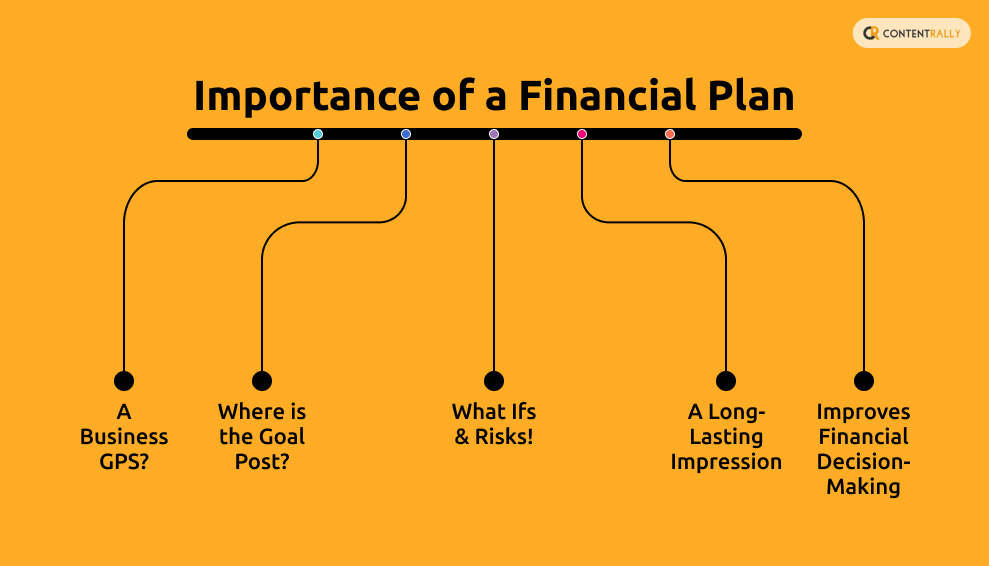
Importance Of A Financial Plan

Here is why you should begin creating your very first-ever financial plan for your small business.

1. A Business GPS?

Imagine yourself driving to a new destination without knowing where you are or in which direction you should proceed.

This is what it is like to open a business without having a financial plan.

A financial plan will give you a clear roadmap to your business journey, and determine how much to spend on each destination.

2. Where Is The Goal Post?

We all have a vague idea of what a startup goal should be. However, getting overwhelmed is common without a clear picture.

A financial plan will provide you with a clear goalpost. I am talking about tangible, measurable, and achievable goals.  

Whether you want to expand your business, increase profits, or reduce costs, a financial plan gives you a clear path.

3. What Ifs & Risks!

It is given that your business won’t be smooth sailing forever!

Businesses often face unexpected expenses. It could be something as simple as equipment breakdowns or sudden major market changes!

As a business owner, being financially ready is a crucial step!

A financial plan can help you set aside emergency funds, so you’re prepared for these surprises.

4. A Long-Lasting Impression

Want investors early on for your business? Then, it would help if you offered them a steady financial plan.

Remember, lenders and investors want to see a well-thought-out financial plan before they commit their money.  

Therefore, having a solid plan shows them that you understand your business’s financial health, its cash flow, and the potential profit opportunity. Hence, we are serious about making your business a success.

5. Improves Financial Decision-Making

With a financial plan, you better understand your cash flow, revenue, and expenses.  

This knowledge helps you make informed decisions, like when to invest in new equipment or whether to cut costs.

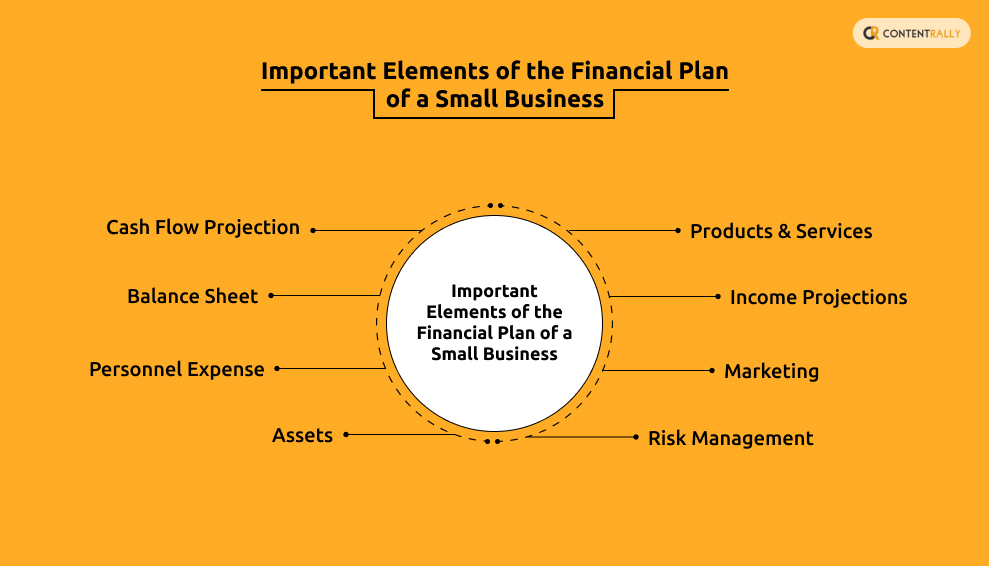
Important Elements Of The Financial Plan Of A Small Business
Important Elements Of The Financial Plan Of A Small Business

Before you begin your financial planning, you should be aware of the different financial jargon for a business.

1. Cash Flow Projection

This includes predicting the market, what effect your product will have on the market, and how much you can earn from it.

Now, taking the potential amount you create capital expenditure for each month. The function of a cash flow projection is to ensure you have enough (at the end of the month) in terms of expansion.

It is common for a business to live month by month with no profit for the first six to eight months of the business. Essentially you are establishing your business.  

However, if it crosses the one-year mark with just a break-evens, the following could be the reason:

  • Your business is not making money because of the lack of demand.
  • The expenditure is way over your income. You must start some cost-cutting methods.
  • There is a lack of marketing, and your small business is not reaching the target audience.
  • You do not have enough investment for the small business you are starting.

Keep these points in mind when starting your cash flow!

2. Balance Sheet

A balance sheet is a financial estimation of your small business’s current state. Here are some of the important items your balance sheet will have:

  • Income & Expenditure
  • Total owning & total owing (personal debts or small business loans).
  • Assets that are currently under collateral.

Upon reading it might sound simple. However, when it comes to a balanced business sheet, you will require a finance professional to craft one.

3. Personnel Expense

This brings us to the next point in any financial plan for a small business. The personnel expense, or the amount you are spending on hired personnel.

It doesn’t always have to be your employees. In fact, the number of employees for a small business will hardly reach 15 in the very first year.

A personnel expense includes individuals working as consultants for the business, and the different professionals you hire to help with the internal work (e.g. Finance officer to create the balance sheet).

Some of the common elements of a personnel expense are:

  • Cost is based on the positions each professional is holding.
  • Personal insurance plans for your workers (at least medical insurance).
  • Expenses are spared for other professionals working externally with the business.

4. Assets

The tangible assets that your small business owns:

Current Assets: What the business currently owns. These include inventories, machinery & tech devices, prepaid expenses (for example, digital tools), and other office supplies.

Tangible Assets: The one that physically exists under the name of your small business. Real estate (This will not include rented warehouses or offices. These will go under the expenditure section), land inventory, tangible investment (gold & bonds), and saleable merchandise.

Non-Tangible Assets: These are assets that are not in a physical form. Intellectual property, pre-paid tools, investments (stocks, Cryptocurrency, mutual funds).

Non-Operable Asset: Assets under your small business but from which you are not getting any income. For example, land you have an investment in but not yet open for any business-related functions.

Operable Asset: Assets that your business owns currently, and that are bringing some income. For example: produced goods, factory space, warehouses, and office space.

5. Products & Services

The products and services you are planning to offer will also come into the financial planning for small businesses.

These include the following:

The raw materials are required to create the goods.

  • Factory costing.
  • Warehouse costing.
  • Transport & Drop shipping costing.
  • Worker’s salary & insurance.
  • Contingency management funding. (In case of any accident or unpredictable situation).

The summation will give you the total cost of production. With which you can create and understand the market value of your product.  

This step is very important to assess the profit and loss of each item.

6. Income Projections

Another crucial part of small business finance planning is prediction. This is how you can predict whether your income will have any substantial income.

Here is how you can protect your business income (before starting it):

  • Check business income projections of competitors through several data analyses. 
  • Is your small business subject matter trending in the market? What is the current market share of such companies?
  • Are investors willing to invest in a business venture as such? In fact, check some of the Shark Tank successes, and analyze which business venture seems more profiting by investors themselves.
  • The inflation rate of the past decade regarding the product or service you are about to sell also matters.

7. Marketing

You cannot spend everything on logistics and not worry about marketing.  

One cannot ignore this matter, especially in today’s day and age when small businesses are reaching new milestones by a simple influencer shoutout, or social media virality!

Here are some of the factors in which you will need to spend in marketing:

  • Social media marketing tools.
  • Influencer marketing.
  • Small ad-films over YouTube.
  • Website building and digital marketing (Website domain and SEO tools).

8. Risk Management

No business is protected from the risks that come to every business in its lifespan. However, the contingency plan is not getting ambushed by a sudden change.

Here are some of the financial risks/uncertainties your new business could face:

Market Risk: The ups and downs of the current & dynamic economy. In fact, after the pandemic, things have become a little less predictable.

Reputation Risk: Social media is indeed bringing customers and businesses closer. However, the downside of such connectivity is the risk of a tampered reputation, especially when audiences jump to conclusions upon hearing anything on the internet.

Competition Risk: This is a common risk every business faces. When your competitors launch something new & exciting, there could be a significant shift in sales numbers for you.

Environmental Risk: One good example of environmental risk that has previously impacted businesses majorly is the pandemic.

Political Risks: The political scenario of your country can have a considerable effect on your business, especially in terms of export-import & business expansion.

This is one of the reasons why having a financial contingency plan for managing sudden risk is one of the crucial components of a business financial plan.

Business Template For A Startup

Business Template For A Startup

As promised, we have a business template that will help you take that very first step for your startup.

Financial Plan For Startup (Template)

Table of Contents 

1. Financial Overview: A Financial Overview will consist of a financial overview of your business’s current state. Also, please provide the key points and takeaways of the financial data that you will provide.

4. Assumptions – Market Research: This is the step for market research and predicting the business’s profit potential.

5. Break-Even Analysis: A table or graph which provides information on the number of units your business needs, and how much you need to sell to make a profit.

6. Financial Statements: This will include the following charts.

– Profit & Loss (Optional if you have a startup)

– Cash Flow Statement (How the monthly cash flow will look)

– Balance Sheet (Monthly/Quarterly/Yearly Income & Expenditure)

Elements For Your Balance Sheet

The following is what your balance sheets should include based on items required: monthly, quarterly, and yearly income & expenditure.

Operational Financial Plan

  • Business Location and Facilities
  • Technology and Equipment
  • Key Operational Processes
  • Supply Chain and Inventory Management

Management and Organization Financial Plan

  • Organizational Structure
  • Key Management Team
  • Roles and Responsibilities
  • Hiring and Training Plan

Financial Plan

  • Start-up Costs (for new businesses like loans, downpayment; collateral, and personal investments)
  • Revenue Projections
  • Expense Projections
  • Cash Flow Statement
  • Profit and Loss Statement
  • Break-even Analysis

Funding Requirements and Strategy

  • Funding Needed
  • Purpose of Funds
  • Potential Funding Sources
  • Funding Timeline

Key Risks

  • Risk Mitigation Strategies

Financial Tools to Ease Your Job

In the modern age of technology, you can always lean on tools to automate some of the financial tasks.

So, if you need that digital assistance when

Begin Your Journey!

This is a sign for you to begin your journey as a first-time business owner. Yes, it is overwhelming, and yes it can be intimidating (hence the long procrastinating period!).

Creating a financial plan for even a startup can be intimidating. Here is how you can make this journey a little easier.

Start with defining your business first. The executive plan is a must. You should know what your business is all about.

Then, move through the basic income and expenditures.

Take help from professionals in tax advice and create a detailed balance sheet.

Finally, consider seeing your whole financial plan in a timely manner. It is important to take one step at a time.

Hopefully, we can give you enough answers about a business financial plan. How is your journey going? Please let us know in the comment section below.

Read Also:

Content Rally wrapped around an online publication where you can publish your own intellectuals. It is a publishing platform designed to make great stories by content creators. This is your era, your place to be online. So come forward share your views, thoughts and ideas via Content Rally.

View all posts

Leave a Reply

Your email address will not be published. Required fields are marked *

Related

Trading

Trading Versus Investing: Which Is Right For You?

There are two distinct stakeholders in every market, we have the traders and the investors. These two sets of people have one thing in common, they both want to make a profit however they approach the market differently. If you are reading this article you are probably interested in the market but, you are a little bit dazed about either deciding on trading or investing. It's time to cheer up friends, don't be disturbed anymore, your questions would be clarified after reading this article. This article would share the necessary information you require to make your decision; trading or investing. Let's get started. What is trading? Trading is a financial activity carried out to earn a profit from short-term fluctuations in the market. Trading involves buying and selling financial instruments; stocks, currencies, commodities, and derivatives to make profits from their price movements within short periods. What is investing? Investing is a long-term financial activity where investors buy a financial instrument; for example, stocks that can yield returns in the long run. Unlike trading, investing requires creating a variety of portfolios of assets and keeping them through every stage of the market till the period they wish or project to take their returns. Unlike trading which is reliant on price movements for returns, investing grants numerous benefits such as bonuses, dividends, buybacks, stock splits, and more. The similarities between trading and investing Trading and investing have a similar objective which is to make a profit. They both offer the possibility of getting rewards. Trading and investment both hold the possibility of a loss; they both have financial risks. You need an account/broker to either trade or invest. Without an account, you cannot buy and sell or invest in stocks, ETFs, options, currencies, and others. The differences between trading and investing The table below would give you a better understanding of the differences between traders and investing: CharacteristicsTradingInvestmentRiskHighModerate/LowCapital growthFrom short-term profitAmass gains/wealth overtime while minimizing risksIntentionPurchase assets during the short term and take advantage of mispricing/irregular price movements in the marketBuy investments and hold them for a long period to grow capitalLeverage offeredYesNoAnalysis neededTechnical analysisFundamental analysisCapital gainsMajorly short termBoth short-term and long termPeriod of investment trackingHigh/ConsistentMedium/lessAsset durationSeconds, minutes, a few hoursWeeks, months, years/decadesAssetsStocks, optionsStocks, bonds, ETFs, mutual funds Conclusion When you are about to make a decision; trading or investing, be introspective. Ask yourself and consider how patient you are. Are you knowledgeable about investing or trading? What are your skills or expertise? Can you manage risks? Or do you prefer to play safe? Based on these questions and your strengths or weaknesses you can think about, you can now decide which; trading or investing is best for you. Remember, trading is more susceptible to financial risk because it is a short-term activity while investing is long-term and less susceptible to financial risk. Trading and investing are not profitable though trading can be a way to earn quick profits while investing wins come in the long run but with fewer losses than trading. You can find your perfect binary options broker as a trader or investor today. Frequently Asked Questions (FAQs) I. Do traders earn more than investors? We can not authoritatively say that a trader is earning more than an investor vis-a-vis. Traders and investors both have the potential to profit. But they both have to make the right and smart decisions otherwise they would lose money. II. What types of trading can I engage with? There are four types of trading; day trading, position trading, swing trading, and scalp trading. Day trading: Positions are held during the day alone. Position trading: Positions are held for months to decades. Swing trading: Positions are held within days to weeks. Scalp trading: Positions are held within seconds to minutes. Scalp trading is usually operated during the day alone. III. What types of investing can I engage with? Some of the types of investing you can engage in are index investing, active investing, passive investing, value investing, market cap-based investing and growth investing. Read Also: Unveiling The Dark Side Of Trading: Exposing Binary Options Scams And Ensuring A Secure Future What Beginners Must Know About Trading Options In Dubai Margin Trading Tips & Strategies For Beginners

READ MOREDetails
Financial Services Copywriting Help You With?

What Can Financial Services Copywriting Help You With?

Content creation can be quite challenging. It is because each business has its own needs, and it’s important to tailor the messaging accordingly. However, financial sectors are a bit tricky, and the writers are required to make the topics simple and digestible. You can find out more about this industry when click this URL. Topics that are quite complex should be accurate but interesting. And, of course, they should optimize everything while being mindful of the brand’s audience and voice. Fortunately, you can get started with landing pages, blog posts, website content, marketing emails, sales copy, and white papers. Here are some of the things that you need to know about. Gearing The Content Towards A More Targeted Audience Every reader has a completely different way of consuming content. It is as if you’re attempting to write universally; everything is going to be generalized and uninteresting. What makes sense to the managers of a Fortune 500 company may not have any impact on the investors. They (investors) are just exploring various investments for the first time. Have a highly targeted audience and know the problems that they are dealing with, their goals, hopes, dreams, concerns, and fears. They might want to save up for their child’s college fund, grasp concepts regarding ETFs, or be better at budgeting. Whichever is the case, you need to be able to write something compelling that provides value for years to come. Tailored For SEO Search engines like Bing or Google are playing a critical role in the success of many businesses today. They can help you rank higher and ensure that you have content that’s easy to read. They are going to effectively push down the readers toward your funnel. The writers from a legitimate financial services copywriting agency can help you utilize white spaces. They help you create engaging headlines, optimize your title tags, and make your pages easily scannable. Quit Being Humble Nowadays, you need to tell others what makes you unique and special. If you have existing financial stats, utilize them and ensure that people know that you’re an expert in something. Shout them at the top of your lungs and display them on your current emails, website, or existing copies. Highlight the number of assets that you have and your sales through the years. Also, highlight the big names that have partnered with you, and the client returns. Let everyone know that they can trust you with their finances, time, and other resources. It would be best if you have case studies on the subject and you have given lectures about proprietary software. They are essentially a game-changer in the marketplace. Strangers and other potential buyers often demand social proof, and if you can get reviews from previous clients, be proud to display them. Tell your audience about what makes you the best, and get ready to be seen by the right people. Elements That Are Effective In Copywriting Understand your audience, and this should be the first thing that you need to do. Identify what they need and tailor your offers accordingly. They should be able to resonate with your messaging so you can have a good chance of cutting through the noise. Another important element is tone since financial services often deal with complex topics. Strike the right balance between professional and approachable, and you’ll want to convey expertise while also making sure your content is accessible and engaging for readers of varying levels of financial knowledge. Call-to-action can also be an added element where you tell your audience what you want them to do next, whether it's signing up for a newsletter, scheduling a consultation, or exploring more products or services on your website. A clear and compelling CTA can significantly increase conversion rates. Effective financial services copywriting combines understanding the target audience, using an appropriate tone that resonates with readers, and including strong CTAs that drive action. Mastering these elements in your copywriting efforts can help you on your way to achieving success in promoting your financial business. Read info about CTA on this webpage: https://dictionary.cambridge.org/us/dictionary/english/call-to-action. Finding A Talented Expert Define Your Needs: Be accurate and specific on the topics that you want to require and research the assistance that these companies can provide. You can then narrow down your options by checking the skills of the copywriter and their expertise in the specific niche that you want. Relevant Experience should be a Preference: Previous works and portfolios of the experts will matter. They should be able to provide you with compelling content that’s related to finance. Those with case studies should also be prioritized so you’ll know that you have a higher chance of achieving success. Check References and Testimonials: Don't hesitate to ask for references from past clients or colleagues who have worked with the copywriter before. Testimonials can provide valuable insights into their professionalism, reliability, and quality of work. Assess their Writing Style: Each copywriter has a unique writing style, so make sure it aligns with your brand's tone and voice. Request a sample or test assignment to evaluate how well they adapt to different styles and communicate complex financial concepts. Additional: How To Get A Trusted SEO Company In 2023? Why Is An SEO Services Company Better Than Others? How To Get More Traffic For Your Small Business With Affordable SEO

READ MOREDetails
Bitcoin Trading

The Profit Revolution: The Best Bitcoin Trading And Investing Platform

Ever since Bitcoin first emerged on the scene, it has been able to polarize opinions, make millionaires overnight, and create secure Blockchain technology. It has also managed to make the world leaders stand up and take notice, obstruct and demonize a democratic and open call for mass equality. The earliest investors in Bitcoin became billionaires in no time. They went from being your average kids to billionaires and millionaires driving supercars and buying villas in downtown LA. However, Bitcoin and other cryptocurrencies came under severe criticisms. From funding terrorists and notorious arms deals to sex trafficking and other evils, world leaders left no stone unturned in opposing the biggest challenge to the global economic and financial order ever. In this article, we will not be looking at the philosophical aspects of Bitcoin or its impacts. We will be looking at how investing in Bitcoins can help you earn handsomely and make the practice a sustainable professional practice. Bitcoin Trading and Investing: Which Platforms to work on? If you are confused about why you will need a Bitcoin Trading Platform, let me clear the air on that one. A bitcoin trading and investing platform work in exactly the same fashion as a share or stock platform. The platform helps you with real-time calculations, suggestions, data and financial expert services at all times. All of the above factors help you make the right informed decision at all times. This minimizes the risk of losses that are the frequent complaints of many a Bitcoin investor. We need to acknowledge the fact that Bitcoin trading has seen its fair share of difficulties. To help you tide over such uncertainties, you need a financial expert that can guide you with the right kind of information. Imagine a situation where you had bought some Bitcoins in early 2018. I am sure all of you remember the depths to which the valuation fell in late 2018. 90% of people who owned Bitcoins sold them and exited their investments. However, the people who bought them at those crashed prices held on to them and saw their value increase to nearly $10000 USD in October 2019. Why should I use the Profit Revolution? There is no doubt that the Profit Revolution is one of the most attractive trading platforms in the digital currency world today. Let us look at some of the factors that make them an immediate choice- 1. The Human Factor (24x7 Financial Expert Consultation): One of the best features of the Profit Revolution platform is the Expert Financial Help on offer 24x7. You can talk to an expert at a time of your convenience from anywhere in the world. Automation is good, but if you have a human element guiding you at all steps of your journey, you definitely feel more reassured. 2. Data and Automation to drive Decision Making: The biggest financial institutions and stockbroking firms use sophisticated AI and Machine Learning to compute data and inform decision-making. Profit Revolution uses the same tech and helps you see how the markets at behaving at all times. They also show projections, trends and offer suggestions on which stocks you should be moving on. 3. Instant Monetization Benefits: Yes, there are other platforms as well. However, the worst criticism of them is that they have several hindrances when it comes to withdrawing funds. On Profit Revolution, you can withdraw the funds instantly from your linked Bank Account. It is as simple as that. No time stipulations, no minimum balance maintenance, and no extra paperwork. Conclusion: If you are looking to invest in Bitcoins, you should check out the Profit Revolution platform. It is easy, convenient and offers complete security at all times. 2019 is perhaps the right time to invest in Bitcoins. Several experts are of the view that the valuation is likely to hit $15000 in early 2020. What are you waiting for? Read Also: Bitcoin Profit Review 2019 What To Expect When You Become A Forex Trader Exciting Facts About Cryptocurrency And Crypto Wallets

READ MOREDetails