











On 11 November 2022, FTX, the world’s third-largest cryptocurrency derivatives exchange, valued at $32 billion at its peak, officially filed for Chapter 11 bankruptcy protection.
Founded by Sam Bankman-Fried, the platform positioned itself as a highly secure, institutional-grade trading platform.
However, the exchange’s underlying operational framework was structurally compromised by a severe lack of internal accounting checks and massive regulatory non-compliance.
This case study analyzes how a secret, multibillion-dollar asset-liability mismatch and illegal balance-sheet commingling systematically hollowed out the platform's liquidity.
The crisis unfolded over a seven-day window following an explosive public balance sheet leak.
When customers launched a highly synchronized, panic-driven digital withdrawal run, they exposed an $8 billion deficit in customer capital.
This cash vacuum forced immediate bankruptcy filings and triggered global contagion across decentralized markets.
Furthermore, it led to sweeping criminal indictments for its core executive leadership team.
The Corporate Alchemy Of The Ftt-Alameda Loop

The structural collapse of FTX was not a standard macro market casualty or an unpredictable investment drop.
Instead, it was an intentional, systemic corporate fraud built around an artificial token-collateral loop and the illegal routing of user deposits.
When users deposited fiat cash or major crypto tokens (like Bitcoin and Ethereum) on the FTX exchange, internal operating scripts routed those assets off the platform's ledger to Alameda Research, a private crypto hedge fund owned by Sam Bankman-Fried.
Alameda used this stolen customer cash to execute high-risk venture bets, purchase luxury real estate, and finance political donations.
To hide this massive hole in user accounts, Alameda left billions of dollars' worth of FTT.
FTX’s in-house utility token, in the exchange's treasury vaults as replacement collateral.
FTX’s developers wrote custom code that granted Alameda a secret $65 billion backdoor line of credit.
Therefore, this ensured the hedge fund could continuously draw down customer cash.
This setup created an extreme concentration of risk.
The entire exchange was backed not by liquid cash reserves but by an illiquid token that FTX had printed out of thin air and artificially valued on the open market.
Granular Timeline Of The Strategic Meltdown
The operational collapse scaled with unprecedented velocity, stripping a global multi-billion-dollar enterprise of its entire liquid asset base in less than a week:
| Strategic Phase Timeline | Financial Event | Underlying Systemic Impact |
|---|---|---|
| 2 November 2022 | CoinDesk leaks Alameda’s balance sheet, exposing that the $14.6B fund was backed almost entirely by illiquid FTT tokens. | Triggers immediate risk-mitigation evaluations among global institutional funds. |
| 6 November 2022 | Binance CEO Changpeng Zhao (CZ) announces on social feeds that Binance will liquidate its entire $580M holding of FTT tokens. | Sparks a massive digital run, crashing the FTT token market value instantly. |
| 7–8 November 2022 | FTX faces a devastating $6 billion mobile app withdrawal run by panicked retail and corporate users. | The exchange runs completely out of liquid cash reserves and halts all customer asset withdrawals. |
| 9 November 2022 | Binance signs a non-binding letter of intent to buy FTX, but backs away 24 hours later due to un-auditable corporate books. | Destroys any hope of an institutional bailout, leaving the exchange completely insolvent. |
| 11 November 2022 | Sam Bankman-Fried resigns, and incoming CEO John J. Ray III takes control of the bankrupt corporate shell. | Chapter 11 bankruptcy filings are executed across 130 affiliated corporate entities. |
Structural Vulnerability Matrix: Root Causes Of The Failure
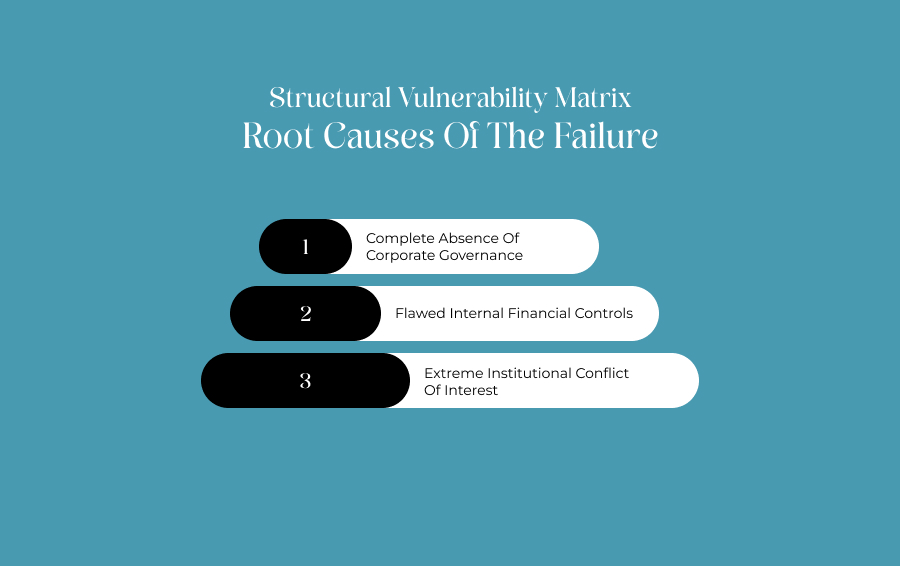
An institutional post-mortem of the FTX Group highlights three distinct, compounding risk management flaws that left the platform completely defenseless against a market shock:
· Complete Absence Of Corporate Governance
The exchange operated without an independent board of directors, lacking external oversight on executive choices.
Corporate cash controls were managed via an unsecured group chat app.
Furthermore, this is where executives approved multi-million-dollar asset allocations using emojis.
Therefore, they left no professional audit trail.
· Flawed Internal Financial Controls
The company completely lacked a dedicated internal accounting department.
John J. Ray III, who famously managed the liquidations of Enron, stated under oath that he had never seen such a complete failure of corporate records.
Additionally, he noted that the company used automated consumer software to track corporate cash balances.
· Extreme Institutional Conflict Of Interest
The boundaries between exchange operator (FTX) and market speculator (Alameda) were completely erased.
Alameda was granted a permanent exemption from the platform's automated liquidation engine.
This meant that while standard retail users were instantly liquidated during market drops to protect the platform's capital.
Alameda could hold massive, bleeding-negative balances indefinitely, shifting its trading losses directly onto the exchange's users.
The Digital Mechanism: A Smart-Contract And Social-Media Driven Run
A defining characteristic of the FTX collapse was the speed of the panic, accelerated by modern communications and digital banking channels.
Traditional historical bank runs unfolded over weeks or months, slowed down by the physical logistics of brick-and-mortar branches. FTX, conversely, was a light-speed digital bank run.
The second the Binance liquidations hit social feeds, user panic spread instantly across public social networks and private messaging channels.
Fearing immediate account freezes, thousands of global users logged into their mobile trading apps simultaneously to initiate electronic withdrawals.
Because the platform's liquid cash reserves had already been secretly drained to cover Alameda's high-risk trading debts, the exchange could not process the massive $6 billion withdrawal load.
The sudden run exposed the underlying fraud in hours, freezing customer accounts and cutting off access to individual wealth worldwide.
Systemic Contagion And Post-Crisis Regulatory Remediations
The fallout from the FTX collapse sent shockwaves through the global decentralized finance sector.
This forced international authorities to implement sweeping structural reforms:
· Market Contagion Waves
The collapse triggered a domino effect across the industry, driving immediate insolvencies among major digital asset lenders such as:
- BlockFi
- Genesis Global
- Voyager Digital
Additionally, it wiped over $200 billion in valuation from the broader digital asset markets.
· The Enforcement Crackdown
International regulatory bodies shifted away from passive tracking to aggressive enforcement actions.
Authorities launched sweeping investigations into offshore exchange structures.
Therefore, this resulted in a 25-year federal prison sentence for Sam Bankman-Fried for historic wire fraud and money laundering.
· Mandatory Corporate Audits
Modern regulated digital asset platforms moved quickly to restore investor confidence by adopting strict Proof of Reserves (PoR) frameworks.
These systems require third-party cryptographic audits to demonstrate that an exchange maintains 1:1 liquid-asset backing for all customer deposits at all times.
Lessons For Corporate Treasury And Capital Allocation
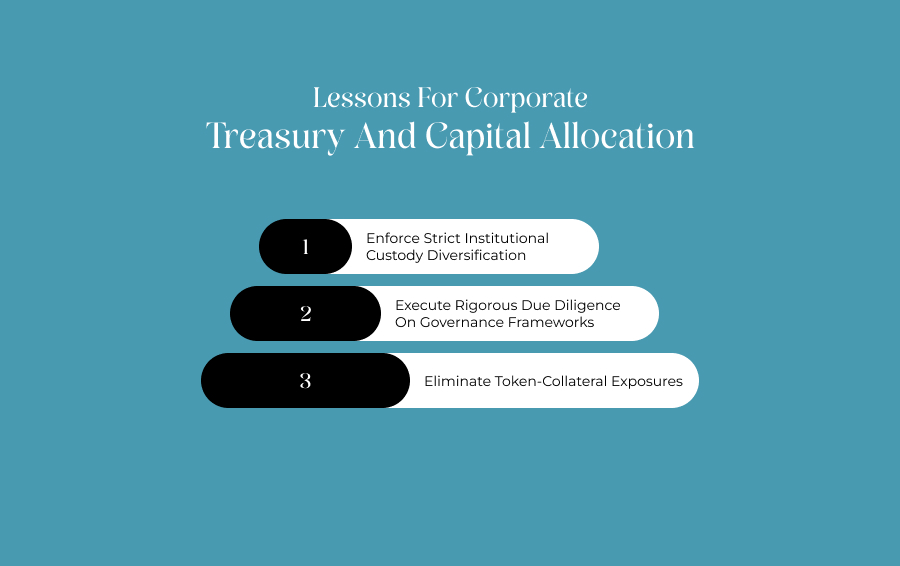
Analyzing the failure of the FTX group highlights several essential risk management rules for modern corporate treasuries and venture capital investors:
· Enforce Strict Institutional Custody Diversification
Never leave your operating capital or digital assets parked long-term on an exchange ledger.
Utilize institutional-grade, multi-signature cold storage infrastructure where your team controls the cryptographic keys, ensuring absolute protection against platform freezes.
· Execute Rigorous Due Diligence On Governance Frameworks:
Venture capital firms poured over $2 billion into FTX without demanding an independent board seat or a formal accounting audit.
Modern investment groups must treat a lack of transparent accounting controls or independent oversight as an immediate disqualification flag.
· Eliminate Token-Collateral Exposures
Never build your corporate treasury around illiquid, self-printed tokens or unhedged digital asset baskets.
Ensure your liquid reserves are held in transparent, top-tier cash instruments—such as short-term sovereign bills—to insulate your balance sheet from sharp market downturns.