












The modern competitive examination landscape demands more than rote memorization and tireless study hours.
For students aiming for elite academic benchmarks such as JEE, NEET, or UPSC Civil Services, navigating massive syllabi within compressed timelines poses a major operational hurdle.
Traditional, rigid classroom teaching frameworks routinely fail to address individual conceptual weak points.
In fact, it forces learners to waste valuable time reviewing topics they have already mastered.
At the same time, it ensures that they leave hidden knowledge gaps completely untouched.
To bridge this educational friction point, adaptive learning technologies have stepped in to revolutionize self-study workflows.
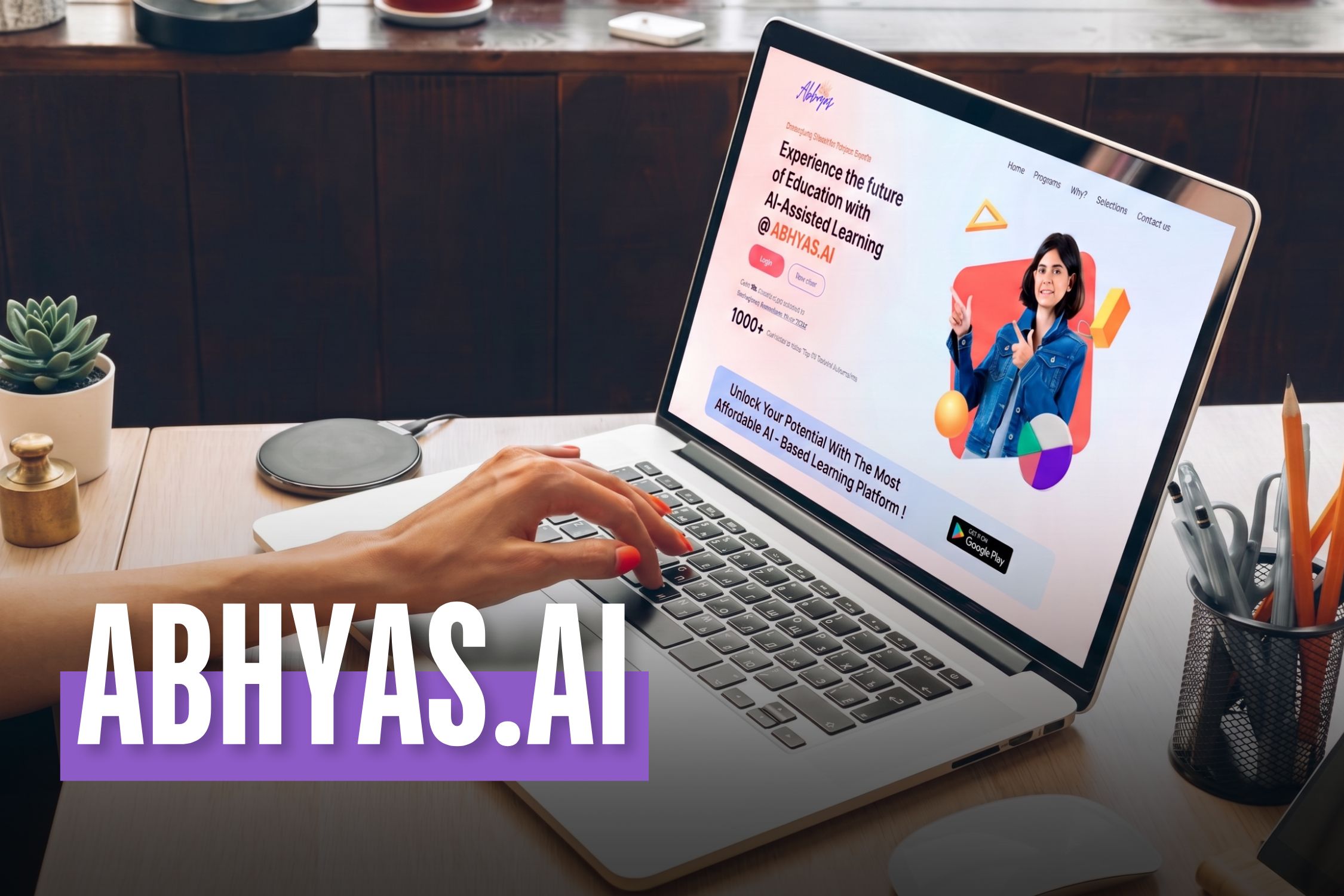
At the forefront of this digital shift stands Abhyas AI—an advanced, machine-learning-driven e-learning platform engineered to maximize score potential through hyper-personalized study paths.
This comprehensive guide provides a detailed structural breakdown of how Abhyas AI operates, its core analytical features, and the precise strategies students can use to transform flat test practice into predictable academic success.
What Are The Core Features Of Abhyas AI?
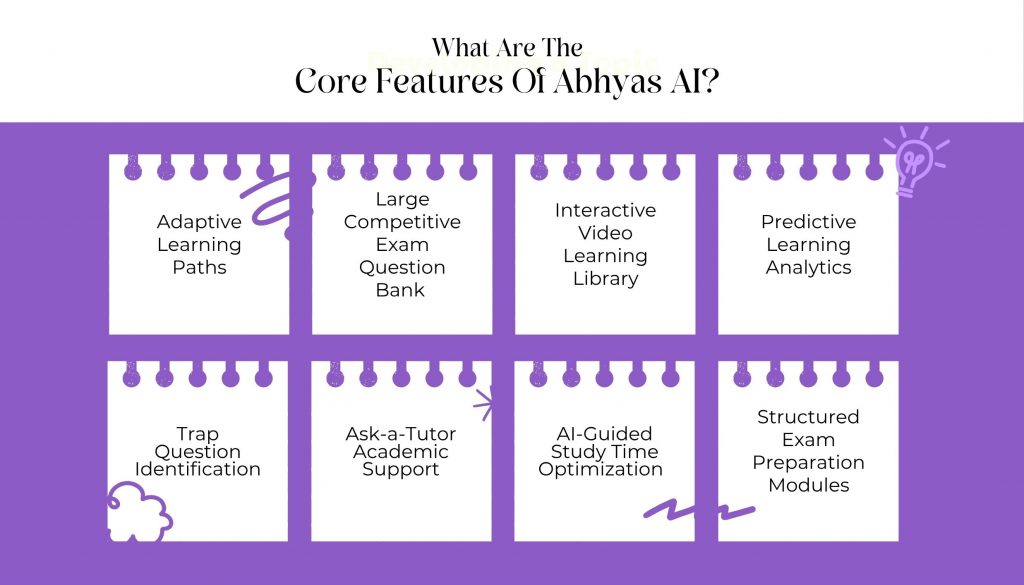
These are the core features of this platform, which make it such a renowned one these days.
1. Adaptive Learning Paths
The platform evaluates student performance and modifies the order of topics accordingly.
It prioritizes areas where students struggle while minimizing redundancy in subjects they have already mastered.
2. Large Competitive Exam Question Bank
With over 300,000 practice questions and more than 600 previous-year exam papers, the system enables students to engage with authentic exam formats rather than just simulated problems.
3. Interactive Video Learning Library
This extensive library offers over 1,000 hours of recorded video tutorials, supplemented with practice exercises.
Additionally, this covers approximately 860 academic topics pertinent to engineering and medical entrance exams.
4. Predictive Learning Analytics
The platform's advanced analytics engine seeks to understand the reasons behind students' mistakes by categorizing them into three types: conceptual gaps, calculation errors, and careless mistakes.
5. Trap Question Identification
The system identifies question patterns that have historically led to negative marking, helping students recognize and avoid common pitfalls during competitive exams.
6. Ask-a-Tutor Academic Support
Students can reach out to subject-matter experts via an integrated messaging system when automated explanations do not adequately address their queries.
7. AI-Guided Study Time Optimization
Rather than promoting repetitive practice across all topics, the platform strategically dedicates study time to areas that still require improvement.
8. Structured Exam Preparation Modules
The platform is organized to facilitate practice and revision for various entrance exams, including JEE Main, JEE Advanced, NEET, and AP EAPCET.
How Does Abhyas AI Identify ‘Trap Questions’In Competitive Exams Effectively?

An intriguing aspect observed during testing is the system's ability to identify what it calls ‘trap questions.’
These types of questions are commonly found in competitive entrance exams.
Additionally, people who craft the questionnaire create this confusion quite intentionally.
This is because they aim to exploit common student errors.
They often feature misleading phrasing and concealed unit conversions.
In addition, they sometimes feature seemingly straightforward calculations that actually contain subtle pitfalls.
Abhyas AI analyzes how many students respond to similar questions.
Moreover, when it identifies a specific question type that consistently yields incorrect answers, the system flags it as a potential trap.
In response, it introduces supplementary exercises to train students to recognize and avoid these common mistakes.
While this feature is not exclusive to Abhyas AI, its integration into the learning path is beneficial.
It helps students identify patterns that could lead to negative marking during exams.
Ultimately, it enhances their test-taking strategies.
What Are The Detailed Content Metrics Of Abhyas AI?
To give you a clear sense of the system's scale, I have created the following table.
It has all the details of the core learning components embedded within the platform's high-tier modules:
| System Resource Asset | Quantitative Volume | Strategic Educational Impact |
| Curated Practice Library | Over 300,000 Questions | Modeled directly after actual exam archetypes to ensure highly relevant practice. |
| Conceptual Video Lessons | More than 1,000 Hours | Features step-by-step breakdowns, from foundational principles to advanced problem-solving. |
| Instant Doubt Resolution | On-Demand Messaging | Connects users directly to subject experts through an integrated "Ask-a-Tutor" support framework. |
How Does Abhyas AI Improve Cognitive Health?
Elite examination boards explicitly design multiple-choice questions with subtle, highly appealing distractor options.
These are commonly known as trap choices.
In addition, these are designed to catch students who rely on superficial memorization of formulas rather than deep conceptual understanding.
Moreover, the analytical engine tracks a student’s response pattern against a detailed matrix of common errors:
| Identified Mistake Pattern | Algorithmic Detection Indicator | System Remediation Workflow |
| Silly / Careless Mistake | High historical accuracy on topic + ultra-low response latency (under 15 seconds). | Temporarily locks the user out of the next question; enforces a manual review of the step-by-step arithmetic sequence. |
| Conceptual Blindspot | Low accuracy on topic + prolonged response latency + selection of high-appeal distractor traps. | Halts the practice loop; routes the user back to a specific 5-minute video segment explaining the core underlying principle. |
| Pacing / Time-Management Failure | Correct answer selection but response latency exceeds the target exam average by more than 150%. | Flags the topic for specialized speed-drills, serving short, time-locked problem sets to build rapid calculation workflows. |
What Are The Pros And Cons Of Abhyas AI?
To understand a platform like this deeply and get the full picture, you must review its extensive list of pros and cons.
As you can see in the table below, it has both prominent pros and consequent cons.
| Pros | Cons |
| Access over 300,000 highly curated questions modeled directly after actual historical exam archetypes. | Subscription costs are heavily tied to specific institutional bundles and can lack upfront public transparency. |
| Provides specialized portals tailored for a wide range of exams, including JEE, NEET, JEE Advanced, and UPSC. | The interface and advanced problem modules can feel overwhelming for students lacking baseline foundational concepts. |
| Uses automated machine learning algorithms to map and isolate continuous conceptual vulnerabilities in real time. | The recommendation engine requires consistent, daily data inputs over several weeks to output accurate study paths. |
| Seamlessly pairs practice sets with thousands of hours of deep video lessons and historical previous-year papers. | Response times within the live "Ask-a-Tutor" support gateway can fluctuate during peak evening study hours. |
| Tracks option-selection paths and response speeds to identify whether a user is falling for deceptive question distractors. | Unbiased, independent student feedback on public app stores is limited compared to legacy edtech competitors. |
| Automatically rebuilds and reschedules weekly micro-goals if a student misses a session due to external commitments. | Functions as an optimization engine; it is not engineered to completely replace human-led classroom coaching. |
Pricing Structure Of Abhyas AI
Investing in an advanced e-learning infrastructure requires absolute clarity on:
- Cost Structures
- Platform Inclusions
- Long-Term Value
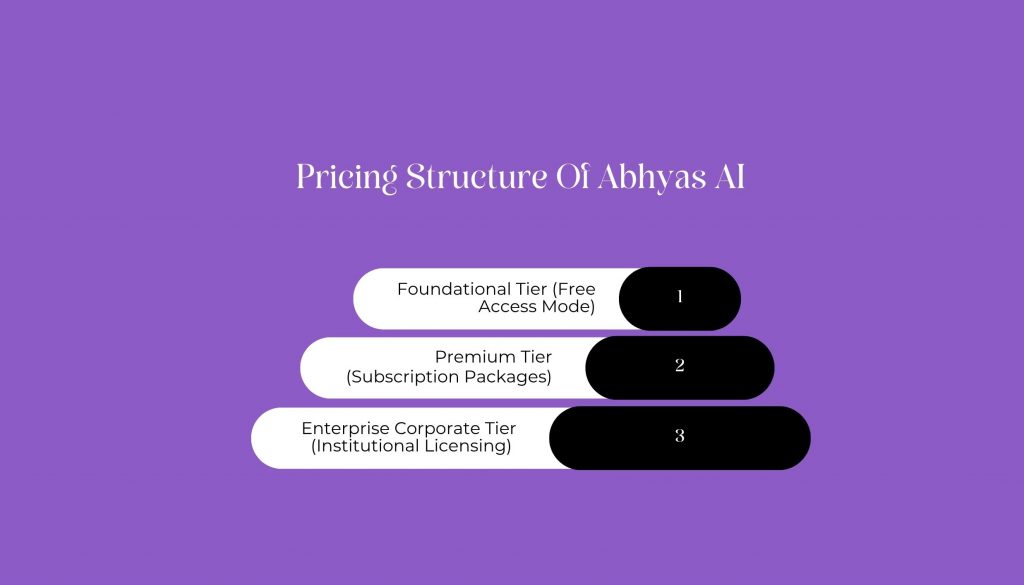
To ensure transparency across its distributed user networks, the access model is split into clear, objective tiers:
1. Foundational Tier (Free Access Mode)
This is the first tier. It provides baseline entry to daily practice questions.
Additionally, you can use this to access a limited number of mock examinations and basic performance dashboards.
Also, this enables students to thoroughly test user interface responsiveness before committing financial capital.
2. Premium Tier (Subscription Packages)
The second tier unlocks the complete 300,000+ question bank and advanced root-cause analytics heatmaps.
In addition, it provides an automated, time-aware study planner and high-definition video lecture modules.
Pricing options vary by examination category.
It typically ranges from ₹1,500 to ₹4,500 per semester package.
Also, you will receive substantial group discounts available for partner institutional rollouts.
3. Enterprise Corporate Tier (Institutional Licensing)
Explicitly designed for physical coaching institutes, colleges, and secondary schools looking to white-label the software framework.
This tier grants human teachers access to administrative dashboards.
Moreover, this allows them to track real-time homework completion and conceptual weak points across entire student batches simultaneously.
Best Practices To Make The Most Out Of Abhyas AI
To ensure you extract the absolute highest return on investment from your digital learning workflow, implement this operational verification plan during your daily study sessions:
- Enter your exact, honest daily availability into the automated study planner to ensure your weekly targets remain sustainable.
- Before launching into a new chapter, review your root-cause dashboard to isolate and fix any lingering weak points from the previous week.
- Actively study the alternative step-by-step solution methods provided in your error logs to train yourself to spot deceptive distractor choices.
- When a question explanation fails to clear up a block, instantly push the item into the messaging gateway for direct expert clarification.
- Utilize the full-length mock test modules under strict time limits once a week to build structural stamina and manage testing anxiety.