



Google Ads MCC: Things To Know About Google Ads Manager

Published on: 04 July 2023 Last Updated on: 11 February 2026
Google Ads MCC

You might be wondering about the best ways to manage your Google Ads account. Well, you do not have to worry much if you have Google Ads MCC. If you want to know more about it, you have reached the right place!

MCC is a Google Ads account type for advertisers or agencies managing multiple client accounts. MCC stands for “My Client Center.” Using a single login, agencies can access multiple Google Ads accounts with the help of the Google My Client Center account.

But is that all that you should be knowing? Well, keep reading this blog till the end to learn more about the same…

What Is Google Ads MCC?  

What Is Google Ads MCC? 

Google Ads MCC stands for Google Ads My Client Center. It is a powerful tool provided by Google that allows advertisers and agencies to manage multiple Google Ads accounts from a single centralized interface. With an MCC, you can link and control multiple client accounts, making it easier to manage and optimize advertising campaigns across various clients or businesses.

According to Google, the “manager account is a Google Ads account that lets you easily view and manage multiple Google Ads accounts (including other manager accounts) from a single location. This article explains where and how to create manager accounts.”

Using a single login, agencies can access multiple Google Ads accounts with the help of the Google My Client Center account. An MCC makes it simple for agencies to view performance statistics across multiple accounts from a single, centralized location because all client accounts can be accessed through a single login.

In other words, MCC is the AdWords account type that lets advertisers use a single interface to access multiple client accounts. Users gain simplified reporting across multiple accounts and additional advanced billing and management features by utilizing an MCC.

Features Of Google Ads MCC  

Features Of Google Ads MCC  

Now that you are aware of what Google Ads MCC is, it is time for you to learn about the features of the same.

Here are some of the features of the Google Ads Manager Account that you need to know:

1. Consolidated Account Management  

MCC provides a consolidated view of all linked accounts, allowing you to navigate between them seamlessly. You can access and manage multiple accounts without the need to log in and out of individual accounts.

2. Efficient User Access And Permissions  

MCC enables you to grant access and permissions to users or agencies at different levels, providing granular control over what actions they can perform within each account. This allows for effective collaboration and management between advertisers and agencies.

3. Streamlined Campaign Management  

You can create and manage campaigns, ad groups, keywords, and ads across multiple accounts simultaneously, saving time and effort. MCC also allows you to easily copy campaigns and settings from one account to another, ensuring consistency and efficiency in advertising strategies.

4. Performance Monitoring And Reporting  

MCC provides aggregated performance data across all linked accounts, allowing you to monitor and analyze campaign performance holistically. You can generate reports at the MCC level or for individual accounts, helping you gain insights and make data-driven decisions.

5. Billing And Budget Control  

MCC offers consolidated billing, making it easier to manage budgets and payments across multiple accounts. You can set budgets at the account level or MCC level, facilitating better financial control and planning.

6. Access To Additional Tools And Features  

Google Ads MCC provides access to additional beneficial features and tools for managing multiple accounts, such as Google Ads Scripts and the Google Ads API. These tools enable automation, customization, and integration with external systems.

How Does Google Ads MCC Work?  

How Does Google Ads MCC Work? 

You might be wondering how the MCC Account for Google Ads works. Well, I have the answer for you!

Google Ads MCC (My Client Center) works by providing a centralized management platform for advertisers and agencies to manage multiple Google Ads accounts. Here’s how it works:

1. Account Creation  

To use Google Ads MCC, you first need to create an MCC account. This is done by signing up for an MCC account through the Google Ads interface.

2. Linking Client Accounts  

Once your MCC account is set up, you can link multiple client accounts to it. These client accounts are the individual Google Ads accounts associated with different businesses or clients you are managing.

3. Access And Permissions  

MCC allows you to grant access and permissions to users or agencies at different levels. You can assign different roles to users, such as account manager, billing manager, or standard user. This enables collaboration while controlling the level of access and actions each user can perform within the linked accounts.

4. Account Navigation  

After linking client accounts, you can navigate between them seamlessly within the MCC interface. This eliminates the need to log in and out of individual accounts and provides a centralized dashboard to manage all the linked accounts.

5. Campaign Management  

MCC allows you to create, edit, and manage campaigns, ad groups, keywords, and ads across multiple accounts simultaneously. You can perform tasks like campaign creation, budget adjustments, keyword optimization, and ad copy updates within the MCC interface, which then reflects the changes across the linked accounts.

6. Performance Monitoring And Reporting  

MCC provides aggregated performance data across all linked accounts. You can monitor campaign performance, view key metrics, and generate reports at both the MCC level and individual account level. This helps you track the success of your advertising efforts and make data-driven decisions.

7. Billing And Payments  

MCC offers consolidated billing, allowing you to manage budgets and payments across multiple accounts more efficiently. You can set budgets at the account level or MCC level, and billing details can be accessed and managed within the MCC interface.

8. Additional Tools And Features  

Google Ads MCC provides access to advanced tools and features like Google Ads Scripts and the Google Ads API. These tools allow for automation, customization, and integration with external systems, enhancing the capabilities of managing multiple accounts.

By utilizing the features and functionalities of Google Ads MCC, advertisers and agencies can streamline account management, campaign optimization, collaboration, and reporting across multiple Google Ads accounts. It simplifies the process of managing and scaling advertising efforts for various clients or businesses.

What Are The Benefits Of Mcc?  

What Are The Benefits Of Mcc? 

Google Ads MCC enhances account management, campaign efficiency, collaboration, and reporting capabilities. It empowers advertisers and agencies to streamline their advertising operations, improve performance monitoring, and drive better results for their clients.

Using Google Ads MCC (My Client Center) offers several benefits for advertisers and agencies. Here are some key advantages:

1. Efficient Account Management  

MCC provides a centralized interface to manage multiple Google Ads accounts. Instead of logging in and out of individual accounts, advertisers can access and control all linked accounts from a single dashboard, saving time and effort.

2. Streamlined Campaign Management  

With MCC, you can create and manage campaigns, ad groups, keywords, and ads across multiple accounts simultaneously. This streamlines campaign setup and optimization, ensuring consistency and efficiency in advertising strategies.

3. Enhanced Collaboration  

MCC allows agencies to collaborate with their clients more effectively. Advertisers can grant access and permissions to users or agencies at various levels, enabling them to work on specific accounts or campaigns. This facilitates seamless collaboration and coordination between multiple stakeholders.

4. Centralized Performance Monitoring  

MCC provides aggregated performance data across all linked accounts, allowing advertisers to monitor campaign performance holistically. You can analyze key metrics, identify trends, and gain insights into the overall performance of your advertising efforts.

5. Customized Reporting  

MCC enables you to generate comprehensive reports at the MCC level or for individual accounts. This allows you to customize reports according to your requirements, providing detailed insights into the performance of specific campaigns, ad groups, or keywords.

6. Budget Control And Billing Efficiency  

MCC offers consolidated billing, making it easier to manage budgets and payments across multiple accounts. Advertisers can set budgets at the account level or MCC level, providing better financial control and planning. This simplifies the billing process and helps manage expenses more efficiently.

7. Access To Advanced Tools And Features  

Google Ads MCC provides access to additional tools and features, such as Google Ads Scripts and the Google Ads API. These tools enable automation, customization, and integration with external systems, allowing advertisers to optimize and scale their campaigns more effectively.

How To Create A Google Ads MCC Account?  
How To Create A Google Ads MCC Account?

A manager account cannot be used to directly create campaigns or advertise products. However, it can be used to create campaigns on behalf of a sub-account that you manage.

Now that you know almost everything about Google Ads MCC, it is time for you to learn about how to create this account for your Google Ads. keep reading this article till the end to learn more about creating a Google MCC account!

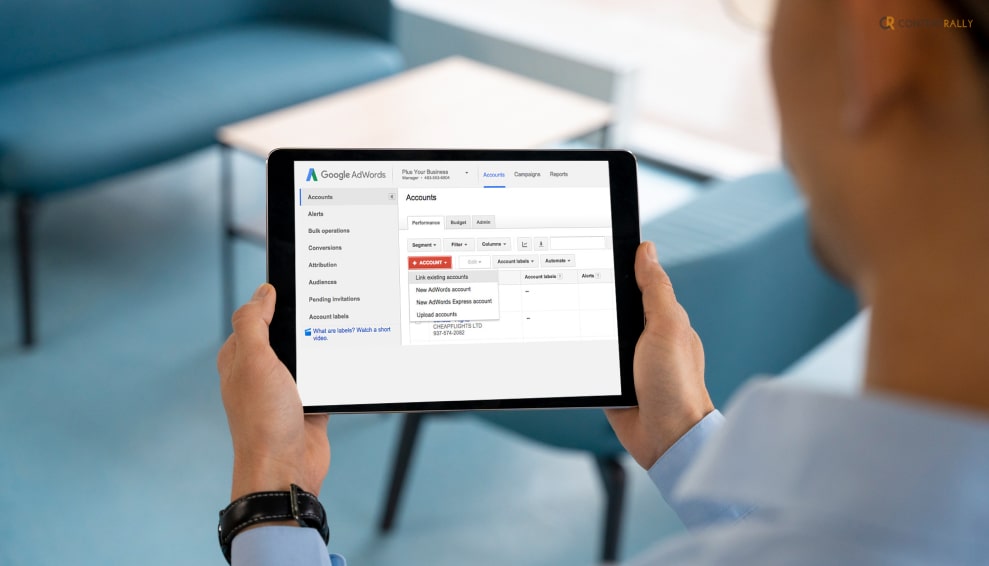
Here are the steps that you need to take to create an Ad Manager Account on Google:

  • Create an account on Google with the Google account you want to use as a manager.
  • Click Create a manager account on the manager account page.
  • Give the manager account a name. In the Access & Security section of the Google Ads UI, this is the name that your merchants see as their manager.
  • Select the account’s use. Choose “Manage other people’s accounts” if you need to manage sub-accounts for other advertisers.
  • Choose your time zone and country.
  • You can’t change the time zone you choose later because it is used for billing and reporting. We suggest picking the time zone where your company is based.
  • Select a fixed currency for billing your account.
  • Choose the currency you use for business, as we suggest. Billing takes place in the currencies of the sub-accounts.
  • Select “SUBMIT.”

How To Create A Manager Account From A Manager Account Homepage?  

How To Create A Manager Account From A Manager Account Homepage? 

In order to create a manager account from a manager account homepage, here are the steps that you need to follow:

  • Click Create a manager account on the Google Ads manager account homepage.
  • Sign in with the email address you want to use to manage your new manager account if you haven’t already.
  • Give the account you’re managing a name. Your customers will see this name in their client account. Note: URLs will no longer be accepted in account names as of March 2023.
  • Select whether you intend to use the account to manage your own Google Ads accounts or to manage those of others.
  • Choose your time zone and country. This time zone cannot be changed because it will be used for billing and reporting on your account. It’s possible that you should pick the time zone where you work. Note: Time zones are immutable.
  • For your account, choose a currency that stays the same.
  • It’s possible that you should pick the currency in which you conduct business. The currencies that have been selected by your client accounts will be used for billing. Keep in mind that you will be able to see any cost-related information converted to the currency used by your manager account when you are checking performance or budget information across accounts in your manager account. In your manager account, find out more about how to convert currencies.
  • To begin, select Explore Your Account.

Wrapping it up!  

Google Ads MCC is a centralized management platform that allows advertisers and agencies to efficiently manage multiple Google Ads accounts, streamline campaign management, monitor performance, control budgets, and collaborate effectively.

In case you were searching for information related to Google Ads MCC and how it can help you, I hope that this article can be of help to you. If there are any other queries related to the same, feel free to let me know. All that you need to do is scroll down till you reach the bottom of the page. Then leave your comments and suggestions in the comment box below.

More Resources:

Ankita Tripathy loves to write about food and the Hallyu Wave in particular. During her free time, she enjoys looking at the sky or reading books while sipping a cup of hot coffee. Her favourite niches are food, music, lifestyle, travel, and Korean Pop music and drama.

View all posts

Leave a Reply

Your email address will not be published. Required fields are marked *

Related

Forex Trader Guide

Forex Trader Guide: How to Start

If you are here, you have probably already decided to run a Forex trading campaign or started considering this as a good online business opportunity. If you want to trade classical Forex or CFDs Forex, you need the truth on how to start, so here is a detailed started guide from actual experts in the field, the Forextb.com team. Let’s start! 1. Learn The Key Principles: Before you start practicing Forex trading through your first demo account, you have to note down and learn the fundamental principles of trading. The list of these short rules will help you even when you get into the professional trading league one day. Don’t expect too much –  All your expectations should be based only on sober judgment. You always have to think of both positive and negative results that can happen when you open the next position and focus on the opportunities rather than on potential profits. The last may cause terrible anxiety and make it impossible to focus on the right things. Don’t invest more than you can lose – Leveraged trading, which makes Forex so attractive, can lead you not only to multiplied profits but to immense losses as well. That’s why you have to avoid investing more than you can payout if you lose. Even if you are 100% sure about a position, don’t try to be in over your head.  Follow the headlines –  Being aware of the markets is incredibly important for every trader. You have to know the entire background of every Forex pair you want to trade to be able to predict the most probable results. Turn off emotions –  Emotional trading is is a failure even if you win the first few times. You should develop a strategy and follow it strictly to the end, without letting your emotions change your decisions. Otherwise, you won’t learn anything from your current strategy and won’t be able to develop a better one. There’s no reason for losing time and money like this.  Get ready to lose – There’s no such trader who doesn’t lose. Even if you look at the trading history of top professionals, you will see multiple losses for every year of their careers. What makes a trader successful is the ability to overcome losses quickly and end up earning more money than losing. 2. Choose a Reliable Broker: Brokers are mediators between you and trading platforms. Technically, they provide you with access to certain trading platforms and charge a certain fee based on the services listed in the agreement. The truth is that brokers can impact the quality of your trading, so it’s very important to analyze all the popular offers and select the one that matches your needs, market standards and has generally positive reviews from the business community and trusted industry experts. 3. Use Stop Loss Orders: Of course, a stop-loss order is not a 100% guarantee that you won’t face losses if the market goes down too fast, but it’s definitely, a way to minimize potential losses. You can set the orders for specific scenarios to be sure that the system will cut you from the falling position automatically until you lose too much. 4. Pick a Strategy & Improve It: There are four main trading strategy categories that cover the vast majority of trading strategies. These common categories include: Scalping – Scalping stands for very short trades that usually take just a few minutes. Scalpers develop strategies aimed at making small profits on multiple trades during the day. One of the most popular examples of scalping is the Forex-1 minute Trading Strategy. Make sure to google it. Scalping is widely considered one of the most advanced trading categories as it requires a trader with a quick, agile mind who can adapt to frequently changing circumstances and understand where the wind blows.  Day trading –  Day trading strategies open and close within the trading day timeframe and last for a few hours. It’s a popular category amongst beginner traders as it provides you with enough time to think and doesn’t overwhelm you with potential overnight market changes. Swing trading –  This category involves trading strategies that last around 2 trading days and stay overnight. It’s quite a risky thing for beginners but can be a great instrument when you have enough experience. Positional trading – This trading strategy type involves following long-term market trends in order to multiply profits on significant currency price shits. Unlike the previous three, this approach is considered long-term and requires traders to be extremely patient and disciplined. There’s no real need to start with your own custom strategy created from the ground up. You can start by testing classic trading strategies that have proved efficient over time and learn what makes them so good while practicing in real-world conditions on your demo account or a real one. 5. Learn to Analyze: The lesson to learn here is that there are two main analysis types:   Technical analysis – This analysis typically involves studying price movement patterns of a specific currency pair or asset. Your aim here is to see historical price trends and try to make accurate predictions on future price movements. This way, you can gain more confidence in the trend you should bid for. You can use indicators, chart patterns, and candle patterns to conduct effective technical analysis. Fundamental analysis – Similar to technical analysis, fundamental analysis involves making predictions, but it focuses on the general economic situation worldwide, including current GDP, interest rates, employment rates, worldwide trade, manufacturing of physical goods, economy-driving commodities, and more. Long story short, fundamental analysis is practically about everything but the price movement pattern. Time to Start a Demo: You can read hundreds of articles, but they are just nothing until you start practicing real-world platforms and instruments. The best way to start right away is to select a reliable broker and open a free demo account to see how it goes. You can practice on a demo account without spending a cent as long as you need to get used to the platform, test your first strategies and try to understand what you feel. Don’t be there too long, though. The real market with real money is the best teacher.  Read Also: How Financial Trading can give you the Life you want Forex Trading Wisdom: Talk Yourself Out of Bad Trades CFD Trading: Everything You Need to Know in 2021  

READ MOREDetails
Company in China

How to Register Your Company in China Fast

Setting up a company in China, possibly a WFOE is one of the best ways of entering a rapidly growing market, which is driven by rapid manufacturing, world-class infrastructure, stable government, and global market reach. To take advantage of this high-potential investment hub, you need to make the first and most important step of registering a company in China. So, how do you go about it? Why China? Why Open a Company in China? As an entrepreneur, the primary goal of starting a business is to see it grow and become a big multinational, but that is only possible with the right platform. This is what makes China stand out from its peers. Everything in China is geared towards making your business succeed. Here are other benefits of expanding your business to China. A large market for your products: One of the factors that you need to get right when determining the place to locate your offshore business is the market size. With a population of more than one billion, investors can rest assured of the great demand for their products. China is the gateway to the Far East and globally too: In addition to the huge local market, China is also strategically positioned, and you can easily access the neighboring Asia markets, including Malaysia, Singapore, India, and Japan. Many areas that you can invest in: There is nowhere else where investment opportunities are as diverse as in China. Although most entrepreneurs are going into manufacturing, you can also invest in agriculture, hospitality, and telecoms, among other areas. Well-developed infrastructure: Whether you are in industrial processing or services sectors, you want an investment hub with well-developed infrastructure that can easily move raw materials, finished products, and labor. In China, both rail and road networks are world-class, allowing you to cut production costs and enhance the efficiency of your enterprise. How to Register a Company in China Now that you know the special benefits of registering a business in China, it is important to appreciate that a business can take several forms, including branch office, joint venture, or a wholly-foreign-owned enterprise (WFOE). However, it is the WFOEs that are more popular because they provide you with full control over your enterprise. To register a WFOE, here are the main steps to follow: Select the business scope. Identify the preferred location. Pick the right business formation. Create a business plan. Submit the company name for pre-registration. Acquire a Letter of Approval from the Ministry of Commerce. Sort all the documents, including a pre-registered Chinese brand, the company’s legal address, articles of association, registered capital, and feasibility study. Register your businesses with the Public Safety Bureau. Open your company bank account and register with the tax bureau. Every year, China is emerging as the business hub of choice for investors, and you should not be left behind in taking advantage of this high potential jurisdiction. Remember to follow the process of registration carefully, ensuring to get all the required approvals and documentation. When it comes to business, you cannot go wrong with China. Read Also: How To Effectively Promote Your Company 6 Benefits of Working with a Managed IT Support Company

READ MOREDetails
entrepreneurship

What Is Entrepreneurship?: Types And Characteristics Explained In Details [Updated 2022]

With the global pandemic of the year 2020 due to the onset of the coronavirus, many people lost their high-paying jobs. With large-scale unemployment, people worldwide started reconsidering the notion of the “stable” job. This was one of the main reasons that they started their own business. Have you ever wondered about building an organization? About starting your own business? If this thought has ever crossed your mind, you may have thought about becoming an entrepreneur. Heard about the term but didn’t quite know what it is? Then, you have come to the right place. In this article, I will guide you on the concept of entrepreneurship and the types and characteristics of the same. So if you want to know more, stick till the end. Read More: How Many Types Of Entrepreneurs Are There What Is Entrepreneurship? Entrepreneurship is the process by which an individual takes the risk to start their own business and run it successfully. You can consider it to be one of the essential points in society. It is one of those resources that economists consider integral to production. However, economists have not consistently defined the exact definition of “entrepreneurship.” However, you can connect it to the natural resources, land, labor, and the capital that we invest in, which has the possibility of generating profit. Every nation values the practice of entrepreneurship because it makes the country stand out more in the global marketplace. Who Is An Entrepreneur? Do you think you have the ability to create and run your own business successfully? And also dare to bear the risk of failure? Well, you might just be capable of being an entrepreneur. While the process of starting your venture and running a business of your own is called entrepreneurship, the one who does that is called an entrepreneur. In order to become an entrepreneur, you must have the desire to start a new venture and administer it to run successfully. But, along with that, you also need to keep in mind that you might have to face failures and even incur losses a few times. In other words, a person who is determined to open a startup and run it successfully while dealing with all the risks of losses is called an entrepreneur. Entrepreneurs have a significant role to play in the economy. They use their skills and business acumen to initiate their journey and bring success to their business and the market in general. Related: Business Tips For Beginner Entrepreneurs Entrepreneurship: Characteristics There are a specific set of skills that one needs to have if one wants to become an entrepreneur. Some of them are below: 1. Risk-taker Because it takes a lot of courage to start an entrepreneurial journey, the essential characteristic for a person to have if they want to become an entrepreneur is the will to take the risk. Entrepreneurs are never too scared of taking risks. They jump into the field knowing the fact that they might incur losses. However, they also know that risk is just an opportunity to learn something new about the market, their business, and themselves.  2. Networking Building and managing the relationships that one business owner has with other professionals help them grow the business. Therefore, one of the most desirable skills for entrepreneurs is to be able to network. It can open up many future opportunities and support the entrepreneur in building a brand with a solid foundation. It also allows entrepreneurs to meet other like-minded professionals and build future collaborations and teams while staying updated with industry trends. 3. Communication It is crucial to communicate with your clients and equally essential to communicate with your employees. Business owners or entrepreneurs require excellent communication skills through verbal communication or messages and reports or emails about the project. This makes sure that the work or the project is executed effectively and reduces the chances of miscommunication. 4. Critical Thinking An entrepreneur should be able to look through the data and information present at hand and arrive at a rational conclusion. This benefits the business. The skill of thinking about a solution critically is essential. It helps business owners connect with ideas logically, scrutinize the information at hand, find if there are any inconsistencies at work, and solve complex issues. Know More: Large Company Entrepreneurship: Definition, Pros, Cons 5. Creative Thinking Being creative is a gift that no one can take from you. So if you want to be an entrepreneur, you should make sure that you can think creatively. We can often consider it to be the backbone of innovation. It is one of the reasons that forces employees to think differently. This makes sure that the business grows innovatively. 6. Leadership Skills One of the most important things an entrepreneur needs is the skill to be an excellent leader. They should be able to inspire their colleagues or those working for them and empower the workforce. Frequently Asked Questions (FAQs): 1. What Does Entrepreneurship Mean? Entrepreneurship is the process through which an individual starts or creates their own business and can run it successfully. 2. What Are The Types Of Entrepreneurship? When it comes to the different types of entrepreneurship, there are many. Some are large company entrepreneurship, social entrepreneurship, startup entrepreneurship, and small business entrepreneurship. 3. What Is The Importance Of Entrepreneurship? There are many reasons why entrepreneurship is essential. It increases the standard of living, encourages creativity, supports innovation, and offers employment. And That’s A Wrap! With the rise of unemployment in many parts of the world due to the pandemic of 2020, many people started rethinking the idea of a stable job. This was one of the reasons why most of them began to open businesses. They started their entrepreneurial journey, no matter how big or small they were. The ability to run a business while dealing with the possibility of incurring losses is essential for an entrepreneur. While keeping that in mind, several characteristics are necessary for becoming an entrepreneur. Some of them are the ability to take risks, communicate, and other leadership skills. So, if you think you have any of the characteristics stated above to be an entrepreneur, it might be your turn to try and set out on a new venture! Read More: How To Become An Entrepreneur? A Brief GuideMargin Trading Tips & Strategies For BeginnersWho Is An Intrapreneur? Definition, Characteristics, Pros/Cons

READ MOREDetails