



Top Interview Skills You Need to Ace The Job Interview

by

23 September 2024

Job & Career

Interview Skills

Got called for an interview for that dream job you have wanted for a long time?

Well, congratulations for starters! Secondly, are you ready with the top interview skills? Ensuring that you are putting your best foot forward!

Do not worry, this doesn’t automatically mean you are underprepared. Your confidence to ace the interview will get half of the job done!

However, to improve your interview game, you should know what the experts say about a guaranteed interview win.

Especially the skills that can help you achieve that goal!

Top Interview Skills – Preparing For A Win

Top Interview Skills – Preparing For A Win

A good interview is more than just an opportunity to show off your resume or learn about a new company.

It’s about having key interview skills to help you shine above the competition. From communication skills to problem-solving abilities, here are the skills you need to start polishing.

Got an interview for your dream job? Great!  

The tricky part is getting the job.  

But don’t worry, I’m here to help with your interview prep. Let’s begin with the following:

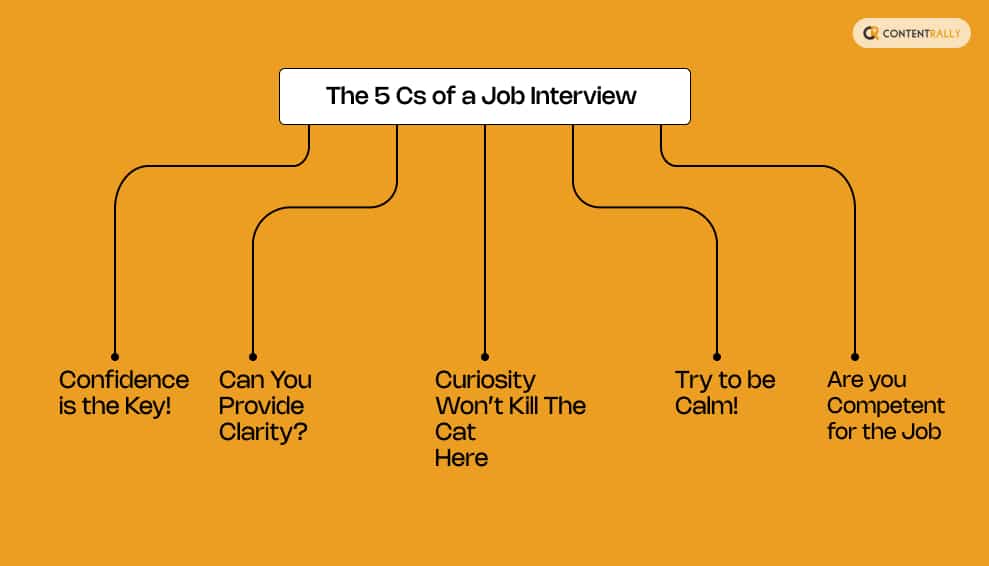
The 5 Cs Of A Job Interview
The 5 Cs of a Job Interview

Here’s a job interview preparation framework: the 5Cs. Five qualities you should try to convey at your interview to be successful.

1. Confidence Is The Key!

Confidence is indeed the key. Employers want to hire people who can perform well under pressure and believe in their abilities.  

You can come with many skills, but how would they know if you cannot showcase them?

However, keep in mind that confidence doesn’t have to be loud and on someone’s face.

There’s a fine line between confidence and arrogance. Be assertive but also respectful and open to learning.

How do you express confidence?  

Start with eye contact, a firm handshake, and positive body language. Know your strengths, but also be ready to discuss your weaknesses and how you’ve worked to improve them.

2. Can You Provide Clarity?

Be clear and concise with your words.  

Stuttering, pausing, or slipping in thoughts will make you appear unconfident. This doesn’t mean you cannot pause between your answers. Whenever you feel like you need to take a break, always do so with confidence.

It will also give the impression that you didn’t memorize the answers but rather know how to have a proper conversation.

Take it slow, and do not chew on your words. It makes the interviewer aware of nervousness! Plus, learn how to answer basic interview questions using clear & succinct lines. Don’t be absolutely clueless there and take your time thinking.

The more focused your answers are, the better you can convey what you think.

3. Curiosity Won’t Kill The Cat Here

Be curious about everything and always be ready to learn. Curiosity keeps the mind engaged and open to new ideas and possibilities, making you a better problem-solver and decision-maker. Plus, your curious questions can also hold the conversation better.

Show genuine interest in the role and company. It is not a surprise that employers love a candidate who is inquisitive and shows they are keen to learn/grow. Ask questions about the company culture, future goals, challenges, etc. Here are some of the unique interview questions to ask employers.

4. Try To Be Calm!

Staying calm is most important in any kind of interview situation. Being mindful, calm, and present are some of the top interview skills out there!

I know it is not easy, and you are totally panicking if it is a dream job, and you do not want to mess up!

But trust me, thinking and losing your sleep over it will not bring you any positive results. The employer wants to see if the person can think clearly and answer thoughtfully, even if you are nervous.  

So, take a deep breath, smile, and if you need a few seconds before answering, that’s alright!

5. Are You Competent For The Job

Again, it could be a dream job, but do not apply for a role (especially in a higher position) if you are not sure!

This is one of the reasons why understanding your competency for the job is crucial. It is not about putting yourself down but knowing your strengths & weaknesses well.

If needed, you can also ask the recruiter beforehand to explain the job role in detail.

Your experience will show your Competence, skills, and how much you know about the job you are being interviewed for. Read the job description properly and respond in a targeted way, describing how your experience fits the role.

Dos & Don’ts Of An Interview

Dos & Don’ts of an Interview

Knowing what to do and not do in an interview can make all the difference. Here are some important dos and don’ts to help you present yourself as a true professional.

Here is what you should do during your job interview:

Do Some Company Research

Before you even get to the interview, make sure you know what you’re getting into. You’ll be able to answer and ask questions more effectively if you’ve taken the time to learn about the company’s history, culture, and goals.

Do Dress Appropriately

First impressions are everything. Dressing appropriately will show that you take the interview seriously and understand the company’s culture. When in doubt, dress business casual unless the culture of the company says otherwise.

Do Listen Attentively

An interview is a conversation, not an interrogation. Listen to what your interviewer is saying and respond accordingly.  

Being a good listener is also one of the crucial interview skills. This will demonstrate that you can work well with others in the workplace.

Now, here is what you shouldn’t do.

Don’t Over-talk Or Interrupt

While it’s important to provide thorough answers, you don’t want to monopolize the conversation. Answer the question and then stop talking. Let the interviewer guide the discussion, and don’t talk over them.

Don’t Say Anything Bad About A Former Employer

Don’t badmouth your former employer Even if you didn’t have a great experience at your last job.

Potential employers are looking for candidates who can remain professional and positive in difficult situations.

Which Skills Do I Need In An Interview?

Which Skills Do I Need in an Interview

Interviewing is all about presenting your best self, and that starts with showcasing your skills. You don’t just want to show that you’re qualified on paper.

Yes, you also want to demonstrate that you can effectively and comfortably communicate your qualifications in person.  

So, here are the top six skills employers look for when they interview candidates!

1. Clear Communication

Clear and effective communication is key for any successful interview. You need to articulate your thoughts, respond to questions, and share your views in an easy-to-understand manner.

Practice speaking clearly and using professional language without unnecessary jargon.

2. Critical Thinking

You may be a natural problem solver and excel in critical thinking or need to work on it. If the latter is the case, it is time for you to polish your critical and quick-thinking skills. A good way to do so is by joining a workshop on interview skills.

Many employers will want to know how you have dealt with difficult situations in the past. Here is your opportunity to let them see your problem-solving skills.   

Think of examples when you devised creative solutions to hard problems.

3. Adaptability

In today’s ever-changing job market, flexibility is the name of the game. You cannot be afraid of change and think you will fixate on the same skills and the same means for years on end.

The whole corporate scene is getting dynamic, which means there is a new change at every corner. Therefore, demonstrate that you can adapt to change and be open to new ideas and challenges.  

You can also give examples of when you were forced to be fluid and how you thrived in a new environment.

4. The Ability To Lead

Leadership skills are essential Even if you’re not applying for a management position. After all, you would want to give the impression that one day you will be capable enough to lead a team.  

Especially if someone asks you about your five-year plan, this shows that you can take initiative, guide others, and make decisions when needed.  

Share examples where you demonstrated leadership qualities, even in small tasks or team collaborations.

5. Technical Skills

The digital trends are growing at an unsteady pace, and you will need to adapt quickly!

For many positions, you’ll also need specific technical skills, whether it’s the ability to use certain software, machines, or tools or expertise in a particular methodology.

Familiarize yourself with the technical skills needed for the position and mention them in your response.

What’s The Best Answer To “Tell Me About Yourself”?

Ah, the dreaded “Tell me about yourself” interview question! No amount of interview skills can prepare you for that!

This one is tough because it’s so open-ended. Yes, you don’t want to give too much away and tell your life story, but you also need to give a well-rounded answer. Here’s how to nail it.

First, give a quick background of your career thus far, including only things that are pertinent to this job application. Briefly mention a few big achievements that might pique their interest (make them want to keep reading!).  

Then, please talk about your skills and how they relate specifically to this role. Finish your statement by explaining why you’re excited about this opportunity and how you’ll help the company as a result.

Here Is A Good Example Of This Question: 

“I’ve spent the past five years working as a digital marketing specialist, where I helped companies grow their online presence and customer engagement. I got to work on some cool campaigns, like a social media campaign that increased our client’s online sales by 30%.

Not only did I learn the ins and outs of SEO, content strategy, and data analytics in my role, but this is also what you’re looking for! I’m super excited to bring my skills to your team and help drive your digital marketing efforts!”

You should also read 10 interview questions, for better preparation!

Read Also:

Content Rally wrapped around an online publication where you can publish your own intellectuals. It is a publishing platform designed to make great stories by content creators. This is your era, your place to be online. So come forward share your views, thoughts and ideas via Content Rally.

View all posts

Leave a Reply

Your email address will not be published. Required fields are marked *

Related

Best Paying Jobs In Energy

Best Paying Jobs In Energy

Over the last decade, job requirements in the energy industry are proliferating in leaps and bounds. Especially when it comes to the renewable energy industry, a sharp hike is observable in their popularity.  In this context, one of the most frequently asked questions is what are the best paying jobs in energy? You may also wonder if energy is a good career path! These are quite natural to ponder upon if you choose the energy sector as your ultimate career destination.   Indeed, these are super tricky questions if you take your personal skills, career goals, and existing industry opportunities into account. There is no need to pressurize yourself; because we will speak about the best paying jobs in Energy industry in 2021.  Background Information About Jobs In Energy Choosing a career is critical, but what’s more difficult is verifying whether a particular career direction is opportunistic or not. Is energy a good career path? What are the best jobs in the energy field? Do energy jobs pay well? What is the best solar energy job salary? All these questions might be forming clouds in your head - right?  Well, leaving aside the negative and positive sides, the energy sector is one of the most prospective career directions. Owing to the social and political support, this sector is of utmost importance in every country. Do you want to explore some merits and demerits of it before hopping on to the best paying jobs in energy? Let’s go!    Advantages Of Careers In Energy Undoubtedly energy jobs are prosperous; particularly, renewable energy jobs have endless career directions with lucrative remunerations. Let’s pinpoint some core benefits of the best paying jobs in energy: Attractive salary packages  Development of technical and soft skills Strong career goals due to robust industry infrastructure There is a steady growth in this industry The energy sector is ever-changing with lots of new opportunities.  Disadvantages Of Careers In Energy No job sector is perfect because of the potential challenges residing in every industry. Energy is also not an exception in this regard. Some demerits of energy-related careers are as follows: There are high upfront costs As it is evolving consistently, you have to keep updating your skills and knowledge. Only people with specialized and high technical attributed get chances High probability of exposure to fatal rays and chemicals   What Are Some Best Paying Jobs In Energy? Now that you have some sound ideas on careers in energy, it’s time to know what are some best paying jobs in the energy sector. In the table below, we have jotted down the top 7 best paying jobs in energy you must know in 2021. This section will guide you to your end question - is energy a good career path? Job Profile  Educational Criterion  Salary (per annum) Experience  Chemical Engineer  Master’s in chemical engineering or industrial chemistry  $108,770 None  Green Construction Manager  Bachelor of Sciences, training in green construction.   $145,000 5 years+ experience in similar fields Data Scientist  Master of Technology in Information Technology, or computer sciences  $97,870 2-5 years of experience in similar fields Solar Project Manager  Bachelor’s in Science, Pro level training in solar project management   $138,500 5 years+ experience in similar fields Petroleum Engineer Master of Science in Petroleum Engineering $137,720 None  Materials Engineer Masters in computer programming, chemical sciences, mathematics.  $93,360 None  Environmental Engineer Biological or chemical engineering, Master’s in environmental sciences $88,860 None  Geoscientists  Master’s in Geology, Geography, Applied Geology, Earth Science, and Geological sciences  $120,253 2-5 years experience Wind Farm Site Manager Bachelor’s in Science, Pro level training in Wind installation and project management $125,780 None  Which Educational Backgrounds Are Preferable For Energy Industry? There is not a single job in the energy industry. For the millions of career opportunities here, the educational qualifications are also multidimensional. Check out what academic backgrounds you need to have for cracking some of the best paying jobs in energy. 1. Information Technology The energy sector is heavily dependent on data. Energy giants BHP Billiton, Royal Shell, Chevron Corporation, etc., have expert IT teams who manage huge volumes of big data. So candidates with IT backgrounds are always welcome.  2. Engineering The energy sector is all about applying scientific understanding to solve real-world problems. So engineering candidates with practical knowledge have high demand in this sector. 3. Business Administration You have to gain business administration degrees if you want to acquire leadership and executive positions in the energy industry.  4. Mathematics, Chemical Science And Physics Mathematical skills, analytical abilities, in-depth knowledge in physics and chemistry are MUST for joining best paid jobs in energy. As you have to deal with scientific elements, possessing expertise in these areas is mandatory.     Is Energy Sector Worthy To Build Your Career? - The Judgement I hope there is no need for any more explanation now. The above-discussed areas have answered all your queries. Firstly, to reply to your question “what do the energy jobs pay,” they pay extremely well if you have the desired skills and qualifications.  Moreover, all the best paying jobs in power generation require intensive self-study and research. With the increasing demand for renewable energy resources, the number of best paying jobs in energy is also increasing. It is expected, in the upcoming years, renewable energy will attract 70% of the global energy investment. So, there are some incredible careers in energy, especially renewable energy jobs waiting for you.  Considering all the above factors, it is possible to say that - YES, Energy Industry Is A Good Career Path in 2021. Also, you will find some of the best paying jobs in energy if you meet all the criteria.  Frequently Asked Questions Q1. What Skills Are Required For the Best Paying Jobs In Energy? Some of the skills required to apply in the best paying jobs in energy are: Mathematical skills Deep knowledge in advanced sciences,  Analytical skills Critical decision-making skills Computer Programming Q2. What Are Some Best Renewable Energy Jobs? Remuneration is always high when it comes to renewable energy jobs salaries. Some best paying renewable energy jobs are: Renewable Energy Designer Solar Project Developer Green Construction Manager Renewables Estimator Wind Operations Leader Q3. What Do Energy Jobs Pay? The average annual salary in the energy sector is $90,806. All the best paying jobs in energy fall under this category. Hence, this sector is good enough to kickstart your career.  Q4. Are Energy Careers in high demand? The shortest answer is Yes. Without energy, the world will never run. Moreover, the market is hoping to make significant value in the upcoming years. Therefore, careers in energy are expected to be in high demand in the coming years.  The Final Verdict  To summarize, careers in energy have limitless possibilities. Not only salary but also in terms of professional development, the jobs energy sector is a promising one. So what are you waiting for? Shortlist your preferences and start applying today. I am sure you will come out with flying colors. I hope this article was able to provide you with the necessary information about the best paying jobs in the energy. Did we miss something? Drop your opinion or query in the commenting area below, and we will be resolving those in no time. Read Also: Is Electric Utilities Central A Good Career Path Is Business Services A Good Career Path Is Hotels/Resorts A Good Career Path

READ MOREDetails
How Long Does It Take To Become An Orthodontist?

What You Need To Know Before You Decide To Become An Orthodontist?

In actuality, orthodontists undergo specialized training that qualifies them as specialists in tooth straightening. They must complete two to three additional years of coursework. Then, they can become an orthodontist and obtain a certification in orthodontic care. Orthodontists treat a wide range of dental alignment problems, commonly referred to as "malocclusion." This comes after receiving their license and certification. For patients of all ages, they employ precise clinical techniques to align teeth safely and effectively and create healthier dental structures. If you've ever received orthodontic treatment, you've probably seen the amazing outcomes these skilled medical practitioners help you achieve. Even though becoming an orthodontist is a difficult, competitive, and costly career path, orthodontists benefit from high pay, excellent work-life balance, and a welcoming, social, teamwork-based environment. Are you interested in this field? Do you want to know how long does it take to become an orthodontist? Keep reading to learn how to work in this area of medicine. How Long Does It Take To Become An Orthodontist? The study that goes into orthodontics is pretty massive, and it remains a lifelong process. Orthodontists take up a subject that costs an incredible sum but pays too well in the long run. If you are curious as to how long it takes to become an orthodontist, you are not alone. Education And Training Requirements In order to become an orthodontist, there are levels that need to be crossed. Here, we are discussing it in detail. This should give you an idea of how long it take to become an orthodontist. Finish Dental School To Become Licensed In order to become an orthodontist, one must first earn a doctorate in dentistry and obtain certification as a dentist. You must complete a bachelor's degree (though some colleges offer a combined degree program) in order to get admission to a dental school. You will also need a passing score on the Dental Admission Test (DAT). Like medical schools, dental schools are extremely demanding and competitive. Additionally, they are expensive. Depending on the program, a dental school degree can cost anywhere from $150,000 to $300,000. Fortunately, the majority of dental professionals discover that the expense of school eventually pays off because dentist as well as orthodontist have high salaries. According to the U.S. News, dentists make a median salary of $151,850, while an orthodontist's salary is $208,000. A doctor of dental surgery (DDS) or a doctor of dental medicine (DMD) are the two categories of doctorates. Depending on your program, the distinction may exist, but you can practice dentistry with either certification. Dental schools typically offer four-year degrees. Typically, the first two years go by in a classroom, studying topics like oral pathology, anatomy, biochemistry, microbiology, and radiology. Students will study under a licensed dentist for the next two years in order to gain experience treating patients in a clinical setting. Orthodontic Residency In their final year of dental school, prospective orthodontists apply to orthodontic residencies; upon earning their DDS or DMD, they will become certified dentists and be eligible to start an orthodontic residency. In addition to taking and passing the National Board Dental Examination, dentists who choose not to pursue further education must also fulfill their state's licensing requirements before they can start practicing. Although dentists are still capable of providing orthodontic treatment, they lack training in this area specifically. As a result, the majority of dentists working today are registered orthodontists who have finished a residency. The term "orthodontist" is exclusive to those dentists. An orthodontic residency is your next step when becoming a licensed orthodontist for those who want to work as full-time practitioners of orthodontics. It is often attached to a university. How To Get Into An Orthodontic Residency Program? It's tough to get into an orthodontic residency. Only one spot is available for every fifteen applicants, according to the American Association of Orthodontists. The best method to secure a spot in an orthodontic residency is to graduate in the top percentage of your dental school class. A prospective orthodontist may submit multiple applications before being admitted to a program. The National Board Dental Examination is the national licensing exam that dentists must pass in order to be eligible to apply to most residency programs. Unless you failed the exam and had to retake it before applying to schools, you won't need to take a break between dental school and your orthodontic residency because this exam is valid during dental school. The American Association of Orthodontists' database has a list of orthodontic residencies that have received CODA accreditation. Both the United States and Canada offer the programs on this list. Most states accept orthodontic training from Canada. However, individuals who have received orthodontic training abroad will probably need to retake their studies in the United States. That, if they want to practice dentistry or orthodontics there. Residency programs range from 3-5 years, depending on the organization. Orthodontists receive extensive training in both the art and science of orthodontia during their residency. They learn about the proper alignment of dental, jaw, and facial mold, as well as how to move teeth in a safe and effective manner. How many years does it take to become an orthodontist, you ask? Their time learning the science is much shorter than their time in practice. Orthodontists who complete a residency program will have treated hundreds of patients, providing them with extensive knowledge in this field. Salary Of Orthodontics While some orthodontic residencies don't charge their residents, others do. If they do have compensation, it usually takes the shape of a stipend, which is a modest yearly sum used to pay for conference travel or some other necessities. Compared to university residencies, hospital residencies are more likely to provide a stipend. Due to its exceptional location and exceptionally high stipend (first-year residents earn over $51,000), this program is highly competitive. For example, Montefiore Medical Center, Bronx, New York.. This program provides top-notch training along with a $60,000 stipend for the duration of the residency.  Getting The License You will be qualified to begin orthodontic practice after completing an orthodontic residency successfully. In order to accomplish this, you need to have fulfilled both the state licensing requirements in the state in which you plan to practice dentistry and the national dental board exam. Like dentists, orthodontists must meet the same licensing requirements. Orthodontists have the option of earning board certification from the American Board of Orthodontics (ABO), though practice in the United States does not require board certification (only in Canada does). Written and clinical exams are required for orthodontic board certification. Visit the American Board of Orthodontics website to find out more about obtaining board certification. Before starting their residency, the majority of orthodontists had already passed the National Board Dental Examination. Throughout their careers, all practicing medical professionals are required to recertify and complete continuing education requirements. States have different requirements for licensing, but most of them ask you to pass a "jurisprudence exam," which measures your familiarity with the dental laws of that state. The state-by-state licensures database maintained by the American Dental Association provides information on dental licensing requirements in each state. Additional clinical exams or requirements may apply. Staying Licensed Just like all other medical professionals, orthodontists must maintain current licensures through regular recertification and continuing education. Dentists and orthodontists are required by law to complete 40 hours of professional education annually in most states. In order to give their patients the best possible care, dental professionals are kept up to date on the most recent clinical and research advancements in their fields. The requirements for renewing a dental license vary by state; for more information on how to maintain your license current, contact the dental board in your state. Wrapping Up So, how long does it take to become an orthodontist? Residency programs vary in length, from three years to five years. Throughout their residency, orthodontists learn from experts in the field to ensure safe and efficient advancement. It provides them with a thorough understanding of this specialty. This entails staying updated about conducting clinical examinations, obtaining and analyzing diagnostic records, providing appropriate direction for dentofacial orthopedics, etc. Key traits that an orthodontist should have include patience, effective written and verbal communication, and the capacity to clarify difficult ideas. These come in handy when dealing with children and teenagers, who make up the bulk of orthodontic patients. You need to apply for and obtain a separate orthodontics license from your national registering body or dental board in addition to your dentist license. It might call for passing a test. After earning your orthodontics degree and license, you can easily find employment or open your own practice!If you have thoughts to share or questions to ask about how long does it take to become an orthodontist, ask us below. We would love to hear from you! Learn More About: Why Going To The Dentist Is A Must? The Ultimate Guide To Finding The Best Dentist In Vaughan Radiant Smiles: A Guide To Different Types Of Dental Implants

READ MOREDetails
slider-img

How Do I Qualify for High Paying Remote Jobs?

In today's world, high paying remote jobs are no longer just a trend. It’s a lifestyle and a serious career choice for many. The dream of not having a commute and working from the comfort of your home is real. Plus, you do not have to sacrifice salary for flexibility (or, on long commutes).  Yes, you can find high paying remote jobs that allow you to build a successful career while enjoying the freedom of working from anywhere. Sounds amazing, right? But where do you start? What are these jobs, and how do you land them? Let’s explore some of the top high-paying remote jobs, and how to get them! Software Developers Developers are emerging as the highest-paid profession in most countries. The best bit about this is the number of companies hiring talented coders, so hunting for a job won’t be tough. Software developers are in high demand currently. Whether it’s creating an app or building a web platform, developers write code that makes anything a digital tick.  Since every industry relies on technology today, companies are willing to pay a high price for talented developers. Average Salary: $80,000-$140,000 a year, depending on your experience and what you specialize in.  What You Need: Advanced proficiency in programming languages (e.g., Python, JavaScript, Ruby). Experience with databases and frameworks. Being able to problem solve and pick up new technologies on the fly. How to Get Started:  You can make a portfolio by contributing to open source or freelancing on sites like GitHub and UpWork, and project management doesn’t require a formal degree. Training camps and online project manager courses are enough! Project Managers Project managers are the ultimate team players, and one of the high paying remote jobs! They run projects from A to Z, ensuring everything runs smoothly and on schedule.  They also ensuring all resources are being utilized properly and everyone’s in the same book (if not on the same page sometimes). Most industries need excellent project management to function – from tech to marketing. Average Salary: $70,000 - $120,000 a year. What You Need: Strong organizational skills. Leadership and communication abilities. (aka, the most important conceptual skills) Understanding of project management tools like Asana, Trello, or Monday.com. How to Start: You can start by learning project management frameworks like Agile or Scrum. There are plenty of certifications like PMP (Project Management Professional) that you can add to your resume.  It is not a degree course, but if you have an MBA degree, it can help your cause more. If you have some experience leading some projects, even on a smaller scale, it’s a good place to start. Digital Marketing Manager Digital marketing roles have been around for over a decade, and they haven’t gone out of fashion yet. Then why is there a high demand for them now? This is because businesses are starting to realize that digital marketing is the path to follow when looking to increase your business’s bottom line. No business nowadays can be successful without the aid of being digital everywhere! But what does a digital marketer do?  Turns out it's not just posting blindly on your company's social media business pages but devising a full-blown data-driven strategy. This will likely help transform their organization's online presence and drive revenue. As more and more businesses go online, the role of a digital marketing manager is becoming one most companies can't do without.  Who can blame them? These folks are multitalented, looking after everything from SEO to social media strategy, working to promote the company’s online presence and help them find new customers. So, if you’re a whizz at digital marketing, there’s plenty of money to be made working from home. Average Salary: $60,000 - $120,000 a year. What You Need: Knowledge of digital marketing tools like Google Analytics, Facebook Ads, and SEO strategies. Strong writing and communication skills. The ability to analyze data and pivot strategies based on performance. How to Get Started: Get experience by working on your websites or doing low-paid gigs for family and friends who need design help.  You can also take inexpensive online courses that don’t require a degree program (like this one) to learn the basics at your own pace and on a budget. User Experience Specialist Are you someone well equipped with consumer psychology and a Picasso at designing? Then this is among the best high paying remote jobs for you! In a world where user experience (UX) can make or break a product, companies are pouring money into UX/UI designers. These are the ones who make sure that apps, websites, and software products are easy-to-use, intuitive, and visually pleasing. Average Salary: $60,000 to $121,006 per year in United States. What You Need: A good grasp of design tools like Figma, Sketch, or Adobe XD. Knowledge of user research and testing methodologies. Creativity and attention to detail. How to Get Started: If you don’t have formal education in design, you can learn almost any skill online now. Use tools like Coursera or Udemy and start building a portfolio of designs by creating mockups or redesigning some web apps. Cybersecurity Expert With data breaches and cyber threats on the rise, companies spend more on cybersecurity than ever before. Cybersecurity analysts protect a company’s data and systems, making it a high-demand, high-paying remote job. Because the demand for these jobs is so high, both government and private industry organizations are desperate to get their hands on talented individuals who can help them secure their computers and networks. Especially after the Covid19 these jobs are seeing a surge, since everything is online now. One data breech can lead to losses of millions! Average Salary: $90,000 - $150,000 a year. What You Need: In-depth knowledge of network security, encryption and ethical hacking. Certifications like CISSP (Certified Information Systems Security Professional) or CEH (Certified Ethical Hacker). You’re going to need both deep and wide knowledge of the business you’re in.  How to get Started: Cybersecurity is a technical field, so it helps to have a background in IT or computer science. If you’re new to the field, plenty of certification programs and online boot camps could give you a good head start. Content Strategist In the digital world, content is still the king! Yes, the advances in AI are helping to create words with a click but creating a strategy that will work is not that simple. This is why companies need people who can create compelling and strategic content to drive traffic, mostly who will engage users on-site and communicate a brand's message.  Content Strategists are also responsible for planning, creating, and managing all types of content — from blog posts to video scripts...literally everything! Average Salary:  60,000 - 100,000 per year. What You Need: Strong writing and editing skills. Knowledge of SEO and content management systems (CMS) like WordPress Can you develop and execute long-term content strategies? Where to Begin:  If you’re a writer at heart, start a blog or write for publications online to gain clips. Freelance your content creation services to small businesses or startups to get some experience under your belt. With your experience and a little upskilling, you can also branch out to market research analyst and increase your salary bracket. Data Scientist Data is everywhere and companies need data scientists to make sense of it. These professionals collect, analyze, and interpret large sets of data to help businesses make more informed decisions.  This is what makes it one of the most in-demand remote jobs with a salary to match. Average Salary: $90,000 - $160,000 a year. What You Need: A decent grasp of programming language, e.g., Python/ R. Analytical bent of mind and problem-solving skills. How to get Started: If you have a background in math or statistics, or even computer science, that's a good starting point - although there are lots of free resources and boot camps out there where you can learn pretty much all the basics of data science. Sales Executive Sales executive positions come with high earning potential because their pay structure is typically commission-based. In this role, you will be responsible for selling products or services and building strong relationships with clients.  The more you sell, the more money you make. If you are a great salesperson, this could be a highly rewarding career for you. Sales executives, particularly those focused on B2B (business-to-business) sales, can earn substantial salaries when an effective approach is taken. Many of these roles have become remote based, especially as companies start to invest in digital sales platforms.  Average Salary: $70,000 - $130,000 a year (plus commission). What you Need: Strong communication and persuasion abilities. Knowledge of the sales process as well as customer relationship management (CRM) tools. Ability to work well independently and with minimal supervision.  Where to Start: Not everyone in sales has a degree. If you have experience in a customer-facing role, strong people skills, and the desire to help businesses grow, you could potentially work in sales. There are many online sales courses and mentorship programs that can help give you the upper hand though. Remote Work is the Future The beauty of these high-paying remote jobs is that they open high-paying opportunities for people all over the world.  Whether you’re just starting out in a new field or looking to level up your career, there’s a remote job out there. The key is to focus on roles that fit your skills, passions, and financial goals. Plus, remember, don’t overlook the importance of continuous learning. Especially in remote roles.  Investing in new skills and certifications will keep you competitive—and help you land the high-paying job you deserve. Now, which of these jobs sparks your interest? Go ahead, explore, and take your career to the next level! Read Also: Remote Jobs With No Experience In 2024? Check Out The List Below What Do Consumer Services Jobs Pay? A Detailed Salary Breakdown

READ MOREDetails