












What Is A Zero Waste Lifestyle & How To Practice It?

by

18 February 2026

Green

zero waste lifestyle

I tried adopting to the zero waste lifestyle in 2018, and I failed after a few weeks. And that is when I realized that it is harder than one can imagine.

However, last year, I went back and tried to analyze the real reason why I failed. This is what I understood:

  • I was focusing more on an overnight change.
  • I constantly doubted whether my efforts could change the world.
  • My sole attempts at measuring my progress were based on what I could see in front of me.
  • The idea of convenience took the better of me!

So, with these things in mind, I restarted my journey of having a sustainable zero waste lifestyle. And trust me, I have been doing so much better.

A zero waste lifestyle is basically a sustainable way ofliving. It focuses on minimizing waste production by refusing unnecessary items, reducing consumption, reusing products, recycling responsibly, and composting organic materials.

The primary goal is simple: to send as little waste as possible to the landfills or the environment!

If you are typing to understand how you can successfully embrace the zero waste lifestyle, keep reading…

Why A Zero Waste Lifestyle Matters Today

These days, a lot of people are talking about zero waste lifestyle. And to be honest, it makes sense – we’re all starting to realize just how much trash we create and how much that hurts the planet. 

The numbers are kind of wild. 

The United Nations says that every year, households, small businesses, and public services churn out somewhere between 2.1 and 2.3 billion tons of solid waste. And this includes about everything from food scraps and plastic wrappers to old electronics.  

Now, the problem is, most waste management systems just can’t keep up. Around 2.7 billion people don’t even have basic waste collection. 

Only about 61% to 62% of all that trash gets processed at proper facilities. So, most of it just ends up sitting somewhere, polluting the environment. 

Still, more people are jumping on the zero-waste bandwagon. About 69% of people worldwide say they support the movement. That’s a big deal. 

But here’s the catch: while lots of people like the idea, only about 51.6 % actually stick to zero-waste routines every day, like sorting their trash or reusing containers. 

So, there’s plenty of enthusiasm, but putting it all into practice? That’s where things get tricky. 

What Is A Zero Waste Lifestyle?
Living a zero waste lifestyle isn’t about being perfect – it’s about trying to send as little as possible to landfills, incinerators, or the ocean. 

Instead of just taking, making, and tossing stuff, people who practice a zero waste lifestyle aim to keep things in use for as long as they can, looping resources back into the system rather than letting them go to waste. 

Most people in the movement stick to what’s called the “5 R’s,” which Bea Johnson talks about in her book, Zero Waste Home. Here’s how it breaks down: 

  • Refuse. 
  • Reduce. 
  • Reuse. 
  • Recycle. 
  • Rot. 

Sure, calling it “zero” waste sounds kind of daunting, but trust me: nobody here is expecting perfection. Rather, the real goal is just to do better, bit by bit.  

About The Zero Waste Movement 

Zero waste started out as a grassroots idea—people in local communities pushing back against all the waste produced by modern industry. 

What began as a small movement has grown into something global. Now, people, organizations, and even governments are getting behind it. 

It is basically about living with as little waste as possible, all inside the bigger picture of a circular economy. Instead of throwing things away, you keep materials in use for as long as you can. 

So, what does that look like? 

Businesses are re-evaluating their product manufacturing processes and creating items that can be repaired, reused, or recycled. Additionally, municipalities are creating their own initiatives to reduce waste.  

Individuals in their everyday lives are also trying to make more conscientious choices, such as using reusable grocery bags or fixing something instead of throwing it away.  

Basically, the main objective is to find a way to keep products and materials in circulation rather than discarding them and continuing to purchase new items. 

Purpose Of Zero Waste Lifestyle Living

According to Banyan Nation, zero waste lifestyle is all about cutting down on trash that ends up in landfills or gets burned. But what does “zero waste” really mean? 

At its core, it’s a way of thinking – and acting – that pushes us to rethink how we use resources, design products, and handle waste. 

It connects directly to bigger goals like: 

  • Protecting nature. 
  • Saving resources. 
  • Fighting climate change. 

When you dig into zero waste, you see it’s not just about tossing less stuff. It’s about making choices that shrink our environmental footprint, use resources wisely, and build products that last. 

On top of that, these practices often bring people together and help communities thrive. In the end, zero waste means creating systems that respect the planet and support everyone who lives here.

Zero Waste Lifestyle: Quick Start For Beginners
• Carry a reusable bag and water bottle.
• Switch to reusable kitchen and bathroom items.
• Start composting food scraps.
• Buy in bulk when possible.
• Say no to single-use plastics.

Zero Waste Lifestyle Myth-Buster: Rethink Your Choices!

As a beginner, you will be surprised to know that most of the things that you think are a zero-waste approach are actually not.

Yes, that’s right. While people try to adopt habits that they believe are sustainable, more often the case is actually the opposite.

Here are some of the myth-busters when it comes to adopting to zero waste, sustainable lifestyle:

1. Clothing Donations:

First on the list is donating your old clothes. Yes, shocking, right? Donating old clothes often leads to them being exported to overseas landfills or incinerated.

I know, this is something that never really occurred to you. Which is why it is best to actually sell them locally.

2. Recycling as a Primary Solution:

Secondly, most people think that zero waste is actually all about recycling. But that’s not true!

Zero waste is a hierarchy that prioritizes refusing and reducing first. Recycling is actually the final, least preferred stage because it requires significant energy.

3. Constant Reusable Swaps:

Thirdly, one of the most common mistakes is buying new “sustainable” products to replace items that you already own. 

For example, you might end up buying new bamboo cutlery just because you want to go green.

And tell me something – do you really need to buy that 10th reusable water bottle when you already have metal utensils and glasses at home?

These seemingly small things are actually not that small. They create more waste through manufacturing and shipping.

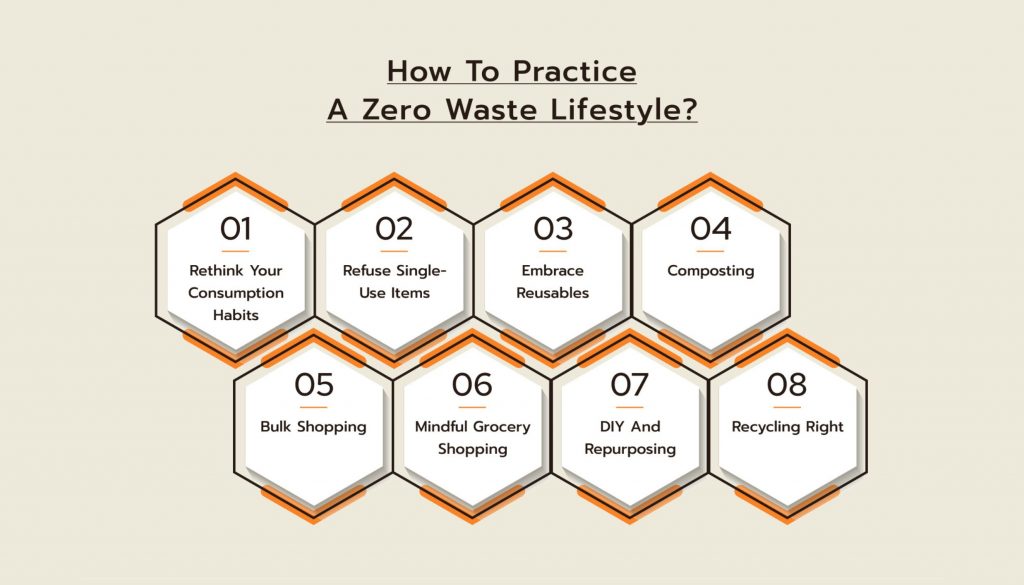
How To Practice A Zero Waste Lifestyle? Step-by-Step Guide
Living a zero-waste life really comes down to paying attention to what you buy and what you throw away. Yes, it is as simple as that. 

Zero-waste living isn’t about being perfect. It’s about paying attention, making better choices, and doing what you can – one step at a time. 

So, if you’re just getting started and want to make a real difference, here’s how you can jump in: 

1. Rethink Your Consumption Habits: 

First, it is important that you take a hard look at how you shop. Consider your shopping habits. 

Do you actually need that item? If so, could you find a more sustainable product that is made with sustainable materials that will outlast the cheap disposable item? 

These small things make a lot of difference! 

2. Refuse Single-Use Items: 

Secondly, you should definitely try to eliminate single-use products as much as possible. This includes plastic grocery bags, plastic straws, disposable eating utensils, etc. 

So, the next time you leave your home, make sure you are carrying a reusable bag and a water bottle to prevent unnecessary waste. 

3. Embrace Reusables: 

Instead of using disposable products on a regular basis, consider using reusable products instead. For example, use cloth napkins rather than paper towels. 

Refill your shampoo, soap, laundry detergent, and other items in refillable containers, rather than continuing to buy disposable containers. 

Another great example of a reusable item is rechargeable batteries. These small changes will have a big impact on the amount of waste you create. 

4. Composting:

Another way to reduce waste is to compost. 

When you compost your fruit and vegetable scraps, or any dead plants, you are putting the nutrients back into the soil so that you can grow food that does not require the use of artificial fertilizers or pesticides. 

If you do not have access to outdoor composting options, you can always compost indoors by using a worm bin or countertop composter. 

5. Bulk Shopping: 

When you can buy in bulk, it is not only a smart way to save money but also your time. 

By carrying your jars, containers, or bags with you to the grocery store, you can help reduce the production of tiny packaging that you usually see. 

Such shopping habits contribute to less garbage being thrown away as landfill, especially the food that regularly appears on our table, such as grains, nuts, and coffee. 

6. Mindful Grocery Shopping:

Before going to the grocery store, make a comprehensive grocery list. Thus, when you get to the store, you just have to refer to your shopping list and want to buy according to the plan. 

As a result, you will be less likely to buy items that are not on the list or even more than your needs. 

Select fresh produce that is not wrapped in plastic. The less packaging or the simplest packaging to recycle an item’s packaging, the better! 

There are various kinds of recyclable materials, so pick recyclable packing materials that are suitable for your local recycling facilities. 

7. DIY And Repurposing: 

Don’t be afraid to get creative. Repurpose glass jars as storage, cut up old t-shirts for rags, or make your own cleaning sprays with vinegar and lemon. You’d be surprised how much you can reuse with a little imagination. 

8. Recycling Right: 

Finally, you need to recycle! While cutting down waste is the main goal, recycling still matters. 

Learn the rules where you live so you can sort things the right way. Focus on using less, but when you have to recycle, do it right.

Common Mistakes Beginners Make When Going Zero Waste

While it is important to know what to do when going zero waste, knowing what NOT to do is equally important (if not more). As I have already mentioned in the beginning, I thought this was something easy – something I could do easily.

But, only after I started doing this, did I realize how difficult it can be at times. Or maybe it was because I put an unnecessary amount of pressure on myself. Whatever the case may be, here are some common mistakes that beginners make:

1. Trying To Change Everything Overnight

Firstly, stop trying to shift to a completely new lifestyle overnight. It doesn’t work like that. Trust me when I say this –  the idea of throwing everything away and starting perfectly feels appealing.

However, if you want to truly transform and start living a sustainable life, it really takes time. So, don’t rush

2. Buying “Eco” Products Unnecessarily

We live in a world where all of us are bombarded by ads. And these primarily aim to cater to our inner consumerism. And let’s be honest, for most of us, retail therapy is a thing. Besides, because we try to buy less, we get the urge to do the opposite even more.

That is why most of the beginners try to buy everything that has the label of “eco-friendly” or “sustainable” on it. But that is not what you need to do. And that is something that I would like to tie to the first point: do not try to change everything overnight!

If you have things at home, finish that up! You do not have to buy things that are “green.” Because when you do that, you automatically end up buying more!

3. Forgetting Zero Waste Is An Approach

Thirdly, and probably one of the most important things that one forgets is the fact that this way of living is an approach. Something that you need to embrace holistically. And that it does not only focus on objects.

As a beginner, you should understand that sustainable zero-waste living is about having a sustainable approach towards consumption, mentality, and behavior.

Try choosing local products and ensure that you are able to really bring down the packaging as much as possible.

4. Letting Perfectionism Kill Motivation

Finally, please try to understand that you do not need to be perfect. You do not have to feel pressured about it. Zero waste does not have to mean “no waste whatsoever!”

You do not have to feel guilty just because you forgot to carry your reusable bag or because you had to use a plastic straw at a restaurant. All you need to do is try to focus on progress over perfection.

Frequently Asked Questions (FAQs)

Here are some of the questions that people often ask about zero waste lifestyle. Take a loo at them before you leave:

1. What Is The Zero-Waste Lifestyle?

A zero waste lifestyle is basically a sustainable way of living. It primarily aims to keep trash out of landfills, incinerators, and the ocean. 
It’s all about changing how you buy and use things, moving away from the old pattern of just using stuff and tossing it out. 
Instead, you find ways to reuse and repurpose what you have, creating less waste and making resources last.

2. How To Start A Zero-Waste Lifestyle?

If you want to start a zero waste lifestyle, here are a few things that you need to do: 
Conduct a trash audit: observe and understand what exactly you want to throw. 
• Make easy swaps: Switch from plastic bottles to glass bottles or stainless steel bottles. 
• Rethink your shopping habits: Always buy things in bulk. In that way, you will be able to reduce the consumption of plastics. Additionally, you can visit thrift stores. 
• Manage organic waste: It is best to practice composting. You can throw your food scraps or house waste into compost bins. 
• Focus on consistency and gradual transition: You don not have to hurry and change your lifestyle. Take small steps.

3. What Are The 5 Steps Of A Zero-Waste Lifestyle?

The 5 steps of zero waste lifestyle are: 
1. Refuse 
2. Reduce 
3. Reuse 
4. Recycle 
5. Rot

4. What Are The 5 Principles Of Zero-Waste?

The 5 principles of zero waste lifestyle include: 
• Refuse: saying no to the things that you do not need to buy. 
• Reduce: minimizing whatever you are buying. 
• Reuse: choosing to stick to reusable items like cloth bags and glass jars. 
• Recycle: recycling and processing the things that you cannot refuse to buy. 
• Rot: choosing to compost organic waste instead of throwing it into landfills. 
Bea Johnson popularized these 5 principles.

Barsha Bhattacharya is a senior content writing executive. As a marketing enthusiast and professional for the past 4 years, writing is new to Barsha. And she is loving every bit of it. Her niches are marketing, lifestyle, wellness, travel and entertainment. Apart from writing, Barsha loves to travel, binge-watch, research conspiracy theories, Instagram and overthink.

View all posts

Leave a Reply

Your email address will not be published. Required fields are marked *

Related

Renewable Sources Of Energy

Is The World Shifting Fast Enough To Renewable Sources Of Energy?

‘Climate Change’ is not a myth or a figment of imagination anymore. Renewable sources of energy should be received in a manner that does not produce a change in society. It is one of the strongest realities, which humankind is experiencing every single day. Global Warming is melting our polar ice caps, spreading wildfires in our forests and exposing humanity to rising sea levels. Even though international organizations like the United Nations, activists like Greta Thunberg are spreading awareness and consciousness; the voices that matter are not doing enough. In this article, we will look at why the most powerful and richest country in the world, the United States of America should start taking renewable sources of energy more seriously. Besides, we will also discuss why it is important not to radically disturb the existing infrastructure in a major way. Why did the World continue to subsidize the Fossil Fuel Industry heavily? According to official reports, governments around the world gave nearly $300 Billion worth of subsidies to the fossil fuel industry 2017. This number is expected to cross nearly $400 Billion by 2020. At the same time, the entire world cumulatively gave only $290 Billion worth of subsidies to renewable sources of energy. Science has claimed that burning fossil fuels in thermal power plants, industries, factories, and automobiles are contributing to global warming in a major way. By using so much fossil fuels like coal, petroleum products, and others, we are overheating our planet. Companies that deal and do business in fossil fuels are multi-billion dollar corporations. They are some of the biggest corporations in the entire world. It is only natural that they use their influence to lobby for their industry and use their financial clout to stop unfavorable legislative attempts that aim to curb their business. Most politicians depend heavily on campaign funding from these companies and individuals. The quid-pro-quo dictates that once the politician comes to power, he will help the fossil fuel companies in any which way they require. This prevents progressive legislation, empties state coffers through subsidizations and kills innovation in alternative energy sources. What are some of the major fallouts of Climate Change and Global Warming? Almost every day, newspapers and television channels carry news items about uncontrollable forest fires, dust storms, snowing incidents in the desert, hurricanes, floods and rising sea levels. While naysayers dismiss these horrendous incidents, almost the entire scientific community believes it to the direct result of humans destroying their planets. The entire world is seeing a temperature increase on a year-on-year basis. This is not only causing huge environmental catastrophes but also leading us closer to the extinction of the human race. While efforts have been made to rebuild our forests, plant more trees and go electric, the damage being done is far faster than the rebuilding process. In late 2019 and early 2020, Australia saw one of history’s worst forest fires. It is estimated that the fires killed more than one billion animals and caused billions of dollars’ worth of destruction to the local economy. The historical city of Venice was in the news for being completely submerged in water following an increase in seawater levels in 2019. Likewise, 2020 also saw steep cold weather conditions in the Middle East, with snowing and heavy hailstorms being reported from UAE and Oman. What should we do to stop Climate Change and turn back Global Warming? While pessimists think that we have already lost the world, many optimists like Greta Thunberg who still believe we have a fighting chance. We must reduce our carbon footprint on a war footing. To do this government leaders and countries must take pro-active actions to reduce the dependence on fossil fuels and promote renewable sources of energy and alternative sources of energy. Douglas Healy, one of the most famous legal experts on energy issues states that it is important to find a not destabilize the existing infrastructure in a major way. He states that renewable sources of energy should be ushered in a manner that does not create a crisis in society. Millions of people are employed in traditional power plants and closing them, down might create problems of a different nature. This is why it is important to use the existing infrastructure and weave away consumers as well as employers away from the traditional fossil fuel industry. Conclusion Everyone needs to do his or her bit to save our planet. From doing small things like carpooling to avoiding the use of single-use plastic, we can all come together to rebuild our surroundings. We must plant as many trees as possible to maintain the ecological balance of the world. What are you doing to help counter the effects of climate change? Let us know in the comments section below. Read Also: The Benefits of Solar Lighting in a Nutshell Top Hi-Tech Airports in the Northern Hemisphere

READ MOREDetails
how to plant grass seed on hard dirt

How To Plant Grass Seed On Hard Dirt? – Latest Update 2022

Are you are giving up on the idea of having a lush and healthy lawn because your yard is full of rocks and hard dirt? I almost did but thorough preparation, hard work, and patience enabled me to have a beautiful lawn that was the envy of my neighbors. Let me share the ideas about how to plant grass seeds on hard dirt. Ask any of the homeowners who have successfully planted grass on hard dirt how she did it and her answer would be as simple as using a shovel to break up the dirt or soak it in water to allow it to loosen then plant the grass seeds. Another option may be to plant grass seeds on a layer or 2 of potting soil laid over hard dirt. Easier read than done. Also Read: 5 Best Vegetables You Should Try Growing In Your Garden What Are The Best Grass Seeds? Here some of the best grass seeds are given below that may be very useful for cultivation in 2021. These seeds are enough good for growing in hard dirt. 1. Zenith Zoysia Grass Seed Zenith Zoysia Grass Seed is 100% pure seed and suitable for those People in Drought Prone Places. On the other hand, It is quite expensive but it is dense and coarse. It includes two pounds of seed without fillers. 2. Kentucky 31 Tall Fescue Kentucky 31 Tall Fescue is best for reaching huge areas. It is more useful than other versions of cool-season grass. Kentucky 31 Tall Fescue produces grass that has broad leaves. It is good for big lawns or parks. 3. Pennington Smart Seed Dense Shade Pennington Smart Seed Dense Shade is suitable for shady areas. These types of seeds are using a less amount of water compared to ordinary grass seeds. On the other hand, It will not grow in direct sunlight as it is suited for the areas which have less sunlight(direct sunlight). You May Also Like: All You Need To Know About Resurrection Plant and its Facts 4. Jonathan Green 10322 Black Beauty Jonathan Green 10322 Black Beauty is suitable for regions with sandy fill. It holds naturally insect repellent grass and preserves moisture. It preserves moisture in the leaf and is drought resistant. Jonathan Green 10322 Black Beauty also includes Fine Fescue. 5. X-Seed Ultra Premium X-Seed Ultra Premium is suitable for sun and shade areas. It is a mixed seed option that germinates fast. It is well for Central and Northern United States climates. This seed can be the best if you want to plant grass seeds on hard dirt. 6. Scotts Turf Builder Grass Seed These Bermuda seeds are pretty tough. As a result, the heat and drought-bearing potentials are high in comparison to the other types of grass. It will create a very thick and durable lawn. Seeds are uncoated, so the water absorption potentials are much higher. High drought tolerance is the most significant benefit of having these seeds on your lawn. 7. X-Seed Moisture Booster Plus Bermuda Grass These seeds are entirely imported from Japan.  And these grass seeds have a modest growth rate.  It can grow under the full sun and also have better water-resistant coatings. But you require immense patience to grow this grass on the lawn. Using the single pack, you can cover 2 000 square feet of your existing lawn. Here Are The Tips On How To Plant Grass Seed On Hard Dirt: There are certain steps that you need to follow if you want to know how to plant grass seed on hard dirt. 1. Collect All The Debris Gather rocks, sticks, and all debris you may find on your lawn. Soak dirt in water or use a shovel to break them up so they will loosen and be easier to pick up. 2. Get Rid Of The Weeds Cut old sod with a sod cutter or till the remaining grass in the soil. Tilling the remaining grass though will not get rid of the roots of unruly weeds. 3. Loosen Up The Soil Blanket Use a rototiller to loosen the soil to as deep down as 6 inches. Do this only with dry soil. Till 1 to 2 inches of compost or peat moss all over the soil to as deep as 18 inches. The amount of compost to use should be equivalent to about 25% - 50% of the weight of the soil. 4. Level Out The Soil Use a rake to level out the soil and remove any debris that has been tilled up. Fill up your lawn roller with water and run it across your tilled lawn. This will make your ground firm. 5. Drop The Seeds Load your grass seed into a drop seed spreader. Follow the directions on the bag of grass seed regarding the amount of grass seed to spread for every 1,000 square feet. Set the dial of your spreader accordingly. Evenly spread the grass seed over your entire lawn. You can also use a rake to spread your grass seed making sure it is within the ¼ inch top of the soil. Press the grass seed more into the soil using a lawn roller (empty). 6. Use The Fertilizer Divide 4 to 6 pounds of nitrogen fertilizer (slow-release type) into 4 equal parts. For every 1,000 square feet, apply 1 pound of fertilizer throughout the entire year. Do the application in 8-week intervals starting with the growing season and through summer, spring, and fall. 7. Watering Your Lawn Water your lawn for 15 minutes each time, two to three times a day. You may need to adjust your watering schedule as applicable because your goal is to have moist and not soggy soil. After the first moving session, cut down on the watering by limiting it to 1 inch each week broken down into 2 watering sessions. Tips To Maintain The Grass Seed On Hard Dirt As your grass grows to be about 3 inches, start mowing your lawn making sure to keep warm-season grass at about 1-2 inches tall and cool-season grass at 2 inches tall. 1. Cutting And Trimming Depending again on the grass variety, this may be about every four to six days. Keep on moving regularly until you are able to cut less than 1/3 of the grass at each mowing process. It is also ideal to mow grass with sharp mower blades. 2. Fertilizer Use Lime & Fertilizer Spreaders to evenly supply the required nutrients to your grass. Proceed further to know more about how to plant grass seeds on hard dirt. 3. Soil Aeratetion Aerate the soil when the soil is dry and during active growth, meaning two times a year. Aerate to as deep as 3 inches. As you can see, it is feasible to plant grass seeds on hard dirt. While hard dirt is not the best environment to grow grass seeds, improving the soil is highly possible. Of course, you will be in for some hard work, but the resulting lush green lawn will be all worth it. It will be as if you grew your grass seeds on rich soil and this will solve your issue on how to plant grass seeds on hard dirt. You May Also Like: How much does a yard of topsoil weigh? When Is The Best Time To Plant Grass Seed? Planting seeds symbolize an expenditure of money, time, and hope. Planting grass seed depends on the type of lawn you are planting and the place you live in. Whether you grow warm or cool-season grasses, timing plays a vital role. When the temperature of the soil is between 50-65 degrees Fahrenheit, Cool-season grass seed grows fast. Freshly planted seeds need consistent soil moisture. For warm-season grasses, Spring Season is best. In natural germination seeds, grass types and varieties vary. In the underground, new grass seedlings take place in their initial growth. You can also do research that when is the best time to plant grass seed or you can take advice from professionals before you start seeding. However, if you are unable to grow grass seed on hard dirt then you can focus on installing artificial grass in your garden. Also Read: Amazing Ways to Maximize Your Profit at Trading How Long Does It Take For Grass Seed To Grow? Depending on the type of variety, the growing time for grass seed varies from five to thirty days. In cold temperatures, it can be even extended than this. How long does it take for grass seed to grow? See, it depends on which place you are living in and what kind of grass seed you are growing. If you are looking for a low-maintenance grass seed then centipede grass seed is your best option. There are mainly some of the factors that play a key role in grass seed to grow: 🌡Temperature - The temperature of the air and the temperature of the ground are the primary ingredients for seed grass to grow. It increases the growth rate of the seed grass.☁ Season - The season also has an impact on the seed as it plays a vital role in seed germination. In the cool season, the grass seed does not grow and it remains dormant for a certain period of time. But as soon as the warm season arrives, the seed grass begins to grow.☀ Sunlight - Sunlight also plays some role in the germination of the grass seed, whether directly or indirectly. Also Read: 4 Must-Have Ingredients for Homemade Beauty Products Frequently Asked Questions (FAQs): 1. How Do You Plant Grass Seed On Hard Soil? There are several steps involved while you want to plant grass seed on hard soil. Some of the essential steps are as follows:-1. Aerate the topsoil.2. You need to do soil testing.3. The hard ground you need to tilt.4. Mix the soil with fertilizer.5. Make a selection of the right seed.6. Cover the topsoil by planting the grass seed over it. 2. Can You Grow Grass On Hard Dirt? You can easily grow the grass on the hard dirt. In most cases, the particles are so compactly pressed and tightly packed that it fixes the grass on air. 3. Will Grass Seed Grow On Compacted Soil? Grass grows well on loose soil, not on compacted soil. Keep your concept clear about it. 4. Can You Just Throw The Grass Seed On Dirt? The easy answer is Yes you can throw the seed on the dirt. You have to make your arrangement in the correct order. Conclusion! Do you also have a lawn with hard dirt? Have you tried planting grass seeds on them? I hope the instructions I shared above can also allow you to have a green lawn just like what I have now despite starting off with soil with hard dirt. 'How to plant grass seed on hard dirt' seems to be tricky but believe me it's far easy and simple. If you have additional suggestions, please feel free to share them in the comments section on how to plant grass seed on hard dirt.

READ MOREDetails
How much does a yard of topsoil weigh?

How Much Does A Yard Of Topsoil Weigh?

Do you need good topsoil to plant your new yard or new garden? Do you have a question how much does a yard of topsoil weigh?  Due to moisture content, the weight of topsoil can vary greatly. In addition, you must know the amount of topsoil you will require. With added fertilizers, bags of topsoil are generally sold by cubic feet and it is a good idea to buy it. Before purchasing topsoil, you must know how much does a yard of topsoil weigh. Choosing the right quality of soil is crucial for both, the short and long term. However, you must know how to calculate it otherwise, it will be a challenging task for you.                                                    Facts You Must Know About Topsoil: In order to know how much does a yard of topsoil weigh, you must know important facts about topsoil. Topsoil is the uppermost layer of the soil usually 5 to 10 inches, in which all the plants grow.  It plays a vital role in the supply of essential nutrients and minerals to the plant. High-quality topsoil contains nitrogen, carbon, mineral particles, water, organic matter, air, essential nutrients, etc. The moisture content and the composition of the soil is an important part that determines topsoil weight. There are generally three types of topsoil i.e., Sand, Loam, and Clay. So, not making you wait any further, here I am going to discuss how much does a yard of upper soil weighs: How To Measure The Amount Of Topsoil You Need? Firstly, you must-have information on this: 1 cubic foot of soil equivalents to 12×12×12 inches1 cubic yard of soil is equal to 27 cubic feetOR, 1 cubic yard equals 1,839.92 kg. Secondly, you need to measure the amount of topsoil you need for yourself. Topsoil comes in the cubic yard and 27 cubic feet equals 1 cubic yard. Suppose you have a garden of 12 by 12 feet and a thickness of approximately 6 inches, Now, you need to follow the below steps: First Step: Turn all the measurements to feet, 6 / by 12 = o.5 ​Second Step: Multiply your figures or numbers if it is in feet. Now multiply the 3 figures (0.5 x 12 x 12 = 72 cubic ft.) ​Third Step: Now divide the cubic feet that you get by the total figure or number of cubic feet available in the 1-yard cube (1=27), and the result (72/27=2.666 cubic yards) is something you will require for your yard or garden. How Much Does A Yard Of Topsoil Weigh? One yard of topsoil will usually weigh about one ton or 2000 pounds. Due to the fact that topsoil contains moisture, it can vary in weight greatly. When soil is damper in the spring season, one cubic yard can weigh well over one ton. On the other hand, in the summer season, the yard of topsoil can weigh up to 1700 pounds or even less than this. How Much Does A Cubic Yard Of Topsoil Weigh? We have already discussed how much does 1 yard of topsoil weigh. Now, 1 cubic yard of topsoil weighs approx 1080 pounds. A cubic yard is created of 27 cubic square feet. Therefore, if buying in bags, you would need 36 bags measuring 40 pounds each and proceeding for a total of 1,440 pounds of soil per cubic yard. If you want to buy a cubic yard of topsoil then you can buy it in bulk instead of purchasing various bags. Frequently Asked Question: What Is The Composition Of Topsoil? Now you know how much does a yard of topsoil weigh. But do you know the price can also be different depending on the compositions of the topsoil? The quality of the topsoil entirely depends on the PH textures or nutrient contents of the top soils. And determine the right prices for the topsoil. You have to know the natural composition of the topsoil. Here are some of the nutritional compounds of the topsoil. 1. Nitrogen The excess supply of Nitrogen is also harming the growth of the plants. You have two options. One is to add the nitrogen compound from an external way. Or you can put the topsoil, which is organically boosted with the right supply of Nitrogen. The excess supply of Nitrogen is also harming the growth of the plants. You have two options. One is to add the nitrogen compound from an external way. Or you can put the topsoil, which is organically boosted with the right supply of Nitrogen. 2. Magnesium MG is another important nutrient for boosting the leaves' chlorophyll supply. Chlorophyll is boosting up the plant’s health, and it enables the plants to do Photosynthesis. But this is also like Nitrogen. Even mg enriched soil costs are pretty high. If you want to know how much does a yard of topsoil weigh. Then I also have to count this part. Excess supply of Mg is harmful to the plant’s health. But when you are picking the Magnesium enriched topsoil is going to boost your plant’s health without harming the natural balance of the top organic soil. 3. Phosphorus This is a key nutrient for root growth. Phosphorus is an exceptional thing that is going to boost the plant's growth. The lack of phosphorus will decrease the growth of the plants. And this is not also enough. The limited supply of phosphorus will turn the colors of the leaves into yellow and discolorations. The phosphorus-enriched topsoil will increase the growth quality of the plants. Usually, bone meals are added to the topsoil to increase the phosphorus ratios. 4. Organic Matter Organic matters mean the living organism which is boosting up the soil’s functions. The organic compounds are bounding the mineral particles in the soil and increase the fertility of the soil.  This living organism will go to help by supplying the right amount of mineral particles, which is boosting up the plant’s growth. Frequently Asked Question: Q1: Can Put The Topsoil Over Existing Lawn Actually Worth It? Yes, you can add the topsoil over the existing lawn. Adding a single layer of the topsoils to your lawn is more like topdressing. But when you already have the existing soil, you have to pick the soil in a proper way. Q2: How Long Does The Grass Take Time To Grow Through Topsoil? Three weeks are enough for the grass seeds to bloom. After planting the seeds, a few weeks are the maximum time it will take. Q3: How Many Wheelbarrows Are Required in A Yard Of Soil? These entirely depend on your wheelbarrow size. 9 to 14 full loads are equal to 1 cubic yard. Conclusion: I have tried my best to give an answer to your question-" how much does a yard of topsoil weigh?" Therefore, before buying a yard of topsoil, you need to calculate the amount of topsoil you will require for your garden. The quality of topsoil is an important factor and you must consider it before starting your experimental project on plants. If you are searching for the best grass seed for your garden then centipede grass seed is your most loyal choice. Feel free to drop your queries in the comment section below.  Read Also: How to Plant Grass Seed on Hard Dirt 7 Health Benefits of Black Seed Oil Bud Producing Feminized Seeds

READ MOREDetails