










How Is Toto1000 Redefining Decentralized Finance In 2026?

Toto1000

I have been studying DeFi, or Decentralized Finance, for the last four years.  

It really started because I was interested in this sector. 

Also, I had to write about it, and therefore, I needed to be aware of everything that was going on here.  

In the rapidly evolving 2026 landscape, Toto1000 has emerged as a significant player in the decentralized finance (DeFi) space.  

I have been constantly reading news and blogs about it.   

Additionally, I think it has become more famous because now, it is specifically associated with the Bitrue exchange. 

Therefore, I suppose now Toto1000 represents a strategic evolution in how commodity-backed assets function. 

In addition, it is also deciding how utility tokens interact within a centralized-decentralized (CeDeFi) ecosystem. 

Therefore, in this guide, I am going to provide an in-depth overview of Toto1000 and its core utility. 

In addition, I will also talk about the safety considerations to keep in mind when trading or holding this asset. 

What is Toto1000? 

Toto1000 is a utility and ecosystem token. I have seen people primarily utilize this within the Toto Finance infrastructure. 

Additionally, as I have mentioned in the intro, it is supported by the Bitrue exchange.  

Now, coming to the main topic. I am fully aware of the fact that many tokens are purely speculative. 

However, I have read that Toto1000 is positioned as a gateway to Tokenized Commodities.   

Additionally, the project aims to solve the liquidity issues historically found in the physical commodity markets. 

I am talking about the most common, like:  

  • Metals 
  • Gemstones 
  • Energy 

In fact, there is another advantage that you get when you are using Toto1000. 

You will gain access to an ecosystem that facilitates the 1:1 backing of digital assets with real-world, vaulted commodities.   

What Are The Core Features And Advantages Of Toto1000?
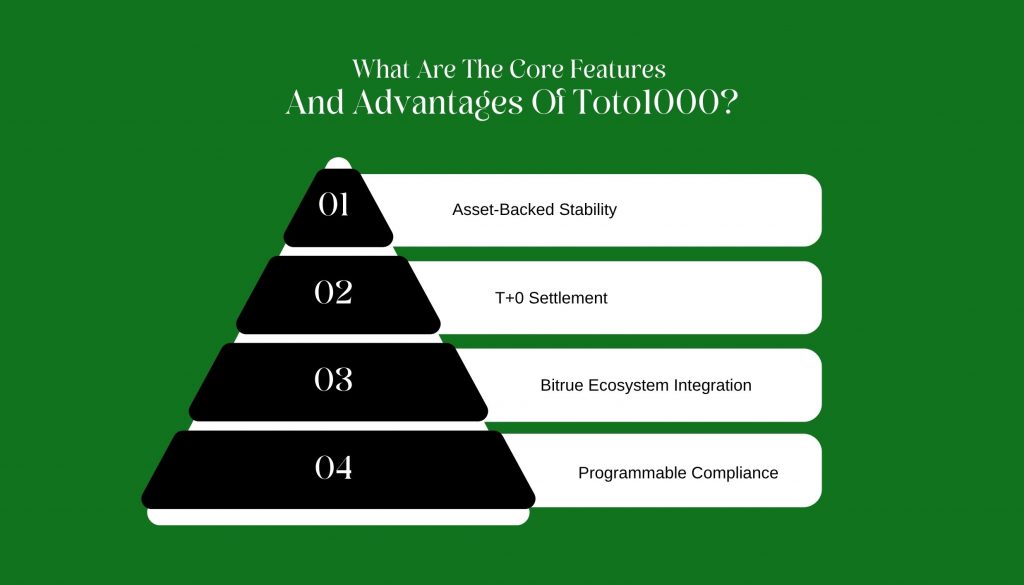
The value proposition of Toto1000 lies in its bridge between traditional finance (TradFi) and the blockchain. 

1. Asset-Backed Stability 

I must mention this first that this one is nothing like many memecoins. 

Rather, I would say that the Toto ecosystem focuses on tokenizing in-ground and vaulted assets.  

So, this provides a tangible floor for the utility of the network.   

2. T+0 Settlement 

Traditional commodity trading can take days to settle. Toto1000 enables near-instant settlement on-chain, 24/7.   

3. Bitrue Ecosystem Integration 

As a partner project on Bitrue, holders often gain access to specialized Power Piggy staking rewards. 

Therefore, this offering has competitive APRs compared to standard savings accounts. 

4. Programmable Compliance 

The token infrastructure includes built-in KYC/AML features. 

Therefore, this ensures that institutional and retail investors remain compliant with global trade regulations.   

What Is The Role Of Toto1000 In DeFi and CeDeFi?

Understanding how the token moves through the market is essential for high-ranking SEO and user trust. 

1. Fee Reduction And Settlement 

Within the Toto Finance platform, the TOTO/Toto1000 variants are used to pay for transaction fees and the minting of new commodity tokens.  

Using the native token often results in significant fee discounts.   

2. Yield Generation 

On the Bitrue exchange, Toto1000 is frequently featured in Yield Farming. In addition, the Liquidity Mining pools also feature this.  

This allows holders to earn passive income by providing liquidity for commodity-based trading pairs. 

3. Governance And Voting 

In line with E-E-A-T principles, the project utilizes a decentralized governance model.  

Holders can vote on which new real-world assets (RWAs) should be tokenized next. 

Additionally, it also ranges from rare earth metals for AI data centers to environmental credits. 

What Are The Safety Concerns And Risk Management Factors About Toto1000?
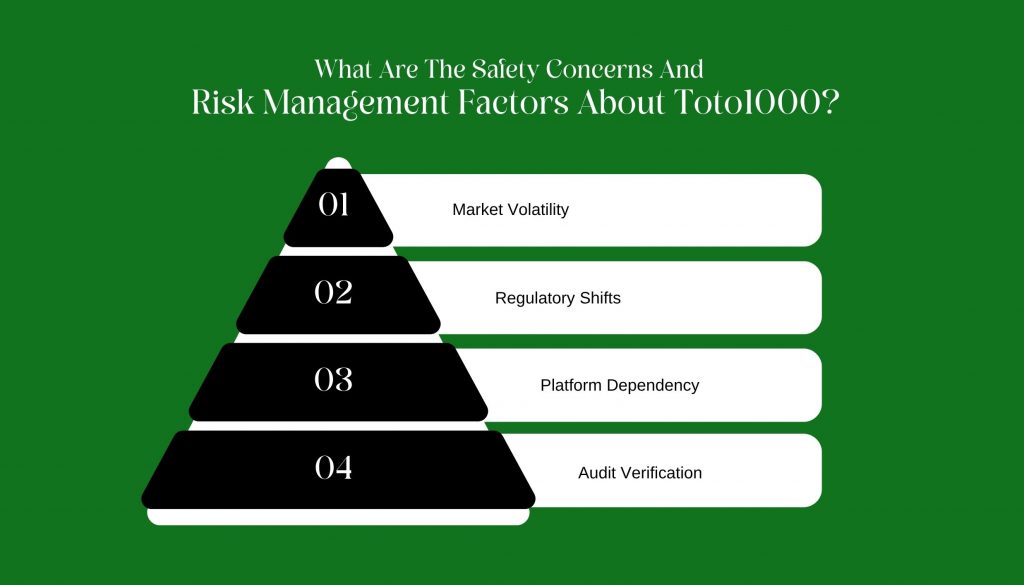
No cryptocurrency investment is without risk. When dealing with Toto1000, keep the following safety protocols in mind: 

1. Market Volatility 

While the ecosystem deals with stable commodities, the utility token (Toto1000) itself can experience high price volatility based on market sentiment and exchange liquidity. 

2. Regulatory Shifts 

Since the token deals with real-world assets, it is subject to the changing legal landscape of Liechtenstein and other financial hubs.  

Ensure you are aware of your local laws regarding RWA tokens. 

3. Platform Dependency 

A significant portion of Toto1000's liquidity is concentrated on Bitrue.  

While Bitrue has a strong security track record since its 2018 launch, exchange risk is always a factor.  

Always consider using a cold wallet for long-term holdings. 

4. Audit Verification 

Always check for the latest on-chain Proof of Reserves (PoR).  

The integrity of the Toto ecosystem relies on the fact that every token is backed 1:1 by a physical asset in a secure warehouse.   

What Are The Slot And Gaming Features Of Toto1000?
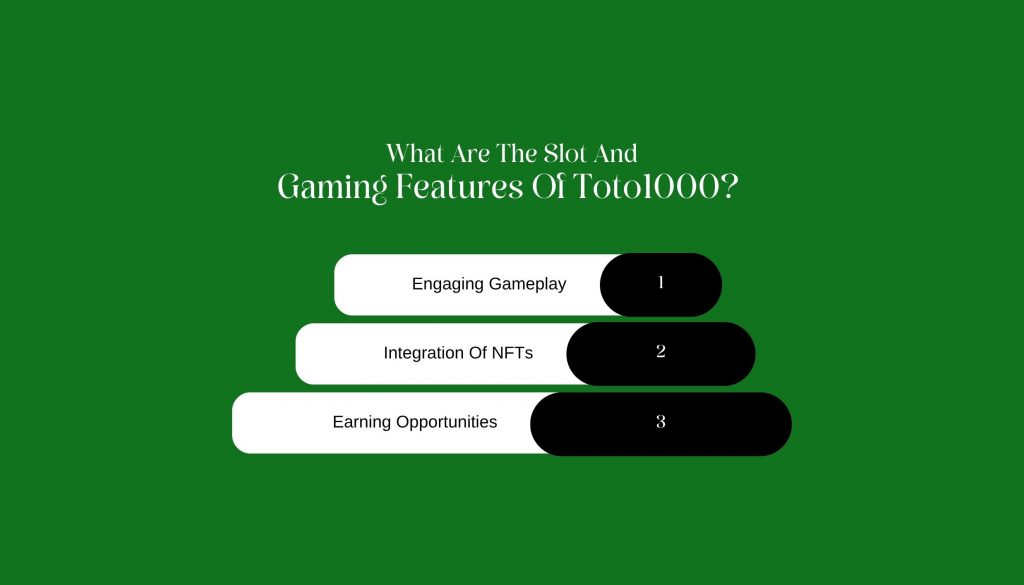
The slot component of Toto1000 revolves around the innovative gaming utilities that the platform is aiming to develop.  

Also, central to this concept is the creation of a Play-to-Earn (P2E) slot or casino-style game that enables players to engage using TOTO coins and exclusive NFTs.  

As a result, this multifaceted gaming experience will offer users several appealing features, including: 

1. Engaging Gameplay 

Players will have the opportunity to participate in a variety of slot-like games that promise not only entertainment but also the potential for tangible rewards. 

2. Integration Of NFTs 

The platform plans to enhance the gaming experience by allowing players to utilize NFTs as unique items or skins within the gameplay.  

This integration not only personalizes the experience but also adds an element of collectability, as players can own distinct digital assets. 

3. Earning Opportunities 

As players engage and succeed in these games, they can accumulate more TOTO coins as rewards for their efforts.  

This system incentivizes players to improve their skills and continue playing to increase their earnings. 

The growing popularity of slot-based P2E games in the crypto realm is due to their straightforward mechanics, enjoyable nature, and the rewarding aspects of gameplay.  

Now, I feel like Toto1000 can successfully bring this vision to life. Therefore, it has the potential to attract a wide array of casual gamers. 

In addition, I feel like I'm eager to explore both the fun and financial benefits of a well-crafted gaming ecosystem. 

What Are The Disadvantages Of Toto1000 To Consider?

So, without wasting time, let’s check out the disadvantages of Toto1000: 

1. Complex Tech Stack 

For a beginner, the concept of Gamma-neutral commodity hedging or oracle validation can be daunting.  

The learning curve is steeper than a standard payment token. 

2. Liquidity Concentration 

If a major exchange were to delist the token, exiting a large position could result in significant slippage. 

This is the difference between the expected price and the executed price. 

Is Toto1000 A Strong Hold? 

As of 2026, Toto1000 stands as a sophisticated example of how anyone can use blockchain technology to modernize the $20 trillion commodity market.  

Therefore, I suggest that you check out how the combination of the security and reach of Bitrue with the institutional-grade infrastructure of Toto Finance works out! 

I can assure you that it offers a unique value proposition for those looking to diversify their portfolio into Real-World Assets.


Barsha Bhattacharya is a senior content writing executive. As a marketing enthusiast and professional for the past 4 years, writing is new to Barsha. And she is loving every bit of it. Her niches are marketing, lifestyle, wellness, travel and entertainment. Apart from writing, Barsha loves to travel, binge-watch, research conspiracy theories, Instagram and overthink.

View all posts

Leave a Reply

Your email address will not be published. Required fields are marked *

Related

3d PrintingTechniques And Application In The Energy Sector

3d Printing: Techniques And Application In The Energy Sector

3D printing is a manufacturing process that constructs a three-dimensional object from a digital three-dimensional model. Emerging technologies like three-dimensional printing have brought revolutionary advancements in various industries, and the energy sector is no exception. This article focuses on the techniques and applications of three-dimensional printing in the energy sector, highlighting its potential to transform traditional manufacturing processes, optimize efficiency, and support sustainable practices. Types Of 3D Printing Techniques For the Energy Sector: There are several techniques employed in 3D printing, including Fused Deposition Modeling (FDM), Selective Laser Sintering (SLS), and Stereolithography (SLA). Each plays a significant role in rapid 3D printing services. So, here's a detailed explanation of these 3D printing methods: Fused Deposition Modeling (FDM): FDM is the most famous 3D printing technique, in which a thermoplastic filament is heated and used to form a 3D object. Also, FDM enables the production of complex shapes, intricate designs, and functional prototypes that improve energy systems. Selective Laser Sintering (SLS): SLM employs a high-powered laser to selectively fuse powdered materials, predominantly metals, generating durable and intricate components. Moreover, this technique is used in manufacturing heat exchangers, turbines, and other robust components of energy systems. Stereolithography (SLA): SLA uses a liquid resin and solidifies it upon exposure to a specific wavelength of light, creating precise, high-resolution objects. Also, SLA produces custom energy storage systems, solar panels, and intricate electrical components to improve energy utilization. Advantages Of 3D Printing In The Energy Sector: So, there are several advantages of 3D printing, and it has been in high demand. Some basic benefits are explained below: Cost Reduction: 3D printing enables the production of intricate, complex components in a single process, eliminating the need for assembly. Moreover, it reduces manufacturing, increases efficiency, and lowers production. Customization And Optimization: The flexibility of 3D printing enables customization of energy components to meet specific requirements. So, by optimizing shapes and structures, energy systems can be designed for optimal functionality, resulting in enhanced performance and reduced energy wastage. Supply Chain Sustainability: Traditionally, energy systems rely on extensive global supply chains. Also, implementing three-dimensional printing can reduce the dependence on transportation, minimize carbon footprints, and shorten lead times, contributing to a more sustainable energy sector. Improved Efficiency: 3D printing enables the creation of lightweight components with intricate geometries, reducing energy consumption and improving overall system efficiency. This translates to enhanced energy generation, transmission, and storage capabilities. Application Areas In The Energy Sector: Three-dimensional printing is applicable in some areas of the energy sector as follows: Renewable Energy Components: So, 3D printing facilitates the production of wind turbine blades, 3D-printed solar panels, and energy storage systems, enabling customized designs that maximize energy output and efficiency. Optoelectronic devices like photovoltaics and sensors can also benefit from 3D printing. Energy Infrastructure: Three-dimensional printing for manufacturing pipes, heat exchangers, and valves reduces costs and enhances their resistance to corrosion, heat, and pressure. Also, advanced materials and designs derived from three-dimensional printing contribute to safer and more reliable energy infrastructure. Energy Efficiency Devices: Customizable, intricate designs are enabled by three-dimensional printing, making it possible to develop energy-efficient devices such as heat sinks, smart meters, and sensors. These technologies enable better monitoring, optimization, and management of energy consumption. Tooling And Prototyping: Three-dimensional printing expedites the production of prototypes and specialized tools for testing and maintenance in the energy sector. This results in faster innovation cycles and improved productivity. How 3D Printing Works? So, the basic steps that are followed by 3d printing  are as follows: 1. Submission Of Design: The customer provides a three-dimensional design file in a compatible format.STL or.OBJ, to the service provider. Also, this design file can be created using three-dimensional modeling software or downloaded from an online repository. 2. Pre-Printing Analysis: The service provider examines the design file to ensure it is suitable for three-dimensional printing. Moreover, they check for potential issues, such as intersecting geometries or unsupported overhangs, that may affect the printing process or the final result. 3. Material Selection: Depending on the customer's requirements and the desired properties of the object, the service provider suggests suitable materials for 3D printing. Moreover, options can include various plastics, metals, ceramics, or composite materials. 4. Printing Process: Once the client finalizes the design and materials, the 3D printing process begins. The service provider prepares the 3D printer, loads the selected material, and starts printing. Then, the printer follows the instructions in the design file to layer the fabric and create the desired object. 5. Post-Processing: After printing, the printed object goes through post-processing steps. Also, it may involve removing support structures, cleaning the thing, or applying surface finishes to achieve the desired texture, color, or smoothness. 6. Quality Assurance: The service provider examines the printed object for defects or imperfections and ensures it meets customer requirements. If necessary, you can make adjustments or corrections before final delivery. Start Integrating 3D Printing Techniques Today! Integrating 3D printing techniques within the energy sector presents transformative opportunities for manufacturing, sustainability, and energy efficiency. Moreover, the ability to customize designs, reduce costs, optimize efficiency, and shorten production timelines can revolutionize energy generation, transmission, and storage. As this technology evolves, a collaboration between three-dimensional printing experts, energy specialists, and researchers will lead to further breakthroughs, fostering a more sustainable and efficient energy future. Read Also: Advance Copier: Printing Quality Business Cards On Your Own Computer 7 Ways To Stop Spending So Much On Printing In Your Business Digital Printing Contributes Much Towards The Progress Of The Industry

READ MOREDetails
Hyperconverged Infrastructure

6 Benefits Of Hyperconverged Infrastructure

As digital services are becoming more critical to how every business runs, and systems continue to grow in sprawl and complexity, more companies are looking for new technological solutions to reclaim control of their infrastructure. Hyperconverged infrastructure (HCI) is now one of the most in-demand solutions. Many organizations have chosen converged architecture to simplify their systems, while hyper-converged solutions carry this notion of operating numerous parts of a single, centralized system to its logical conclusion. In addition, HCI offers a cost-effective and more efficient means of managing extensive IT infrastructure, but it might only be appropriate in some circumstances. As a result, you should know a few things about the benefits and drawbacks of HCI systems when deciding on one. What Exactly Is "Hyperconverged Infrastructure"? HCI is a software-defined infrastructure solution that virtualizes all components of a conventional hardware-based system. Networking, computing, and storage are all integrated into a single system. Many of the difficulties involved with data center operations may be removed by bringing everything under one roof, making for a more streamlined, adaptable solution. Moreover, HCI differs from those other converged infrastructure technologies in that it focuses on services rather than servers. Any changes may be instantaneously mirrored throughout the whole system, and workloads controlled from a single place when apps and the hardware they reside on are handled from one system. 6 Hyperconverged Infrastructure Benefits: The goal of HCI is to make managing rapidly increasing networks as simple as feasible. And firms may expect to reap various benefits as a consequence of this. 1. Greater Reliability Using software-defined infrastructure enables automated tools to handle activities like workload monitoring and balancing to optimize resource utilization and keep a real-time watch on a system's health, making modifications as needed to sustain performance. Furthermore, if a node fails due to a problem, others may provide service continuity, increasing resilience and enabling administrators to replace or add nodes without disrupting operations. 2. Easier Management Once systems are installed, maintaining them efficiently becomes considerably simpler. Compared to older options, optimizing and monitoring HCI installations is straightforward, with automated software removing most of the day-to-day management from the hands of IT professionals. Additionally, administrators may operate from a single management platform in a distant location when modifications are necessary, with fundamental tasks such as backups handled through simple point-and-click operations. 3. Better Scalability Another major benefit of HCI is the ability to develop and expand in any business. A system is more easily scalable when combining storage, computing, and network solutions. Expanding your infrastructure's capabilities in a legacy system is significantly more complicated. You may need to purchase new gear, such as a new hypervisor and servers, and spend some time configuring it. Scalability is critical for expanding businesses. It is also essential for any firm whose IT requirements may alter abruptly. New resources and capabilities may be easily added to a framework using an HCI system. Everything is defined by software. The system's hyper converged infrastructure software may adjust automatically to accommodate changes. 4. Simplified Deployments HCI systems simplify service implementation. With a single, virtualized network, IT admins won't waste time thinking about product compatibility since they'll deal with a single supplier for all the essential tools. Because the components are pre-configured, the energy and time required to acquire, integrate, and install conventional infrastructure is saved. 5. Reduced Costs Most businesses employ hyperconverged infrastructure because it lowers workload operating costs throughout their life cycles. It can consolidate equipment resources and enhance their use. Besides that, it will significantly decrease the demand for additional servers and power and cooling needs. Because hyperconverged infrastructure may be built using commodity hardware, enterprises can save the costs associated with installing specialist servers, network components, or storage. Direct-attached storage is used in hyper-converged infrastructure. It assists businesses in avoiding the significant costs associated with establishing and administering a SAN. They may acquire HCI software and develop their HCI systems with the assistance of a reference architecture. 6. Improves Performance HCIs may assist increase the overall efficiency of your workloads since they function as a single system. An HCI system, for instance, may use both SDDs and HSDs for storage, guaranteeing that the varying needs of various applications are addressed most cost-effectively. Interestingly, since processing and storage operations are maintained near together, cabling and latency are reduced. 3 Drawbacks Of HCI Before choosing to use HCI, businesses must first grasp the possible challenges. As a relatively new solution for controlling data center operations, there will be a few obstacles to overcome, particularly if businesses are shifting from old technology for the first time. 1. Hardware Interconnectivity Many HCI services are constructed on the concept that everything goes as a bundle from the same supplier, which may lead to concerns like vendor lock-in to ensure performance if you're not cautious. While extending an HCI system using low-cost minimum resources usually is feasible, this will likely result in performance concerns since it will perform less well as a fully-converged platform designed particularly for that environment. Organizations are often forced to choose between performance and cost when scaling up their systems. 2. Compatibility Issues It is critical to distinguish the virtualization capabilities of HCI technologies from actual cloud computing solutions and assume they coexist harmoniously. Some HCI settings may struggle to properly share resources across numerous systems and offload particular activities to cloud services. This is particularly true when a company employs equipment from leading suppliers. 3. Greater Power Requirements HCI designs pack a lot of workloads into a small area, which typically means they use more power than data centers are built for. While this may be addressed by transferring certain tasks to the cloud when practicable, administrators may need to consider reorienting their sites to guarantee enough power and cooling options to satisfy demand, which can incur additional expenditures. Conclusion Creating the proper IT framework is critical to the success of any firm. You'll be well-positioned for success if you reach peak productivity and cover your future demands. Hyperconverged infrastructure might be the answer you've been looking for. The benefits listed above should have made it apparent why you should consider this arrangement. Read Also: Is Computer Software Prepackaged Software A Good Career Path? Volte: What Is It, And How Is It Different From VOIP? Questions to Ask Before a Data Center Relocation

READ MOREDetails
Paper Shredding

Paper Shredding is Nothing Like in Hollywood Movies

How many times in Hollywood movies have you seen somebody frantically feeding papers into a shredder before the authorities arrive on the scene? It may be a common trope, but this doesn’t resemble how people use professional shredders today. Everybody has sensitive documents which could cause a devastating data breach if they got into the wrong hands. Having such information is an inevitable part of being a citizen — it doesn’t mean you have something to hide. Please keep reading to learn more about how professional shredding works in the real world. Home Shredding: Every day people are targeted by scammers who try to piece together whatever personal information about strangers they can get their hands on. People hire a paper shredding company every day to ensure that their home is free of data liabilities that could come back to bite them later. Here are a few of the items professional shredders commonly need to destroy: Tax documents Banking information Contracts Pages with passwords and usernames Especially with more people than ever working remotely, having sensitive information at home is more common than ever. If you have these or other such documents at home, the safest thing to do is get them professionally shredded. Commercial Shredding: It’s impossible to do business for any length of time without generating paperwork. From the smallest business to the largest corporation, there’ll be an endless procession of things like receipts, HR documents, contracts and agreements, and other paper documents which corporate saboteurs or identity thieves would love to possess. Just as with home shredding, professional shredders can destroy your sensitive documents on-site or remotely. For example, if you are located in California, you can look for shredding services in San Francisco to dispose of your documents securely. Even if they aren’t connected to the internet, electronics are a common source of data leaks, and these devices need to be eliminated with the same thoroughness as paper documents. Professional shredders will destroy the microchips on the device, so it’s impossible for a data thief to retrieve information. Do you have old phones, computers, or other electronics that you used for work? Obsolete technology might not be useful in your day-to-day life, but a corporate saboteur would love to find it! Call a professional shredder to get rid of electronics that are no longer useful safely. While some such devices like computers and phones are an obvious vector for identity theft, other devices that you may not think of also contain very sensitive information. If your office or home office contains an old photocopier or printer memory card, calling a professional shredder to eliminate it is the safest course of action you can take. People in all walks of life need to be careful that their personal and professional information doesn’t fall into the wrong hands. While the most prominent victims of identity theft get the bulk of the news coverage, it’s an issue that can affect anyone. Call professionals to help you steer clear of all risks associated with data theft. Read Also: High Technology Devices for Better Life Get The Best Assistive Technology: A Telecare Equipment

READ MOREDetails