












On 25 June 2020, Wirecard AG, the shining jewel of Germany's fintech landscape, valued at €24 billion at its peak, filed for corporate insolvency.
Founded as a payment processor, the company rapidly rose to inclusion in Germany's elite DAX 30 stock index.
It positioned itself as a global challenger to legacy digital transaction networks.
However, the enterprise’s underlying operational framework was structurally compromised by a massive, multi-year balance sheet manufacturing operation.
This case study analyzes how a strategic asset-inflation trap and unverified third-party processing loops systematically distorted the company's financial health.
The structural breakdown occurred over a chaotic two-week window when auditors demanded proof of €1.9 billion in cash balances supposedly held in Asian escrow accounts.
When the trust banks confirmed those funds did not exist, the ghost balance sheet collapsed instantly.
This operational disaster led to immediate criminal indictments for its core executive leadership team, triggered a complete overhaul of German financial regulatory laws, and remains a definitive case study in corporate oversight failure.
Problem Statement: The Tech Alchemy Of Third-Party Acquiring (Tpa) Loops
The collapse of Wirecard was not a standard case of business stagnation or a drop in market volume.
Instead, it was an intentional, systemic corporate fraud built around a network of phantom transactions and unaudited offshore escrow accounts.
The fraud's core mechanism relied on Third-Party Acquirers (TPAs).
In high-risk sectors or global territories where Wirecard lacked local operating licenses, it paid outside payment processors to handle client credit card transactions.
Wirecard then logged its share of these high-margin transactions as massive corporate revenue.
To mislead investors and regulators, Wirecard claimed that the cash generated by these international third-party processors was routed into highly secure trust escrow accounts managed by local banks in the Philippines and Singapore.
However, investigative audits revealed that these high-volume merchant portfolios were almost entirely fabricated.
The company used a network of fake digital entities and fabricated transaction sheets to inflate its reported processing volumes.
So, this relied on self-printed documentation to trick external auditors while concealing its burning core operating losses.
Granular Timeline Of The Strategic Meltdown
The operational collapse scaled with unprecedented velocity, stripping a major European fintech giant of its entire market cap in less than a week:
| Strategic Phase Timeline | Financial Event | Underlying Systemic Impact |
|---|---|---|
| Jan 2019 – Oct 2019 | The Financial Times publishes investigative exposes detailing faked asset records and manufactured revenues across Asian operations. | Wirecard management flatly denies the claims and files criminal complaints against journalists. |
| March 2020 | KPMG conducts a highly anticipated independent forensic audit and states it cannot verify the authenticity of major TPA revenue lines. | Public shareholder trust drops, and short-selling restrictions fail to stabilize the asset value. |
| 18 June 2020 | EY auditors announce they cannot trace €1.9 billion in missing cash balances supposedly stored in Philippines banks. | The stock drops 60% in a single day as the company's financial records are exposed as fraudulent. |
| 22 June 2020 | Wirecard's executive management officially admits that the missing €1.9 billion "likely does not exist." | CEO Markus Braun is arrested, and COO Jan Marsalek flees the country to avoid arrest. |
| 25 June 2020 | Wirecard files official corporate insolvency filings with the Munich court. | The company becomes the first active component in DAX 30 history to go bankrupt. |
Structural Vulnerability Matrix: Root Causes Of The Failure
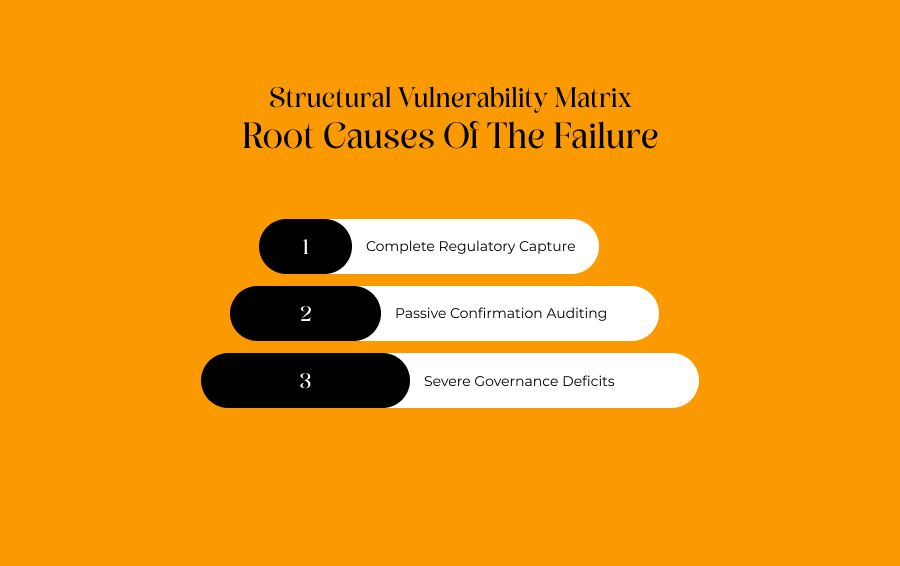
An institutional post-mortem of Wirecard AG highlights three distinct, compounding risk management flaws that left the enterprise completely defenseless against a forensic check:
· Complete Regulatory Capture
Germany’s financial regulator, BaFin, suffered from severe systemic blindness.
Also, it didn’t waste time investigating Wirecard's suspicious books.
Rather, BaFin launched criminal market-manipulation investigations against the journalists.
It also did the same to short-sellers who exposed the fraud, effectively shielding the corrupt executives.
· Passive Confirmation Auditing
For over a decade, external auditing teams accepted simple, third-party balance screenshots.
Additionally, it kept unverified email letters from local Asian trustees as absolute proof of the €1.9 billion cash holdings.
However, they failed to contact the primary banks directly to verify the ledger positions.
Also, they allowed a basic paper trail to survive multiple audit runs.
· Severe Governance Deficits
The corporate board operated without any baseline transparency.
Chief Operating Officer Jan Marsalek held absolute control over the platform's international shadow transactions, managing complex shell companies and moving massive corporate assets without any internal accounting oversight or secondary board approvals.
Post-Crisis Regulatory Remediations
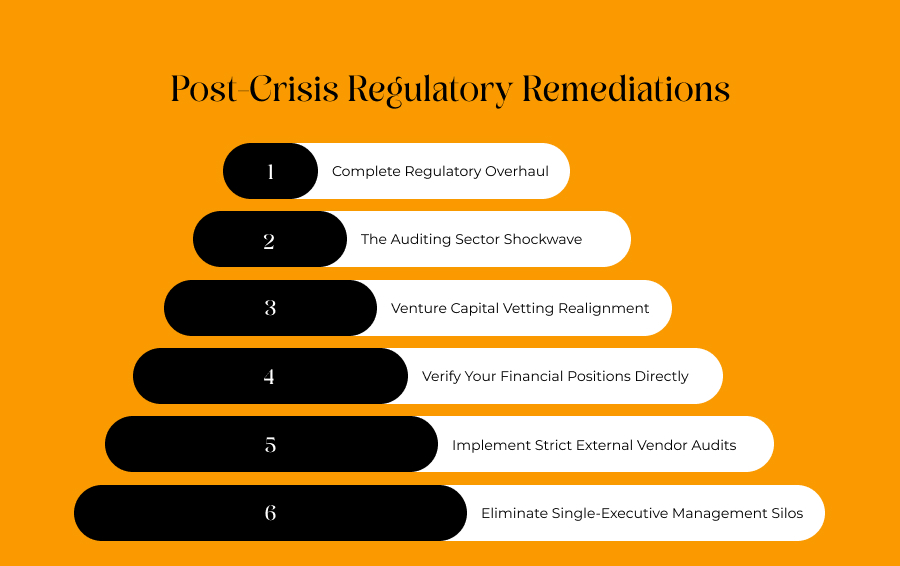
The fallout from the Wirecard scandal shattered the reputation of European financial markets and forced international authorities to implement sweeping structural reforms:
· Complete Regulatory Overhaul
The German government passed the FISG Act (Financial Market Integrity Strengthening Act).
This sweeping legislation completely restructured BaFin, granting the agency direct powers to audit major corporate accounts independently, while introducing a strict 10-year rotation cap for external auditing firms.
· The Auditing Sector Shockwave
The multi-year failure to catch the phantom assets permanently damaged the credibility of top global auditing houses, triggering massive legal liability suits from institutional investors and driving structural changes across corporate vetting networks worldwide.
· Venture Capital Vetting Realignment
Modern tech investors shifted away from tracking simple top-line processing volumes.
Due-diligence protocols now demand independent, automated tracking of underlying payment streams, matching reported numbers against hard transaction files to eliminate faked books.
Comprehensive Lessons for Corporate Treasury and Capital Allocation
Analyzing the structural failure of Wirecard highlights several essential risk management rules for modern corporate treasuries and venture capital investors:
· Verify Your Financial Positions Directly
Never trust a third-party image, an unverified PDF screenshot, or an isolated email letter from a regional middleman bank as proof of your cash holdings.
Ensure your internal treasury teams run independent, automated bank integrations to track your cash reserves on a 1:1 basis.
· Implement Strict External Vendor Audits
If your company relies heavily on Third-Party Acquirers or independent outsourcing networks to generate revenue, enforce continuous compliance checks.
Track actual, granular transaction logs to verify that your business growth is driven by real consumer demand rather than faked digital logs.
· Eliminate Single-Executive Management Silos
Establish tight internal controls that prevent a single executive or operations officer from managing international shell networks or bank routing pipelines without oversight.
Furthermore, you must ensure all cross-border cash transfers require multi-signature approvals from independent board members.
This is an important step to prevent unaudited cash vacuums.
The Dynamics Of The Wirecard Scandal Explained
The failure of Silicon Valley Bank was a classic asset-liability mismatch.
But Wirecard's collapse was a case of institutional accounting fraud and broken regulatory oversight.
Moreover, Wirecard did not fail because the digital payment market slowed down.
Rather, the Wirecard scandal happened because its leadership manufactured billions in fake processing revenue to hide a failing business core.
Therefore, to understand it better, it is important that you study this structural breakdown.
Then, modern financial officers can learn to look past flashy tech valuations and prioritize direct transaction checks. Also, you will be able to manage corporate capital with absolute, data-driven certainty.