












The asset management sector requires strict risk mitigation parameters, diversified portfolio allocation, and structural buffer liquidity.
When managing alternative digital asset portfolios, investment funds must balance directional bets with real downside risk modeling.
A primary historical baseline for structural collapse within the web3 ecosystem is Three Arrows Capital (3AC).
Founded in 2012 by former classmates Su Zhu and Kyle Davies, 3AC transitioned from traditional foreign exchange trading to become the premier crypto hedge fund, managing over $10 billion in assets at its valuation peak.
However, its aggressive market footprint ended in a catastrophic corporate implosion.
In June 2022, a British Virgin Islands court ordered the liquidation of the fund, preceding its Chapter 15 bankruptcy filing in New York.
This exhaustive case study evaluates the strategic overreach, uncollateralized debt architectures, and interconnected counterparty defaults that triggered a systemic multi-billion-dollar financial meltdown.
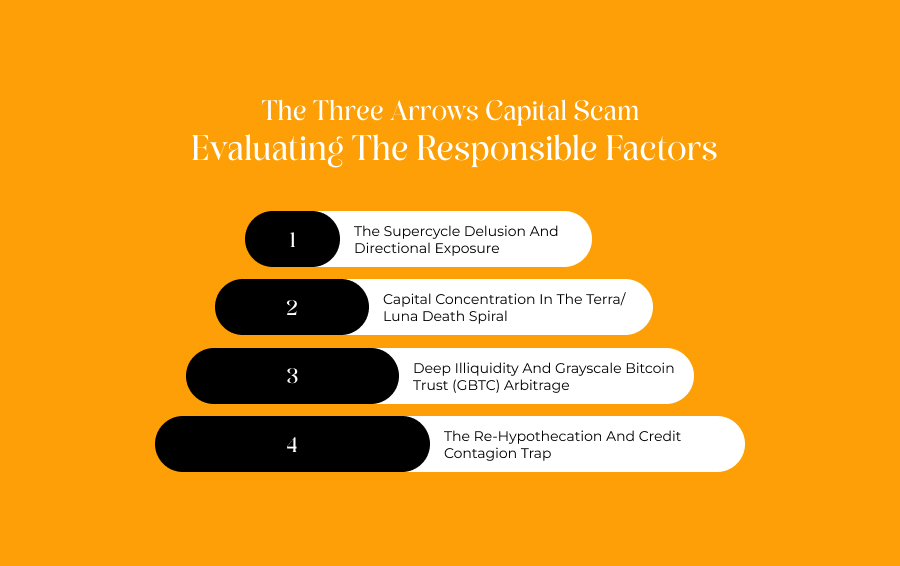
The Three Arrows Capital Scam: Evaluating The Responsible Factors
Like all the historic financial disasters, this one too has some of the most obvious yet striking reasons behind it.
Let us take a closer look at what these factors really are:
1. The Supercycle Delusion And Directional Exposure
The core strategic flaw of Three Arrows Capital was its absolute structural dependence on a continuous upward market trajectory.
It is a thesis Su Zhu publicly promoted as the crypto "Supercycle."
3AC abandoned market-neutral hedging protocols.
Therefore, this transformed the hedge fund into a massive, unidirectional long bet on digital assets.
When the macroeconomic environment shifted toward quantitative tightening, this unhedged exposure left the fund completely defenceless against downside corrections.
2. Capital Concentration In The Terra/Luna Death Spiral
The primary catalyst for 3AC's downfall occurred in May 2022.
The fund had deployed over $200 million into locked Luna (LUNC) to back the algorithmic stablecoin ecosystem TerraUSD (UST).
When the UST algorithm broke its peg, it triggered a rapid death spiral that completely erased over $40 billion in market value in less than a week.
3AC's direct equity positions in the asset plummeted from hundreds of millions to zero, instantly wiping out a massive portion of the fund's liquid capital reserves.
3. Deep Illiquidity And Grayscale Bitcoin Trust (GBTC) Arbitrage
To compound its vulnerabilities, 3AC locked up massive amounts of capital in the Grayscale Bitcoin Trust (GBTC).
The fund had previously executed a profitable arbitrage trade by exploiting the premium value of GBTC shares relative to spot Bitcoin.
However, as institutional market dynamics shifted, the premium inverted into a severe discount.
3AC found itself holding massive, illiquid positions in GBTC shares that it could not sell on the open market without realizing devastating capital losses.
Therefore, this trapped its remaining assets during a severe liquidity crisis.
4. The Re-Hypothecation And Credit Contagion Trap
SunEdison relied on complex subsidiaries.
However, Three Arrows Capital relied on a web of institutional counterparty debt. 3AC operated as a central borrower.
So, they took billions in uncollateralized or under-collateralized loans from prominent crypto lenders, including:
- Genesis Trading
- Voyager Digital
- BlockFi
- Celsius Network
Crucially, 3AC engaged in aggressive re-hypothecation. They used the exact same borrowed capital pools to secure secondary and tertiary loan agreements across different lenders.
When the values of 3AC's underlying assets collapsed, lenders issued immediate margin calls.
Because 3AC had already deployed this capital into illiquid venture investments and locking protocols, it could not fulfill its payment demands.
Therefore, this triggered a cascading wave of multi-billion-dollar defaults that bankrupted its lenders.
Forensic Accounting Breakdown: Phantom Assets Vs. Real Liabilities
The underlying driver of 3AC's swift collapse was an extreme gap between reported asset values and liquid balance-sheet realities.
· Venture Caching Overvaluation
3AC counted equity stakes in early-stage web3 start-ups and highly illiquid NFT portfolios.
One of the most common examples of this is their Starry Night collection. This is taken at theoretical "mark-to-market" valuations.
Additionally, these positions looked highly lucrative on paper during a bull market.
However, they had near-zero open-market liquidity during a downturn.
· The Creditor Deficiency Grid
When the BVI liquidators took corporate control, they uncovered a massive accounting deficit.
The fund owed $3.5 billion to over 20 institutional creditors.
In addition, there were digital asset broker Genesis holding the largest individual claim at $1.2 billion.
Furthermore, 3AC had actively used fresh, unsecured institutional loan capital to pay out minor margin calls on secondary desks.
Also, this ran a hidden liquidity carousel until the entire credit ecosystem froze.
The Global Crackdown On Crypto Shadow Banking
The structural failures of 3AC acted as the primary catalyst for an aggressive global regulatory clampdown on the crypto "shadow banking" sector.
Prior to the collapse, firms like 3AC operated in regulatory blind spots by continually shifting their legal domiciles across:
- Singapore
- Dubai
- The British Virgin Islands
After the contagion, international regulators shifted from observation to aggressive enforcement.
The Monetary Authority of Singapore (MAS) officially banned both founders from the country's regulated financial sector for nine years.
Moreover, they tightened compliance mandates for all localized digital asset funds.
Globally, the collapse accelerated the enforcement of strict liquidity coverage ratios (LCR).
Additionally, there was a traceable impact on explicit transparency mandates for re-hypothecated assets.
Furthermore, it influenced how specific yielding protocols were classified under traditional securities laws.
3AC effectively ended the era of unregulated institutional crypto credit.
Core Lessons For Modern Wealth Management And Digital Asset Funds
| Risk Mitigation Imperative | The Three Arrows Capital Failure | Institutional Corrective Action |
|---|---|---|
| Delta Neutrality | Abandoned risk hedging in favor of highly concentrated, directional market long bets. | Maintain strict delta-neutral or multi-asset market hedging corridors. |
| Collateral Integrity | Re-hypothecated identical assets across multiple uncoordinated lending desks. | Implement transparent, real-time cryptographic proof-of-reserves tracking. |
| Liquidity Profiling | Locked short-term borrowed capital into long-term, highly illiquid venture equity. | Ensure maturity-matching constraints; limit illiquid assets to a fixed equity tier. |
| Counterparty Vetting | Leveraged personal reputation and social prestige to bypass standard credit due diligence. | Require automated, smart-contract-enforced over-collateralization parameters. |
The Dynamics Of The Three Arrows Capital Collapse Explained
The downfall of Three Arrows Capital stands as an institutional reminder that massive scale can never substitute for disciplined risk management.
3AC did not implode due to a lack of technical trading competence.
Rather, it collapsed because it substituted sound financial math for ideological market delusions.
Additionally, it utilized unsecured leverage to fund illiquid assets.
For asset managers, wealth advisors, and decentralized financial innovators, Three Arrows Capital remains the permanent baseline warning.
They now know that leverage amplifies profits during an expansion.
But unhedged leverage guarantees systemic destruction during a contraction.