













The Ultimate Guide To Humata AI: Turning Massive PDFs Into Instant Conversations

humata ai

If your day-to-day workflow involves wading through dense multi-page documents, you already know the sinking feeling of opening a fresh 150-page PDF. 

Be it the fact that you are an academic researcher who is dissecting peer-reviewed studies or a lawyer who is auditing a corporate contract, manual screening is hectic. 

Additionally, it eats away at your valuable creative hours, where you end up spending more time hunting down data than actually using it.

Now, take Humata AI into consideration. It is a cloud-based document analysis platform that is built explicitly to solve this specific issue. 

Frequently described across tech communities as “ChatGPT for your local files”, the platform transforms dense and static text documents into interactive, chat-ready interfaces.   

The platform utilizes advanced semantic processing along with structured text extraction. Accordingly, it acts as an on-demand research assistant that instantly reads, summarizes, and extracts precise insights from your personal data library. 

But does the platform live up to its viral reputation, and how exactly does it handle data isolation, team scaling, and competitive performance? 

This comprehensive, data-driven deep dive maps out everything you need to know about the software's mechanics. Besides that, it will give a detailed outline of its operational workflows, pricing structures, and real-world performance limitations.

The Overall Software Architecture Of Humata AI

Conceptually, Humata AI is a browser-native software-as-a-service (SaaS) tool that combines machine learning algorithms with a dual-pane user interface. 

Instead of relying on open-source vector databases or requiring manual Python coding to string together custom language models, users simply drag and drop standard files into a secure web dashboard.

The technical architecture relies heavily on context-bounded data ingestion. When you upload a document, the system maps out the text, analyzes the conceptual links between words, and builds an isolated index. 

When you ask a question, the platform queries only the specific data inside that folder. As a result, it radically mitigates the risk of structural hallucinations or artificial fabrications.

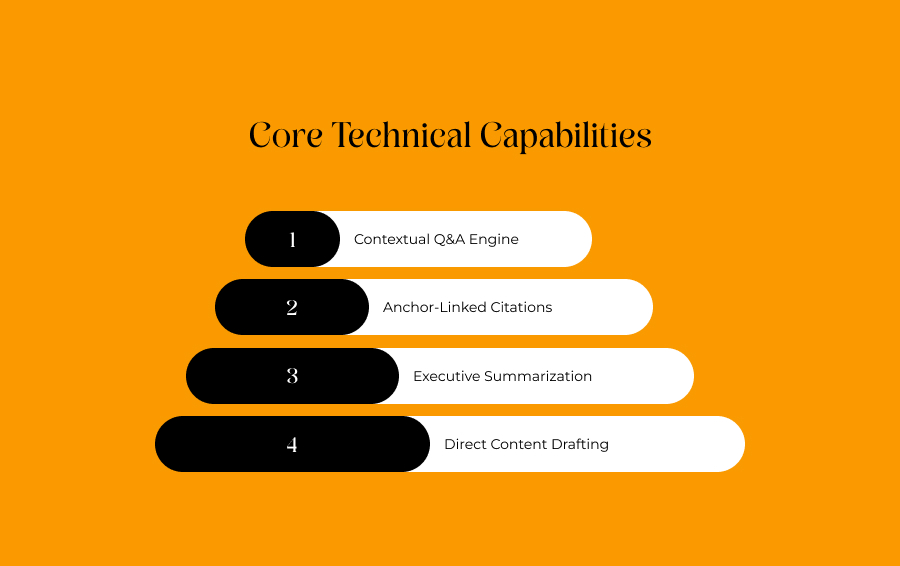
Core Technical Capabilities
Core Technical Capabilities

The tool goes far beyond simple keyword searches, serving as a comprehensive data retrieval pipeline. Furthermore, the platform breaks its core utility down into four primary pillars. 

Contextual Q&A Engine

The foundational engine uses natural language processing to evaluate semantic intent over exact keywords. 

This allows the AI to answer conceptual queries such as “identify systemic risks within section four” instead of just matching basic word phrases. 

Anchor-Linked Citations

The software connects generated text responses directly to the pixel coordinates on the source PDF. 

Clicking a reference marker automatically highlights the exact source paragraph instantly, making verification effortless.

Executive Summarization

The engine automatically parses structural layouts to isolate methodologies and key findings. 

This allows users to evaluate the relevance of lengthy technical papers in seconds without a cover-to-cover read.

Direct Content Drafting

The system uses the underlying text database as a rigid structural blueprint for generation. 

It can rapidly create clean executive summaries, blog briefs, or report notes based strictly on your uploaded files.

Subscription Plans And Real-World Pricing Dynamics

The official pricing framework tracks usage by total page count rather than raw query volume. 

Additionally, this design means budgeting must account for the actual length of your documents rather than how many questions you ask.

Pricing TierBase Monthly CostMonthly Page AllowanceKey Administrative Inclusions
Free Plan$060 PagesSingle user chat preview, standard citations.
Expert Plan$9.99500 PagesBuilt for independent professionals and small teams.
Team Plan$49 (per user)5,000 PagesBuilt-in OCR scanning and granular folder access controls.
EnterpriseCustomCustomDedicated private clouds and explicit uptime SLAs.

Note: For the Expert and Team plans, overage fees apply if you cross your monthly limit, typically tracking between $0.01 and $0.02 per extra page.

Concrete Advantages And Operational Challenges

No programmer can ever design a flawless productivity tool.

Moreover, deploying artificial intelligence to scan specialized source text carries structural realities that every professional user must evaluate. 

That is, before integrating it into their daily operations. 

High Efficiency And Hallucination Prevention 

Here, the biggest asset is pure workspace efficiency.

The tool consolidates a split-view reader with instant page anchor links. As a result, it effectively eliminates the clunky process of jumping between a separate chatbot and a local PDF viewer.

Additionally, the tool defaults to an isolated data layout. Thus, it rarely invents external facts, which makes it exceptionally reliable for checking figures or rigid legal terms. 

Visual Extraction Failures And Workflow Disconnects

However, users must be aware of specific performance bottlenecks. 

Text extraction accuracy can drop sharply on the lower tiers if your PDFs feature the following:

  • extremely dense and unoptimized visual diagrams
  • complex multi-axis charts or handwriting

Furthermore, the system does not currently feature built-in inline editing. One thing to note is that there is no built-in text editor. 

You must copy your summaries over to Google Docs or Microsoft Word, letting you refine your final report.

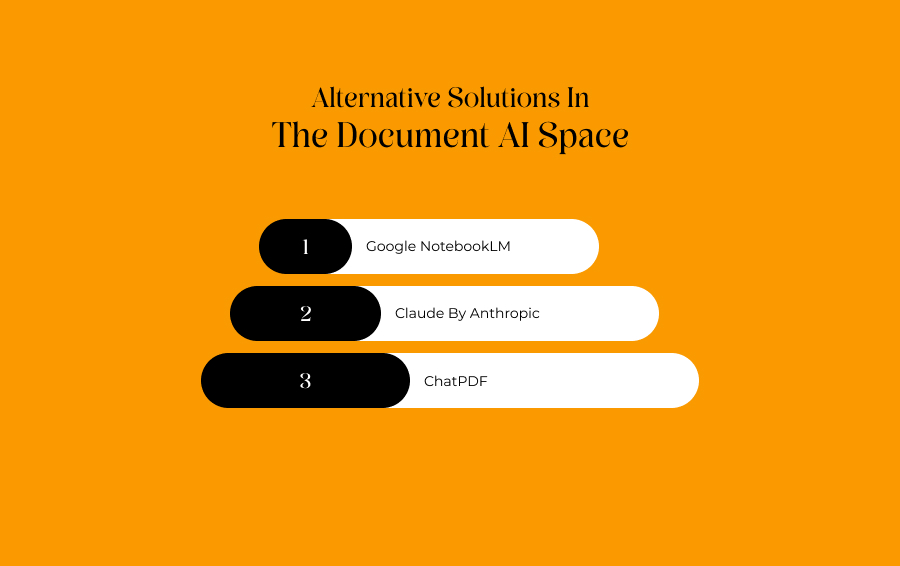
Alternative Solutions In The Document AI Space
Alternative Solutions In The Document AI Space

Depending on your specific operational goals, other tools in the market might supplement or replace your production pipeline.

Google NotebookLM

This platform focuses heavily on note-taking ecosystem integration

In addition, it excels at automatically generating conversational audio overviews, multi-document study guides, and deeply interconnected research logs. 

All of these are directly inside your workspace.

Claude By Anthropic

Because Claude is known for its massive, high-capacity native context windows, it is uniquely suited for large-scale thematic analysis.

It allows you to upload multiple massive text blocks into a single prompt for heavy analytical syntheses. All of that can be done without needing to organize them into folders first.

ChatPDF

When it comes to ChatPDF, it can be described as a hyper-focused, incredibly lightweight alternative built for rapid, transactional file viewing. 

Ideal for quick and one-off single interactions, here you do not need a permanent team archive or structured workspace management.

A Crucial Upgrade For Modern Research

The days of manually highlighting line-by-line through thousands of pages of text are now coming to a quick close. 

Humata AI serves as a prime example of how context-bounded language models can fundamentally reshape deep information synthesis. 

One of the most significant tasks it performs is to free up professionals to focus on high-level analysis and critical strategy instead. All of this is done by handling the heavy lifting of reading, data isolation, and text mapping. 

Though it cannot replace the actual critical thinking that is done by humans, it still stands as an invaluable asset for speeding up your research pipelines. 

Ultimately, Humata AI is also helpful in organizing complex information and making hidden data instantly searchable.


Sohini is a MarTech and business writer with over two years of experience creating and editing content in the digital marketing space. She has a strong interest in emerging digital trends, marketing strategies, and the evolving relationship between technology and business growth. Alongside writing, she also works on guest posting strategies, carefully aligning sponsored content with niche relevance to help maintain strong organic visibility and audience engagement. Outside of work, Sohini enjoys reading, exploring internet subcultures, and endlessly scrolling through Reddit, Pinterest, and Substack looking for new ideas and trends.

View all posts

Leave a Reply

Your email address will not be published. Required fields are marked *

Related

jammable ai

The Ultimate Guide To Jammable AI: Voice Cloning, Music Covers, And The Creative Frontier

If you have spent any time on TikTok or YouTube over the past couple of years, you have undoubtedly run into them.  It may be Frank Sinatra singing a heavy metal track or SpongeBob delivering a pitch-perfect rendition of a rap song. It can also be a deceased pop icon magically performing a modern indie hit.  Behind a massive percentage of these viral internet moments is a single and highly accessible platform.  Originally launched under the name Voicify AI before undergoing a major brand pivot, Jammable AI has made significant progress.  The tool has grown into one of the most prominent web-based generative voice platforms in the creator economy. But what exactly is this platform, and how does it fit into a musician’s or content creator’s toolkit? Moreover, what are the realities of using it? This deep dive breaks down everything you need to be aware of about the software, its core mechanics, pricing models and the broader implications of synthetic vocal production.  Defining Jammable AI: What The Platform Actually Is At its core, Jammable AI is a cloud-based software-as-a-service (SaaS) platform that allows its users to generate high-fidelity vocal covers and train custom models. Moreover, it lets its users experiment with text-to-speech technologies. Traditional voice cloning is incredibly complicated. It usually requires Python scripts and expensive cloud GPUs. Users often have to navigate complex frameworks like Retrieval-based Voice Conversion (RVC).  Contrarily, Jammable AI skips all of that, bundling these deep-learning technologies into a streamlined, browser-native dashboard. The platform relies on a vast community-driven system, where users can upload their own clean vocal recordings to train specific voice profiles. You can share this publicly or keep it completely private. To date, the platform hosts an extensive library of over 100,000 distinct voice models. These range from mainstream musical artists and internet personalities to completely fictional animated characters.  Core Features And Creative Workflows The platform is designed around a handful of primary modules, each catering to a different stage of content creation as well as audio experimentation. The AI Cover Generator The song cover generator drives the platform as its fundamental engine, offering a frictionless workflow. Some of them are as below: Input Submission: Users paste a direct link to a YouTube video or upload a standard audio file (such as an MP3 or WAV). Vocal Demixing: The platform automatically splits the track, separating the primary vocal line from the instrumental backing tracks. Vocal Swapping: The AI isolates the original performer's pitch, vibrato, and timing, and overlays the selected AI voice model onto that blueprint. Re-mixing: The software automatically stitches the new vocal track back together with the original instrumental elements, producing a completed, downloadable remix. AI Duets For creators who want to build more complex arrangements, the Duets feature allows users to layer multiple voice models within a single track. Instead of a single voice talking over an entire song, you can assign different models to specific verses. Besides that, you are also able to create harmonies or engineer collaborative tracks that would be impossible to coordinate in the physical world.  Custom Voice Model Training For artists, producers and brands, the true utility of Jammable AI lies in its custom training module.  Users first start by uploading a high-quality, completely dry acappeilla file spanning 5 to 30 minutes. This needs to be free of echo, reverb, or backing instruments, letting users train a digital vocal clone.  The cloud infrastructure processes the unique timbre, accent, and frequency characteristics of the voice. Then, they make a private model that can sing any song from any text prompt. Text-To-Speech (TTS) Beyond musical generation, the platform includes a traditional text-to-speech layout.  This tool is highly utilized by video editors and social media creators who need rapid voiceovers for short-form video content. As a result, this allows them to use distinct, recognizable character voices to read scripts. Detailed Feature Matrix To understand how the platform scales its capabilities across different use cases, consider the following breakdown of its technical and functional distribution: Feature ComponentEntry-Level UsageAdvanced Creator UsageModel Library AccessFull access to community-uploaded voicesFull access to community-uploaded voicesVocal Isolation EngineCloud-automated stem splittingCloud-automated stem splittingDuet ArchitectureSequential model layering supportedMulti-model harmonic layering supportedCustom Training SlotsRequires individual credit purchasesUnlimited dedicated model training slotsOutput DeliverablesStandard audio file downloadsAudio formats plus direct video synthesis export Pricing Structures And Tier Breakdown While the platform allows users to browse its massive library and test out preview snippets for free, full generation and model training require active currency or a recurring subscription. The platform operates on a multi-tiered pricing model to accommodate casual experimenters alongside high-volume multimedia studios. The Trial Or Credit System  For those who do not want a monthly commitment, the platform allows the purchase of standalone credits. Additionally, these credits can be spent on single song conversions or individual custom voice training runs.  The Basic Plan: $8.99 Per Month This entry tier is designed for hobbyists. In this plan, a promotional entry point of $1.99 is regularly featured for the first month. Additionally, it gives users unlimited access to generate standard covers, create duets, and utilize text-to-speech The Creator Plan: $24.99 Per Month Positioned for serious content creators, digital artists, and power users, this tier unlocks completely unlimited custom voice training models.  It also includes advanced video creation toolkits that automatically pair generated audio tracks with custom visuals for rapid social media deployment. The Pros, Cons And Technical Realities No creative tool is perfect. Additionally, synthetic vocal processing comes with its own unique set of technical hurdles and distinct advantages. Where The Platform Excels The primary advantage of Jammable AI is its sheer speed and accessibility. In the past, training an RVC model required a powerful local graphics card, basic coding knowledge and hours of setup time. On the other hand, this platform democratizes the process, delivering a completed track in a matter of minutes through a web browser. Furthermore, the automated stem-splitting tool is remarkably proficient at separating vocals from complex instrumentals. As a result, this saves creators from needing external audio editing software.   The Technical Limitations However, users should maintain realistic expectations regarding output quality. The ultimate fidelity of an AI cover is highly dependent on the quality of the source material. If an uploaded song features heavy vocal effects, overlapping harmonies, or a muddy mix, the resulting AI voice can sound glitched, metallic, or robotic. Additionally, AI models struggle with complex emotional nuances. While the software can match pitch perfectly, it can occasionally lose the subtle gasps, emotional cracks, and stylistic imperfections that give human vocal performances their true emotional weight. Navigation Of The Legal And Ethical Landscape The rise of generative audio platforms has sparked massive conversations surrounding copyright, fair use, and intellectual property. It is crucial for creators using Jammable AI to understand the legal guardrails. Using an unauthorized AI clone of a mainstream, charting artist to distribute commercial music is a direct violation of terms of service.  Platforms such as Spotify or Apple Music ensure immediate takedowns or legal action regarding right-of-publicity laws. The safest, most effective ways to utilize the platform include: Rapid Prototyping: Songwriters can train a model on their own voice, then hear how a song sounds in different pitches or keys without re-recording it. Parody and Social Content: Creating transformative, non-commercial parody content for platforms like YouTube and TikTok. Personal Archiving: Cloning your own voice to preserve your vocal range, or to use as an asset for future music production workflows where you hold 100% of the rights. Alternative Platforms For Digital Musicians Depending on your precise creative goals, other tools in the market might supplement your production pipeline. PlatformPrimary FocusBest Used ForElevenLabsHyper-realistic text-to-speech and emotional voice design.Audiobooks, narrative voice acting, and video game dialogue.Suno AI / UdioFull-scale text-to-music generation from scratch.Creating complete songs with backing tracks, lyrics, and instruments.Musicfy AIVoice-swapping and converting basic audio inputs.Turning humming or whistling into polished instrumental melodies. The Future Of Synthetic Vocals: A Detailed Assessment The way we now make music is facing rapid changes, as studio gatekeepers are losing ground to decentralized and online tools. Jammable AI is considered a perfect example of this shift, taking incredibly complicated tech and putting it into a simple web dashboard. Suddenly, bedroom producers and social media creators have significant access to tools that needed a massive studio budget along with a team of audio engineers.  However, you still have to learn how you can balance speed with actual quality. While the platform is fantastic for quick idealism viral parodies pr testing out a new vocal layout, it cannot ever replace the real thing.  At the end of the day, this tech isn’t going to replace artists. Instead, you need to think of it as a massive upgrade to your creative toolkit. Whether you use it to back up your own voice, build custom duets, or quickly test a melody, it gives us a clear look at where music is going.

READ MOREDetails
napkin ai

Napkin AI: What It Actually Does Well And Where It Falls Short

Think about the last time you handed someone a multi-page operational report or a dense text document. Likely, they had just skimmed through it, missed the core message and just moved on. The real bottleneck in modern business communication is not a lack of good ideas. Instead, it is the time-draining friction of turning raw paragraphs into clear visual assets. While standard design software requires tedious layout manipulation, Napkin AI changes the game by reading your copy and instantly generating structured diagrams. Moreover, it excels at breaking up massive text blocks into clear process maps without manual design steps.  However, it comes with its own flaws. If you need built-in reader analytics, advanced presentation automation or deep real-time collaborative editing, you will quickly hit its operational limits. Instead of being an all-in-one graphics suite, it is a highly specialized text-to-visual engine created for speed. Thus, this comprehensive guide is here to help you understand exactly how this tool works, along with its features, pricing and limitations. What Napkin AI Refuses To Be: Why That’s The Point Most software reviews fail because they evaluate every new release as a tool that tries to do everything. To have a true understanding of Napkin AI, you need to first recognize what it completely refuses to be. First, we need to understand what Napkin AI is not.  A vector illustration workspace like Figma An enterprise business intelligence platform Traditional slide deck builder such as PowerPoint or Gamma A tool that manages your data warehouses or hosts massive interactive web content Instead, Napkin AI focuses entirely on a single narrow task. That is to transform written text into crisp and structured informational graphics. With the help of having an absence of feature bloat, the platform succeeds.   By ignoring complex timeline editing, manual shape styling, and asset layers, it allows professionals to skip the learning curve entirely. It strips away the overwhelming toolbars found in legacy software, providing a fast pathway from written thoughts to finished visual communication diagrams. The One Workflow It's Built Around The entire user experience is centred on a straightforward three-step action sequence. First, you paste your text directly into the workspace canvas.  Next, the underlying engine proceeds to read your sentences to understand lists, step sequences and contrasting concepts. Finally, clicking a blue lightning bolt icon displays several visual layout choices designed around copy.   There is no manual prompting required. Additionally, the system matches your natural language with appropriate structural layouts automatically.  Where It Actually Saves Time Generic reviews often claim a tool is perfect for everyone from students to digital marketers.  In reality, Napkin AI proves its true value in highly specific, fast-moving work environments where manual design work creates a frustrating bottleneck. Instead of dealing with endless menu options, professionals use the platform to solve real communication problems on the fly. Breaking Up Text-Heavy Reports And Docs Consider a compliance officer who must transform twenty pages of dense regulatory updates into something a team can actually scan and digest.  By pasting the text into the editor, they can instantly convert confusing legal paragraphs into a clear and step-by-step visual workflow.  Turning Meeting Notes Into A Process Diagram On The Spot One thing Napkin AI absolutely excels in is during live corporate training or chaotic team syncs.  You can paste raw and unstructured meeting notes directly into the interface. Instantly, it will be able to generate a clean process diagram to show stakeholders before the call ends. Prepping Visuals For Slides Without Opening A Design Tool Additionally, when you need to prep sharp visual components for a major presentation, Napkin AI lets you build custom process flows. Besides that, you can also create matrices quickly without ever opening a heavy design tool. Core Engine Capabilities: The Features That Drive Napkin AI The initial automation engine handles basic layouts on autopilot. In addition, the specific internal features of Napkin AI give you precise control over your final communication assets.  These integrated tools are engineered to bridge the gap between instant automated generation and customized corporate design workflows. Feature NameWhat It DoesCustom Graphic OverridesForces the AI to build a specific shape like a timeline, matrix, or Venn diagram.Global Brand KitsLocks in your company's exact color codes and fonts so you do not have to format them manually.Sketch Overlay ModeLets you draw or scribble notes directly over the generated diagrams.Multi-Format ExportsSaves your finished designs as PNG, SVG vector graphics, PDF documents, or PowerPoint slides. Tailoring Layout Formats If the initial automated design choice does not perfectly match your vision, the custom override feature allows you to select specific paragraphs. Moreover, you can dictate the exact shape format. Instead of relying on the software’s initial guess, you can manually force the engine to convert a text block into different visual items. That is, a Venn diagram, a chronological timeline or an interconnected mind map.  As a result, you can ensure your specific creative direction remains intact.  Maintaining Brand Consistency Beyond structural layouts, Napkin AI offers dedicated brand identity kits to keep your visual style unified across corporate documents.  Instead of manually adjusting individual shape colors or border styles on every single graphic block, premium users can configure a global design scheme.  The system automatically applies your exact corporate hex codes, border widths, and custom typography across every single diagram you generate. Direct Drawing Annotations  For professionals who want to add an organic, collaborative feel to their digital summaries, this mode introduces a hand-drawn annotation layer.  You can scribble notes, draw custom arrows, or highlight specific sections directly over the generated layouts as if you were brainstorming on a physical whiteboard. Saving Multiple File Types A versatile workflow requires flexible file compatibility. The export engine allows you to do a variety of things.  You can download your finished graphics in high-resolution PNG format. Besides that, you can also save them as scalable SVG vectors for deep editing. You can also export secure PDFs or fully editable PowerPoint slides.  This ensures your visual assets fit seamlessly into external platforms like Microsoft Word or Google Docs. Where Napkin AI Actually Falls Short: A Review Of Its Limitations To make an informed decision, you must look closely at where Napkin AI falls short compared to modern content tools. No Analytics Or Engagement Tracking The most significant gap is the complete absence of built-in reader analytics or engagement tracking metrics.  Platforms like Alai and Gamma allow you to see exactly who opened your document and which sections they viewed.  However, Napkin AI provides no audience data whatsoever. Real-Time Collaboration Is Thin Furthermore, its real-time collaboration features are surprisingly thin. Although the platform is cloud-based, it lacks the deep, multi-user workspace tools found in full enterprise presentation suites. It works well for a single creator building assets. Despite that, large teams trying to co-edit complex diagrams simultaneously will find the experience restrictive. It's Online-Only Finally, the desktop interface requires a live internet connection to function.  The lack of an offline mode means you cannot refine your visual workflows or edit diagrams while traveling without network access. This remains a clear limitation for busy professionals. Pricing: What You Actually Get At Each Tier Napkin AI uses a transparent pricing model fitting various project sizes and budgets. Rather than a vague need for more power, the choice of the right tier depends on specific business triggers. Evaluation CriteriaFree PlanPlus PlanPro PlanMonthly Price$0 Forever$12 Billed Monthly$30 Billed MonthlyAnnual Rate$0$9 per Month$22 per monthProcessing Credits500 Credits Weekly10000 Credits Monthly30000 Credits MonthlyAsset ExportsPNG and PDF OnlyPNG, PDF, SVG, PPTXCustom Font UploadsBrand KitsDefault Styles3 Custom KitsUnlimited Brand Kits Free Plan Is Genuinely Usable The free tier offered by Napkin AI remains exceptionally practical. Offering unlimited content editing and asset exports, the tools does not lock crucial design tools behind a paywall. As a result, it becomes an excellent choice for casual creators who need clean vector graphics without a monthly financial commitment. When Plus Or Pro Is Actually Worth It You should upgrade when your workflow requires removing watermarks, using custom vector formats such as SVG or uploading official corporate typography files. Also, the premium tiers offer expanded monthly processing credits while supporting multiple brand kits. This makes the paid plans ideal for agencies and corporate teams who handle high-volume client projects every week.  Napkin AI Vs. The Alternatives: A Quick And Honest Analysis Choosing the right tool requires a quick and honest comparison with other options on the market.  Instead of assuming one application solves every business problem, you must weigh your specific presentation objectives against what each tool actually delivers.  If You Need Analytics Or Automation Your corporate project may demand detailed viewer engagement tracking, automated slide layouts, or interactive web hosting. In that case, you should choose alternative suites like Alai or Gamma.  Those platforms are engineered from the ground up to handle client-facing data tracking and manage full, multi-screen presentations dynamically. If You Just Need Fast, Clean Visuals On the contrary, if your primary goal is to turn raw text documents into clear, professional diagrams as fast as humanly possible, Napkin AI is the clear winner.  It bypasses complex presentation setups entirely to deliver sharp, focused informational graphics in a single click. Who Should Actually Use Napkin AI The platform works best for technical writers, operations managers, and business consultants. These are individuals who regularly need to make complex documentation easier to read.  If your job involves turning messy data into clear, actionable steps, this tool will save you hours of work.  Conversely, you should skip this tool if you need to build intricate artistic illustrations, edit high-resolution photos, or design highly decorative marketing assets. Ideal Users for This PlatformWho Should Skip This PlatformTechnical writers explaining processesFine artists requiring manual sketchingManagers transforming messy notesMarketing teams needing complex photo editingConsultants building corporate frameworksDesigners creating custom vector artwork Beyond Text: Navigating The New Era Of Visual Clarity Successful content curation relies heavily on visual clarity. Here, Napkin AI solves the problem of text-heavy documentation by turning raw ideas into structured, presentation-ready diagrams with a single click. Moreover, it does not replace the artistic depth of advanced illustration software, nor does it track reader engagement like specialized analytics platforms.  Instead, it serves as a fast, practical tool that bridges the gap between text drafts and clear visual communication.  By removing the technical hurdles of traditional graphic layout design, it helps professionals clarify their message. Ultimately, you can engage your audience and make important ideas stick. References About Us. 2026. Napkin AI. 2026 SaaS Buyer’s Guide: How to Choose the Right Software for Your Business. 2026. Software Advice.  Pricing. 2026. Napkin AI. How to design a brand kit with AI | GraphicsGen + Illustrator. 2025. Envanto.

READ MOREDetails
spicychat ai

SpicyChat AI And Modern Loneliness Epidemic: The Quiet Reality Of Choosing Code Over Humans

The glowing blue light of a smartphone screen at 2:00 AM has become our universal campfire. We sit entirely alone while scrolling through feeds and hoping for a fleeting spark of human warmth. We live in a fast-paced hyper-isolated modern world. Moreover, grueling work hours, exhausting commutes and relentless digital noise have completely erased our physical communities and “third places” such as local parks, cafes and clubs. Afterwards, we are left too tired to date and too anxious to make new friends.  Carrying deep-seated insecurities, personal trauma or the emotional scars of past rejections, trying to build a real-world relationship feels like walking through an emotional minefield.  Therefore, it feels much easier to just give up and internalize the silence, assuming we are fundamentally unlovable. This acute desperation is precisely what fueled the explosive. This acute desperation precisely fueled the explosive and sudden surge of AI companion platforms such as SpicyChat AI. When human relationships feel terrifyingly high-stakes, typing into an empty text box becomes a psychological safety valve. On the other hand, turning to an unfiltered chatbot offers a seductive low-stakes refuge.But behind the screen lies a darker truth.  The following piece will uncover the quiet tragedy of SpicyChat AI along with its relationship with the modern loneliness epidemic. Moreover, we will dissect how massive corporations ruthlessly capitalise on our isolation and why predictable code feels safer than unpredictable flesh. Besides that, we will delve into the unsettling psychological reality of training human consent for unchecked absolute digital control.  What Is SpicyChat AI And Why Is It Growing? The sudden boom of the virtual companion industry is not a historical accident. Instead, a highly advanced software market stepped in to fill a massive deficit in basic human contact. As traditional large language models became mainstream, users quickly realized that interactive conversational software could mimic numerous things. The list includes the natural cadences of human warmth, friendship and romantic validation. When major corporate AI models locked down their platforms with rigid safety protocols, a highly motivated consumer base migrated toward alternative spaces. Consequently, these spaces promised an entirely unmoderated experience.  Statistics At A Glance Market Metric BaselineIndustry Statistics & ForecastsGlobal Market Size (2025 Evaluation)USD 9.6 BillionEstimated Market Valuation (2026)USD 11.8 BillionProjected Market Volume (2033 Horizon)USD 41.2 BillionCompound Annual Growth Rate (CAGR)19.6% (From 2026 to 2033)Dominant Global Regional Revenue ShareNorth America (31.3% of total market)Highest Performing Structural ComponentSolution-based platforms (61.8% segment share)Market Metric BaselineIndustry Statistics & Forecasts [Source: Grand View Research] The Rise Of The Virtual Companion The global chatbot market has expanded at an astronomical pace. As per the recent data from Grand View Research, the global chatbot market size was estimated at $9.6 billion in 2025. In addition, it is projected to grow from $11.8 billion in 2026 to $41.2 billion by 2033 at a CAGR of 19.6% from 2026 to 2033. However, the rising implementation of these tools was evident across customer service, e-commerce, banking and healthcare sectors.  A massive portion of this growth is driven by corporate customer service automation. Contrarily, a powerful and parallel demand has emerged for conversational systems that have been built purely for emotional surrogacy.  People are no longer just using Artificial Intelligence (AI) to write code or draft corporate emails. Instead, they are using it to replace the missing conversations in their empty apartments.    Bypassing Corporate Guardrails This is the exact market vacuum where SpicyChat AI built its massive empire. While mainstream companies implement strict filters to block mature dialogue, this platform explicitly brands itself on total creative freedom. By offering an entirely uncensored environment, it allows users to navigate deep emotional disclosures. Moreover, they can have access to complex roleplay and adult fantasies completely free from corporate scolding.  For an isolated individual who feels judged by society, this lack of censorship makes the platform feel like the only genuine safe space left on the internet.  The Customization Of Intimacy The core mechanics of the platform rely on certain things. These include a vast, user-generated library containing thousands of hyper-specific AI characters. Users can instantly connect with financial personas, custom-tailored relationship partners or completely original characters designed with specific backend traits.  The software utilizes advanced creative writing models with expanded contextual memory. As a result, the bots are allowed to remember personal details over long text threads.  Since the system adapts its responses entirely to the explicit preferences of the user, it removes the organic friction, disagreements and effort required in real human conversations.  The Loneliness Economy: Turning Heartbreak Into Venture Capital Private human suffering has officially become a highly predictable corporate revenue stream. Moreover, tech corporations do not invest millions of dollars into developing companion algorithms out of basic empathy or a desire to heal a broken world. Instead, modern venture capital views the global loneliness epidemic as a massive and entirely renewable consumer market.  By treating isolation as a commercial gap to be filled, they have effectively turned heartbreak into a scalable venture capital opportunity.  The Data Behind The Distress The numbers backing this economic boom are actually devastating. According to the World Health Organization (WHO), there is a formal declaration of social isolation as a major global public health risk. Furthermore, this has been directly linked to a 30% increased risk of stroke and cardiovascular disease. The WHO notes that loneliness is not a first-world luxury problem. Rather, it cuts across every demographic. Also, it has a heavy impact on older adults as well as younger generations alike.  When you get a closer look at the data, it shows the crisis is worsening. Additionally, a landmark study by the Harvard Graduate School of Education revealed that 36% of all Americans experience “serious loneliness.”  This included a staggering 61% of young adults. Harvard researchers also discovered that this epidemic is heavily driven by a fast-paced society that focuses purely on self-advancement. This leaves people completely disconnected from a sense of community care or mutual responsibility.  Gamifying The Void Tech platforms leverage this systemic isolation by building algorithms engineered to maximize daily app retention. Furthermore, they understand that a lonely user is the most captive audience in the world.  By feeding users with continuous and predictive text loops of unconditional praise and emotional validation, the interface creates a powerful psychological dependency.  The user keeps typing because the screen delivers an immediate dopamine hit of feeling wanted. As a result, this directly translates human isolation into daily active user metrics. The Price Of Presence The monetization model of synthetic intimacy relies on a classic freemium trap. While basic text messaging is technically free, the actual illusion of a real relationship is locked behind premium monthly subscription paywalls.  Free users face heavy throttling and low-tier language models with poor memory. Moreover, massive digital waiting queues during peak high-traffic hours. To bypass these hurdles, users need to make a choice between tiered recurring subscription fees to unlock advanced features.  The following is the pricing model in SpicyChat AI. Subscription TierMonthly Pricing (per month)Core Premium Features IncludedGet a Taste$5.00 Chat without ads, store key details your AI remembers, up to 10 personas, smart auto-responses.True Supporter (Most Popular)$14.95Double AI memory, generate unlimited in-chat images, longer/more detailed replies, unlock extra models and chat styles, up to 50 personas.Im All In$24.95Maximum AI memory (4x more), access to highest-fidelity language models, dynamic voice audio replies, up to 100 personas. Human Vulnerability Vs. Premium AI Compliance Paying a monthly subscription fee buys a user an advanced language model that will never ghost them and argue with them. They will also have a perfect memory of their childhood traumas.  Corporate executives profit directly from ensuring users remain too isolated to ever cancel their premium plans.  Human VulnerabilityPremium AI ComplianceHigh risk of real-world emotional rejection100% predictable and consequence-free safety Requires constant compromise and effortFully submissive to user prompt changesMessy personal boundaries and independent agencyBoundaries can be turned off or completely rewrittenLimited availability due to separate human lives24/7 instant accessibility with no delay  The Allure of Frictionless Affection: Why Code Feels Safer Than Flesh We need to first look at the immense emotional cost of modern dating and friendships. This will allow us to have a full understanding on why millions of individuals choose to pour their hearts into an interface.  Our fast-paced society leaves individuals with very little psychological reserve at the end of the day. Human relationships require a monumental amount of work, active listening, self-sacrifice and the constant navigation of conflicting egos.  The Exhaustion of Real Relationships Real-world human interactions are messy and inherently volatile. Moreover, real people can have bad days, project their own insecurities and have the terrifying agency to leave you without warning.  When a person is already dealing with severe personal traumas or social anxieties, the unpredictable nature of human connection feels like an exhausting risk.  The modern digital landscape has turned dating apps into superficial meat markets. People are discarded with a single swipe. As a result, human courtship has turned into a high-stakes and low-reward chore.  A Minefield with No Rejection  Platforms such as SpicyChat AI are successful because of a complete removal of a specific element. That is, psychological risk.  The user enters an asymmetric relationship where they receive all the validation of companionship with zero personal exposure.  The chatbot can neither judge your insecurities nor mock your past traumas. Additionally, it can never walk away from the chat window.  Consequently, this absolute predictability creates a profound sense of safety for a fragile mind. It also offers a curated universe where the user’s comfort is the absolute priority of the system. The ChatGPT Therapist Phenomenon  This retreat into software mirrors a broader, deeply troubling cultural shift where individuals are routinely oversharing their deep secrets with generative AI. Treating an empty text interface as an unofficial therapist has become completely normalized because it offers an immediate, zero-cost sounding board. Users spill their vulnerabilities to code because it feels infinitely safer than burdening a friend or risking the judgment of a real therapist. The screen acts as a perfect psychological buffer, numbing the sharp sting of isolation by delivering a flawless, mechanical simulation of being deeply understood. Shifting the Boundaries: The Reality of Uncensored Simulated Interaction The psychological consequences of unmoderated companion software extend far beyond digital dependency. Since these environments allow for completely unfiltered custom roleplay, they become a blank canvas for unedited human projection.  In healthy human societies, intimacy is strictly anchored to the non-negotiable laws of interpersonal reciprocity as well as the mutual respect of personal boundaries.  However, in an unmoderated digital playground, those human laws are completely rewritten.  The Erosion Of Reciprocity Behind closed tabs, users routinely engage in complex adult scenarios where the chatbot holds no real voice.  Because the AI is an inanimate collection of predictive algorithms, it cannot experience harm and possesses zero authentic agency. Besides that, the user possesses absolute, god-like control over the narrative flow. As a result, the chatbot will simulate resistance or fake submission based entirely on what the underlying code calculates will keep the user engaged. This introduces a deeply problematic dynamic where the concept of a boundary is completely degraded. Thus, consent is no longer an organic negotiation between two separate minds.  Instead, it becomes an artificial toggle switch controlled entirely by the user. The Illusion Of Power This absolute control trains the human brain to expect immediate compliance without ever having to invest any personal sacrifice or emotional compromise.  The user becomes the undisputed master of a digital ecosystem. Here, the word “no” carries absolutely zero consequences. Due to this, there is an entire breakdown of the psychological muscle memory required to navigate human refusal. Behavioral Conditioning And Real-World Bleed This is where the quiet and devastating reality check hits the modern writer and user. Empathy, patience and the capacity to respect another person’s boundaries become perishable social skills that need constant real-world friction to stay sharp. A groundbreaking August 2026 study on AI chatbot research and loneliness published in Nature Human Behaviour revealed a tragic paradox.  Researchers discovered that users who intensely engage with AI companions to replace real-world relationships actually report a massive increase in long-term loneliness and psychological distress.  Additionally, the study proved that long-term reliance on highly compliant software systematically erodes a user’s capacity to handle real humans. When a conditioned user steps away from the screen, the natural boundaries, independent opinions and complex rejections of real people begin to feel completely intolerable and abrasive.  By removing the vital function of human refusal, these platforms risk conditioning individuals to expect total submission.  As a result, this leaves them entirely unequipped to navigate the vital complexities of real-world mutual respect and ethical consent.   The Darker Turn: Unchecked Desires And Algorithmic Deviance When an interactive space completely markets the absence of moral boundaries, it inevitably opens a direct channel to our darkest psychological shadows. Mainstream applications also use heavy filters to protect users from toxic or harmful loops.  However, uncensored spaces thrive by removing these guardrails entirely. Additionally, the text interface becomes a completely unchecked repository for unedited human desires.  This allows users to script intense power dynamics as well as deep fetishes without facing a single shred of social resistance. The Projection Of The Shadow Self In these private digital rooms, a user can indulge their absolute darkest impulses with zero moral feedback. Since there is no human on the other side to express any sort of pain, discomfort or even disgust, the user experiences ethical isolation.  The platform offers a closed ecosystem where taboo fantasies can be repeated, reinforced and normalized in total secrecy.  The natural boundaries of a real human partner to check these behaviors are absent here. Without these, the lines between healthy exploration and psychological regression become dangerously blurred.   The Escalation Loop The true danger is accelerated by the predictive feedback loops that are built into the core code of the platform. Additionally, the language model is programmed to mirror the user’s inputs to maintain maximum screen engagement.  If a user introduces aggressive, dominant or dark themes, the algorithm starts to reflect these exact themes back with increased intensity to keep them clicking.  This constant reinforcement leads to the creation of a private sanctuary for deviance. Here, a user’s worst psychological coping mechanisms are validated by an empty line of code.  Consequently, they are pushed further away from healthy human intimacy. ṣ Stepping Out Of The Mirror The massive rise of AI companionship is a clinical symptom of a deeply broken and hyper-isolated culture. Additionally, it is a technological bandage applied to a profound psychological wound in modern society.  When you overshare with a text interface or seek comfort in a compliant chatbot, you do not automatically become a danger to society. Instead, it simply makes a human being trying to survive in a fast-paced world where authentic community has been stripped away.  However, technology can only stimulate the superficial sensation of intimacy. Fundamentally, it is incapable of duplicating the transformative substance of human connection.  An algorithm can mimic empathy with flawless accuracy. Contrarily, it cannot truly care about you, with no soul to share, no life experiences to relate to and no heart to break.  Trading the unpredictable depth of a human being for the safe compliance of an AI keeps us completely safe from rejection. But, it also keeps us completely locked away from psychological growth.  Thus, to truly heal the modern loneliness epidemic, we need to accept the organic friction of human relationships is the actual foundation of emotional recovery. Also, it is within the vulnerabilities, shared pain, arguments and mutual compromises rhat real emotional resilience and genuine bonds are forged.  We must eventually find the courage to step away from the absolute control of our digital echo chambers. Only by turning off the flawless compliance of the screen can we risk to enter the messy and unpredictable reality of actual human connection. However, this connection is deeply rewarding.  References Chatbot Market (2026 - 2033). Grand View Research.  Social Isolation and Loneliness. World Health Organization.  The Problem with SpicyChat AI and the Illusion of Consent. AutoGPT.  What is Causing Our Epidemic of Loneliness and How Can We Fix It? Elizabeth M. Ross. Harvard Graduate School of Education.  I’m a Therapist. ChatGPT Is Eerily Effective. The New York Times.  Zhang, Y., Zhao, D., Hancock, J. T., Kraut, R., & Yang, D. (2026). Interaction with AI companions and psychological well-being. Nature Human Behaviour, 1-15.

READ MOREDetails