













How to Perform Workout Splits? – A Comprehensive Guide for Beginners

Published on: 28 November 2024 Last Updated on: 28 January 2026
workout splits

With the help of workout splits, you can divide your workout routine throughout the week. Here, the division is such that it focuses on specific muscle groups. In fact, it is a great option to choose if you want to add variety and structure to your training regime. This way, you can train different regions of the body.

In this article, you will learn about workout splits and their importance for all-round training regimes. Apart from that, this article will also explain different types of workout splits and how to choose the one that suits you the best. Moreover, you will also learn tips to effectively perform workout splits. Hence, to learn more, read on to the end of the article.

What Are Workout Splits?

What Are Workout Splits_

Workout splits are really helpful if you are looking for ways to structure your exercise regimen. For instance, it is not possible to do a full-body workout daily. Also, it is not a way if you want to maximize your results. In such cases, workout splits help a lot.

Basically, with a workout split, you can work on different parts of your body on different days of the week. This way, you also give enough time to your muscles to recover after wear and tear that happens during a workout.

Hence, with this divide-and-conquer approach, you can focus your efforts accordingly to train each part of your body daily. This is a really good way if you want to optimize your training results.

Here, you are not working out without a goal by just joining a gym. In fact, you have a goal that you are breaking down with a plan. In this case, workout splits help you to work as per your plan. Hence, you can work not only harder but smarter, too. As a result, you will end up with faster and better results.

Major Types of Workout Splits

Major Types of Workout Splits

The type of workout splits can vary as per the goal of the person. For instance, if your goal is to improve athleticism, your splits will be different from ones that focus more on aesthetics or someone whose plan is to gain strength. Hence, it is important to learn about different types of workout splits:

1. Body Part Workout Split

In this workout split, you have to train one/two body parts per training session twice every week. Actually, this workout split is a popular option among bodybuilders. This is because such a split lets them train their muscles more often. For example, you train back with biceps one day and chest and triceps the next.

2. Upper-Lower Workout Split

With this workout split, you can train the upper body one day and train the lower body on the other. In fact, this is a good option for beginners and people who are on a tight schedule. If your focus is to get stronger when you are starting to train your muscles, this is a good option to consider.

3. Push-Pull-Legs Workout Split

This works similarly to the upper-lower workout split. However, you actually divide the workout into three days: pushing, pulling, and lower-body training. This type of workout split is a great option if you focus on powerlifting. For example, you can build your program like this: pushing, pulling, and squats.

The Benefits of Workout Splits in Training
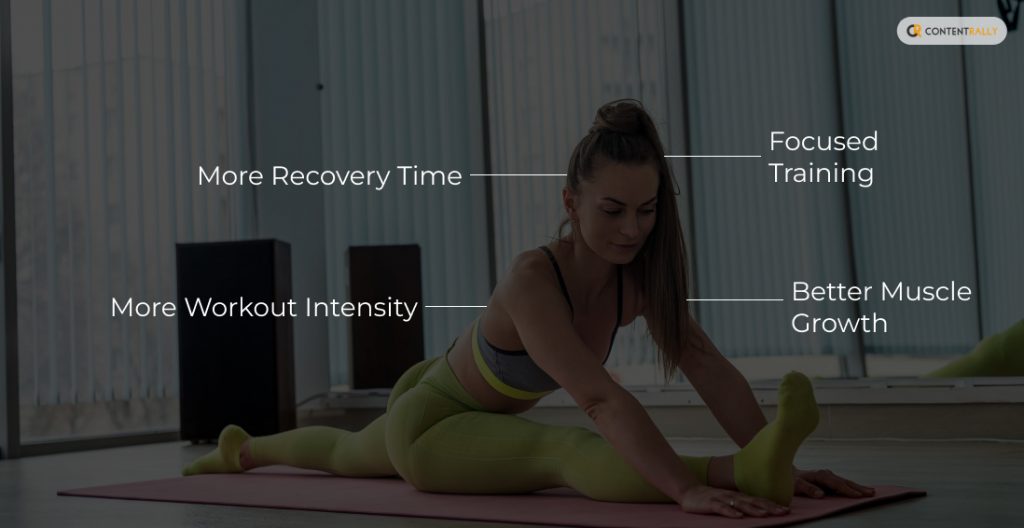
The Benefits of Workout Splits in Training

The following are the major advantages of workout splits that you will benefit from:

1. Focused Training

Focused training is one of the major benefits of workout splits where you train specific muscle groups. Also, you will get better muscle recovery between workouts since you are dedicating separate days to different muscle areas in your body. Apart from that, workout splits also ensure better workout intensity since you are targeting each area of your body.

On the other hand, with a workout split, you can also get shorter workout sessions. Moreover, you have the ability to address different imbalances in your muscles since you get chances to train weaker areas of your body. Hence, there shall be all-round muscle growth and fitness.

2. Better Muscle Growth

As you dedicate a full workout session to different muscle groups, you get the chance to target these muscle groups with more exercises. Hence, you will have high volume and muscle growth. However, this is something that you will not get with a full-body workout.

3. More Recovery Time

As you follow a workout split routine, you are giving your muscles adequate rest days between training sessions. Thereby, you do not end up overtraining your muscles. Hence, your muscle recovery is better. Also, if you have a busy schedule, using splits helps you create shorter workout sessions. Hence, exercise fits easily into your schedule.

4. More Workout Intensity

By using workout splits, you are only working on a few muscle groups per workout. As a result, you can push your muscles with heavy workouts. Hence, you can stimulate your muscles more. Moreover, you can also train your weak muscle groups that are weaker than other muscles.

Choosing the Right Workout Split: How to Create One?

Choosing the Right Workout Split_ How to Create One_

The right workout split depends on factors like training, goals, experience, recovery needs, weaknesses, and more. Depending on your bodybuilding needs, you can choose your type of workout split. However, if you are a beginner who is starting out bodybuilding, a full-body workout is more helpful.

The following are the factors you must consider when you are selecting your workout split:

  • Training Experience: If you are a beginner, you should start with simple splits and must mostly stick to full-body workouts. However, if you are an advanced individual, you can try complex workout splits.
  • Training Goals: With different goals, workout splits change. For instance, if you want muscle training, you can choose body part workout split. On the other hand, if you want to save time, you must choose the upper-lower workout split. Moreover, the push-pull-leg workout split works more for powerlifters.
  • Frequency of training: If you train two to three days per week, you need a full-body workout. However, if you train 5-6 days per week, you must start with workout splits.

Tips for Effective Workout Splits

Tips for Effective Workout Splits

Before you create your workout split, you must always consider your fitness level, goals, schedule, and recovery time. This will help you create a workout split that tailors to your needs and demands. The following are a few tips you must consider if you want to create effective workout splits:

  1. Your fitness levels matter. For instance, if you are a beginner, you must go with a full-body workout. On the other hand, as an advanced individual, you can try a workout split like push-pull-legs.
  2. Be consistent and sure about your workout schedule. Hence, you can design a split that fits your needs and demands.
  3. When you have sufficient days for rest, you can ensure muscle repair. Also, you can prevent muscle strain due to overtraining.
  4. If you want to have optimal strength gains, you must focus more on compound movements. Here, you work in different muscle groups simultaneously.

Common Mistakes to Avoid and Precautionary Steps

Common Mistakes to Avoid and Precautionary Steps

Here are a few precautionary steps you must take if you do not want to end up with no results:

1. Do not start with workout splits if you are a beginner. As a beginner, you need a full-body workout with a resting day between two workout days.

2. After you train a muscle area after a workout, make sure there are adequate rest days in between. This allows for better muscle recovery.

3. When you are working out, make sure to gradually increase its intensity, repetition, or weight. This will help you with growth as you progress.

4. Once you include different workouts for the same muscle groups, you end up targeting different muscle fibers. This helps in all-around muscle growth.

5. To get the best results, make sure to have the right form while you lift weights.

Start Workout Splits Now

Now you know the importance of workout splits and how they work to produce better results. However, if you are preparing for a split training program, make sure to prepare beforehand. Moreover, keep track of your exercises and make sure to have rest days for recovery.

Do you have more suggestions on how to create workout splits? Please share your ideas and opinions in the comments section below.

Read Also:

A passionate writer and an avid reader, Soumava is academically inclined and loves writing on topics requiring deep research. Having 3+ years of experience, Soumava also loves writing blogs in other domains, including digital marketing, business, technology, travel, and sports.

View all posts

Leave a Reply

Your email address will not be published. Required fields are marked *

Related

Rehabilitation Process

Understanding The Rehabilitation Process A Journey To Recovery

In today's fast-paced world, the need for rehabilitation is a reality that many individuals face. Whether it's recovering from a sports injury, surgery, or addressing substance abuse issues, the rehabilitation process plays a crucial role in restoring one's physical and mental well-being. So, in this comprehensive guide, we'll delve into the intricate details of the cocaine rehab canada process, offering insights. At the same time, we intend to provide guidance and answers to some common questions you may have. Rehabilitation  Rehabilitation is a holistic process aimed at helping individuals regain their physical, mental, or emotional well-being after facing a setback. It encompasses various forms, depending on the condition's nature and the rehabilitation process's goals. Types of Rehabilitation As mentioned above, rehabilitation helps an individual get oneself on track. Again, they help one get the right time for recovery and ensure that the individual has a great career ahead. However, we discuss some rehabilitation types here in this section. 2.1 Physical Rehabilitation Physical rehabilitation focuses on restoring physical function and mobility. Hence, it is a common prescription for individuals recovering from surgeries, accidents, or injuries.   2.2 Occupational Rehabilitation Occupational rehabilitation helps individuals regain skills needed for daily life and work. This type of rehabilitation is often necessary after prolonged illnesses or injuries. So, this type of rehabilitation is often necessary after prolonged illnesses or injuries. 2.3 Substance Abuse Rehabilitation Substance abuse rehabilitation is a vital part of the recovery process for those struggling with addiction. It addresses the physical and psychological aspects of addiction. The Rehabilitation Team The Rehabilitation Team The efficacy of rehabilitation lies to an extent in a good team of professionals. At the same time, their coordination and observation determine the success of the recovery process. This very section sheds light on the nitty-gritty of team building.  3.1 Physicians and Specialists The rehabilitation process begins with a team of medical professionals who assess the patient's condition and create a tailored plan for recovery. 3.2 Therapists Therapists play a crucial role in rehabilitation, providing physical, occupational, or psychological therapy to facilitate recovery. 3.3 Support Staff Support staff, including nurses and caregivers, offer invaluable assistance and care throughout rehabilitation. The Initial Assessment One of the primary steps in the rehabilitation process is the initial assessment in this stage. The team of experienced professionals performs different tests to understand the issue and the depth of the problem. After the entire study is conducted, the team of experts moves on to the next stage, which is strategizing the entire rehabilitation of the individual.  4.1 Setting Goals Establishing clear rehabilitation goals is the first step. These goals provide a roadmap for recovery and motivate the individual to progress. In general, the tenure of an athlete is quite short. So, the person would definitely understand the length of the rehabilitation. The sooner it is set, the better it can be. Hence, goal setting becomes one of the important aspects linked directly with goal setting. 4.2 Creating a Personalized Plan A personalized rehabilitation plan is then developed, outlining the specific treatments, therapies, and milestones to achieve during the rehabilitation journey. A personalized rehabilitation plan has its own advantages. At the same time, it helps one be motivated and charged up for the entire recovery stage. Simultaneously, it helps the team of professionals oversee the entire procedure and flow of the rehabilitation.  The Rehabilitation Journey Rehabilitation is a comprehensive and lengthy process in itself. It is akin to a journey. Hence, you can understand the flow or important elements associated with the recovery process. 5.1 Phase 1: Assessment and Evaluation The initial phase involves thorough assessments to understand the individual's current condition. It sets the foundation for the rehabilitation plan. Through the continuous process, the professional tries to frame the probable pathway for recovery or rehabilitation. At the same time, they engage themselves in talks and discussions mainly to understand the process of recovery. Ultimately, it brings clarity to understanding the journey of recovery. 5.2 Phase 2: Treatment and Therapy Treatment and therapy are implemented to address the identified issues. This phase requires dedication and patience as individuals work toward their goals. 5.3 Phase 3: Monitoring and Adjustments Regular monitoring ensures progress, and adjustments are made to the rehabilitation plan as needed to optimize results. Challenges and Triumphs The pathway to rehabilitation is complex, and it is time-consuming, thats for sure. From an athlete's perspective, the entire wellness journey goes through its highs and lows. At times, there will be frustration, and one might experience the joy of attainment. But the team of professionals continuously pumps up the care user.  6.1 Overcoming Plateaus Plateaus in recovery are common, but with the right support and determination, individuals can push through and continue progressing. 6.2 Celebrating Milestones Celebrating small and significant milestones along the way boosts motivation and provides a sense of accomplishment. Emotional Well-being in Rehabilitation At times, the entire journey of rehabilitation becomes emotional. The athlete goes through both the pain and frustration of slow recovery, agony, and the fear of the future. But also, at the other end, there is the victory, the triumph of winning through the recovery stretches. 7.1 Coping with Frustration Emotional challenges are an integral part of the rehabilitation process. Learning to cope with frustration and setbacks is crucial.  These are testing times, and the team of professionals goes through the entire journey together. It works as a psychological stimulus for the athlete. 7.2 Building Resilience Building emotional resilience is a key aspect of rehabilitation. It equips individuals to face challenges with a positive outlook. Preparing for Life Beyond Rehabilitation The final stage is preparation for life. Here, the athletes complete the last rehabilitation stage before returning to normal life.  8.1 Transitioning to Independence As rehabilitation nears completion, individuals prepare to transition back into their daily lives, often with newfound independence. 8.2 Maintenance and Preventative Care Maintenance and ongoing care are essential to ensure the long-term success of the rehabilitation process. Conclusion The rehabilitation journey is a testament to the human spirit's resilience and determination. It offers a path to recovery, enabling individuals to reclaim their lives and move forward with renewed vigor. Read Also: What Is Thinspo? | Impact On Physical And Mental Health 5 Mental Health Benefits of Massage Therapy That You Must Know When Will Social Media Addiction Be Considered a Mental Health Condition?

READ MOREDetails
slider-img

Life with Braces: Tips from Surrey’s Orthodontic Experts

Surrey, British Columbia, is a dynamic city where nature's beauty intersects with a vibrant community and a growing healthcare landscape. Among its many offerings, Surrey is known for its exceptional orthodontic care, which is provided by experts committed to crafting beautiful smiles. Braces are an important part of strategies taken towards resolving a wide range of dental issues. For individuals suffering from crowded teeth or have concerns with rotated, gapped, or crooked teeth, it is a necessary solution to align the teeth. Furthermore, braces help improve the functionality of the teeth along with their appearance and health. Starting your journey with braces might seem daunting, but with guidance from skilled orthodontist surrey professionals, you can easily embark on this path. Whether for teens or adults, these expert tips will help you manage your orthodontic journey effectively. Getting to Know Braces Braces, a staple in orthodontic treatment, correct misalignment in teeth and jaws by applying steady pressure to shift teeth into desired positions. This path to a healthier smile demands patience, care, and a commitment to follow through with the necessary maintenance. If you are still a little confused with regards to the way braces actually help in resolving a wide range of orthodontic issues, then you should read the steps as discussed in the article.  Mostly, people with gapped teeth, crooked teeth and crowded teeth might want to use braces. Simultaneously, if you are someone who has issues with the way their teeth fit together, which is also known as malocclusion, then using braces can help you get a better solution.  With any concerns regarding braces, consulting orthodontists is the best way to go! Even though you can consult general dentists because some of them offer these services too. Pre-Braces Preparation There are different reasons why people get braces; therefore, individuals considering having braces should learn about how these work. It is also necessary to know about the different types of braces and how they work. Based on the types, you can decide on which one you will choose. At times, it is not on the patient but on the doctor to decide the type of braces that will be effective. It is also an important approach to understanding the severity of the condition and its necessary strategies to effectively bring change.  For example, if you are using metal braces, it is visible when you smile. Or if you use tooth-colored ligatures, it will be less visible! Selecting an Orthodontist Your first step is finding the right orthodontist Surrey, a decision that can significantly impact your treatment experience. Surrey offers a wealth of skilled practitioners who prioritize personalized care and comfort, ensuring you find the best match for your needs. Establishing Clear Expectations Openly discuss your objectives and any apprehensions with your orthodontist. A clear understanding of your treatment's scope, duration, and anticipated results will help temper expectations and foster a smoother journey. The Braces Experience Apart from knowing the types of braces, it is important for you to understand that there will be some side effects, such as irritation on the inner cheeks, lips, or tongue. You might also have some jaw pain along with difficulty in eating! In the initial days after you get braces, you can get temporary discomfort. Especially when experiencing tightening, it is quite common to feel uncomfortable. Be aware before you use braces. Following the steps below, you will learn how to take care of your braces! 1. Prioritizing Dental Hygiene Maintaining excellent oral hygiene is more critical than ever with braces. Surrey's experts advise brushing after every meal and committing to daily flossing to avoid food build-up and potential dental complications. 2. Utilizing Orthodontic Wax Orthodontic wax can be a game-changer in mitigating irritation from braces to your mouth's inner linings. A bit of wax on troublesome brackets or wires can provide immediate comfort and protection. 3. Dietary Adjustments Certain foods, including hard, sticky, or chewy items, pose a risk to braces and should be avoided. To safeguard your braces, favour softer foods and consider cutting harder foods into smaller pieces. 4. Managing Discomfort Some discomfort is expected when braces are first fitted or adjusted. Surrey's orthodontists might recommend mild pain relievers, soft foods, or cold treats to ease gum soreness during these periods. 5. Consistent Follow-Ups Keeping up with orthodontic appointments is essential for timely adjustments and progress assessment. Regular visits are a key component of your treatment's success, ensuring any delays are minimized. Post-Braces Care A lot of people use colorful ligatures which are tiny elastic bands keeping the wires firmly in place. At times, individuals might use ceramic braces which work similar to metal braces however, they are less noticeable. It is due to the fact that the ligatures and wires along with the brackets of the braces are tooth colored thus, blending with your smile. If you are someone who is worried about the visuals of the braces, they can use these braces. I would like to bring to your attention that there is a high possibility that it will break. Ceramic braces are one of the most fragile braces which are unable to withstand pressure! So, try and take care of the retainers. 1. The Importance of Retainers Retainers are crucial post-braces for maintaining your teeth's new positions. Adhering to your orthodontist's guidance on retainer wear is imperative to prevent teeth from shifting back. 2. Embracing Your New Smile Completing your orthodontic treatment is an achievement worth celebrating. Not only does it enhance your appearance, but it also boosts oral health and confidence. 3. Ongoing Oral Health Maintaining oral health doesn't stop once braces are removed. Continue with regular dental hygiene practices and routine dental check-ups to keep your smile shining for years to come. Benefits Of Using Braces! Braces contribute effectively to your dental health because at times, if the teeth are misplaced, they might not be completely functional. Individuals might suffer significant problems such as pain, cavities, gum diseases, bad bites, injury, tooth decay and bone erosion. It is therefore important to consider the significance of using braces especially when they are used to correct malocclusion and bite problems. From a young age, you must have proper orthodontic care which not only takes care of the health of your teeth but also your overall oral health! If you are facing concerns such as overcrowding or bite problems, even though it is minor, you must address it. You should regularly clean your teeth along with evaluation of oral health on regular intervals. This will contribute to an overall understanding of the oral health consequences! Final Thoughts Embarking on an orthodontic journey in Surrey, BC, is a step towards attaining the smile you've always envisioned. By heeding local orthodontic specialists' advice, you can confidently navigate the experience, looking forward to the transformative results that await. Remember, the process is a partnership between you and your orthodontist to achieve lasting oral health and aesthetic benefits. Read Also: Rediscovering Your Smile: Cloverdale’s Dental Bridges How to Use Practice Analytics to Improve Your Dental Practice Emergency Dental Clinic Immediate Care When You Need It Most

READ MOREDetails
slider-img

Early Signs Of Oral Cancer: What You Need To Know?

Early signs of oral cancer are persistent mouth sores, unexplained bleeding, difficulty swallowing, and changes in voice. In such cases, you must visit an oncologist, an expert who deals with cancer diagnosis and treatment. Oral cancer is one of the most common cancers worldwide. It can affect the mouth, tongue, gums, and throat. In fact, there are several factors that contribute to its development. These include tobacco use, excessive alcohol consumption, prolonged sun exposure, and infections like HPV. However, early detection plays a crucial role in increasing the chances of successful treatment. Also, it helps in improving outcomes. In this article, you will get details about the early signs of oral cancer and what you should be mindful of. Hence, to learn more, read on to the end of the article. What Is Oral Cancer? Oral cancer is one of the most common forms of neck/head cancer. Generally, it affects people above 60 years of age. In fact, oral cancer first affects your lips, tongue, mouth roof, and mouth floor. Apart from that, it also affects your oropharynx, which is the last part of your tongue. Also, it might affect the roof of your mouth, the sides and the back of your throat, and your tonsils. At first, oral cancer can look like a common problem in your mouth and your lips. For instance, you can see white patches or bleeding sores. Basically, the difference between a common problem and a potential cancer is that the problems do not go away. Here, if you leave the problems without any treatment for a long time, it can spread through your mouth and your throat. Moreover, it will also spread to other areas of your head and neck. 8 Common Warning Signs of Oral Cancer You Shouldn't Ignore Recognizing the early signs of oral cancer can significantly improve treatment outcomes. Here are eight common symptoms you must watch for and discuss with a cancer specialist promptly. 1. Presence of White/Red Patches in the Mouth A classic sign of potential oral cancer is the presence of white or red patches in the mouth without any reason. Patches can occur on the tongue, roof of the mouth, inner cheeks, or gums. Patches can be painful sometimes but are usually asymptomatic.  However, you must not ignore them. If you see any of these patches extending more than a few weeks, visit an oncologist for a checkup at Apollo Hospital Belapur. Here, you will get a thorough examination. 2. Persistent Mouth Sores Oral cancer can be indicated by mouth sores that do not heal within two weeks. The sores may be on the tongue, inside the cheeks, or gums, or on the roof of the mouth. However, getting sores in the mouth is quite common.  Still, you must let an oncologist evaluate sores that don’t improve. Don’t ignore the sores if they are painless or persistent. It could mean something more serious. 3. Difficulty Swallowing or Chewing Pain or discomfort when swallowing or chewing food may be a sign of oral cancer. When there is a tumor blocking the throat or esophagus, difficulty swallowing or dysphagia often occurs. In some cases, this symptom may be accompanied by a feeling that food gets stuck in the throat or chest.  However, if this continues, it is important to see a specialist to help diagnose any underlying health issue early on. 4. Unexplained Bleeding Unexplained bleeding on the inside of the mouth is a cause for concern. It could be blood in your saliva or while you brush your teeth. However, if there is any unexplained bleeding from the gums, tongue, or mouth, you must immediately visit a healthcare professional.  Apart from that, bleeding from your gums can be a sign of a minor gum problem. However, if it’s consistent or unusual, it could mean something more serious, such as oral cancer. If you are bleeding, don’t hesitate to visit the best oncologist in Mumbai to get it evaluated. 5. Numbness or Pain in the Mouth or Jaw If you have numbness or persistent pain in the mouth or jaw that doesn’t go away with over-the-counter pain relief, don’t ignore it. This may mean that cancer is affecting the nerves in your mouth or jaw area. This pain can get worse over time and often comes with other symptoms, such as difficulty moving the jaw or feeling fullness in the mouth.  Hence, you must consult a medical expert. Basically, the expert can help in figuring out the reason behind it and suggesting reasonable treatment alternatives. 6. Unexplained Weight Loss Sudden weight loss, especially if it is unintentional, can be a sign of a number of health conditions, including oral cancer. Cancer cells can interfere with your body’s metabolism, leading to weight loss.  Moreover, if you get sudden weight loss along with other symptoms such as mouth sores, pain, or difficulty swallowing, see a medical expert as soon as possible. Early diagnosis can enhance the prognosis and treatment options for oral cancer. 7. Changes in Voice or Hoarseness If you find that your voice or hoarseness doesn’t go away, it could be because oral cancer is affecting your vocal cords or the area around them. If the hoarseness lasts more than a couple of weeks, it’s a good idea to consult an oncologist. Any change in voice should be evaluated to rule out any serious condition, including oral cancer. 8. Lumps or Swelling in the Neck Signs that the cancer may have spread to nearby lymph nodes include swelling or lumps in the neck. At first, these lumps may be painless, but they can become tender as the disease progresses. If you see any lumps or swelling in your neck, you should see a doctor right away.  An oncologist will evaluate these lumps. Also, the expert will ensure an accurate diagnosis to find whether these lumps are cancerous. Activities that Increase Oral Cancer The following are some of the major activities that increase oral cancer: Smoking (cigarettes, pipes, and cigars) Other tobacco products include chewing tobacco, snuff, water pipes, dip, etc. Drinking excessive amounts of Alcohol daily. Spending a lot of time under the sun without protecting the lips. Having the Human Papillomavirus (HPV). Having a history of oral cancer in the family. Detecting Oral Cancer: The Way Forward Recognizing the early signs of oral cancer is critical for effective treatment and improving your overall prognosis. If you notice any of these symptoms, it’s essential to seek professional medical advice promptly.  For instance, the Apollo Hospital Belapur, located in Navi Mumbai, is equipped with state-of-the-art facilities. It has expert oncologists who specialize in diagnosing and treating oral cancer. You can consult the best oncologist at Apollo Hospital for a thorough evaluation and a personalized treatment plan. Basically, you must stay vigilant and consult an expert as soon as you notice unusual symptoms. This way, you can increase your chances of early detection, ensuring that your oral health remains in the best condition possible. Do you have more suggestions to add on how to detect oral cancer? Please share your ideas and opinions in the comments section below. Read Also: 5 Skin Cancer Warning Symptoms & Early Signs to Know How Talcum Powder & Ovarian Cancer Is Related?

READ MOREDetails