













The Delisting Of Didi Global From The New York Stock Exchange: A Case Study

Didi global

On 10 June 2022, Didi Global Inc., the undisputed market leader of the Chinese ride-hailing industry, officially de-listed its American Depositary Shares (ADS) from the New York Stock Exchange (NYSE).

Just eleven months prior, the tech giant completed a massive $4.4 Billion Initial Public Offering (IPO).

There, it priced its enterprise market valuation at an elite $68 Billion.

However, the company's aggressive timeline created an immediate, catastrophic regulatory collision with state data security authorities.

This case study analyzes how a severe data sovereignty conflict unraveled a dominant tech infrastructure asset.

Not just that, this incident is also a failure to prioritize national security compliance.

The structural breakdown began within 48 hours of the high-profile US market debut.

The regulators launched a comprehensive cybersecurity review.

Additionally, they ordered all major Chinese app store platforms to remove Didi's digital applications.

Moreover, this operational lockdown exposed the intense vulnerabilities faced by cross-border tech enterprises.

The crisis concluded with a mandatory delisting and a massive $1.2 Billion regulatory penalty fine.

In addition, there was a complete restructuring of how international markets evaluate Chinese technology stocks.

Didi Global Traces The Friction Between Global Capital And Data Sovereignty

The collapse of Didi Global’s American market presence was not caused by a drop in user demand or a failure in its ride-hailing unit economics.

Instead, it was a structural structural failure driven by a direct collision between global fundraising timelines and state enforcement of digital borders.

Furthermore, the core mechanism of the crisis rested on the strategic value of high-density geographic data.

As a massive logistics and transport infrastructure app processing billions of rides annually, Didi’s data servers hold immense amounts of sensitive national information.

This includes detailed real-time mapping files, user movement metrics across major government hubs, and biometric driver identification databases.

Right before the listing execution, the Cyberspace Administration of China urged Didi to delay its US market debut to ensure compliance with strict new data protection frameworks.

Fearing that a delay would sour international investor sentiment and hurt its valuation, Didi management rushed the IPO forward anyway.

This choice triggered immediate state action.

Regulators viewed the rush as a direct threat to data sovereignty, concerned that foreign disclosure rules could expose sensitive domestic transport mapping networks to outside intelligence auditing.

Timeline Of The Regulatory Meltdown

The operational unwind scaled with unprecedented speed, stripping a multi-billion-dollar tech powerhouse of its international public market status in less than a year:

Strategic Phase TimelineFinancial EventUnderlying Systemic Impact
30 June 2021Didi executes its $4.4B IPO on the NYSE, marking the largest US listing by a Chinese company since Alibaba.Investor sentiment peaks, pushing early trading market caps past $70 Billion.
2 July 2021The CAC launches an official cybersecurity review into Didi to protect national security and public data assets.Rushes a wave of stock liquidations as international markets react to regulatory risk.
4 July 2021Regulators order local app store networks to completely remove Didi's applications from public download platforms.Blocks new user registration loops, cutting off the company's vital growth engine.
December 2021Under intense regulatory pressure, Didi’s corporate board announces immediate plans to delist from the US.Begins a long compliance transition to move its secondary listing to the Hong Kong Stock Exchange.
June 2022Didi officially terminates its active trading on the NYSE and pays a record $1.2 Billion state penalty fine.Marks the definitive conclusion of the uncoordinated cross-border listing experiment.

Analyzing The Root Causes Of The Didi Global Failure

Analyzing The Root Causes Of The Didi Global Failure

An institutional post-mortem of Didi Global highlights three distinct, compounding risk management flaws.

These had left the platform completely defenseless against a data compliance check:

· Misjudgment Of Geopolitical Risk

Didi’s leadership treated their corporate expansion pipeline as a traditional tech sprint, assuming that immense consumer scale and strong financial metrics would insulate them from state data rules.

They failed to realize that in the modern tech ecosystem, national data security completely overrides short-term shareholder convenience.

· Severe Cross-Border Regulatory Mismatch

The enterprise ran directly into conflicting legal rules.

While the US Holding Foreign Companies Accountable Act (HFCAA) required foreign listings to open their internal accounting books to American regulators, China’s data laws explicitly barred local tech firms from transferring sensitive local user data across international borders, creating an impossible regulatory trap.

· The New User Acquisition Vault

When regulators ordered the removal of Didi’s apps from local stores, the company lost its ability to onboard fresh consumers during a high-growth market cycle.

This structural restriction allowed nimbler local competitors to aggressively chip away at Didi's market share, proving that a digital platform cannot survive long-term app store blocks.

Lessons For Corporate Governance And Risk Management
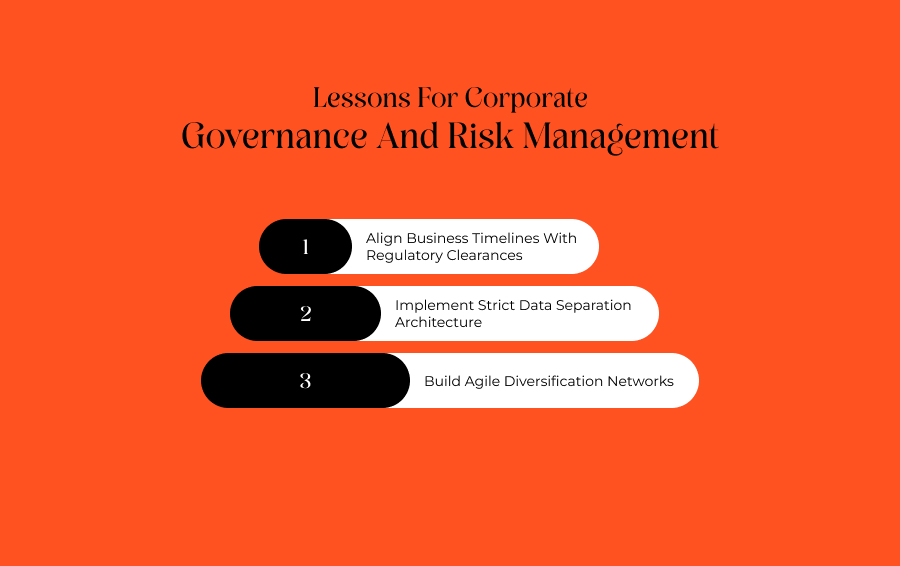
Lessons For Corporate Governance And Risk Management

Post this fiasco, the companies wanted to learn from this and analyzing the structural failure of Didi Global.

Therefore, they looked at how this case highlights several essential risk management rules for modern chief financial officers.

Also, these are the ways it equally affects multinational tech developers:

· Align Business Timelines With Regulatory Clearances

Never execute a high-profile public listing or corporate merger while active government reviews are still pending.

Rushing a financial exit ahead of final regulatory sign-offs exposes your brand to severe asset freezes and sudden operational stops.

· Implement Strict Data Separation Architecture

If your tech business processes high-density user or location data across multiple national lines, build completely isolated, localized cloud server infrastructure.

Storing domestic user histories safely within their native country limits prevents cross-border data leakage and satisfies national compliance rules.

· Build Agile Diversification Networks

Never rely on a single public stock exchange or consumer download platform to secure your company's value.

Maintain multi-layered listing strategies across regional hubs and build alternative web-access corridors to shield your active consumer traffic from sudden app store bans.

The Dynamics Behind The Didi Global Scam Explained

The failure of Silicon Valley Bank was an operational asset-liability mismatch, and the collapse of FTX was institutional fraud.

But the story of Didi Global is a case study on the overriding power of national data sovereignty in the modern digital age.

Didi did not fall due to weak user engagement or bad ride-hailing margins, but because its leadership underestimated state regulatory determination to protect domestic data assets.

Following its delisting and subsequent compliance re-alignment, the restructured company serves as a vital reminder that tech scale can never outrun national security mandates. For modern corporate leaders, the ultimate lesson is clear: eliminate compliance shortcuts, ground your global expansions in strict data transparency, and execute your long-term business strategy with absolute data-driven certainty.

Sohini is a MarTech and business writer with over two years of experience creating and editing content in the digital marketing space. She has a strong interest in emerging digital trends, marketing strategies, and the evolving relationship between technology and business growth. Alongside writing, she also works on guest posting strategies, carefully aligning sponsored content with niche relevance to help maintain strong organic visibility and audience engagement. Outside of work, Sohini enjoys reading, exploring internet subcultures, and endlessly scrolling through Reddit, Pinterest, and Substack looking for new ideas and trends.

View all posts

Leave a Reply

Your email address will not be published. Required fields are marked *

Related

FTX Collapse

The Structural Collapse Of The FTX Crypto Exchange And Its Impact: A Case Study

On 11 November 2022, FTX, the world’s third-largest cryptocurrency derivatives exchange, valued at $32 billion at its peak, officially filed for Chapter 11 bankruptcy protection. Founded by Sam Bankman-Fried, the platform positioned itself as a highly secure, institutional-grade trading platform. However, the exchange’s underlying operational framework was structurally compromised by a severe lack of internal accounting checks and massive regulatory non-compliance. This case study analyzes how a secret, multibillion-dollar asset-liability mismatch and illegal balance-sheet commingling systematically hollowed out the platform's liquidity. The crisis unfolded over a seven-day window following an explosive public balance sheet leak. When customers launched a highly synchronized, panic-driven digital withdrawal run, they exposed an $8 billion deficit in customer capital. This cash vacuum forced immediate bankruptcy filings and triggered global contagion across decentralized markets. Furthermore, it led to sweeping criminal indictments for its core executive leadership team. The Corporate Alchemy Of The Ftt-Alameda Loop The structural collapse of FTX was not a standard macro market casualty or an unpredictable investment drop. Instead, it was an intentional, systemic corporate fraud built around an artificial token-collateral loop and the illegal routing of user deposits. When users deposited fiat cash or major crypto tokens (like Bitcoin and Ethereum) on the FTX exchange, internal operating scripts routed those assets off the platform's ledger to Alameda Research, a private crypto hedge fund owned by Sam Bankman-Fried. Alameda used this stolen customer cash to execute high-risk venture bets, purchase luxury real estate, and finance political donations. To hide this massive hole in user accounts, Alameda left billions of dollars' worth of FTT. FTX’s in-house utility token, in the exchange's treasury vaults as replacement collateral. FTX’s developers wrote custom code that granted Alameda a secret $65 billion backdoor line of credit. Therefore, this ensured the hedge fund could continuously draw down customer cash. This setup created an extreme concentration of risk. The entire exchange was backed not by liquid cash reserves but by an illiquid token that FTX had printed out of thin air and artificially valued on the open market. Granular Timeline Of The Strategic Meltdown The operational collapse scaled with unprecedented velocity, stripping a global multi-billion-dollar enterprise of its entire liquid asset base in less than a week: Strategic Phase TimelineFinancial EventUnderlying Systemic Impact2 November 2022CoinDesk leaks Alameda’s balance sheet, exposing that the $14.6B fund was backed almost entirely by illiquid FTT tokens.Triggers immediate risk-mitigation evaluations among global institutional funds.6 November 2022Binance CEO Changpeng Zhao (CZ) announces on social feeds that Binance will liquidate its entire $580M holding of FTT tokens.Sparks a massive digital run, crashing the FTT token market value instantly.7–8 November 2022FTX faces a devastating $6 billion mobile app withdrawal run by panicked retail and corporate users.The exchange runs completely out of liquid cash reserves and halts all customer asset withdrawals.9 November 2022Binance signs a non-binding letter of intent to buy FTX, but backs away 24 hours later due to un-auditable corporate books.Destroys any hope of an institutional bailout, leaving the exchange completely insolvent.11 November 2022Sam Bankman-Fried resigns, and incoming CEO John J. Ray III takes control of the bankrupt corporate shell.Chapter 11 bankruptcy filings are executed across 130 affiliated corporate entities. Structural Vulnerability Matrix: Root Causes Of The Failure An institutional post-mortem of the FTX Group highlights three distinct, compounding risk management flaws that left the platform completely defenseless against a market shock: · Complete Absence Of Corporate Governance The exchange operated without an independent board of directors, lacking external oversight on executive choices. Corporate cash controls were managed via an unsecured group chat app. Furthermore, this is where executives approved multi-million-dollar asset allocations using emojis. Therefore, they left no professional audit trail. · Flawed Internal Financial Controls The company completely lacked a dedicated internal accounting department. John J. Ray III, who famously managed the liquidations of Enron, stated under oath that he had never seen such a complete failure of corporate records. Additionally, he noted that the company used automated consumer software to track corporate cash balances. · Extreme Institutional Conflict Of Interest The boundaries between exchange operator (FTX) and market speculator (Alameda) were completely erased. Alameda was granted a permanent exemption from the platform's automated liquidation engine. This meant that while standard retail users were instantly liquidated during market drops to protect the platform's capital. Alameda could hold massive, bleeding-negative balances indefinitely, shifting its trading losses directly onto the exchange's users. The Digital Mechanism: A Smart-Contract And Social-Media Driven Run A defining characteristic of the FTX collapse was the speed of the panic, accelerated by modern communications and digital banking channels. Traditional historical bank runs unfolded over weeks or months, slowed down by the physical logistics of brick-and-mortar branches. FTX, conversely, was a light-speed digital bank run. The second the Binance liquidations hit social feeds, user panic spread instantly across public social networks and private messaging channels. Fearing immediate account freezes, thousands of global users logged into their mobile trading apps simultaneously to initiate electronic withdrawals. Because the platform's liquid cash reserves had already been secretly drained to cover Alameda's high-risk trading debts, the exchange could not process the massive $6 billion withdrawal load. The sudden run exposed the underlying fraud in hours, freezing customer accounts and cutting off access to individual wealth worldwide. Systemic Contagion And Post-Crisis Regulatory Remediations The fallout from the FTX collapse sent shockwaves through the global decentralized finance sector. This forced international authorities to implement sweeping structural reforms: · Market Contagion Waves The collapse triggered a domino effect across the industry, driving immediate insolvencies among major digital asset lenders such as: BlockFi Genesis Global Voyager Digital Additionally, it wiped over $200 billion in valuation from the broader digital asset markets. · The Enforcement Crackdown International regulatory bodies shifted away from passive tracking to aggressive enforcement actions. Authorities launched sweeping investigations into offshore exchange structures. Therefore, this resulted in a 25-year federal prison sentence for Sam Bankman-Fried for historic wire fraud and money laundering. · Mandatory Corporate Audits Modern regulated digital asset platforms moved quickly to restore investor confidence by adopting strict Proof of Reserves (PoR) frameworks. These systems require third-party cryptographic audits to demonstrate that an exchange maintains 1:1 liquid-asset backing for all customer deposits at all times. Lessons For Corporate Treasury And Capital Allocation Analyzing the failure of the FTX group highlights several essential risk management rules for modern corporate treasuries and venture capital investors: · Enforce Strict Institutional Custody Diversification Never leave your operating capital or digital assets parked long-term on an exchange ledger. Utilize institutional-grade, multi-signature cold storage infrastructure where your team controls the cryptographic keys, ensuring absolute protection against platform freezes. · Execute Rigorous Due Diligence On Governance Frameworks: Venture capital firms poured over $2 billion into FTX without demanding an independent board seat or a formal accounting audit. Modern investment groups must treat a lack of transparent accounting controls or independent oversight as an immediate disqualification flag. · Eliminate Token-Collateral Exposures Never build your corporate treasury around illiquid, self-printed tokens or unhedged digital asset baskets. Ensure your liquid reserves are held in transparent, top-tier cash instruments—such as short-term sovereign bills—to insulate your balance sheet from sharp market downturns.

READ MOREDetails
Why did Vine Shut Down

Why Did Vine Shut Down? The $21.6M Creator Revolt and Post-Mortem Case Study

Do you remember Vine? Yes, I am talking about that app where we used to spend hours completely glued to our phones watching six seconds' worth of content. I still remember the exact hypnotic rhythm of clicking open an app just to watch a six-second loop change my entire day.  If you have grown up online in the mid-2010s as I have, then you know exactly what I am talking about.  We didn’t just watch these videos. Instead, we lived in an era entirely defined by the iconic phrases “Welcome to Chilli’s,” or “Look at all those chickens,”. For millennials and Gen Z, Vine was not just a video-uploading platform. Instead, it was a collective cultural heartbeat. Moreover, it was a collective cultural heartbeat. To sum it up more specifically, it was lightning in a digital bottle. It crammed up flawless comedic timing, music trends, and surreal internet humor into a fraction of a second.  However, suddenly the loop stopped for all of us. The app didn’t just slowly fade away. It had completely vanished. Meanwhile, it left behind a graveyard of dead links with a digital culture permanently altered.  Most business analyses look back at our favorite era and offer a superficial and lazy diagnosis: “It was a six-second gimmick and Instagram simply copied it.”  However, that narrative completely misses the mark.  To have a full and true understanding of the collapse behind an ecosystem we loved, you need to look past the surface. Also, you have to ask the ultimate question. Why did Vine shut down when it had over 200 million monthly active users? The death of the app was not an accident of shifting consumer taste, but a systemic case study in structural corporate failure. Moreover, it is an absolute refusal to protect a digital supply chain. Let's dive into the failure of the platform to understand the difference between viral user engagement and a sustainable business model. The Anatomy Of A Collapse: Year-By-Year Timeline To map out the core factors behind why did Vine shut down, you need to look at how quickly its cultural explosive growth disconnected from its corporate management. Instead of just a slow fade, it was a series of sharp and institutional missteps that happened over less than five years. ṣ The Timeline At A Glance Year Key Milestones & Structural ShiftsCore Impact on Ecosystem2012Founded by Hofmann, Yusupov, & Kroll; bought by Twitter for $30M pre-launch.Placed an unreleased project inside a massive public company prematurely.2013Official iOS launch; explodes to 40M users. Instagram fires back with 15s of videos.Established Vine as market leader but invited massive Big Tech competition.2014Hits 100M+ users, dominating cultural trends. Zero native ad infrastructure built.Burning millions in hosting costs while generating zero profit.2015Top 1% creators demand $21.6M total to stay. Twitter rejects the ultimatum.Massive talent exodus; content pipeline dries up almost overnight.2016User engagement drops. Twitter faces Wall Street pressure and cuts Vine.Official sunset announced as part of a 9% Twitter corporate layoff.2017Application servers taken offline permanently. Musical.ly acquired by ByteDance.The loop stops, paving the ultimate infrastructure runway for TikTok. 2012: The Premature Sale In June 2012, three tech founders, Dom Hoffman, Rus Yusupov and Colin Kroll, had come together to build a simple app. Furthermore, it was designed to stitch short video clips together, and it was named Vine.  Before even being launched to the public, Twitter’s executive team had noticed the prototype. Consequently, terrified of missing the mobile video wave, Twitter bought Vine in October 2012 for a reported $30 million.  This structural move proved to be fatal. Moreover, it placed an unreleased and experimental product inside a massive, publicly traded tech company.  The company was still trying to figure out its own identity, sowing the earliest seeds of why did Vine shut down.  2013: Lightning In A Digital Bottle Vine officially launched on the iOS App Store in January 2013. Furthermore, the response was also explosive. Within months, it hit 13 million active users while scaling to an astonishing 40 million by the end of the year. Besides this, it also went on to become the fastest-growing video app in the world.  However, the mainstream tech giants were watching.  In June 2013, Instagram dropped a massive counter-strike. This was a native 15-second video feature.  While Instagram videos didn’t loop yet, that extra length gave users more room to breathe.  This led to a direct and silent battle for the future of mobile video. This accelerated the timeline of why did vine shut down.  2014: The Peak Of The Loop By 2014, Vine was a cultural powerhouse. Moreover, it was driving global internet trends, launching mainstream music hits while creating a brand-new class of digital celebrities. The app hit over 100 million active users. Millions of Gen Z and Millennial teens spent hours scrolling through their feeds every day. As a result, this turned 6-second loops into an entirely new comedic language.  However, beneath the surface, a major issue was growing. That is, the app still had no way to run ads.This meant it had been burning through millions of dollars in hosting costs while making zero profit. Consequently, this illustrated the financial reality of why did vine shut down. 2015: The Secret Los Angeles Ultimatum This was the definitive breaking point for the platform. By mid-2015, Vine’s ecosystem was top-heavy. Here, just the top 1% of creators generated over 90% of the platform’s total views.  Recognizing their immense leverage, a group of 18 premier Vine stars staged a coordinated intervention at the Graffiti Cafe in Los Angeles.  2016: The Content Desert And the Axe By early 2016, the mass migration of talent had left the app empty. With the top stars gone, user engagement plummeted. Moreover, the main feed had gone stagnant. At the same time, the parent company, Twitter, had started to face intense pressure from Wall Street due to slowing user growth and dropping stock prices.  Facing a financial crunch, Twitter laid off 9% of its workforce in late 2016. Additionally, costing an estimated $10 million a month to maintain without generating any revenue, Vine turned out to be the first project cut,  On October 27, 2016, Twitter officially announced that it was shutting down the app.  2017: The Servers Go Dark In January 2017, the mobile application was officially taken offline. In addition, the servers were wiped. The live and looping ecosystem was turned into a static read-only desktop archive. An entire generation’s digital history was frozen in place. Consequently, less than a year later, ByteDance would buy a lip-syncing app called Musical.ly. Furthermore, they would go on to merge it with their own software and launch TikTok. They used the exact short-form video blueprint that Vine had built. However, they failed to protect it.   Short-Form Evolution: The Architectural Landscape Compared To map out exactly why did Vine shut down while later short-form models captured a global footprint, you need to look at the structural, financial and mechanical differences across generations of apps.  This comparison highlights how completely different these tools are under the hood. Feature DimensionThe Vine Platform (Historical)TikTok (Modern Paradigm)Instagram Reels (Ecosystem Fit)YouTube Shorts (AdSense Pivot)Max Content Length6 Seconds strictly.15s to 10+ Minutes (Expanded).15s to 90 Seconds.Up to 60 Seconds.Core Feed Discovery EngineFriend network and chronological feeds.Personalized interest-based feed.Friend network mixed with interest recommendations.Subscriber pool mixed with dynamic recommendations.Built-In Video Editing StackBasic multi-clip stitch camera tool.Built-in filters, green screens, audio effects.Audio syncing tracks and layout templates.Simplified multi-clip camera, audio tracks.Native Payout ArchitectureNone ($0 native money pool for creators).Creator Rewards Program, Marketplaces.Seasonal cash bonuses and branded badges.Shared Shorts ad revenue partner program.Direct E-Commerce LayerNon-existent.In-app shopping tabs and product links.Integrated shopping tags in video.Affiliate marketing extensions.Primary In-App Ad UnitNone (Relied entirely on individual feeds).Full-screen video ads between scrolls.Sponsored clips inside main feeds.Video commercials between scrolls. The Algorithmic Shift: Friend Networks Vs. Pure Interests The core structural reason behind why did Vine shut down, whereas TikTok conquered the market, comes down to the way they decide what video to show you next.  Vine relied on a Friend Network framework, whereas TikTok built its success on a personalized interest feed.  The Vine Model: The Friend Network App The overall feed logic of Vine was built around a traditional follow system.  That is, the content you saw was determined almost entirely by who you actively chose to follow. Moreover, if a user followed twenty people, their feed was restricted strictly to the content created or re-shared by those specific twenty accounts.  However, there were two fatal product issues. The Empty Feed Problem For New Users When a new user downloaded Vine, their feed was completely empty.  Additionally, they had to manually hunt down and follow popular accounts before the app became fun to use.  This caused one issue. If the new users did not know who to look for, they left.  The Winner-Takes-It-All Problem For Creators Since growth was tied to your network, early creators who gained followers quickly became permanently locked at the top of the app. On the contrary, new and highly talented creators posting incredible six-second videos were completely invisible. That is because they did not have an existing audience to pass their clips along.  The TikTok Model: Personalized Interest Feed By completely abandoning the friend network model, TikTok was able to do something different. When you open the app, the primary view is the “For You” feed. Additionally, TikTok does not care who you are aware of or who you follow. Instead, it treats your natural behavior and interests as a vote. Consequently, it automatically runs every newly uploaded video through a quick test.  The Small Test Group: The video is pushed out to a small trial of a group of 100 to 500 everyday users. The Real-Time Evaluation: The app silently measures how many users watch the video to the very end, how many let it loop multiple times and how many share it. The Automatic Push: If the video scores well with the small test group, the app will automatically push it to a larger group of 10,000 users. Eventually, it will be pushed to millions.  Elimination Of The Empty Feed Issue This completely eliminated the empty feed problem. Additionally, TikTok tracks passive signals every millisecond you spend scrolling.  Also, it measures whether you watched a video all the way to the end. Besides these algorithmic analyses, it further checks whether you hesitated over a clip for a few seconds before scrolling past.  It also examined whether you stayed to watch multiple videos using the exact same background song.   By turning content into a pure meritocracy, any random video could go viral overnight regardless of how many followers the creator had.  Each time a user opens the app, they receive a stream of highly addictive content that is tailored exactly to their immediate mood.  A Structural Breakdown Of The Infrastructure War: Why Did Vine Shut Down The core product design mistake was treating short-form video as an isolated novelty. Contrarily, there was an opportunity to turn it into a functional business ecosystem around it.  When Instagram entered the landscape, it brought Facebook’s massive corporate infrastructure. Along with it, they also integrated deep engineering talent pools and mature ad-buying networks. This was a pinnacle point behind why did Vine shut down.  The Revenue Void Vine’s six-second loop format made traditional video commercials impossible without ruining the user experience. Since leadership resisted overlay ads or sponsored feed placements early on, the platform failed to generate revenue before its operational costs spiked. Moreover, the absence of native monetization made Vine into a bleeding asset for Twitter.  By late 2015, Twitter was facing severe financial pressure from Wall Street due to flat user growth and dropping stock prices.  Since Vine cost an estimated $10 million per month to run while bringing in zero native revenue, Twitter’s board viewed the app as an unsustainable project. Furthermore, they chose to cut it during company-wide layoffs.  Lack Of Creator Tools While Vine pioneered the format, it left the creative environment incredibly bare.  Moreover, the application offered basic in-camera capture with almost no editing tools, filters or audio modification systems. When Instagram launched its video engine, it introduced stabilizers, filters and a more robust discovery grid.  Despite that, Vine stayed rigid while its competitors evolved.  Twitter Cannibalization And Executive Flight The internal issues at Vine were further aggravated by poor management from its parent company. Additionally, the two engineering teams never successfully integrated.  In January 2015, Twitter launched its own native video player directly inside the main app timeline. This move led to the creation of internal competition for attention and ad revenue. As a result, Vine was left isolated.  Frustrated by creative disagreements with Twitter’s leadership, all three of the original co-founders had abandoned the company shortly after the acquisition.  The Sudden Rise Of Musical.ly: Shifting The Paradigm The creator base at Vine started to fall apart slowly. As a result, a major platform shift occurred that fundamentally changed the short-form video landscape.  This was the sudden rise of Musical.ly. Launched in 2014 by Alex Zhu and Luyu Yang, the app did not try to copy the dry skit-based comedy ecosystem of Vine.  Instead, it focused on a highly specific repeatable action. That is, 15-second lip-syncing videos paired with popular commercial music.    With this structural shift, everything changed for certain primary reasons.  Lowering The Barrier To Entry Vine had a significant issue for many creators. That is, it can be incredibly difficult to create a hilarious and perfectly timed 6-second comedy sketch.  On the other hand, lip-syncing or dancing to a trending pop song requires far less creative effort. This enabled everyday users to become content producers instantly.  The Audio Loop System Instead of just using sound as an afterthought, Musical.ly treated sound as the core organizing principle of the platform. Additionally, users can tap the audio track on any video to instantly see everyone else using the exact same sound snippet.  The Path To TikTok In November 2017, less than a year after Vine officially went dark, a massive shift occurred. The Chinese tech giant, ByteDance, acquired Musical.ly for an approximate amount of $1 billion.  Moreover, they merged its entire user database directly into their own app. As a result, this caused the creation of the global footprint for TikTok. Monetization Engineering: How TikTok And Reels Sustained Modern short-form video platforms did not succeed because their content was better. Instead, they survived because they built sustainable financial models. Furthermore, this model fixed Vine’s core monetization design flaws, showing us by omission why did Vine shut down. The Programmatic In-Feed Ad Unit TikTok and Instagram Reels bypassed the commercial issue of Vine entirely. That is by making ads look exactly like native user content. By placing vertical and skippable video ads directly inside the primary scrolling feed every 4 to 5 videos, these platforms created an ad model that scaled cleanly without hurting user retention. Diversified Revenue Pipelines Modern platforms treat creator payout systems as a foundational part of their business model instead of an afterthought. The Ad-Revenue Split: Automated systems place ads directly adjacent to a creator’s constant feed. Moreover, it shares a clean slice of this ad money back out to the account holder. Live Stream Virtual Gifting: TikTok built a massive tipping system inside their live-streaming feature. Here, users buy digital coins to tip creators in real-time. Thus, the platform is given a clear cut of each transaction.  Social Commerce Integration: By linking shopping checkouts straight into short video clips, modern apps transformed video from a simple entertainment tool into a high-conversion digital storefront.  Strategic Lessons: What Vine Could Have Done Differently If the executive leadership of Vine had understood the platform’s underlying business mechanics, they could have avoided the question of why did vine shut down by using some clear strategies. Pivot To A 15-To-30 Second System Early The strict 6-second limit was brilliant for establishing the app’s initial identity. However, it became a cage for creators. As the platform grew, the expansion of the time limit early on would have given creators room for complex storytelling. Additionally, it would have also been perfect for creating enough visual space to run native advertising options smoothly. Launch An Ad-Network Revenue Split Instead of rejecting the 2015 LA creator ultimatum out of hand, Vine should have fast-tracked an ad-revenue system. For instance, copying YouTube’s playbook would have given the app a clear percentage of ad revenue straight to the talent. Additionally, the top creators would have stayed on the platform permanently.  Build A Unified Music Matrix Vine should have recognized the massive cultural wave of lip-syncing and dance trends happening on its platform early on.  By signing licensing deals with major record labels to build a native in-app music library, Vine could have blocked Musical.ly from ever taking over that market space. The Phantom Successors and Ghost Codebases The void left by Vine sparked multiple attempts to revive its specific magic.  Additionally, the structural evolution of Vine's core team eventually led to the launch of Byte in January 2020, created by Vine co-founder Dom Hofmann.  Byte returned to the classic 6-second looping framework, attempting to capture nostalgic purists. Subsequently, it was acquired by Clash in 2021. Later, it was rebranded to Huddles.  However, these platforms failed to capture mass-market traction because TikTok had already established a dominant monopoly across the social video landscape. Nostalgia for the platform even reached the highest levels of corporate tech ownership. Following his 2022 acquisition of Twitter (now X), Elon Musk ran a highly publicized poll about reviving Vine and instructed engineering teams to actively review the platform's historical code base.  Despite the viral interest, a live app relaunch has not occurred. A modern revival faces an uphill infrastructure battle against deeply entrenched platforms like TikTok, Instagram Reels, and YouTube Shorts, which have spent years perfecting what Vine left unfinished. The Immutable Laws Of The Attention Economy Vine’s trajectory proves that audience retention is not a corporate moat. Additionally, having 200 million monthly active users means nothing if your underlying product cannot generate cash. Monetization is a core infrastructure requirement instead of an expansion feature to be figured out down the line.  In the attention economy, your creators are your primary supply chain.  If you fail to design a reliable, sustainable path for your top talent to make a living, your competitors will happily build a payroll system to steal them away.  Vine pioneered the grammar of modern mobile media, but its collapse stands as a warning to tech builders. That is, pioneering a format is meaningless if you lack the infrastructure to sustain the people who create it.

READ MOREDetails
what happened to WeWork

What Happened To WeWork: A Case Study On It’s Collapse And Restructuring

WeWork officially emerged from Chapter 11 bankruptcy in June 2024 after restructuring its corporate operations. Additionally, this wiped out $4 billion in legacy debt. Moreover, it shed over $12 billion in long-term commercial lease liabilities. The financial unraveling of this shared-office pioneer serves as a definitive case study in: Venture capital overvaluation Weak board governance High-risk real estate arbitrage This case study details the systemic failures, the judicial reorganization process, and the brand's modernized operating model. What Happened To WeWork: Unravelling The Collapse Dynamics In November 2023, WeWork Inc., once valued at a private market peak of $47 billion USD, filed for voluntary Chapter 11 bankruptcy protection. Founded on the promise of transforming global office culture through technology, the company’s hyper-expansion strategy was heavily exposed to rigid real estate liabilities. When the global pandemic triggered a massive, permanent shift toward remote and hybrid work models, WeWork's fixed lease costs completely overwhelmed its volatile desk-subscription revenues. Using federal bankruptcy frameworks, court-appointed restructuring teams systematically dismantled the company's unprofitable locations. WeWork successfully completed its financial reorganization in mid-2024. Additionally, it had successfully converted billions in debt into equity. Moreover, it cut its long-term financial obligations in half to emerge as a lean, corporate-focused flexible space aggregator. High-Density Case Timeline: The Collapse And Stabilization The multi-year corporate descent and subsequent operational restructuring of WeWork can be mapped across four distinct economic phases: Strategic Corporate PhaseCritical Financial MilestoneUnderlying Operational MechanismThe Tech Bubble Peak (2019)Valuation hits $47 billion USD driven by massive SoftBank capital injections.The Core Valuation Error: Masked a low-margin commercial real estate leasing business as a hyper-scalable software platform.The IPO Failure (Late 2019)The initial public offering attempts collapse following a deep forensic audit of its S-1 filing.Governance Deficit: Public disclosure of chaotic founder self-dealing, massive luxury spending loops, and unhedged net losses.The Bankruptcy Filing (Nov 2023)Official execution of Chapter 11 protection filings across US and Canadian corporate boundaries.The Liquidity Vacuum: Saddled with over $13 billion in rigid lease lines right before a global macro shift to remote work models.The Post-2024 RebirthEmerges from bankruptcy under new executive leadership, shedding its massive legacy debt.Lean Operational Footprint: Canceled non-viable lease contracts, erased $4 billion in debt, and secured $450M in fresh capital. What Happened To WeWork: Analyzing The Core Strategic Failures WeWork’s fundamental business model rested on a dangerous real estate experiment. The company signed rigid, long-term 10- to 15-year commercial lease commitments with traditional office-building landlords. They then divided the physical real estate into trendy, micro-co-working layouts. Furthermore, they leased them to early-stage startups and freelance contractors on short-term monthly subscription contracts. When a major macroeconomic shift occurs—such as the massive shift to work-from-home models—desk subscription revenues drop immediately. However, WeWork's billions of dollars in fixed lease liabilities remained completely unmovable, hollowing out its cash position in months. Venture capital giant SoftBank poured billions into the platform, treating a brick-and-mortar property leasing company as a hyper-scalable software asset. This endless flow of private capital allowed early leadership to scale up non-profitable locations globally without auditing their core unit economics. Furthermore, the complete lack of independent corporate board oversight enabled chaotic spending loops and unsustainable real estate acquisitions to proceed completely unchecked. The Reorganization Mechanism: The Restructuring Solution WeWork did not shut down its physical doors entirely. Rather, the enterprise used judicial frameworks to strip away its broken legacy infrastructure: · Real Estate Portfolio Remediation Under Chapter 11 protection, WeWork systematically audited its global commercial footprint. The company terminated or renegotiated over 300 non-viable corporate leases, saving more than $12 billion in future lease liabilities. · Debt-to-Equity Capital Restructuring The platform wiped out $4 billion in legacy debt obligations. Therefore, this converted those liabilities into equity stakes for its senior institutional backers (including SoftBank and Yardi Systems). This strategy cleared the company's balance sheet of toxic debt and brought in $450 million in fresh operating capital to fund long-term growth. · Enterprise Asset Shift Moving past high-turnover individual hot-desk sales, the modernized WeWork prioritizes long-term office hub allocations for Fortune 500 corporate teams seeking flexible satellite offices. Comprehensive Structural Comparison: Then vs. Now Operational Parameter BaselineThe Legacy WeWork ArchitectureThe Modernized WeWork FrameworkMarket Valuation StandardAn inflated, highly speculative $47 Billion tech bubble.Pragmatic, real estate asset market valuations.Primary Financial FocusRapid, high-cost global footprint expansion.Profit-per-square-foot margin optimization.Lease Architecture ModelHigh-risk, long-term fixed commercial contracts.Risk-sharing management partnerships with property landlords.Primary Client Base MixIndependent freelancers and unstable early startups.Established corporate enterprises and distributed hybrid teams. What Happened To WeWork Explained The story of what happened to WeWork delivers a critical risk-management lesson to the modern commercial landscape: speculative capital infusions cannot cure broken unit economics. A business cannot hide legacy real estate debt beneath high-tech marketing copy indefinitely. Following its restructuring, the slimmed-down WeWork operates as a viable option for businesses looking to scale down their long-term office liabilities. To build proper financial resilience in your own enterprise, organizations in 2026 need to decouple their core cash flows. This step is very important in order to protect them from rigid long-term debt liabilities. Also, this will help you to maintain agile spatial operational footprints and base your corporate expansions on hard unit profitability metrics rather than speculative investor trends.

READ MOREDetails




