











What Happened To WeWork: A Case Study On It’s Collapse And Restructuring

what happened to WeWork

WeWork officially emerged from Chapter 11 bankruptcy in June 2024 after restructuring its corporate operations.

Additionally, this wiped out $4 billion in legacy debt. Moreover, it shed over $12 billion in long-term commercial lease liabilities.

The financial unraveling of this shared-office pioneer serves as a definitive case study in:

  • Venture capital overvaluation
  • Weak board governance
  • High-risk real estate arbitrage

This case study details the systemic failures, the judicial reorganization process, and the brand's modernized operating model.

What Happened To WeWork: Unravelling The Collapse Dynamics

What Happened To WeWork Unravelling The Collapse Dynamics

In November 2023, WeWork Inc., once valued at a private market peak of $47 billion USD, filed for voluntary Chapter 11 bankruptcy protection.

Founded on the promise of transforming global office culture through technology, the company’s hyper-expansion strategy was heavily exposed to rigid real estate liabilities.

When the global pandemic triggered a massive, permanent shift toward remote and hybrid work models, WeWork's fixed lease costs completely overwhelmed its volatile desk-subscription revenues.

Using federal bankruptcy frameworks, court-appointed restructuring teams systematically dismantled the company's unprofitable locations.

WeWork successfully completed its financial reorganization in mid-2024.

Additionally, it had successfully converted billions in debt into equity.

Moreover, it cut its long-term financial obligations in half to emerge as a lean, corporate-focused flexible space aggregator.

High-Density Case Timeline: The Collapse And Stabilization

The multi-year corporate descent and subsequent operational restructuring of WeWork can be mapped across four distinct economic phases:

Strategic Corporate PhaseCritical Financial MilestoneUnderlying Operational Mechanism
The Tech Bubble Peak (2019)Valuation hits $47 billion USD driven by massive SoftBank capital injections.The Core Valuation Error: Masked a low-margin commercial real estate leasing business as a hyper-scalable software platform.
The IPO Failure (Late 2019)The initial public offering attempts collapse following a deep forensic audit of its S-1 filing.Governance Deficit: Public disclosure of chaotic founder self-dealing, massive luxury spending loops, and unhedged net losses.
The Bankruptcy Filing (Nov 2023)Official execution of Chapter 11 protection filings across US and Canadian corporate boundaries.The Liquidity Vacuum: Saddled with over $13 billion in rigid lease lines right before a global macro shift to remote work models.
The Post-2024 RebirthEmerges from bankruptcy under new executive leadership, shedding its massive legacy debt.Lean Operational Footprint: Canceled non-viable lease contracts, erased $4 billion in debt, and secured $450M in fresh capital.

What Happened To WeWork: Analyzing The Core Strategic Failures

WeWork’s fundamental business model rested on a dangerous real estate experiment.

The company signed rigid, long-term 10- to 15-year commercial lease commitments with traditional office-building landlords.

They then divided the physical real estate into trendy, micro-co-working layouts.

Furthermore, they leased them to early-stage startups and freelance contractors on short-term monthly subscription contracts.

When a major macroeconomic shift occurs—such as the massive shift to work-from-home models—desk subscription revenues drop immediately.

However, WeWork's billions of dollars in fixed lease liabilities remained completely unmovable, hollowing out its cash position in months.

Venture capital giant SoftBank poured billions into the platform, treating a brick-and-mortar property leasing company as a hyper-scalable software asset.

This endless flow of private capital allowed early leadership to scale up non-profitable locations globally without auditing their core unit economics.

Furthermore, the complete lack of independent corporate board oversight enabled chaotic spending loops and unsustainable real estate acquisitions to proceed completely unchecked.

The Reorganization Mechanism: The Restructuring Solution
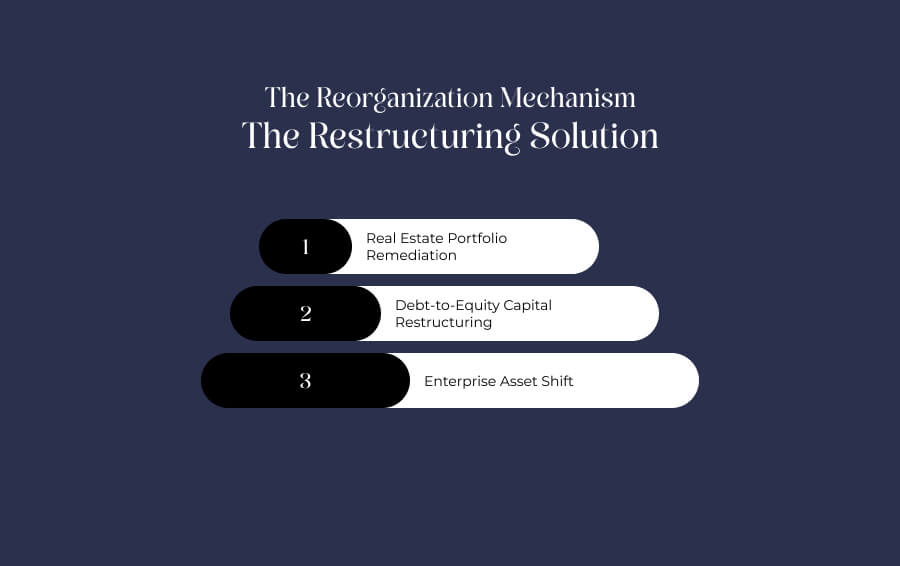
The Reorganization Mechanism

WeWork did not shut down its physical doors entirely.

Rather, the enterprise used judicial frameworks to strip away its broken legacy infrastructure:

· Real Estate Portfolio Remediation

Under Chapter 11 protection, WeWork systematically audited its global commercial footprint.

The company terminated or renegotiated over 300 non-viable corporate leases, saving more than $12 billion in future lease liabilities.

· Debt-to-Equity Capital Restructuring

The platform wiped out $4 billion in legacy debt obligations.

Therefore, this converted those liabilities into equity stakes for its senior institutional backers (including SoftBank and Yardi Systems).

This strategy cleared the company's balance sheet of toxic debt and brought in $450 million in fresh operating capital to fund long-term growth.

· Enterprise Asset Shift

Moving past high-turnover individual hot-desk sales, the modernized WeWork prioritizes long-term office hub allocations for Fortune 500 corporate teams seeking flexible satellite offices.

Comprehensive Structural Comparison: Then vs. Now

Operational Parameter BaselineThe Legacy WeWork ArchitectureThe Modernized WeWork Framework
Market Valuation StandardAn inflated, highly speculative $47 Billion tech bubble.Pragmatic, real estate asset market valuations.
Primary Financial FocusRapid, high-cost global footprint expansion.Profit-per-square-foot margin optimization.
Lease Architecture ModelHigh-risk, long-term fixed commercial contracts.Risk-sharing management partnerships with property landlords.
Primary Client Base MixIndependent freelancers and unstable early startups.Established corporate enterprises and distributed hybrid teams.

What Happened To WeWork Explained

The story of what happened to WeWork delivers a critical risk-management lesson to the modern commercial landscape: speculative capital infusions cannot cure broken unit economics.

A business cannot hide legacy real estate debt beneath high-tech marketing copy indefinitely.

Following its restructuring, the slimmed-down WeWork operates as a viable option for businesses looking to scale down their long-term office liabilities.

To build proper financial resilience in your own enterprise, organizations in 2026 need to decouple their core cash flows.

This step is very important in order to protect them from rigid long-term debt liabilities.

Also, this will help you to maintain agile spatial operational footprints and base your corporate expansions on hard unit profitability metrics rather than speculative investor trends.

Sohini is a MarTech and business writer with over two years of experience creating and editing content in the digital marketing space. She has a strong interest in emerging digital trends, marketing strategies, and the evolving relationship between technology and business growth. Alongside writing, she also works on guest posting strategies, carefully aligning sponsored content with niche relevance to help maintain strong organic visibility and audience engagement. Outside of work, Sohini enjoys reading, exploring internet subcultures, and endlessly scrolling through Reddit, Pinterest, and Substack looking for new ideas and trends.

View all posts

Leave a Reply

Your email address will not be published. Required fields are marked *

Related

most successful Shark Tank rejects

11 Most Successful Shark Tank India Rejects: In-Depth Business Profiles

The baseline metric of success on Sony Entertainment Television’s Shark Tank India has historically been a live, televised handshake. Also, it features a distinguished panel of Indian venture capitalists. However, there is an objective analysis of the domestic consumer and tech markets. It proves that leaving the studio floor empty-handed can serve as a massive, unintended launchpad for long-term growth. A television rejection often becomes a powerful lesson in operational resilience when an Indian founder refuses to: Surrender massive equity slices Accept predatory loan terms Bow to lowball valuations In India, evaluating the most successful Shark Tank India rejects reveals systemic blind spots within fast-paced pitch ecosystems. The panel frequently prioritizes immediate cash flows, hyper-trendy D2C plays, or personal network protections. Also, it occasionally misses major shifts in: Macro Industrial Infrastructure Deep-Tech Assistive Innovations Foundational Unit Economics This granular corporate audit conducts an in-depth analytical review of 11 most successful Shark Tank rejects. The Top 11 Most Successful Shark Tank Rejects: Getting Into The Details These are multi-crore Indian brands that successfully bypassed the panel to dominate their respective markets. 1. Zypp Electric Zypp Electric’s founders: Akash Gupta and Rashi Agarwal Zypp Electric at Shark Tank: Season 1, Episode 17 Investment: Asked for ₹2.2 Crores for 1% equity; left empty-handed with no deal from the Sharks (later raised Series C funding rounds on an institutional scale) Zypp Electric operates a high-density, tech-enabled EV-as-a-service last-mile delivery fleet tailored for India’s booming quick-commerce and e-commerce sectors. The company provides electric two-wheelers, integrated battery-swapping infrastructure, and trained delivery riders to enterprise giants like Zomato, Swiggy, Zepto, Blinkit, and Amazon. · The Post-Tank Strategic Pivot The Sharks flatly rejected the company's valuation, claiming an asset-heavy vehicle fleet was an unscalable cash drain. Instead of backing down, the founders utilized the broadcast to showcase their enterprise utility to institutional funds. Zypp moved away from loose retail rentals to lock down massive, multi-year B2B corporate logistics contracts. · Modern Valuation And Market Stance Proving the Sharks completely miscalculated the economics of green logistics, Zypp raised a massive Series C funding round led by global energy icon ENEOS. The company’s operational fleet exceeds 21,000 active EVs, anchoring its market valuation at over ₹3,000 Crores. 2. Recode Studios Recode Studios’ founders: Dheeraj Bansal and Rahul Sachdeva Recode Studios at Shark Tank: Season 2, Episode 1 Investment: Asked for ₹1 Crore for 1% equity; rejected by the panel on television despite stellar, highly profitable bootstrapped sales metrics. Recode Studios designs, manufactures, and distributes premium-grade mass-market cosmetics, skincare, and beauty utilities. The brand targets tier-2 and tier-3 Indian urban centers. Additionally, it utilizes an aggressive pricing strategy that undercuts mainstream international cosmetic houses. Consequently, it delivers identical chemical parity and wear longevity. · The Post-Tank Strategic Pivot Despite presenting highly profitable numbers with over ₹15 Crores in bootstrapped sales, the Sharks completely refused to invest. This was due to personal friendships with rival D2C cosmetics founders on the panel. Recode instantly flipped this rejection into a powerful public relations asset. Moreover, they leaned into a transparent "consumer-backed, elite-rejected" marketing campaign across social channels. · Modern Valuation And Market Stance The massive wave of organic public support accelerated their expansion of physical retail locations. Recode successfully expanded its distribution network to operate over 250+ physical store layouts and counter modules across India. So, it maintains a highly profitable, self-sustaining financial trajectory completely independent of mainstream capital networks. 3. Moonshine Meadery Moonshine Meadery’s founders: Rohan Rehani and Nitin Vishwas Moonshine Meadery at Shark Tank: Season 1, Episode 34 Investment: Asked for ₹80 Lakhs for 0.5% equity; walked away empty-handed due to unviable, heavy valuation cut counter-demands. Moonshine Meadery is a pioneering alcobev brand that created India's very first licensed, commercial craft meadery. The company sources pure, raw honey from local apiaries and ferments it with fruits and spices to produce a premium, gluten-free alcoholic beverage line targeting the rapidly growing alcobev segment. · The Post-Tank Strategic Pivot While the panel praised the product's taste and branding precision, they backed away due to the complex regulatory red tape, inter-state excise structures, and long distribution timelines tied to the Indian liquor market. The founders flatly rejected the Sharks' heavy counter-demands for valuation cuts. They systematically optimized their regional manufacturing loops, focusing on high-margin metro hubs like Mumbai, Pune, and Bengaluru. · Modern Valuation And Market Stance Moonshine successfully expanded its international distribution footprint, locking down exports to Europe and North America. By retaining absolute control over their proprietary fermentation equations, they independently secured their corporate valuation at the ₹160+ Crore ceiling. 4. Urban Monkey Urban Monkey’s founder: Yash Gangwal Urban Monkey at Shark Tank: Season 1, Episode 35 Investment: Asked for ₹1 Crore for 1% equity; rejected flatly by the investor panel on the studio floor. Urban Monkey structures, curates, and scales premium lifestyle products centered entirely around underground Indian street culture. The brand manufactures: Highly Stylized Skateboarding Apparel Graphic Streetwear Tees Modular Corduroy Waist Bags Premium Snapback Caps Therefore, it aims to build an authentic brand community around local hip-hop artists, street skaters, and break-dancers. · The Post-Tank Strategic Pivot The investment panel dismissed the pitch. It labeled localized streetwear an unscalable, micro-niche category with highly volatile consumer loyalty. The brand chose to skip traditional fashion marketing channels entirely. Instead, they built an exclusive, high-margin direct-to-consumer (D2C) online framework. Moreover, they scaled through organic product placements in top Indian hip-hop music videos and at underground, independent cultural events. · Modern Valuation And Market Stance Urban Monkey emerged as the definitive style statement for Indian street youth. In fact, it has been frequently worn by major pop culture celebrities. By bypassing traditional multi-brand retail margins, the company maintains high profit margins. Furthermore, it sustains massive multi-crore annual organic revenues nationwide. 5. Livofy Livofy’s founder: Sahil Pruthi Livofy at Shark Tank: Season 1, Episode 18 Investment: Asked for ₹1.5 Crores for 1.25% equity; the founder flatly rejected the Sharks' heavy 16% equity dilution counter-demand and walked out deal-less. Livofy is an advanced health-tech application that leverages: Customized nutrition plans Targeted coaching modules Machine learning algorithms So, it assists users in managing chronic lifestyle conditions. The platform targets metabolic health, delivering clinical remediation tracks to reverse PCOS, obesity, Type 2 diabetes, and elevated thyroid indices. · The Post-Tank Strategic Pivot Four out of five Sharks wanted to fund the company, but attempted to force a predatory 16% equity dilution counter-offer on the table. Recognizing that surrendering such a massive chunk of early equity would ruin his long-term funding leverage, founder Sahil Pruthi walked away. He used the massive broadcast publicity to expand his market positioning, rebranding the company from Keto India to Livofy to reach a broader wellness demographic. · Modern Valuation And Market Stance Moving forward on his own terms, Pruthi raised over $550,000 USD (approximately ₹4.5 Crore) in subsequent seed rounds from institutional angel funds, thereby protecting his founder wealth while scaling his health-tech engine among global NRIs. 6. Morriko Pure Foods Morriko Pure Foods’ founders: Tanuja Shah and Pramod Shah Morriko Pure Foods at Shark Tank: Season 1, Episode 34 Investment: Asked for ₹1 Crore for 3% equity; left empty-handed after refusing to compromise their business core or lower their valuation parameters. Morriko Pure Foods operates a specialized food-processing framework that manufactures fruit and vegetable snacks that are: Clean-Label Preservative-Free Zero-Added-Sugar The company utilizes proprietary, state-of-the-art solar dehydration technology to preserve full nutritional value. Therefore, it aims to serve health-conscious snackers and clean-eating consumers. · The Post-Tank Strategic Pivot The Sharks attempted to alter the company's baseline operational model, demanding steep drops in retail valuation and a shift toward cheaper, sugar-infused candy formulations to maximize short-term retail velocity. The founders flatly refused to compromise their healthy brand core. Instead, they focused on high-margin niche wellness e-commerce portals, organic grocery networks, and high-volume corporate pantry supply channels. · Modern Valuation And Market Stance Morriko established itself as an essential clean-label partner for global corporate offices and fitness chains. By building a dedicated, loyal audience that values genuine product purity over low-grade chemical pricing, the brand scales its multi-crore manufacturing infrastructure across regional health channels completely ad-free. 7. ExperientialEtc ExperientialEtc’s founders: Karan Bhardwaj and Sameer Bhatia ExperientialEtc at Shark Tank: Season 2, Episode 40 Investment: Asked for ₹2 Crores for 4% equity; left with no deal as the panel passed due to technology scalability doubts. ExperientialEtc is a high-end visual tech company that structures and deploys disruptive, immersive marketing campaigns for enterprise brands. The agency manufactures, programs, and rents high-density kinetic light walls and 3D holographic displays. Additionally, it works with interactive projection-mapping fixtures. Also, it creates augmented-reality environments to maximize crowd engagement at physical venues. · The Post-Tank Strategic Pivot The investment panel struggled to comprehend the scalability of specialized, high-cost spatial tech, dismissing the pitch as an unpredictable event-management service rather than an enterprise software asset. The founders pivoted by embedding their hardware rigs into a comprehensive, high-margin corporate licensing model. They signed long-term retainer accounts with blue-chip global firms requiring recurring high-tech trade show displays and premium brand launches. · Modern Valuation And Market Stance The company has an ironclad reputation as a premier high-tech agency, serving major global corporate tech events in: Dubai Singapore Mumbai Additionally, it generates stellar multi-crore service margins annually. 8. Torch-It Torch-It’s founder: Hunny Bhagchandani Torch-It at Shark Tank: Season 1, Episode 29 Investment: Asked for ₹2.5 Crores for 1% equity; rejected by the Sharks, who focus-tested the hardware model as low-margin charity rather than an enterprise asset. Torch-It functions as a highly awarded deep-tech social enterprise that engineers assistive mobility hardware. Also, it works with integrated AI software to empower visually impaired citizens worldwide. Furthermore, their flagship product line uses predictive ultrasonic sensor arrays and spatial machine learning algorithms. Therefore, this will help map physical obstacles. In fact, this will guide users safely with precise haptic vibration feedback patterns. · The Post-Tank Strategic Pivot The Sharks viewed the social-impact device as low-margin charity rather than a viable enterprise asset, passing on the investment. Founder Hunny Bhagchandani leveraged his television exposure to secure institutional backing directly from the Government of India. Also, he gets good support from corporate social responsibility (CSR) capital funds and international accessibility NGOs. · Modern Valuation And Market Stance Torch-It expanded its core technology stack to produce over 40+ distinct AI-enabled assistive solutions, including the Jyoti AI Smart Glasses. The organization operates as a highly successful, self-sustaining assistive tech provider, deploying tens of thousands of units across Africa, South Asia, and the Middle East. 9. Shades of Spring Shades of Spring’s founders: Nidhi Gupta and Anup Kumar Shades of Spring at Shark Tank: Season 2, Episode 10 Investment: Asked for ₹3 Crores for 1% equity; walked away empty-handed after the panel passed due to aggressive tech-forward pricing disagreements. Shades of Spring is an innovative, tech-enabled e-commerce platform that operates a direct-from-farm fresh-flower subscription network. Moreover, this connecting flower farms directly with urban homes via automated cold-chain logistics. By this, the platform completely bypasses traditional flower wholesale layers. Furthermore, it ensures that blooms arrive at local doorsteps significantly fresher than those from traditional florist shops. · The Post-Tank Strategic Pivot The panel reacted with intense skepticism to the company's valuation metrics. Moreover, the panel claimed that flowers were an unpredictable, seasonal commodity with zero long-term subscription retention. Furthermore, the founders ignored the criticism. They invested heavily in building automated sorting facilities. Also, they built a seamless, user-friendly mobile application interface to streamline recurring weekly orders. · Modern Valuation And Market Stance The startup proved the massive potential of the localized home-curation market. Today, Shades of Spring processes thousands of active subscription orders across major metropolitan areas. It maintains a highly profitable model and a valuation that meets its initial enterprise milestones. 10. Agri Tourism India Agri Tourism India’s founder: Pandurang Taware Agri Tourism India at Shark Tank: Season 1, Episode 31 Investment: Asked for ₹50 Lakhs for 5% equity; flatly rejected by the panel, who classified the rural network as an unscalable, offline project. Agri Tourism India operates a sustainable, community-driven eco-tourism aggregator model that connects urban travelers with working rural agricultural farms. The platform allows tourists to experience authentic rural farm stays, traditional local culinary methods, and sustainable harvesting practices, funneling alternative revenue lines straight to local farmers. · The Post-Tank Strategic Pivot The Sharks flatly dismissed the pitch, filing rural eco-tourism away as a slow, unscalable, and unmarketable offline lifestyle project. The founders stuck to their core vision, bypassing premium city marketing agencies to partner directly with local state tourism boards, environmental educational organizations, and international corporate eco-retreat planners. · Modern Valuation And Market Stance The platform scaled across multiple states, transforming thousands of remote rural farms into high-margin, self-sustaining hospitality centers. The company remains the definitive pioneer of Indian agritourism, proving that eco-friendly, asset-light community systems deliver excellent long-term financial stability. 11. SamparkMe SamparkMe’s founder: Saurabh Garg SamparkMe at Shark Tank: Season 2, Episode 45 Investment: Asked for ₹50 Lakhs for 5% equity; left with no deal after the Sharks claimed local drivers lacked the civic intent to adopt QR vehicular tools. SamparkMe designs, manufactures, and scales localized QR-based vehicular communication tags and security ecosystems. Additionally, this company places a secure, encrypted QR decal onto a vehicle’s windshield. Therefore, the system allows the public or parking officers to contact the owner anonymously in an emergency, such as: Double Parking Towing Fire Risks However, you can go forward with this without exposing private mobile phone numbers. · The Post-Tank Strategic Pivot The Sharks were highly critical of the app's community-driven model, with several panel members asserting that local citizens lacked the necessary "civic sense" to actively scan QR codes or respect drivers' anonymity. Founder Saurabh Garg ignored the panel's negative review. Then he pivoted his marketing strategy away from loose retail sales to focus on high-volume B2B corporate partnerships. Additionally, he associated with car insurance networks, luxury residential real estate projects, and premium commercial parking garages. · Modern Valuation And Market Stance SamparkMe successfully transformed into a reliable, everyday safety asset across India’s crowded tier-1 metros. The platform tracks a rapidly climbing active user base. Therefore, this proves that when privacy and vehicular safety are combined with zero-friction mobile software, Indian drivers will adopt smart civic tools at scale. The Most Successful Shark Tank Rejects Give Us A Lot To Learn The long-term success of these 11 startups proves that a televised rejection on Shark Tank India can serve as a massive, long-term corporate asset. When a founder protects their early company equity and stands firm on their true valuation, they retain the freedom and financial leverage to build a highly successful, self-sustaining business on their own terms.

READ MOREDetails
Didi global

The Delisting Of Didi Global From The New York Stock Exchange: A Case Study

On 10 June 2022, Didi Global Inc., the undisputed market leader of the Chinese ride-hailing industry, officially de-listed its American Depositary Shares (ADS) from the New York Stock Exchange (NYSE). Just eleven months prior, the tech giant completed a massive $4.4 Billion Initial Public Offering (IPO). There, it priced its enterprise market valuation at an elite $68 Billion. However, the company's aggressive timeline created an immediate, catastrophic regulatory collision with state data security authorities. This case study analyzes how a severe data sovereignty conflict unraveled a dominant tech infrastructure asset. Not just that, this incident is also a failure to prioritize national security compliance. The structural breakdown began within 48 hours of the high-profile US market debut. The regulators launched a comprehensive cybersecurity review. Additionally, they ordered all major Chinese app store platforms to remove Didi's digital applications. Moreover, this operational lockdown exposed the intense vulnerabilities faced by cross-border tech enterprises. The crisis concluded with a mandatory delisting and a massive $1.2 Billion regulatory penalty fine. In addition, there was a complete restructuring of how international markets evaluate Chinese technology stocks. Didi Global Traces The Friction Between Global Capital And Data Sovereignty The collapse of Didi Global’s American market presence was not caused by a drop in user demand or a failure in its ride-hailing unit economics. Instead, it was a structural structural failure driven by a direct collision between global fundraising timelines and state enforcement of digital borders. Furthermore, the core mechanism of the crisis rested on the strategic value of high-density geographic data. As a massive logistics and transport infrastructure app processing billions of rides annually, Didi’s data servers hold immense amounts of sensitive national information. This includes detailed real-time mapping files, user movement metrics across major government hubs, and biometric driver identification databases. Right before the listing execution, the Cyberspace Administration of China urged Didi to delay its US market debut to ensure compliance with strict new data protection frameworks. Fearing that a delay would sour international investor sentiment and hurt its valuation, Didi management rushed the IPO forward anyway. This choice triggered immediate state action. Regulators viewed the rush as a direct threat to data sovereignty, concerned that foreign disclosure rules could expose sensitive domestic transport mapping networks to outside intelligence auditing. Timeline Of The Regulatory Meltdown The operational unwind scaled with unprecedented speed, stripping a multi-billion-dollar tech powerhouse of its international public market status in less than a year: Strategic Phase TimelineFinancial EventUnderlying Systemic Impact30 June 2021Didi executes its $4.4B IPO on the NYSE, marking the largest US listing by a Chinese company since Alibaba.Investor sentiment peaks, pushing early trading market caps past $70 Billion.2 July 2021The CAC launches an official cybersecurity review into Didi to protect national security and public data assets.Rushes a wave of stock liquidations as international markets react to regulatory risk.4 July 2021Regulators order local app store networks to completely remove Didi's applications from public download platforms.Blocks new user registration loops, cutting off the company's vital growth engine.December 2021Under intense regulatory pressure, Didi’s corporate board announces immediate plans to delist from the US.Begins a long compliance transition to move its secondary listing to the Hong Kong Stock Exchange.June 2022Didi officially terminates its active trading on the NYSE and pays a record $1.2 Billion state penalty fine.Marks the definitive conclusion of the uncoordinated cross-border listing experiment. Analyzing The Root Causes Of The Didi Global Failure An institutional post-mortem of Didi Global highlights three distinct, compounding risk management flaws. These had left the platform completely defenseless against a data compliance check: · Misjudgment Of Geopolitical Risk Didi’s leadership treated their corporate expansion pipeline as a traditional tech sprint, assuming that immense consumer scale and strong financial metrics would insulate them from state data rules. They failed to realize that in the modern tech ecosystem, national data security completely overrides short-term shareholder convenience. · Severe Cross-Border Regulatory Mismatch The enterprise ran directly into conflicting legal rules. While the US Holding Foreign Companies Accountable Act (HFCAA) required foreign listings to open their internal accounting books to American regulators, China’s data laws explicitly barred local tech firms from transferring sensitive local user data across international borders, creating an impossible regulatory trap. · The New User Acquisition Vault When regulators ordered the removal of Didi’s apps from local stores, the company lost its ability to onboard fresh consumers during a high-growth market cycle. This structural restriction allowed nimbler local competitors to aggressively chip away at Didi's market share, proving that a digital platform cannot survive long-term app store blocks. Lessons For Corporate Governance And Risk Management Post this fiasco, the companies wanted to learn from this and analyzing the structural failure of Didi Global. Therefore, they looked at how this case highlights several essential risk management rules for modern chief financial officers. Also, these are the ways it equally affects multinational tech developers: · Align Business Timelines With Regulatory Clearances Never execute a high-profile public listing or corporate merger while active government reviews are still pending. Rushing a financial exit ahead of final regulatory sign-offs exposes your brand to severe asset freezes and sudden operational stops. · Implement Strict Data Separation Architecture If your tech business processes high-density user or location data across multiple national lines, build completely isolated, localized cloud server infrastructure. Storing domestic user histories safely within their native country limits prevents cross-border data leakage and satisfies national compliance rules. · Build Agile Diversification Networks Never rely on a single public stock exchange or consumer download platform to secure your company's value. Maintain multi-layered listing strategies across regional hubs and build alternative web-access corridors to shield your active consumer traffic from sudden app store bans. The Dynamics Behind The Didi Global Scam Explained The failure of Silicon Valley Bank was an operational asset-liability mismatch, and the collapse of FTX was institutional fraud. But the story of Didi Global is a case study on the overriding power of national data sovereignty in the modern digital age. Didi did not fall due to weak user engagement or bad ride-hailing margins, but because its leadership underestimated state regulatory determination to protect domestic data assets. Following its delisting and subsequent compliance re-alignment, the restructured company serves as a vital reminder that tech scale can never outrun national security mandates. For modern corporate leaders, the ultimate lesson is clear: eliminate compliance shortcuts, ground your global expansions in strict data transparency, and execute your long-term business strategy with absolute data-driven certainty.

READ MOREDetails
Silicon Valley Bank collapse

Why Did The Silicon Valley Bank Collapse: Examining The Asset-Liability Breakdown

Silicon Valley Bank (SVB) is the 16th largest commercial banking institution in the United States. On 10 March 2023, it was officially closed by regulators following an unprecedented liquidity crisis. For over four decades, SVB functioned as the primary financial anchor for the global technology, venture capital, and life sciences startup ecosystems. However, its specialized business model left its balance sheet highly vulnerable to sudden market shifts. This case study analyzes how a severe asset-liability mismatch, combined with aggressive macroeconomic interest rate hikes, created a massive hole in the bank's finances. When management attempted a forced, uncoordinated sale of assets to raise cash, it sparked immediate panic across highly connected venture capital networks. The resulting panic triggered the first light-speed, mobile-app-driven bank run in human history, with depositors attempting to withdraw $42 billion in a single 10-hour window. This institutional breakdown forced emergency regulatory interventions from the Federal Reserve to safeguard global market stability. The Silicon Valley Bank Collapse Speaks Of An Asset-Liability Trap The collapse of Silicon Valley Bank was not caused by high volumes of bad loans or toxic credit defaults. Instead, it was a structural failure. Additionally, it was driven by a classic Asset-Liability Mismatch (ALM) that left the bank completely exposed to rapid shifts in interest rates. During the tech boom of 2020 and 2021, venture-backed startups flooded SVB with massive amounts of liquid cash. Therefore, this caused total deposits to balloon from $61 billion to over $189 billion in less than 24 months. In addition, short-term corporate lending demand could not keep pace with this sudden wall of capital. Therefore, SVB’s treasury department made a fateful investment choice. Then, it parked $91 billion of this excess cash in long-term, fixed-rate Held-to-Maturity (HTM) mortgage-backed securities and US Treasuries. This allocation strategy assumed that macroeconomic interest rates would remain low indefinitely. However, throughout 2022, the Federal Reserve launched an aggressive monetary tightening cycle to combat rising inflation. This rapidly raised benchmark interest rates. As interest rates soared, the open-market value of SVB’s older, low-yield fixed-rate bonds depreciated significantly. Because these assets were locked in the HTM accounting box, these massive multi-billion-dollar losses remained hidden on paper. It stayed this way until the tech funding market began to dry up. Therefore, this forced startups to draw down their accounts and forced SVB to find immediate cash. How Does The Timeline Look? The operational lifecycle of the crisis shows how a stable financial institution can spiral into complete insolvency in less than 48 hours: Milestone DateFinancial EventUnderlying Systemic ImpactMid-2021SVB invests over $90B in fixed-rate bonds at an average yield of 1.56%.Locks up vital cash reserves into long-term assets right before a major inflation cycle.Full-Year 2022Federal Reserve raises interest rates from 0% to over 4.25%.Triggers massive, unhedged paper losses across SVB's long-term bond portfolio.8 March 2023SVB liquidates $21B in available bonds at a crushing $1.8 billion net loss.Management announces an uncoordinated $2.25B emergency stock sale to plug the hole, triggering widespread market alarm.9 March 2023Prominent VC firms order their portfolio companies to withdraw their funds immediately.Sparks a massive digital run, with customers initiating $42 billion in electronic withdrawal orders in 10 hours.10 March 2023Regulatory agencies step in to freeze operations and protect assets.The DFPI revokes the bank's operating license and places SVB into official FDIC receivership. What Are The Root Causes Behind The Silicon Valley Bank Collapse? These three are the primary causes of this major shutdown. Let’s look at each of these closely. 1. Extreme Deposit Concentration Risk This case is completely different from traditional commercial banks that diversify their ledgers across: Retail Consumers Varied Manufacturing Lines Multiple Distinct Industries SVB's client base was almost entirely concentrated within the venture capital and tech startup ecosystem. Furthermore, an overwhelming 90% of SVB’s total deposits exceeded the standard $250,000 FDIC insurance limit. This lack of baseline security meant that when tech funding slowed down, clients began drawing down their accounts simultaneously. Also, this left the bank highly vulnerable to a sudden herd mentality. 2. Complete Lack Of Interest Rate Hedging As the Federal Reserve launched its historic interest rate hikes, SVB's asset managers failed to adjust their strategy. In fact, throughout 2022, the bank systematically reduced or completely canceled its interest rate swap derivatives. Therefore, the standard financial instruments institutions use to hedge against bond value drops. This left its multi-billion-dollar bond portfolio completely exposed, turning a macroeconomic rate adjustment into a fatal capital drop. 3. Severe Corporate Governance Silos The bank's internal safety checks failed due to leadership gaps. SVB operated without an official Chief Risk Officer (CRO) for nearly eight months during the exact window when the Federal Reserve was aggressively raising interest rates. This internal vacuum allowed the asset-liability mismatch to expand completely unchecked by internal risk auditors. The Digital Mechanism: The First Smartphone Bank Run A defining characteristic of the SVB collapse was the speed of the panic, accelerated by modern communications and digital banking channels. Traditional bank runs were physically constrained by real-world logistics—customers had to stand in lines outside brick-and-mortar branches, which naturally slowed the withdrawal rate. SVB, conversely, was the first entirely digital bank run. The second the bank announced its balance sheet losses, prominent venture capital funds flagged the risk on private WhatsApp groups, Slack channels, and public social networks. Fearing immediate capital freezes, fund managers advised their founders to withdraw capital immediately. Because tech founders are highly connected and online, they initiated multi-million dollar wire transfers simultaneously via mobile apps and online portals. This light-speed panic pulled $42 billion out in a single day—accounting for a quarter of the bank's total deposit base—and completely broke the bank's liquidity routing systems. Comprehensive Lessons For Modern Corporate Treasuries Analyzing the SVB collapse highlights several essential risk-management rules for modern financial officers and corporate team leaders: · Implement A Multi-Bank Diversification Strategy Never park your entire operating capital within a single financial institution, no matter how specialized they are in your sector. Secure your funds by spreading your cash reserves across multiple systemic banks using automated sweep accounts to maximize your FDIC insurance coverage. · Maintain Strict Liquidity Buffer Allocations Ensure your internal treasury guidelines require that at least 20–30% of your total corporate reserves be held in highly liquid, short-term cash equivalents. These can be overnight deposits or short-term Treasury bills. Both of which can be accessed instantly without triggering market-sale penalties. · Enforce Active Macro Hedging Mandates Board-level risk committees must enforce strict, ongoing evaluation cycles to track shifts in macroeconomic interest rates. Ensure your internal treasury policies are actively aligned with changing central bank rates, using interest rate swaps to insulate long-term asset values against sudden market shifts.

READ MOREDetails