











Which Targeting Option is Best for Influencing Consideration?

by

24 August 2021

Marketing

Which Targeting Option is Best for Influencing Consideration?

Question: Which targeting option is best for influencing consideration?

  • Remarketing
  • Demographics
  • Custom Intent
  • Custom Affinity 

Correct Answer: Custom Intent

Detailed Answer Of “Which Targeting Option Is Best For Influencing Consideration?”

The answer to your question “Which targeting option is best for influencing consideration?” is Custom Intent

Custom Intent is the best targeting option for influencing consideration because it helps you to reach your ideal audience by entering apps, URLs, and relevant keywords. 

According to the reports, many digital campaigns are not able to reach their target audience. To eliminate this problem, Google launches Custom Intent audiences. This program enables digital marketers to create audiences based on online behavior and relevant keywords. 

Besides, you can set up this in your Video, Gmail, Discovery, and Display campaigns by adding particular apps, URLs, and keywords, related to your goods and services. 

What are Custom Intent Audiences?

targeting option is best for influencing consideration

Now, you might be confused about custom intent audiences. No need to worry! I am going to explain in detail Google’s custom intent and its benefits in the long run. 

Custom Intent audiences is a Google product that enables marketers to target individuals presently researching particular solutions, products, and topics on the web by making use of Youtube or display video campaigns

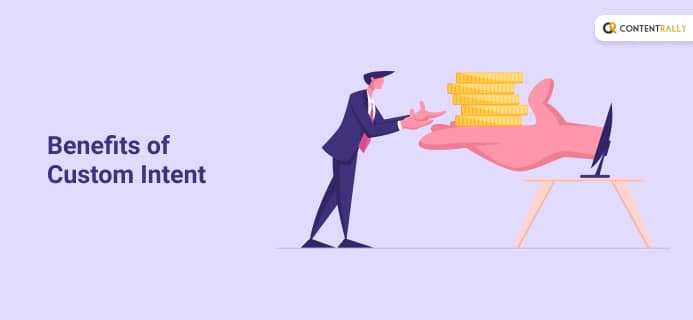
Best Benefits of Custom Intent Audiences
targeting option is best for influencing consideration

Yes, there are various benefits of custom intent audiences as it lowers the waste in ad budgets and reduces the stream of irrelevant online ad experiences by targeting high-quality prospects. 

Now, let’s discuss some powerful benefits of Google’s custom intent audiences.

1. Custom Intent Audience Targeting is Cheaper:

Custom Intent audience campaigns reduce the rate of CPC (Cost Per Click) to a great extent while targeting the same high intent searchers. 

So, the drawback of the high intent search keywords i.e., high CPC eliminates by Custom Intent Audience. This is regarded as the best benefit of targeting options for influencing consideration.

2. Custom Intent Reduce Waste in Ad Spend 

Another benefit of the custom intent audience is that it reduces waste in ad spending. This gives you an opportunity to target only the most likely customers by making use of suitable offers. 

Moreover, this ad is only shown to a specific group of audiences who are interested in a particular topic related to your goods and services. This means that there are less wasted impressions when firms target unspecific niches or have too wide of a target audience.

3. Eliminates Targeting Expenses

Eliminates targeting expenses is another benefit of using custom intent audiences. As already discussed above that search ad comes with a high CPC and the targeting prospects of both are nearly the same.

Besides, responsive display ads featured in Custom intent campaigns get more click-through rates, impressions, and clicks at a lower cost. 

4. Become a Thought Leader On A Given Topic

Do you want to make your business a thought leader in your particular domain? If yes, then make the right use of custom intent audiences! 

You can analyze the URLs that are ranking on the first page of Google and make use of those in order to rank on the top pages of the search engine result page. Keep in mind, digital display ads with custom intent can reach the same result faster with a higher return on investment

5. Tap Into Competitor’s Targeting Data & Advertise To Their Customers  

Custom intent audiences enable you to perform competitive research to gain insights into the keywords that bring conversions to your competitor’s websites. 

This way you can easily collect the data and use it for your own campaigns to target your prospect customers and increase conversion rates to a great extent. 

How To Create Custom Intent Audiences?

targeting option is best for influencing consideration

To create custom intent audiences, you need to consider some factors that are listed below:

i). Competitor’s pages

ii). Competitor’s keywords

iii). Search volume

iv). Main competitors

v). In-market keywords.

Now, the proper steps to custom intent for your business, follow the below-listed tips step by step:

  • Sign in to your Google Ads Account
  • Click on “Display Campaigns” 
  • Pick one active campaign and click “Audiences
  • Then, select an ad group and click the plus icon 
  • Click on the pencil icon under the browser tab
  • Select the blue plus icon and create a name for your custom intent 
  • Now, check the potential reach of your campaign under ‘Audience size’ 

The Final Verdict

Custom Intent is the answer to your question “Which Targeting Option is Best for Influencing Consideration?” The above-described information explains the reasons why custom intent audiences can be used for targeting purposes and what are the benefits of the same.

You May Read Also:

Content Rally wrapped around an online publication where you can publish your own intellectuals. It is a publishing platform designed to make great stories by content creators. This is your era, your place to be online. So come forward share your views, thoughts and ideas via Content Rally.

View all posts

Leave a Reply

Your email address will not be published. Required fields are marked *

Related

Email Campaigns

Getting The Most Out Of Your Email Campaigns By Getting The Audit Right!

Excerpt: Delivering email campaigns that perform exceedingly well requires effort and email audits help you get closer to better ROIs. Read on! So half of the year has gone by smoothly (well, almost), your brand’s making money, your workflows are automated, and your email marketing campaigns are doing well. Wait, yes, pause at the last part of the sentence. Are they really performing optimally? To get a clear understanding of the efficacy of your email marketing campaigns, no matter how great and well-automated they might be in your perspective, you NEED to run audits twice or thrice every twelve months. If you meet an email marketer over drinks, they will probably have a lot to say about their KPIs and how the click-throughs are not making the cut. So how can one ensure that their email marketing efforts don’t go down the drain? The answer is quite simple indeed: execute email marketing audits to unveil your strengths and weaknesses, areas of improvement, and those that are doing just fine. In the blog that follows, we will delve into the different kinds of email marketing audits that one can conduct and ways to go about executing them. Let’s get cracking! The Kinds of Email Marketing Audits That One Can Conduct In simple terms, an email marketing audit is a deep analysis of the various factors that contribute to the success of an email campaign so that you know what’s working and the areas that need to be tweaked. The following are some kinds of email audits that you can carry out; each of them focuses on different facets of the email. 1. Email Content & Design Marketing Performance Audit One of the most common kinds of audits, here you delve into your various KPIs (CTR, CTOR, etc.) to get a holistic understanding of the email campaign’s performance. The aspects that you need to look out for are: Subject line: Try to keep them personalized, crystal clear, non-sales, and within the range of 40-45 characters, optimized for mobile viewing. Please steer clear of spammy words such as “earn quick money” or basically anything that sounds too good to be true. Preheader text: It should be related to the subject line, albeit not repetitive. Header: First impressions are often long-lasting; cliched though that may sound, it does hold some weight. The header text next to your logo should be noticeable, clear, and in alignment with the brand ethos. Email copy: Grammatical errors and typos are a major turn-off. No wonder brands invest in the best copywriters to churn out good copy, even in the age of AI! Keep it crisp, clean and deliver maximum value in minimum words. CTA: The Call to Action buttons are the ones that can make or break the ROIs. Keep the design and text in tandem with the brand guidelines, easy to spot and click, devoid of broken links that lead nowhere! Graphics: When crafting an HTML or interactive email, ensure that the graphics render well across devices and the visual hierarchy is maintained. Conversions & Engagement rates: This is the litmus test of your email campaign. Are your emails good and engaging enough to keep subscribers interested, or are there more hits than misses? The KPIs should spill the beans on this one. 2. Email accessibility audit When crafting your emails, if one overlooks the critical aspect of disability, you might fail to foster inclusivity with your campaigns, thereby risking losing the patronage of your subscribers. Keeping email accessibility in mind is absolutely essential, and is something that all email marketers should perpetually strive for. Ensure that there is no sensory overload for those with visual disabilities by keeping a simple and clean email layout. For those living with tactile difficulties, make the CTA buttons larger to ensure greater clickability and visibility across a range of devices. Remember to check for alt text in images to simplify things for users deploying the services of a screen reader. 3. Deliverability Audit You might have the best of Salesforce email templates (or Hubspot; whatever rocks your boat) and check all the above aspects, but if your email campaigns fail to reach the intended inboxes, all your efforts will end up in vain. To check for email deliverability issues, one needs to check the following aspects; Clean email list devoid of incorrect email ids Email Authentication HTML code failures Domain reputation Blocklisting Spam traps IP address 4. Compliance Audit This would include checking the level of compliance of your email campaigns with the guidelines and requirements of CCPA, GDPR, PECR, etc. 5. Email Code Audit Here, one would evaluate and carry out a code clean-up, fix bugs (if any), and ensure the incorporation of the best practices in email coding. One would also conduct tests to see how well the email renders across different email clients and devices. 6. Design Audit In this kind of audit, one would review the emails from the design and aesthetics viewpoint and check how consistent the layout is with the branding guidelines. The different elements one would generally bring under the lens in this kind of audit are checking for the right use of white spaces, design patterns in accordance with the heat map, fonts, logo, layout, graphics, etc. 7. Automation Audit Here, one would check automated email campaigns to see if everything is in order, such as API triggers, templates, links, rules, customer journey maps, etc. One can either carry out all these audits or create a bespoke audit plan that includes permutations and combinations of the different kinds of audits mentioned above. Steps For Conducting The Perfect Email Audit Now that we are privy to the kinds of email audits that one can carry out, let’s move over to getting started with the process of what’s going well and what’s lacking in your current email campaigns. Firstly, you need to begin with drafting a clear set of goals. Much like in other areas of life, the lack of well-defined goals in sight can very well be akin to sailing in a rudderless ship, and frankly, no one wants to be aboard such a ship! You could begin by jotting down the kinds of audits you’d want to run on your existing campaigns and, based on the purpose of the audit, figure out your bespoke learnings and takeaways. Then, you’d like to create a list of measurable Key Performance Indicators (KPIs) that you will be evaluating to check the health and effectiveness of your current campaign. These may include: Unsubscribe rates Open rates (albeit not a very effective one as per Apple’s Mail Privacy Protection feature unveiled in the WWDC conference held on 7 June 2021) CTR (Click Through Rates) CTOR (Click To Open Rate) Spam complaints Conversions Email client & device assessment You can create a spreadsheet to maintain a record of your audit. Here’s what you can document: Name of the email campaign Date deployed (not applicable in case of automated emails) Name of the audience segment Subject line Soft bounce rate Hard bounce rate CTOR CTR Conversion rate Unsubscribe rate You can modify the contents of the spreadsheet as per your unique requirements. One can also diversify the main spreadsheet by adding tabs for different kinds of emails, such as promotional, transactional emails, etc. Once you have your data in place, you can and should proceed with the data analysis. Begin with scanning all the metrics and specifically scrutinize those that fall on the extremities of the curve. The ones that did really well and the ones that missed the mark. Proceed with asking yourself the following questions, Are the subject lines and preheader texts enticing enough? Will I click on them if I receive them in my inbox? Is the visual hierarchy of the email in place, or does it look too cluttered? Does it offer a personalized experience to the subscriber? Does the email copy offer value to the reader, or does it appear too salesy? Does it cater to specific buyer personas and age demographic, or does it appear mass-produced with no specific target audience in mind? Is the cadence too annoying for the subscribers leading to higher unsubscribe requests? Are the CTAs visible, quirky, and enticing enough to get users to click on them? Are your emails accessible to users across the entire spectrum? Wrapping It Up While there are a number of tools available in the market to help you conduct email audits, and you can always request colleagues for a fresh eye perspective on your campaigns, if you’d rather have experts analyze the game for you, that’s possible too! Email Uplers will not only help you analyze your existing campaigns but also deliver interactive emails from scratch attuned to your specific needs. Do drop by for more information! Read Also: Should You Consider Outsourcing Your Brand’s Marketing Campaign? Your Ultimate Guide To Creating SMS Marketing Campaigns Content Marketing Campaign Strategy For Small Business

READ MOREDetails
lifestyle entrepreneurs

Top 10 Best Lifestyle Entrepreneur Of All Time In 2024 – Lifestyle Entrepreneur

Are you thinking of starting your own business and become an entrepreneur? Are you looking for inspiration? Do you wonder how famous lifestyle entrepreneur started their journey? Following their passion and making it your profession will never be outdated. When you love what you do, or you do what you love, it will offer you more opportunities to be successful. Here, we will talk about 10 names who think the same way you think of being the boss of your own. The list of the top 10 entrepreneurs of all time is here. And they are on this list. 10 Best Lifestyle Entrepreneurs Of All Time Here is a list of the 10 best lifestyle entrepreneurs of all-time in 2024. This list includes all the names that are more than enough to inspire you to start your journey.  1. Tim Ferriss Do you want to know the name behind lifestyle entrepreneurship? Tim Ferris is the person who has brought the concept of this into the mainstream. And the popularity of his book The Four-Hour Workweek has worked as the fuel to this journey. It is a must-read for those who also want to be lifestyle entrepreneurs. As the book is all about the concept of lifestyle entrepreneurship, it will be a perfect guide for you. After the book, he continues to write books, blogs, and runs a globally known podcast, and uses his diverse income for living a lifestyle or travel and freedom. 2. Michelle Schroeder-Gardner Michelle Schroeder is a personal finance blogger. By driving traffic to her blog from Pinterest, she became a successful lifestyle entrepreneur. Recently, focusing on SEO along with other traffic sources, she has diversified her traffic. With the growth of her business, Michelle also diversifies the ways of her blogs.  3. Johnny FD Apart from being a digital nomad, Johny FD is a great lifestyle entrepreneur. In order to make money, Johny only needs internet and a laptop. He loves taking advantage of this and travel around the world. Though Asis is on his priority living. Due to the lower cost of living in parts of Asia than the USA, he chooses to live here while earning in USD. This thing is common among many lifestyle entrepreneurs. This way, Johny FD saves a large portion of his income.  4. Jasmine Alley Jasmine Alley is an Instagram influencer. Through several brand collaborations, this Instagrammer managed to make a living as a travel influencer. Her primary current source of income is those Instagram brand collaborations. After leaving her job, Jasmine spent two years developing her travel brand. And now she gets to explore beautiful places along with complimentary stays in luxurious hotels. She actually used to make more money from her job than she is currently making. But she prioritized her independent, fun, full, and luxurious travel life. 5. Pat Flynn Pat Flynn started blogging much before it became cool. He was ahead of most people who did not have any idea that one could actually make money from blogging. Currently, he is running smartpassiveincome.com, which is an empire of content production. He started his business just to prioritize time with his family. These are some of the common motivations for most lifestyle entrepreneurs. From his blog, he makes more than millions on a yearly basis.  6. Melyssa Griffin As a graphic designer, Melyssa Griffin felt burned out while selling services. When she started selling products instead of selling services, she experienced huge success. She started selling online and started riding the stairs in popularity of online courses. This has brought massive success to her. Melyssa does not publish her income report anymore, but as per the report of December 2016, she has managed to make a profit of around $200,000 in that particular month alone.  7. Brian Dean The initial story of Brian Dean is pretty much similar to Melyssa Griffin's, and that is, he also started by selling services. But later on, he realized that in order to live the life he had been dreaming of, he needed to sell products. At present, he is running Backlinko, which is an SEO blog that is highly successful. He sells online courses as well, like Melyssa. If you want to know more about him, you can read the article on Forbes.  8. Shelby Church Being a west coast based vlogger and Youtuber, Shelby is another example of an aspiring lifestyle entrepreneur. She does not make millions only from her lifestyle business, unlike other entrepreneurs on this list. In her 2019 income recap Youtube video, she unveiled that her channel managed to earn revenue of $140,000. If we cut down the taxes and other expenses, it would be nearly $100,000 or less than that. Yes, it is a decent income but not near to the income of other lifestyle entrepreneurs. She has always been transparent about her income.  9. John Lee Dumas Have you heard of the podcast Entrepreneurs on Fire? Yes, the one where entrepreneurs are interviewed. John Lee Dumas is the person behind it. His advice is worth listening to. He always asks F.O.C.U.S, which means Focus on One Course Until Successful. On a regular monthly basis, he nets profits of six figures only from his podcasts. He is the perfect example of how it often takes years to earn a living from a lifestyle business. He, as a lifestyle entrepreneur, always believes in slow and steady wins in the race.  10. Lindsay Mostrom Pinchofyum.com is a food blog that is run by Lindsay and her husband. As per a report from early 2017, this lifestyle entrepreneur managed to make around $70,000 on a monthly basis. After that, their business has grown, so it is clear their income is more than what it is currently. It also took many years to reach this point. So, you see, as a lifestyle entrepreneur, you get a wide array to try. 11. Jen Gottlieb She is a former Broadway actor and VH1 host, who is now also an entrepreneur who has co-founded the online training and education company called Super Connector Media. Her award-winning company helps entrepreneurs reach larger audiences and grow businesses by leveraging on social media. She has been recognized as one of the Top 50 Speakers in The World” by Leaders Magazine. Jen has several accolades to her name, including becoming the number 2 on Maxim Magazine’s “Top Entrepreneurs Of 2022.” She has appeared on quite a few popular platforms, such as Forbes, Business Insider, and CBS. Gwyneth Paltrow’s Goop also named Jen one of the “Top 11 Coaches” Bottom Line.  Bottom Line These top entrepreneurs never fail to inspire us with their journeys and words. Maybe they are the reason why more and more entrepreneurs are rising, leaving their boring desk jobs to follow their passions. But the list does not end here. It goes on with the names of Pieter Levels, Oprah Winfrey, Marie Forleo, Daniel Vassallo, and many more.  Read Also:  How to Plant Grass Seed on Hard Dirt? Top Easy Way To Fix Avast UI Failed To Load Error Easy Steps to Change the YouTube Channel Name  

READ MOREDetails
Marketing Strategies

5 Ways Marketing Strategies Will Change Post COVID-19

To think life will go back to normal post-Pandemic is a pipe dream. The world underwent a paradigm shift to the new normal, and there is no returning now. The COVID-19 Pandemic has brought many changes we couldn’t have ever predicted. The unheralded health crises impacted nearly everything, from personal affairs to governmental decisions and even corporate matters. Business operations, in particular, faced quite a few alterations. Digital mediums took over the world by storm, and e-commerce businesses experienced a significant rise in demand. These reshaped business activities welcomed a considerable restructuring of marketing strategies. Marketers primarily shifted their focus to online tools, giving digital marketing an unanticipated hype. Given the technological innovations rate, marketers expect to see many more advancements in the marketing department post-COVID-19. Read below to find out how marketing strategies will change after the Pandemic. 1. The Importance of Online Presence:  If businesses have to choose one takeaway from the crisis, it would be essential to have an online presence. With strict lockdowns and restrictions on going out, the entire world switched to conducting and participating in businesses online. Many also realized the convenience such platforms bring. Hence, owning a website has now become an essential business marketing strategy. Almost 56% of businesses with a website perform better as compared to the ones without a website. Besides, a website is one of the most powerful digital marketing tools. It marks your presence on the internet and helps you get more reach. A website also lets you upload a customizable flip book or eBook where you can share all necessary details about your products and services. It is an exceptional technique to spread awareness about your brand, attract traffic, and eventually boost sales. A website gives your customers ease of access and costs much less than traditional marketing, and dramatically impacts investment return. It is a proven worthwhile investment. An authentic-looking website enhances your business’s professionalism and adds value to it. Hence, having a website is vital for a business’s success. So, it is safe to say that website marketing will be a critical element post-COVID-19. 2. The Emergence of Social Media: Social media is undisputedly the king of marketing. The world is quickly becoming digitally advanced, with social media users increasing rapidly. Nearly 83.3% of people use social media worldwide, and the figure is likely to grow by 10% each year. Not only that, 71% of businesses have a social media account, out of which 90% experience improvements in sales and growth. 90% of users connect with brands through social media, and 54% of consumers make purchases from brands after scrolling through the brand’s social media account. The statistics above prove the criticality of a social media presence for businesses. The future is uncalled for, but one thing is for sure; social media’s regime will only grow. Social media helps connect brands with potential customers and allows marketers to make informed decisions based on the target audience. It also gives businesses an incredible opportunity to grow. The paid advertising options on Facebook, Instagram, and Snapchat are the easiest, quickest, and most affordable promotion plans for your business. So, you can popularize, promote, and increase your brand’s overall ROI without breaking the bank. Social media is here to stay and quite possibly grow into a platform unimaginable. Hence, social media was, is, and will remain, marketers, fundamental focus. 3. Video Marketing: Video marketing was every marketer’s favorite even before COVID-19 and is still growing phenomenally. Studies confirm that videos interest more users than any other graphics form and carry great potential for attracting customers. YouTube and other video streaming sites are experiencing an incredible increase in usage. These sites allow businesses to market their products and services or raise brand awareness in the form of high-quality videos. Video content also plays an essential role in emails. It exceptionally increases your email’s click-through rates and decreases the unsubscribe rates. Additionally, it boosts your SEO by attracting traffic and increasing your site’s searchability and visibility on different search engines. After seeing how effective video marketing leaves on the brand and consumers, it is likely to grow and remain a powerful marketing strategy in the future. 4. Customer Retention and Loyalty: One major disadvantage many businesses had to face due to the Pandemic was to cut down costs in essential areas like marketing. As a result, markets had to shift their focus to different, long-run marketing tactics like building customer loyalty. Customer loyalty helps you stay one step ahead of your competitors. Loyal customers give you valuable feedback, increasing your business’s rating and eventually attracting new customers. Building customer loyalty considerably reduces your marketing spending, but retaining a customer also leads to a more profitable outcome. Remember, customer retention is what powers customer acquisition. The free word-of-mouth promotion your business gets from loyal customers is one of the most significant benefits of building customer loyalty. Loyal customers are also likely to make purchases repeatedly and trust your business enough to pay premium prices. 5. Less Is More: The Pandemic has stipulated marketers think about innovative marketing strategies without having to go all out. They have to find ways to develop creative marketing campaigns, which are both practical and inexpensive. Moreover, with a limited budget, marketers have restricted resources which they have to ensure to save for more than one campaign. In short, the coronavirus has compelled marketers to do more with less. Marketers need to make efficient use of technology to find solutions and make decisions quicker. The “less is more” trend will continue long after the Pandemic is over as marketers turn their attention to enhancing innovation and improving skills. Conclusion: Businesses will undoubtedly have to deal with the pandemic effects for a long time to come. However, organizations have to push ahead. The Pandemic led to several changes in consumer buying patterns which marketers cannot ignore at any cost. The changes in consumption techniques encouraged marketers to think ahead and think creatively. Even though companies cut down the cost of marketing immensely due to COVID-19, the role of marketing has thoroughly increased during the Pandemic. However, there is still quite a lot of room for growth and innovation. These alterations in marketing strategies are likely to continue and grow post-COVID. Read Also: Key Components for Your Marketing Stack How To Foolproof Your Digital Marketing Strategy? Why Email Marketing is the BEST Digital Marketing Outreach in Singapore

READ MOREDetails