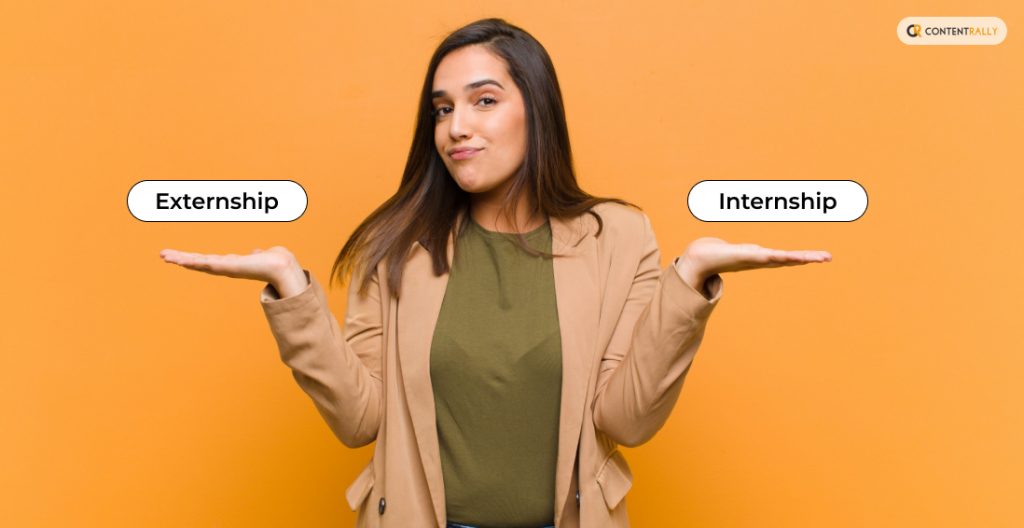
Externship vs Internship: What Are The Major Differences?

by

22 November 2024

Job & Career

Externship vs Internship

Externship vs Internship – Often many beginners in the job market or students in universities confuse these two terms.

Generally, both are short-term professional learning experiences. Moreover, both are professionally valuable for beginners. Hence, knowing the difference between the two is important.

In this article, you will learn about the difference between an externship and an internship. Additionally, this article will also explain the benefits of each of these professional experiences.

Moreover, you will also learn common myths that persist among students and beginners. Hence, to learn more, read on to the end of the article. 

Definition Of Externship

Definition of Externship

In an externship, you have to perform job shadowing for a short time span. Basically, the focus here is to learn about a job profile by observing someone’s daily work routine.  

In general, people who go through externships (externs) are college/University students. However, the college might not choose to give credit to the student for an externship. 

Moreover, the length of an externship depends on the professional that the student is job-shadowing. In fact, it is the time that the professional can afford to offer to the learner.

Basically, the program can last for a day or even eight weeks. Hence, a student can choose to perform multiple externships during a break period. 

Definition Of Internship

Definition of Internship

An internship is a training program where the student/beginner learns while being on the job. Here, the intern works under an employer and learns by working on projects.

Hence, an intern can have employee-like responsibilities. These include working on projects, organizing files, updating information, and more. 

Moreover, the learner can also earn college credits by working on internships. In some cases, the employer might also offer a small base salary to the learner. However, in other cases, an employer might not offer payments to the learner. 

For instance, if you are a student or a college grad, you can choose to complete an internship with a company during your school year.

Moreover, if you have enough time, you can choose to complete multiple internships. However, you will need to inform your internship coordinator if you have a school semester to prepare for. 

Both externships and internships are helpful for college students to learn about different careers and job roles. Apart from that, in both cases, students can learn whether they want to pursue a career or not. 

Externship vs Internship: Key Differences

Externship vs Internship: Key Differences

The following are the major differences between an externship and an internship: 

Factor Externship Internship 
Compensation You might get no payment in an externship. This is because the work involves only observing a professional for a certain time period. Since you get to work with hands-on experience, you will receive compensation. However, in some cases, an employer might not offer compensation to an intern. 
Length An externship does not extend to more than eight weeks. In fact, in some cases, the externship can even end in a day. Basically, it depends on the amount of time that the professional you are observing can provide you. An internship requires at least two months and can extend to six months. In some cases, it can require more time. This is because you are learning with hands-on experience.  Moreover, you will also find internships that align well with your University schedule. 
Course Credit Generally, students don’t receive course credits after an externship. This is because the length of an externship is short. In most cases, colleges/universities offer course credits for internships. Moreover, universities even encourage students to work as interns before they graduate. This is because students get good industry experience as they make progress. However, to ensure that your University recognizes your internship, you have to submit proof. 
Responsibilities In an externship, you do not need to complete any task. Also, there is no supervisor to give feedback on your work.  In an internship, you will receive on-the-job training. Also, you have to contribute to the company’s workflow.  Moreover, if your performance is good enough, the employer might provide you with a full-time opportunity after your graduation. 

Externship vs Internship: Major Benefits

Externship vs Internship: Major Benefits

Here are the major benefits of an externship and an internship: 

Benefits Of An Externship 

One of the major benefits of an externship is that you will learn a lot about a particular job role. For instance, as a student, you will understand whether a given career is suitable for you or not. Moreover, if you are a professional, an externship will let you understand a career change better. 

Basically, with the help of an externship, you will have a good perspective on your career options. For example, if you are a business major and not sure about whether you want to join accounting or finance, you can do an externship in both.  

Moreover, you will also learn how to prepare for an interview or how to build a resume for the job role. 

Benefits Of An Internship 

The most important benefit of an internship is that you will have work experience before you become a full-time employee. In fact, it will be a competitive advantage while you are still in college or University. This is because employers always prefer someone with industry experience to a fresher candidate. 

Meanwhile, you will also learn the duties and responsibilities of different departments and responsibilities. This will help you a lot in your future jobs. Apart from that, while being an intern, you will get the chance to create a professional network. This will open up options for you after you graduate. 

Basically, if your internship has been a positive experience for you, you can transition easily to a permanent job. Additionally, if your performance was good enough during your internship, the employer can even consider offering you a permanent role. 

Externship vs Internship: Which One To Choose? 
Externship vs Internship: Which One To Choose? 

Both externship and internship have their own benefits and opportunities. Hence, you must assess your situation and your future needs to choose the one that suits you the best.  

For instance, if you are unsure about whether to pursue a career or not, an externship might be the best option to choose. Here, you can check the daily work-life of a professional that you strive to be in the near future. 

On the other hand, if you are sure about your career path, you must look for an internship with an employer. This way, you will get practical work experience in a field. As a result, it will be easier to find a job after you complete your graduation. However, you will need to consider whether you have enough time to take on a full internship. 

How To Find Externships And Internships?

How to Find Externships and Internships

To find a good externship or an internship, you can use your college’s resources and personal and social media connections. In fact, one of the best ways to find an internship or an externship is by completing your LinkedIn profile. This is one of the best platforms to create a professional network and look for job opportunities. 

Apart from that, you can also contact your college’s placement cell or talk to your academic counselor to offer some advice. Additionally, you will also learn about internship or externship opportunities through professional networking events. 

On the other hand, if you are confident enough, you can even try a head-on approach. For example, if you want to work for a particular company that you think can offer you a good opportunity, reach out directly to them. Ask them whether they have an internship or externship opportunity for you or not.  

Externship vs Internship: Common Myths

Externship vs Internship: Common Myths

A common myth of externships is that it does not help much in knowing about a job role. However, the fact is that if you choose the professional properly with the guidance of your academic mentor, you will have a great experience. Thereby, you will know whether a particular job is good for you or not. 

On the other hand, a big myth about internships is, “Interns mainly do beginner-level tasks…” However, the fact is interns do work on important and complex projects. This helps them gain industry experience early on. 

Another myth about internships is that only top-performing students get internships. However, the fact is that although internships are competitive, there are many places to look into. All you need is the right set of skills. 

Final Thoughts

Externship vs Internship – Now you know the major differences between them. Basically, if you are unsure about whether to choose a career or not, an externship is helpful. On the other hand, if you want early industry experience, an internship is the way to go. 

Do you have more suggestions on how to look for externships and internships? Please share your ideas and opinions in the comments section below. 

Read Also:

A passionate writer and an avid reader, Soumava is academically inclined and loves writing on topics requiring deep research. Having 3+ years of experience, Soumava also loves writing blogs in other domains, including digital marketing, business, technology, travel, and sports.

View all posts

Leave a Reply

Your email address will not be published. Required fields are marked *

Related

Jobs for 15 Year Olds

15 Amazing Jobs For 15 Year Olds And Teenagers In 2025

There are some amazing jobs for 15 year olds that do not require a college degree or an age limit to apply. Also, there can be many reasons why a teenager wants to have part-time employment. For instance, it can be either to spend money, pay for college, or save for a big gift. Hence, it is important to learn about jobs that a teenager can apply for.  In this article, you will learn about various job options for 15-year-olds. Apart from that, this article will also discuss factors like legal considerations, balancing work and school, parental considerations, and gaining work experience. Moreover, this article also explains how a 15-year-old can get a job.  Hence, to learn more, read on to the end of the article.  Jobs for 15 Year Olds: Legal Considerations  The enforcement and administration of federal child labor laws fall under the purview of the US Department of Labor’s Wage and Hour Division (WHD). According to the US Department of Labor, “The FLSA's child labor provisions are designed to protect the educational opportunities of youth and prohibit their employment in jobs that are detrimental to their health and safety.”  Basically, according to the Fair Labor Standards Act (FLSA), the minimum age of employment is 14 years.   Apart from that, it also states the hours a child of under-16 can work. Additionally, it also prohibits the employment of youth under 18 in hazardous jobs. Moreover, the FLSA also sets the wage standard for employees who are less than 20 years of age.   Furthermore, there are also wage standards for apprentices, student learners, full-time students, and employees with disabilities.   15 High-Paying Jobs for 15 Year Olds and Teenagers  The following are some of the best and high-paying jobs for 15 year olds that you must learn about:  1. Cashier  You will find cashiers in grocery and departmental store. Here, the duty is to attach rings to customers’ products, and also to ensure a smooth checkout process. Generally, the job requires you to perform price checks, validate coupons/cards, collect cash, and package items.  2. Grocery Stocker  As the name suggests, the job requires you to stock the shelves of the grocery store that you are working for. Basically, you have to store the groceries soon after the store receives and checks in its inventory.   In most cases, you might have to work in a particular part of the store. Moreover, in other cases, you might need to work overnight or might have early morning hours.  3. Pet Sitter  As a pet sitter, you have to watch over animals, mostly dogs, when their owners are not present. In most cases, you will have to take care of dogs. Generally, you have to feed them, take care of them, and take them outside.   Also, you must ensure that their living areas are clean. Moreover, in some cases, when the pets are sick, you might even need to take them to the vet.  4. Lifeguard  In this case, you will be working near natural or artificial waterbody (for example, a swimming pool, lake, river, or ocean). Here, your job is to enforce safety rules and regulations around the facility. Moreover, you might also need to assist in swimming lessons, perform first aid, and rescue swimmers.  5. Server  As a server, you will have to work in a restaurant or a fast-food establishment. For instance, you have to take orders from customers and hand them the food/drinks from the kitchen. Moreover, your job also requires you to collect payments and tips. Apart from that, you must also clear up tables after the customer is gone and reset the area for the next customer.  6. Sales Associate  In this case, you will need to work in a store and assist customers who want to make a purchase. Here, the major duties include responding to inquiries and complaints. Additionally, you will also need to maintain an orderly appearance and make product recommendations.  7. Delivery Associate  As the name suggests, you will be delivering fast food or retail orders to customers. Moreover, you must review orders, accept payments, and ensure quality customer service. Apart from that, in some cases, you might need to handle complaints and maintain documentation.  8. Actor  You already know what an actor does. Depending on your role in a stage play, movie, advertisement, or TV show, you have to portray a certain role. Also, you have to memorize your lines in a script and act out your character.  9. Babysitter  In this case, you have to look after young children when their parents are away. For instance, you have to bathe and dress them. Also, you must feed them by preparing their meals. In some cases, babysitters help babies with homework and keep them occupied with games.  10. Landscape Laborer  The duties of a landscape laborer are manifold. For instance, it includes mowing lawns, trimming hedges, pulling out weeds, watering plants, and more. Moreover, the job may change a little depending on the location.  11. Youth Sports Referee  As the name suggests, a youth sports referee oversees games of sports teams at a high school level. Generally, you need to keep track of games and adhere to game rules. Also, you have to make game calls and inspect teams between games.  12. Caddy  Caddies are golfers’ assistants. Basically, you have to carry golf bags, measure yards, clean golf pins and golf balls, replace ball marks, hold flags, etc. In some cases, you might even need to advise golfers on how to use the club.  13. Tutor  The tutor teaches and aids students in their coursework. However, you have to do it outside their regular school hours. Moreover, you must also review their performance in class and hand out assignments. Also, you can point out trouble areas and devise strategies to teach them and make them study.  14. Dog Walker  As a dog walker, you have to take other people’s dogs out for a walk. Here, you will also be exercising the dogs and helping them socialize with other dogs and animals. Generally, you have to walk the dogs when their owners are away. Hence, if you love dogs, this can be one of the most rewarding jobs for you.  15. Automotive Technician  If you know about car parts and machinery, this is a great job for you. Although you have to start as an apprentice, there is a lot to learn. Moreover, you will also learn how to carry out diagnostic tests and maintenance tasks.  How To Find Job Opportunities? The following are the places you must consider if you are looking for jobs for 15 year olds:  Check online job portals like LinkedIn, indeed, etc.  Contact a relative or a friend person to recommend a job opportunity.  Look for job advertisements on online sites and newspapers.  Reaching out to a job consultant for job recommendations and suggestions.  Moreover, make some effort to build your resume as well. For example, information about how many bullet points per job on a resume, how to add skills to a resume, etc., can help a lot.  Why 15 is a Good Age to Start Working?  Reasonably speaking, 15 is actually a good age to start working. It not only helps the child to understand the true meaning of responsibility but also helps in developing work history from an early stage. Also, they will be able to learn valuable life skills, including organization, time management, communication, etc.  Basically, by starting to work early, the 15-year-old child can learn how to be accountable and responsible. Also, they will learn how to take early initiative, keep commitment, and work independently. Moreover, some teens may start working to find a sense of belonging and learn to be a part of a team.  On the other hand, one of the major advantages of starting to work as a teenager is to learn money management. For instance, a 15-year-old child will learn early how to earn, spend, and save for the future.  Jobs for 15 Year Olds: Why Is It Beneficial for You?  Here are the major advantages of early work experience you will benefit from if you start working as a teenager:  You will have practical experience from a young age. Hence, you will have an advantage in future jobs.  You will learn essential skills like teamwork, communication, soft skills, social skills, etc.  An early job and earning from a young age will heavily increase your self-confidence.  Moreover, you will have a lot of time to experiment with career options.  Apart from that, an early job will help you build a professional network around your area of expertise.  Are You Looking For Jobs For 15 Year Olds  If you are looking for well-paying jobs for 15 year olds, start by looking for job opportunities online. Apart from that, you can also ask people you know for opportunities and recommendations. However, don’t try to get into a job that you don’t like. Start with what you are good at or something that interests you.  Do you have more suggestions for jobs for 15 year olds? Please share them in the comments section below.  Read Also: 7 Proven Tips To Leave A Lasting Impression On Your Interviewer How Many Jobs Are Available in Consumer Services? Top 9 Signs You Will Get The Job After Interview

READ MOREDetails
Free Resume Builder For High School Students

Why Use A Free Resume Builder For High School Students?

Entering the job or internship market as a high school student can be intimidating. Plus, writing your first resume can feel overwhelming. Fear not, because free resume builders for high school students are here to help! These platforms allow students to create professional-looking resumes with no prior experience needed. Easy-to-use, ATS (Applicant Tracking System)- friendly layouts and modern designs make these the best resumes for showcasing academic accomplishments, extracurriculars, and volunteer work. Below, I’ve outlined the best free resume builder tools specifically designed for high school students, along with some helpful tips and tricks. Resume Builder For High School Students Free Without any further ado, let’s get into the free tools that will help you in your future. 1. Canva: Drag-And-Drop Simplicity Canva is one of the best design platforms offering many resume templates for high school students. It is even easy to use with the drag-and-drop interface. In fact, you can also easily customize your resume to fit your style and taste. You will need no design skills to work through the application features. A large selection of free, professionally designed templates will appeal to many users. Allows creative resumes with color and layout variations. Resume Tips: Use templates that balance creativity and professionalism. The design should not overpower the content of your resume since the purpose is to present your conceptual skills and experiences clearly. 2. Zety: ATS-Friendly Templates Among the free resume builders for high school students! Zety provides templates that will get through the ATS, which is important if you apply to larger corporations. ATS is an applicant tracking system that could get some of them to use this software to filter resumes. So, your resume needs to be ATS scannable. Do not worry! With Zety, your resume comes out already ATS approved. They also provide real-time tips as you build your resume, so you do not doubt what’s expected. Why It’s Great for High School Students: Provides ATS-compliant templates. Gives you comments for each part as you are writing it.   You get the resume free when finished. Resume Tips: Avoid overly creative designs if you apply to corporations or internships with strict ATS systems. Stick to clean, simple formats that highlight key information. 3. Resume.com: The All-Rounder If you're looking for a free online resume builder for high school students without experience creating one, we've got you covered! These templates are downloadable and easy to use, so you can spend more time doing what you love. The best part is that each download comes with expert advice on creating an effective high school resume. It's free, and there's no charge at any time.   Simple interface, perfect for beginners. Real-time previews as you type so you can see exactly what your resume will look like. Resume Tips: The first section of your resume should introduce you to the reader positively and enthusiastically. If you are a high school student, this is usually not an issue, and you can move on to the next section. 4. Kickresume: Customization With Real-Time Tips Kickresume is a resume builder that enables you to create, edit, and share your resume. All in one! It also offers customization resources with pre-written real-time tips and samples. For people who have never created a resume, this application also has them covered. Yes, you will get a quarter of a million resumes for inspiration. Why It’s Great for High School Students: Customizable templates with real-time suggestions. Access to templates for various fields. Free option but only with access to basic tools. Resume Tips: List your extracurricular activities and volunteer experiences. These are valuable when you don’t have much job experience. Tailor them to reflect relevant skills like leadership or teamwork. 5. VisualCV: Portfolio And Resume Combo Want to send a CV alongside the cover letter? This free resume builder for high school students is the one for you! VisualCV allows students to build a resume/portfolio hybrid, which is great for creative fields like design or media. You can craft a PDF visual resume or build a portfolio from scratch. Ideal for students with creative projects or personal websites. A free version is available and has basic features. Resume meets portfolio all in one place. Resume Tips: If you’re applying to creative fields, use VisualCV to share your school projects or other work outside of class. You can even include a link to your website or portfolio. 6. Indeed Resume Builder: Built For Job Seekers While primarily a job search engine, indeed also provides its users with a resume-builder tool. Plus, it is very helpful for high school and college students. In fact, their resources are simple to use. Once you are done creating your resume, you can also apply for jobs with just a click of the mouse through the same application. Why It’s Great for High School Students: Quick and easy interface. Resume Tips: Use the resume builder to make a resume with a foundation for jobs. 8. Novoresume: Professional Templates With Extras Novoresume offers premium and free resume templates. However, you do not need to pay for the advanced features if you are new to resume-making. Because whatever you need as a student, you don’t need to pay to get access to good-looking ATS-compliant templates. Why It’s Great for High School Students: ATS-optimized, modern templates. Step-by-step instructions on what to include. The free version contains all the important features. Resume Tips: Be sure to add in any special skills you have, such as being good with software (i.e. Microsoft Office, Adobe Suite). High schoolers usually forget this section and it’ll make you different from others applying. 8. ResumeGenius: Step-by-Step Guide ResumeGenius will walk you step-by-step through the resume creation process. Therefore, ensuring you do not miss anything when creating your first resume is particularly useful. Because It’s Awesome for High Schoolers: Simple step-by-step. Pre-written bullet points you can customize. ATS-friendly templates. Resume Tips: If you’re having trouble writing your experience or skills section, ResumeGenius has many pre-written examples. This can help you tailor your resume. In fact, it's particularly helpful if you don’t know what to write. 9. MyPerfectResume – Pre-Written Examples For starters, MyPerfectResume, a free resume builder for high school students has one of the largest pools of pre-written examples on the internet. If you don’t know how to put your skills or experience into words, it gives you ideas by sending lists of phrases everyone uses. However, do not overdo it because it will make your resume sound too cliche! Why It’s Great for High School Students: Offers examples you could use right away. Possibility to easily alter the patterns. Download resumes in several formats. Resume Tips: Use their examples as a starting point, but always personalize them to reflect your ideas and experience. Even if you’re using a sample, ensure it’s for the same reason as your intended role. Enhance Template - For All the Fancy Resume If you are one of those who wants their resume to look close to perfect, then this is for you! Enhanced templates are visually appealing without compromising professionalism. You’ll get basic templates as a free user, but they are more than enough for a student entering the professional arena. Why It’s Great for High School Students: Free templates that have basic features. Drag-and-drop sections. Customizable layouts that are still professional. Resume Tips: Choose a design that reflects your personality but doesn’t distract from your qualifications. Avoid overly complex designs that may be hard to read. How To Make The Most Of Your Resume Builder Tools Now that you know what the best free resume builder for high school students, here are a few additional resume tips to perfect it Proofread Everything: Even if the tool says they do this, never use something without doing manual proofreading. You don't want a typo in what could have been the perfect resume. Tailor Your Resume: Make sure that every resume you send out has specific information relevant to the employer you’re targeting. Highlight skills and experiences most applicable to the position for which you’re applying. Keep it Concise: Generally, employers and intern coordinators prefer a one-page resume. This is usually enough space to include all necessary information. Only include the most important things employers need to know about you, and don’t include “fluff” or irrelevant information. Use Action Verbs: Try to begin each bullet point in your experience section with an action verb. Leading with passive language dilutes the impact of your achievement. Emphasize Soft Skills: Soft skills, like leadership or problem-solving, can make a big difference in any role. Be sure to emphasize these as well. Happy Job Hunting! It might seem like a lot of work to create a resume, but with the right tools and helpful tips, it's not as tough as you think. If you're applying for part-time jobs, internships, or scholarships, these great free resume-builder apps will guide you through creating an awesome resume! In fact, high schoolers can do it all themselves — for free! Just make sure to tweak each resume for each job or opportunity to make yourself stand out! Read Also: Student’s Guide: 14 Essay Types from the Easiest to the Hardest One 8 Tips for Tech CV Writing to Highlight Skills & Experience Is Hotels/Resorts A Good Career Path In 2021

READ MOREDetails
peace officer vs police officer

Peace Officer VS Police Officer: Understanding Their Roles and Differences!

If you plan to start a law enforcement career, you might likely get torn between a peace officer and a police officer! However, the decision might get easier once you start understanding what they do and their roles. While both patrol at times, they are not the same. And yes, even if both carry guns (licensed, obviously!), their duties are quite different. And yes, these are some of the most dangerous jobs in the world. If you are interested in learning the differences between these two officers' roles and responsibilities, you have reached the right place! Therefore, keep reading this blog until the end to learn more… Peace Officer vs Police Officer: Understanding Their Jobs in Society! Before discussing the differences in terms of their roles, it is important to learn about who they are and what they do. So, without further ado, let us get started! What is a Peace Officer? You might be confused by this term, right? There's no need to! A peace officer is someone with the legal power to uphold the law and maintain peace. This covers a wide range of occupations, including law enforcement positions like sheriffs and state troopers. Besides this, the peace officers are sworn in when they take an oath to perform their duties effectively and adhere to the law. Additionally, they frequently have guns on them and have the authority to make arrests. Their primary objective is to ensure everyone abides by the law and contributes to everyone's safety. They have a heavy-duty to keep people and property safe. What is a Police Officer? A member of the police force is referred to as an officer. Enforcing the law, ensuring everyone abides by the regulations, and keeping people safe are their duties. They operate in certain regions, such as cities or neighborhoods. Officers on patrol for crimes assist in times of need and monitor the streets. They can make an arrest when someone violates the law, drives police cars, and wears a uniform. And yes, they make lots of money! Police officers converse with members of the public to deter crime and find solutions to issues. They are vital because they work hard to guarantee everyone can live in a secure and tranquil environment. Peace Officer vs Police Officer: Key Differences You Need to Know The main difference between a peace officer and a police officer lies in the scope of their authority and the areas they serve.  While all police officers are considered peace officers, not all are police officers. Scope of Authority The authority of peace officers is more expansive and can go beyond what is typically assigned to police personnel. Depending on their role, they may work for different law enforcement agencies and have varying tasks.  First, there is a significant distinction between the authority and responsibility held by peace officers and police officers. Due to their broad reach, peace officers can perform a variety of law enforcement duties.  They may have distinct responsibilities and work for different organizations. A county sheriff, for instance, has powers different from those of a state trooper assigned to highway patrol. Police officers, on the other hand, are authorized to do more particular tasks. They typically work for the police department of a municipality or city.  Their primary responsibility is to maintain the safety of their community by patrolling, looking into crimes, and handling emergencies. At work, they concentrate on upholding the law. Therefore, the primary distinction is that police officers often have a specific duty in a certain area, but peace officers can have multiple roles in various locations. Both are crucial in upholding the law, although they do so in various contexts and methods. Jurisdiction As you know, "jurisdiction" refers to the domain in which an individual possesses the authority to decide and act. It all comes down to where peace officers and police personnel can carry out law enforcement.  A police officer's jurisdiction is usually restricted to the town or city where they work. They focus on certain areas and ensure that the law is followed there. If you notice a police cruiser or officer wandering around, it's likely that they are patrolling their area. Peace officers' jurisdiction is more expansive. They may operate in several regions or throughout the entire state.  For instance, one sort of peace officer who can enforce the law in state parks and wildlife areas, which can be rather large areas, is the game warden. To put it briefly, jurisdiction refers to the "where"— the areas where these authorities are free to exercise their power.  Law officers have a specific "where," such as municipal limits. The "where" for peace officers is broader and can encompass various locations and law enforcement roles.  It is significant since it designates the individuals responsible for maintaining order in various locations. Peace Officer vs Police Officer: Roles and Responsibility You Need to Know Now that you know their scope of authority or jurisdiction, it is time to learn about their roles and responsibilities. One thing you must know is that these are not the low stress jobs. Let us take a step, one at a time: Peace Officers Peace officers are vital members of the legal community who perform a variety of duties. They may be state troopers, sheriffs, game wardens, court officials, or other officers. Although the duties of each type of peace officer vary, they are all concerned with maintaining law and order.  In a county, the sheriff is in charge of law enforcement. They are in charge of the county police department and the local jail. The county's residents choose the sheriff, and deputies assist the sheriff in carrying out his duties.  State troopers, often known as highway patrol officers, enforce the law on state-owned roadways. They contribute to road safety by apprehending speeders and reckless drivers. They can work anywhere in the state and help out in big emergencies. Game wardens are peace officers who protect wildlife. They ensure that people don't harm nature and follow hunting and fishing rules. They also monitor parks and natural areas to protect plants and animals. Court officials work in courtrooms. They help with court papers, keep judges safe, ensure the court is secure, and ensure everyone follows court rules. Any of these peace officers can arrest someone if needed. Their uniform shows they are responsible for enforcing the law. They often have guns, handcuffs, and radios to help them do their job. Peace officers are ready to deal with many situations, like helping lost people or catching criminals. They need to know the law well and be good at talking to people fairly and kindly. Peace officers can include:Sheriffs: Oversee county law enforcement.State Troopers: Patrol state highways and provide statewide law enforcement.Game Wardens: Enforce hunting, fishing, and wildlife conservation laws.Court Officers: Maintain security within courtrooms. Police Officers Police officers are the ones you frequently see driving patrol cars, responding to various problems in your community, and wearing uniforms. They are a particular class of peace officers from the police force. Their primary responsibility is to ensure everyone's safety and the community's rules are obeyed. There is patrolling, for instance. Officers of the law spend a great deal of time walking or driving through the area under their jurisdiction. This enables them to monitor the situation and be ready to assist anyone who requests it. Investigating crimes is also a major task for which the police are responsible. They investigate crimes as they happen, attempting to ascertain what occurred and who was responsible by gathering evidence and speaking with witnesses. Additionally, when police officers establish a rapport with the community's citizens, this is known as community policing. They converse with the inhabitants, pay attention to their worries, and collaborate to find solutions. This improves the neighborhood's quality of life by reducing crime. And yes, how can we forget emergency response? Police officers are among the first to arrive and assist in an emergency, such as a vehicle accident or a natural disaster. In addition to these responsibilities, they frequently manage traffic, help missing children find their homes, and conduct safety awareness training. It is safe to say that every day is different, so they must be ready for everything. Law enforcement officials receive training on handling challenging circumstances and treating everyone fairly and with dignity. They need to be knowledgeable about the law and how to enforce it, but they also need to be highly skilled in interpersonal interactions and sensitive to others' concerns. Police officers are tasked with:Patrolling: Monitor areas to prevent and detect crime.Investigating: Solve crimes and gather evidence.Community Policing: Engage with the community to build trust and prevent crime.Emergency Response: Provide immediate assistance during emergencies. Peace Officer vs Police Officer: Training and Qualifications Both peace officers and police officers need to finish a rigorous training program. Through this teaching, they learn specialized procedures, applicable laws, and how to maintain physical health. However, the specific expertise that law enforcement agencies need to obtain may vary depending on the state. To be a peace or police officer, one must meet certain qualifications and finish specialized training.  This will enable them to do their jobs well and guarantee everyone's safety. For Peace Officers An individual must ensure no history of significant offenses before being eligible to work as a peace officer. They accomplish this by proving their excellent conduct and passing a background investigation. They ought to be at least eighteen and have completed high school or something similar. Individuals must also pass a physical examination to prove they are qualified for the position. In states such as California, they must demonstrate their ability to make wise decisions and dependability. They learn how to manage crises, make arrests, and maintain thorough records of everything that occurs while they're on the job during their training. For Police Officers: The typical requirement to become a police officer is to graduate from high school or a comparable program. In addition, you must be of legal age and free of criminal history. Once you've demonstrated the necessary knowledge and abilities, you take tests. If you pass, you enroll in a police academy to gain comprehensive knowledge of being a police officer.  This covers how to look into crimes, handle various circumstances, and defend the rights of individuals. Even once they begin their careers, police officers must continue their education and training. This keeps people informed about new legislation and safety measures for the neighborhood.  Being a police officer comes with a lot of duty. The training ensures their readiness to assist the people they serve. Police officers must possess the abilities, know-how, and moral fiber necessary to carry out their duties effectively and win the public's trust. (Psst.. if you want to drop out of it, you can still become a detective!) Wrapping It Up! Although they have different functions and responsibilities, people often used the terms "peace officer" and "police officer" interchangeably in law enforcement. If you were looking for information on peace officers vs. police officers, I hope this blog was useful.  Do not hesitate to contact me if you have any more questions. Scroll down until you reach the bottom of the page. Next, post your thoughts and recommendations in the space provided below. Additional Reading: 5 Little-Known Founder Habits To Advance Your Career & Personal Life How To Become A Blockchain Developer In 2024? Is It A Good Career Path 51 Blue Collar Jobs/Career Options to Pursue If You Get Laid Off From Big Tech In 2024

READ MOREDetails