











One unexpected message can change the mood of an ordinary day: “Your phone number was registered with WhatsApp on a new device.”
Perhaps WhatsApp has logged you out. Maybe a friend has called to ask why you requested money. Or you can still open the app, but an unfamiliar computer appears under Linked Devices.
If you searched for “WhatsApp hacked,” you probably do not need a long explanation of encryption first. You should know your next steps and the order of your actions.
What matters most is whether you can still access WhatsApp. If you can’t access your WhatsApp account, or your mobile number shows as “non existing” you need to take quick action.
However, some people get caught in the confusion and fear. They drastically end up deleting their account. As a result, recovering their information becomes more challenging.
WhatsApp Hacked? Start With This Emergency Check
| What you see | What to do first |
|---|---|
| WhatsApp still opens normally | Check Linked Devices and remove anything you do not recognise |
| WhatsApp says your number was registered elsewhere | Log back in and verify your number immediately |
| Your SIM suddenly has no signal | Contact your mobile provider and check for a SIM swap |
| Your phone was lost or stolen | Ask the provider to block the SIM and issue a replacement |
| Friends received money requests from your account | Secure the account, warn contacts, and preserve the messages |
| You received a code but did not share it | Do not share it. Someone may have attempted, but not completed a takeover |
Do not spend the first few minutes emailing several support addresses or posting on social media. Start with the action that can remove the attacker’s access.
Is Your Whatsapp A/C Really “Hacked”?
Often people don’t understand what the term “hacked” actually stands for. They confuse a lot of A/C related problems with being hacked. Here is a detailed clarification on ther same:
1. Your Account Gets Kicked To Another Phone
At first open the whatsapp ap. Do not enter any specific chat. Did you get a message like this:
“Your number is now registered on a different device.”
That might not be a tech glitch. The reality could be that some else entered the 6 digit code and entered your account. Yes, that is not normal. They might have cloned your sim or sought the OTP from you by guile.
The fix is simple. Just rereguster the A/C on your device as soon as possibla. AGain, you need to be careful about sharing temporary credentials like the whatsapp OTP with anyone else in the future.
2. A Device You Don't Recognize Shows Up
This one's sneakier. WhatsApp still opens fine on your phone. To clarify, nothing looks wrong at first glance.
But under Linked Devices, there's a browser, laptop, tablet, or second phone you never added. Whoever's behind it doesn't need to lock you out. Simply put, they can just sit there reading your chats alongside you.
That's exactly why Linked Devices should be the first thing you check the moment you're worried something's off, while you can still get into the app at all.
3. Someone Created A Copycat Profile
A scammer can use your photograph and name with a different phone number. Your real WhatsApp account may remain completely secure while the copycat messages your contacts.
In that situation, tell your contacts that the other number does not belong to you. Ask them to report and block it. You should also tighten who can view your profile photo, About information, status, and last-seen activity.
4. Your Phone May Be Compromised
If other apps are behaving strangely, unknown software has appeared, or someone can access your screen and notifications, the problem may extend beyond WhatsApp. Follow a broader hacked Android phone check after securing your WhatsApp account.
Do not assume every logout is an attack, either. A service interruption or app problem can produce different symptoms. Check whether you are dealing with a wider WhatsApp not working issue before resetting anything.
What to Do If You Can Still Open WhatsApp
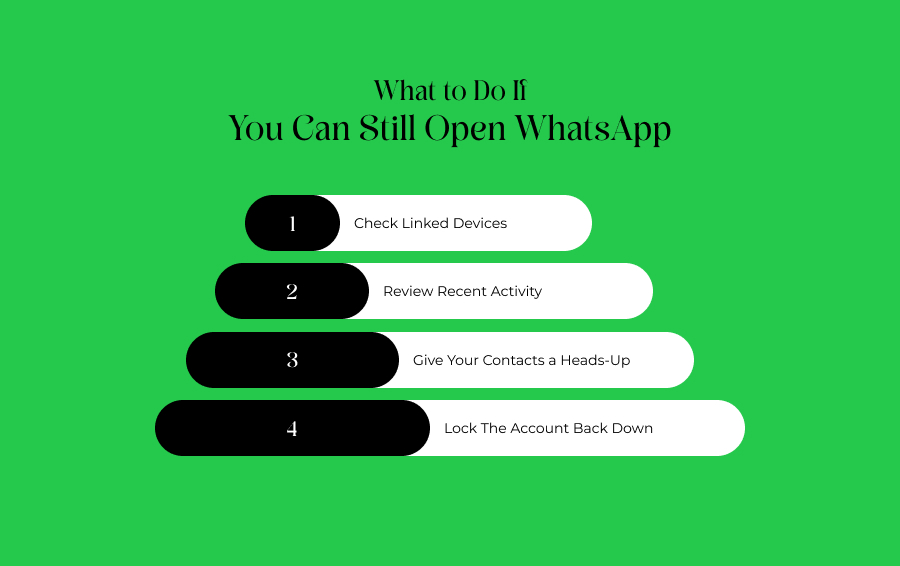
If the app opens normally, act before the unfamiliar session has more time to read messages or contact people.
Step 1: Check Linked Devices
On Android, open WhatsApp, tap the three-dot menu, and select Linked Devices. On iPhone, open WhatsApp, choose Settings, and then select Linked Devices.
Review every browser, computer, tablet, and phone shown on the screen. If you see one that you do not recognise, select it and tap Log Out. WhatsApp provides a separate official guide for checking and removing linked devices.
If it will not delay you, take a screenshot of the unknown device first. The device type and last-active time may help you document the incident. Security takes priority, however, so do not leave the session connected simply to gather more evidence.
Step 2: Review Recent Activity
Check your recent chats, archived conversations, calls, status updates, profile photograph, About information, and newly joined groups. Look for anything you did not send or change.
Do not delete suspicious messages immediately. Save screenshots if the attacker requested money, shared payment details, sent phishing links, or threatened someone.
Step 3: Give Your Contacts a Heads-Up
Don't just post and hope people see it. Actually call the people who matter most. Parents, close friends, anyone at work who'd normally hear from you. A status update is fine as a backup for the wider list, but it's not a substitute for a real phone call to someone who might have already gotten a message asking for money.
Something like this works as a template for the status, or for texting people through a different app:
My WhatsApp got accessed without my permission. If you've had a request for money, a verification code, personal details, or a link to click, ignore it. Call me before you act on anything that seems off.
Step 4: Lock The Account Back Down
Once the unfamiliar devices are gone, don't stop there. Turn on two-step verification, attach a recovery email, and set up a passkey if your phone supports it. We'll walk through each of these in more detail further down.
Are You Reallly Logged Out: What Are The Next Steps?
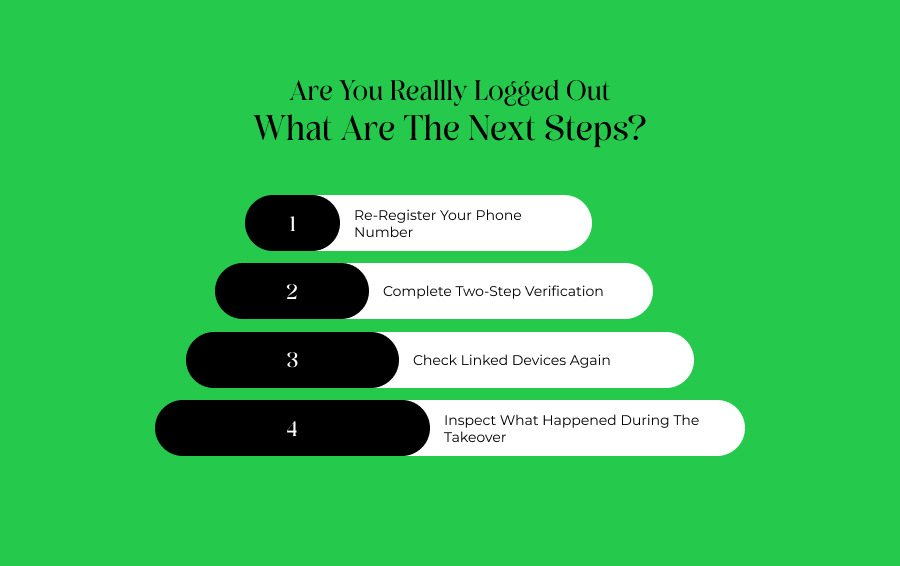
An usual scam is registerimngg your whatspp a/c to another device. Hence taking the control away from you as soon as possible.
Somepeople in this situation waits for the response from whatspp through email thinking a glitch has actually happened with them. On the contrary, whats needed at that moment is recovering the A/C immediately through whatspp.
Step 1: Re-Register Your Phone Number
Open WhatsApp and choose Log Back In or continue through the registration screen. Enter your complete phone number and request the verification code.
Enter only the code delivered to your own number. According to WhatsApp’s compromised-account recovery guidance, re-registering the account with the six-digit code automatically logs out the other devices using that WhatsApp account.
Never send this code to someone claiming to be a WhatsApp employee, mobile-provider representative, friend, employer, competition organiser, or police officer.
Step 2: Complete Two-Step Verification
WhatsApp may ask for the two-step verification method attached to the account. If you created it, enter it. If someone else changed it or you cannot remember it, use the recovery options WhatsApp displays.
Depending on the account setup, WhatsApp may require a waiting period before allowing a two-step verification reset. Do not repeatedly request codes or follow unofficial “instant recovery” services. Use only the recovery options inside WhatsApp or its official Help Centre.
Step 3: Check Linked Devices Again
Once you regain access, return to Linked Devices. Remove anything you do not recognise, even if the earlier re-registration should have disconnected other sessions. This second check confirms that your account is clean.
Step 4: Inspect What Happened During The Takeover
Review sent messages, deleted conversations, group activity, calls, profile changes, and status posts. Ask trusted contacts whether they received messages that are no longer visible on your phone.
What If Your SIM Suddenly Stops Working?
Sometimes a dead signal really is just a dead signal. In reality, the problem may be a dropped tower, a billing glitch, or nothing sinister. But if it shows up right alongside a WhatsApp logout you didn't trigger.
Then, followed by a password-reset email you didn't ask for. Or a bank alert about something you didn't do, don't wave it off as a coincidence. That combination is the signature of a SIM swap.
Grab a different phone and call your provider directly. Ask flat out whether anyone recently approved a replacement SIM, an eSIM activation, or a request to port your number elsewhere. If something went through without your say-so, tell them to reverse it and get your number back under your control.
Lost the phone entirely, or had it stolen? WhatsApp's own guidance is to contact your carrier right away so they can kill the old SIM and issue a new one. Once that replacement is live on your original number, you can re-register WhatsApp and take the account back. WhatsApp guidance for a lost or stolen device
What Not to Do After A WhatsApp Takeover
- Do not share a registration code, two-step verification password, passkey prompt, QR code, or device-linking code.
- Do not pay a stranger who promises to recover the account.
- Do not approve an unexpected QR-code scan or pairing request.
- Do not delete the account before trying the official recovery process.
- Do not assume uninstalling WhatsApp removes a linked device.
- Do not erase suspicious messages before saving useful evidence.
- Do not wait for email support before re-registering a number you still control.
- Do not click a two-step verification reset email that you did not request.
- Do not blame encryption for a code, SIM, or device-linking scam.
How Whatsapp Accounts Are Taken Over In 2026
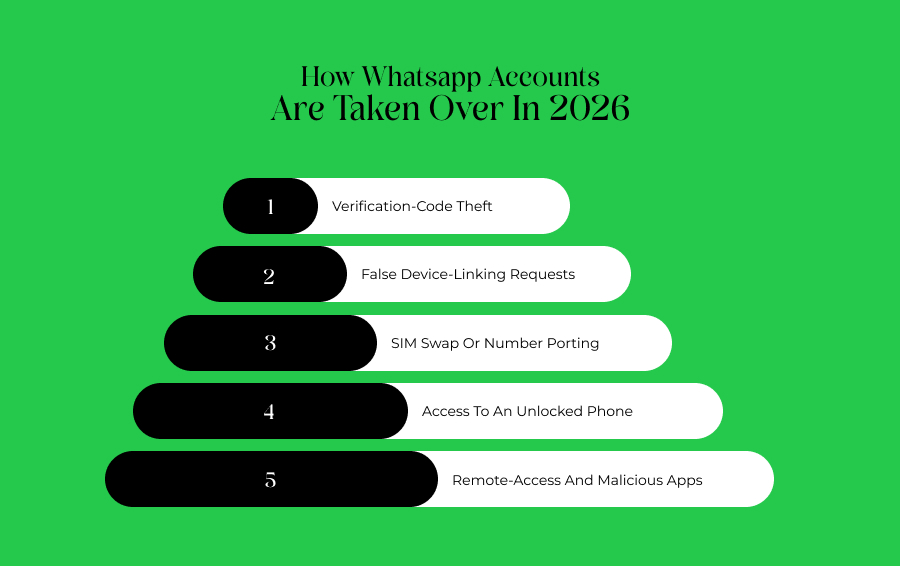
Most WhatsApp account takeovers do not involve criminals breaking the app’s end-to-end encryption. Attackers usually target the person, phone number, or device-linking process.
Verification-Code Theft
A scammer starts a WhatsApp registration using your number. The six-digit code reaches your phone, and the scammer invents a reason for you to share it. Once you provide the code, the scammer may be able to complete the registration.
False Device-Linking Requests
A scammer may ask you to scan a QR code or enter a linking code to vote in a competition, see a photograph, join an event, receive a job offer, or verify your identity. The code may actually connect the scammer’s device to your WhatsApp account.
In March 2026, Meta introduced suspicious device-linking warnings that show where a request originates and alert users when behavioural signals suggest a possible scam. Meta’s 2026 device-linking warning
SIM Swap Or Number Porting
Someone persuades or deceives a mobile provider into transferring your number to another SIM or eSIM. The attacker can then receive registration messages intended for you.
Access To An Unlocked Phone
Someone who can use your unlocked phone may link another device, read visible conversations, change settings, or intercept notifications. A strong device lock is therefore part of WhatsApp security.
Remote-Access And Malicious Apps
A scammer may convince you to install screen-sharing or remote-access software. If the app can view notifications, messages, or your screen, it may expose registration codes and other sensitive information.
Can A WhatsApp Hacker Read Your Old Messages?
The answer depends on how the account was accessed.
An unauthorised linked device may access messages made available to that linked session. That is why removing unknown linked devices is urgent.
Registering your number on another phone does not automatically unlock every historical chat stored in an encrypted backup. Access to a backup may also depend on the cloud account, backup password, encryption key, or device credentials.
WhatsApp allows users to protect eligible backups with a password or 64-digit encryption key. WhatsApp’s encrypted-backup explanation
The risk is broader if an attacker has your unlocked phone, controls your email or cloud account, installs monitoring software, or persuades you to reveal a backup password.
In that situation, change the passwords for your email, Apple, or Google account from a trusted device and review their recent login activity.
What To Check After You Recover The Account
| Area | What to inspect |
|---|---|
| Linked Devices | Remove every unfamiliar browser, phone, computer, or tablet |
| Chats and calls | Find messages or calls you did not make |
| Profile | Restore your name, photograph, About text, and privacy settings |
| Groups | Leave unfamiliar groups and warn affected members |
| Email account | Change the password if it may also be exposed |
| Cloud backup | Confirm that backup protection and recovery details belong to you |
| Mobile account | Check for an unauthorised SIM or eSIM request |
| Financial activity | Review bank, card, wallet, and UPI notifications |
| Phone security | Remove unknown apps and install system and app updates |
What If The Attacker Asked Your Contacts For Money?
Warn affected contacts as soon as the account is secure. Anyone who transferred money should contact their bank or payment provider immediately and save the transaction ID, phone number, payment details, and screenshots.
In India, victims of online financial fraud can call the national cybercrime helpline at 1930 and file a complaint through the National Cyber Crime Reporting Portal. Suspicious phone numbers, WhatsApp numbers, URLs, and social-media accounts can also be submitted through the portal’s Report Suspect facility.
WhatsApp can help with account access and abuse reporting, but it cannot reverse a bank transfer. Financial recovery must begin with the bank or payment provider.
How To Protect Whatsapp In 2026
There are a few crucial protection steps that every whatsapp user should be aware of in 2026.
Use Stronger Two-Step Verification
WhatsApp announced in August 2026 that it was upgrading two-step verification from a six-digit PIN to a longer password that can contain letters, numbers, and special characters. The feature is designed to protect the account even when someone obtains a one-time registration code. WhatsApp’s August 2026 security update
Open Settings, select Account, and choose Two-Step Verification. Add an email address you control so that you have an official recovery route. If your app still displays the older PIN interface, use it until the stronger option reaches your account.
Create A Passkey
A passkey lets WhatsApp verify you through your fingerprint, face recognition, or device screen lock instead of depending only on a code. WhatsApp reported in August 2026 that more than one billion people had set up a passkey and that users could add more than one passkey when using Android and iOS devices.
Go to Settings, select Account, and choose Passkeys.
Review Linked Devices Regularly
Do not wait for a security incident. Check Linked Devices once a month and whenever WhatsApp requests a registration or linking action you did not initiate.
Use Privacy Checkup
Open Settings, choose Privacy, and start Privacy Checkup. Review who can see your personal information, who can add you to groups, how unknown calls are handled, and what additional protection is available.
Consider Strict Account Settings
In January 2026, WhatsApp announced a lockdown-style option for users who may face sophisticated attacks. Strict Account Settings applies restrictive privacy choices and can block attachments and media from people outside your contacts.
The feature is available under Settings > Privacy> Advanced where it has been rolled out. It may be especially useful for journalists, public-facing professionals, campaign workers, executives, and people experiencing targeted harassment. WhatsApp Strict Account Settings
Protect The Phone Number Itself
Ask your mobile provider whether it offers an account PIN or additional check before issuing a replacement SIM or approving number porting. Keep the provider account password separate from other passwords.
Keep Whatsapp And The Phone Updated
Install WhatsApp only from the official Google Play Store, Apple App Store, or WhatsApp website. Keep the phone’s operating system current and avoid unofficial WhatsApp modifications.
For a wider explanation of privacy and encryption, internally link readers to ContentRally’s guide on whether WhatsApp is safe.
A WhatsApp Takeover Is Usually an Identity-Control Problem
When someone says “my WhatsApp was hacked,” the attacker has often stolen control of a registration code, linked device, SIM, or unlocked phone. Not broken WhatsApp’s encryption.
That is why the first ten minutes matter. Remove unknown devices if you are still logged in. Re-register the number if you have been logged out. Contact the mobile provider if the SIM stops working. Then warn contacts, document any fraud, and strengthen the account with two-step verification and passkeys.
Speed is important here. However, the order matters more.
Read More About: